Advanced Vinyl Collection Statistics: Insights Beyond Record Count
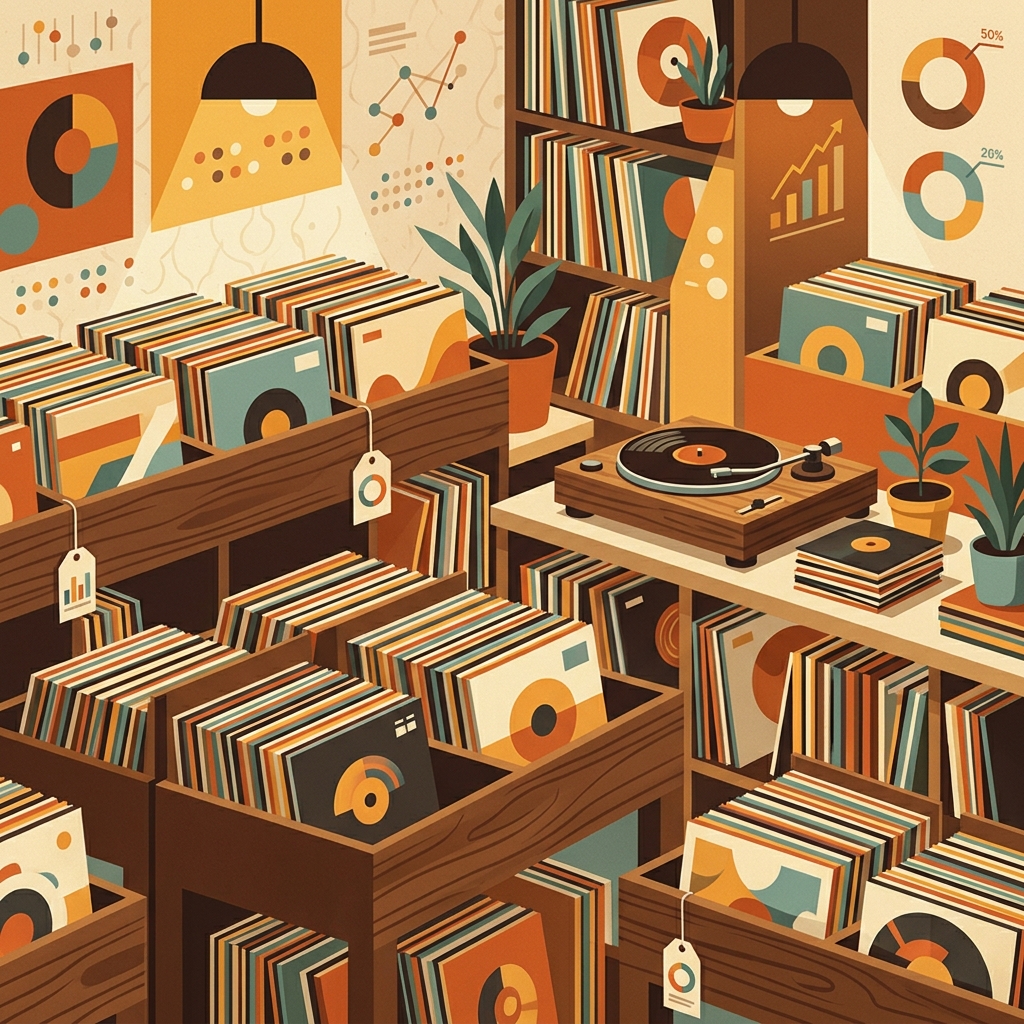
A record count is satisfying, but it is not very informative. Two collectors can each own 600 LPs while having completely different collections: one may play nearly everything, while the other has most of their money concentrated in 20 scarce pressings. Useful vinyl collection statistics insights begin when you connect catalog data with condition, purchase cost, market activity, and actual listening.
The RIAA's 2024 year-end report counted 43.6 million LP and EP units in the United States, with retail value reaching about $1.44 billion. Collectors now have better marketplace data, catalog tools, and resale history than earlier generations did. The trick is knowing which numbers deserve attention.
Start with data quality, not dashboards
Advanced analysis fails if pressings are identified only by artist and title. A useful catalog should include the exact release, catalog number, country, year, format, media and sleeve condition, purchase price, date, and source. Runout details are valuable for expensive or easily confused pressings.
Discogs lets collectors add condition, notes, folders, and custom fields, then export the collection as a CSV file. That export is a practical foundation for a spreadsheet or analytics tool. Before calculating anything, measure your metadata completeness rate: the percentage of records with every field you consider essential. If only 55 percent of your collection has a purchase price, any profit calculation is telling a partial story.
Measure value in layers
A single collection value is tempting, but it creates false precision. Discogs calculates low, median, and high estimates from the 30 most recent marketplace sales for each release, and records without sales history are excluded. That makes the median a useful market signal, not a guaranteed selling price or insurance appraisal.
Track at least four numbers:
- Total cost basis: what you actually paid, including shipping and taxes if you want a true acquisition cost.
- Estimated market value: preferably the sum of recent median sales.
- Value coverage: the percentage of your records that have usable sales data.
- Concentration risk: the share of total estimated value held by your top 10 or 20 records.
Suppose a 600-record collection has a $14,000 median estimate, but 40 records have no sales history and the top 15 records represent $5,600. The headline is not merely “worth $14,000.” The sharper insight is that 40 percent of the estimated value sits in 2.5 percent of the collection, while part of the catalog remains unpriced.
Condition also needs its own layer. Goldmine's grading guide says a VG+ record is generally valued around 50 percent of Near Mint, while VG often sells for no more than 25 percent of Near Mint. Those are broad conventions, not an automatic pricing formula, but they show why a dashboard that ignores grading can badly overstate value.
Calculate how much of the collection you actually use
Market value answers what other people might pay. Listening statistics answer whether the collection works for you. Log each spin with a date, then calculate these metrics over the last 90 or 365 days:
- Active collection rate: unique records played divided by records owned.
- Dormant share: records with no logged play during the period.
- Repeat concentration: the percentage of all plays generated by your 10 most-played records.
- New-arrival conversion: purchases played within 30 days divided by total purchases.
- Cost per play: purchase cost divided by lifetime plays.
Imagine buying 48 records in a year and playing only 29 of them within 30 days. Your new-arrival conversion rate is about 60 percent. That is more actionable than knowing you added four records per month. It may suggest that bargain-bin volume is outrunning your listening time, or that new purchases need a dedicated “play next” queue.
What's Spinning can make this analysis less tedious by turning now-playing activity into a listening history. Once plays are captured consistently, patterns that felt anecdotal become measurable.
Look for shape, balance, and blind spots
Break the catalog down by genre, release decade, country, label, format, artist, and acquisition source. Then compare ownership share with listening share. If jazz represents 12 percent of your records but 31 percent of your plays, your behavior is giving you a clear buying signal. If 1980s rock occupies a third of the shelves but receives 8 percent of spins, that category may contain candidates to sell, trade, or revisit.
Artist concentration is another useful measure. Count how much shelf space and value belong to your top five artists. A deep catalog may be exactly the goal, but the number reveals whether your collection is broad, specialist, or accidentally repetitive. Also track duplicate editions separately from duplicate albums. Owning an original, an audiophile reissue, and a mono pressing may be intentional; owning three indistinguishable copies may not be.
Add preservation risk to the dashboard
Collection analytics should protect the objects, not just price them. The Library of Congress notes that grooved discs average more than 35 pounds per shelf-foot and recommends upright storage, dividers every four to six inches, and about 35 to 40 percent relative humidity. Track shelf location, storage risk, cleaning date, sleeve type, and insurance photos.
Create a simple risk score using value, condition, storage location, and replaceability. A $300 private pressing stored near a radiator deserves attention before a common $8 reissue in the same room. You can also monitor the percentage of high-value records with updated condition notes and photos.
A monthly vinyl analytics routine
Once a month, update purchases and plays, refresh values only where recent sales exist, and review five questions: What did I play? What did I ignore? Where is value concentrated? Which categories are growing fastest? What needs cleaning, better storage, or documentation?
The goal is not to turn record collecting into accounting homework. Good statistics reduce uncertainty. They help you buy fewer duplicates, discover neglected music, document valuable pressings, and shape the collection around what you genuinely enjoy.
Frequently Asked Questions
What is the most useful vinyl collection statistic?
For most collectors, active collection rate is the best starting point because it compares what you own with what you actually play. Pair it with estimated value and metadata completeness for a balanced view.
How accurate is a Discogs collection value?
It is an estimate based on recent marketplace sales, not a guaranteed sale price. Discogs uses the 30 most recent sales for low, median, and high figures, and releases without sales history are left out. Exact pressing, condition, location, fees, and demand still matter.
How often should I update collection statistics?
Update listening and purchase data continuously or weekly. A monthly review is usually enough for trends. Market values for ordinary records do not need daily updates; quarterly checks are often sufficient unless you are preparing to sell or insure the collection.
Should I track records I plan to sell?
Yes. Give them a separate status rather than deleting them immediately. This preserves cost basis, play history, sale proceeds, and the reason you removed them, which makes future buying decisions much smarter.
Sources
A spreadsheet tracks what you own. What's Spinning identifies what's playing.
On-device vinyl ID logs your listening history automatically. 7-day free trial.
Looking for Shazam for vinyl?
What's Spinning identifies what's playing on your turntable on-device, logs history, and AirPlays now-playing to your TV.
Comparing vinyl ID apps?
Analog requires Discogs and is iPhone-first (iPad coming). What's Spinning works without Discogs on iPhone and iPad with AirPlay.
Try What's Spinning Free
Turn your iPad into a live now-playing display. Track every record you spin.
START FREE TRIALThen $4.99/mo or $39.99/yr · Cancel anytime
Get it on your iPhone
Open on iPhone