Using AI to Discover New Vinyl Releases Based on Your Collection

Vinyl discovery has a pleasant problem: there is more new music, more reissues, and more small-label activity than any collector can manually track. In the United States alone, the RIAA reported 46.8 million vinyl units and $1.043 billion in vinyl revenue for 2025, up 7.9% and 9.3% respectively from 2024. That scale makes “keep an eye on everything” a losing strategy. A better approach is to use AI to discover new vinyl releases from the evidence already sitting on your shelves.
Your collection is more informative than a generic genre preference. It contains repeated artists, labels, eras, producers, scenes, formats, and buying habits. What's Spinning can help organize that history, while AI uses it to build a sharper shortlist for your ears.
Start with a clean picture of your collection
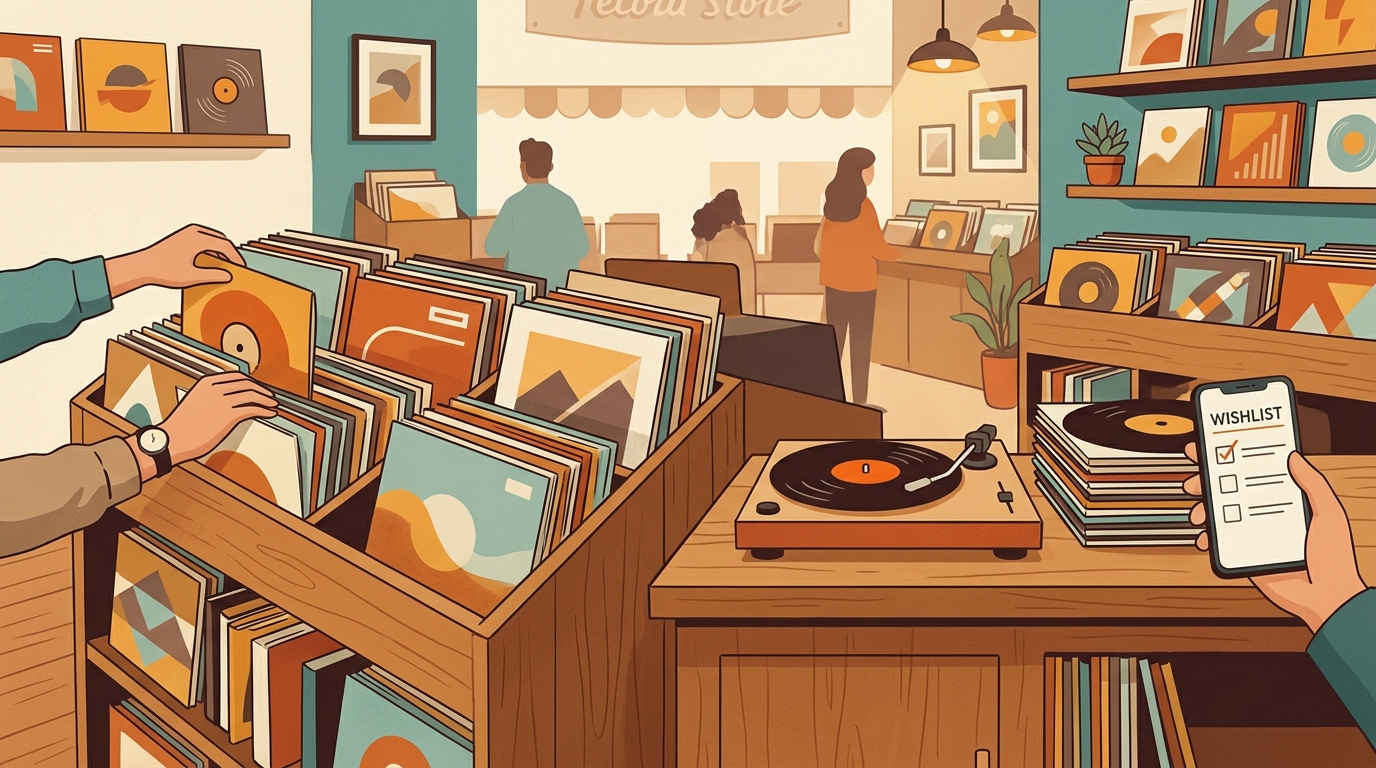
Recommendations are only as good as the input. Begin with artist, title, year, label, format, and any personal rating or note you maintain. Discogs lets collectors export an entire Collection as a CSV file, and its collection view can be sorted by artist, title, label, catalog number, format, year, rating, or date added. That is enough structure to reveal patterns that may be hard to notice while staring at a wall of spines.
Separate owned records from wantlist entries. Mark five records you play constantly, five purchases that disappointed you, and three directions you want to explore. A collection full of jazz does not mean you want generic jazz picks. You may want current spiritual jazz, affordable reissues, or electronic records with the spacious production of favorite ECM titles.
How AI turns shelves into useful signals
A practical recommendation system combines three methods. Content-based matching looks for shared attributes such as genre, instrumentation, label, producer, or mood. Collaborative filtering asks what listeners with overlapping taste also enjoy. A language model adds a conversational layer, so you can state constraints such as “new releases only,” “available on vinyl,” or “avoid deluxe box sets over $75.”
Spotify researchers have described systems that balance familiarity, similarity, and discovery. Their Text2Tracks research found that music-specific generative retrieval could map natural-language prompts directly to track identifiers and outperform existing prompt-based approaches. For collectors, the model should connect language to verified catalog IDs, not invent plausible releases.
Open music data provides grounding. MusicBrainz exposes releases, artists, labels, and genres through a REST API, with a public rate limit of one request per second. Last.fm's track.getSimilar method returns similar tracks from listening data. Together, they help turn fuzzy similarity into identifiable releases.
A prompt that produces better vinyl recommendations
Do not paste 500 album titles into a blank chat and ask, “What should I buy?” Give the model a job, constraints, and a required output format. Try this:
Analyze my collection by artist, label, genre, decade, and producer. Identify five strong taste clusters and two underrepresented directions. Recommend 12 albums released or reissued on vinyl in the last 90 days. Exclude anything I already own. For each recommendation, explain the connection to two records in my collection, identify the label and release date, distinguish an original album from a reissue, and provide a source confirming that the vinyl edition exists. Include at least four choices outside my dominant genre and flag limited editions separately.
“Provide a source” forces verification. The date window keeps the answer focused, connections to owned records make the reasoning inspectable, and the diversity requirement prevents twelve near-copies of one familiar sound.
Separate musical fit from physical availability
An album can be a perfect recommendation and a terrible vinyl lead. It may be delayed, region-limited, sold out, or available only from resellers. Treat discovery and purchase verification as separate stages.
Confirm each candidate through the artist, label, a trusted store, or a marketplace listing tied to the correct catalog number. Bandcamp Discover can be filtered for vinyl and new releases, while fan accounts can follow artists and surface releases in a music feed. This is especially useful for independent records with little editorial coverage.
Also ask the AI to label confidence. “High confidence” might mean the artist, release date, vinyl format, and seller are all verified. “Medium confidence” could mean the release is announced but not yet shipping. Anything without a catalog page should remain a lead, not a purchase recommendation.
A weekly workflow that takes 15 minutes
- Update your collection. Add recent purchases and correct duplicates or ambiguous editions.
- Generate a taste summary. Ask for recurring artists, labels, eras, producers, and sonic traits.
- Search a short date window. Use the last 30 to 90 days, plus announced releases in the next month.
- Force diversity. Reserve about one-third of the shortlist for adjacent scenes, unfamiliar labels, or less popular artists.
- Verify the vinyl edition. Confirm catalog number, release date, pressing details, price, and stock.
- Listen before buying. Sample the full album when possible, especially if the recommendation rests on mood rather than close stylistic similarity.
- Record the outcome. Mark “bought,” “passed,” or “follow artist.” Those decisions improve the next round.
A pass is useful data. If you reject picks because they are too polished, expensive, or loosely connected, record that reason. The system should learn your buying taste, not merely your listening taste.
Keep the collector in control
AI is good at reducing a huge release landscape to a manageable set of leads. It is weaker at judging mastering, pressing defects, packaging, replay value, and whether a color variant is worth the premium. Those remain collector decisions.
The ideal result is not an automated shopping cart. It is a weekly list of ten plausible records, each with a clear reason, reliable release evidence, and enough variety to create a genuine surprise. Your shelves provide the map. AI simply helps you notice the roads you have not taken yet.
Frequently Asked Questions
Can AI scan my Discogs collection?
Yes, if you export your Discogs Collection as a CSV and provide the file to a tool that can analyze spreadsheets. Review the file first, remove private notes, and make sure owned records and wantlist items are clearly separated.
How do I stop AI from recommending records I already own?
Use catalog identifiers when possible, not titles alone. Deluxe editions, regional pressings, and remasters often share titles. Ask the system to compare artist, release title, year, format, label, and catalog number before adding a recommendation.
Will AI know whether a new vinyl release is actually in stock?
Not reliably without live web access. Require a current artist, label, store, Bandcamp, or marketplace source for every suggestion, then open that source before buying. Stock and release dates can change quickly.
Can AI recommendations help me discover music outside my usual genres?
Yes, but you should request it explicitly. Set a diversity target, such as four of twelve recommendations from adjacent genres or unfamiliar labels. Research on music recommendation shows that relevance and discovery need to be balanced intentionally.
Sources
A spreadsheet tracks what you own. What's Spinning identifies what's playing.
On-device vinyl ID logs your listening history automatically. 7-day free trial.
Looking for Shazam for vinyl?
What's Spinning identifies what's playing on your turntable on-device, logs history, and AirPlays now-playing to your TV.
Comparing vinyl ID apps?
Analog requires Discogs and is iPhone-first (iPad coming). What's Spinning works without Discogs on iPhone and iPad with AirPlay.
Try What's Spinning Free
Turn your iPad into a live now-playing display. Track every record you spin.
START FREE TRIALThen $4.99/mo or $39.99/yr · Cancel anytime
Get it on your iPhone
Open on iPhone