Best Albums of 1973 on Vinyl
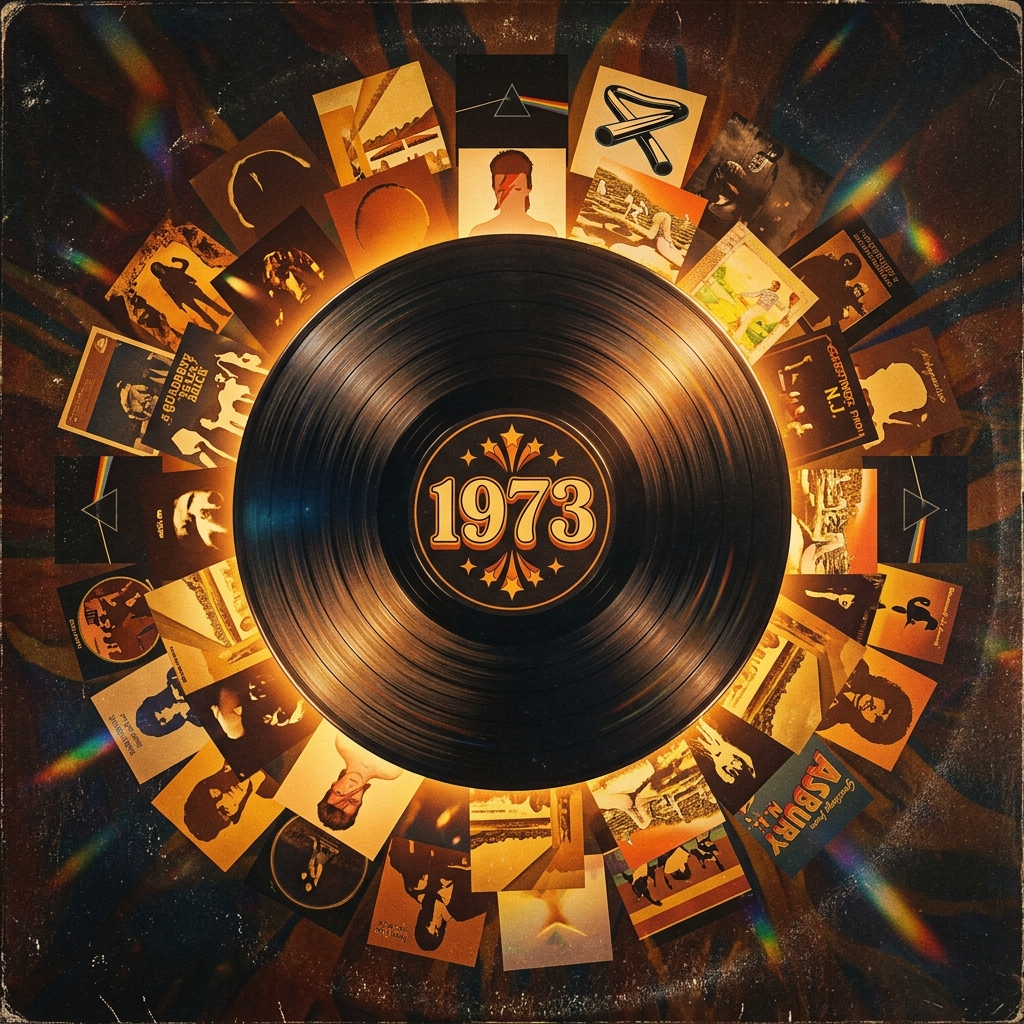
1973 was the year the LP went from a delivery format to the dominant art form in popular music. Pink Floyd spent 39 weeks at number one, Stevie Wonder released three classic albums in eighteen months, and a nineteen-year-old British multi-instrumentalist named Mike Oldfield turned a single twenty-five-minute piece into one of the fastest-selling instrumental records of the decade. For vinyl collectors, 1973 is also one of the richest years for pressing quality: the major labels were still cutting lacquers in-house, gatefolds were standard for any artist who mattered, and most of the records below have well-documented mastering variants that reward the hunt.
This guide picks 15 of the best albums released in 1973 with the collector's lens: which pressing to chase, which covers reward close inspection, and which ones still feel like discoveries rather than catalog staples. If you use What's Spinning to log what you actually play, this is a year that rewards both daily players and shelf trophies.
For research, I cross-checked album histories, release dates, mastering credits, RIAA certifications, and chart data from Wikipedia, AllMusic, MusicBrainz, the Discogs database, and the Pitchfork retrospective on 1973. The list is curated for vinyl-first listening, not resale price or streaming play count.
The 15 best vinyl albums of 1973
The Dark Side of the Moon by Pink Floyd
The obvious starting point, because it is one of the rare obvious answers that still earns its place. Pink Floyd built the record at Abbey Road with engineer Alan Parsons, layering tape loops, EMS synthesizers, spoken-word interviews, and Clare Torry's vocal improvisation on The Great Gig in the Sky into a continuous side of music. The album first shipped on Harvest (UK) and Capitol (US) in March 1973, with the iconic prism sleeve and solid-blue or solid-black inner sleeves that collectors still grade by. Two early UK first-press variants are most prized: the solid-blue inner sleeve with two post-tab flip-back corners, and the slightly later solid-black inner with no post-tabs. By 1988 the record had logged 741 weeks on the Billboard 200, and a 2003 hybrid SACD reissue added another eight hundred thousand US sales. The 2011 remaster by James Guthrie on 180-gram vinyl is the modern sweet spot for a daily player, though early Harvest copies remain the trophy. Wikipedia.
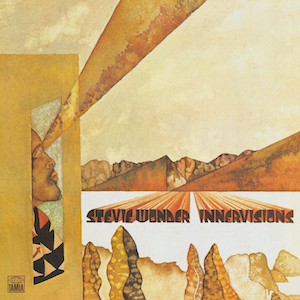
Innervisions by Stevie Wonder
Wonder's sixteenth studio album was also his third in eighteen months, and the most cohesive of the three. Recorded at Crystal Industries and Record Plant in Los Angeles, Innervisions was the first record where Wonder produced himself fully, with Tonto's expanding-polyphonic synthesizer as a primary instrument on tracks like Higher Ground and Living for the City. The original Tamla pressing has the textured gatefold with the rear painting and inner sleeve lyrics, and the 1980 digital-remaster reissue is the one most casual collectors end up with. For the soul-and-R&B corner of a vinyl shelf, this is the record that justifies the cost of a quiet modern copy. Wikipedia.

Goodbye Yellow Brick Road by Elton John
A double LP from Elton's most ambitious year, recorded in three and a half weeks at Strawberry Studios in France with Bernie Taupin, producer Gus Dudgeon, and the Elton John Band. The original 1973 DJM pressing (UK) and MCA pressing (US) both come in a gatefold with the painting by Ian Whiteman that depicts Elton's face inside a frame. The 2014 Mercury remaster on heavyweight vinyl preserves the cover art better than the thin 1990s reissues, and the 2008 reissue included bonus tracks on a second disc that purists skip. Saturday Night's All Right and Bennie and the Jets anchor the A-side; Candle in the Wind and the title track close it. Wikipedia.
Head Hunters by Herbie Hancock
Where jazz-funk pivoted into the mainstream. Hancock assembled the Mwandishi cohort - Bennie Maupin, Harvey Mason, Bill Summers - and added synthesizers (an ARP 2600 and a Hohner D6 Clavinet), with Sly Stone's engineer David Rubinson at the controls. The opening Chameleon and the Cantaloupe Island re-recording (the "Watermelon Man" hook) became staples of AOR radio. The CBS Japan pressing from 1973 is the audiophile favorite, with a quieter cut than the US Columbia issue; the original US pressing has the gatefold and the iconic sleeve photograph of Hancock's headshot. The album crossed over to R&B audiences in a way no previous Hancock record had, and was the first jazz album to go platinum. Wikipedia.
Catch a Fire by The Wailers
The first album to bring reggae to a rock audience. Produced by Chris Blackwell at his Compass Point studios with added rock arrangements and overdubs, the original 1973 Island pressing shipped in a unique Zippo-style lighter sleeve - a controversial move at the time and a pressing variant collectors still hunt. The first Jamaican pressings on the Wild Bunch label are exceptionally rare, and the standard Island ILPS 9245 gatefold is the everyday collector copy. The 2013 half-speed mastered reissue on 180-gram vinyl by Chris Bellman at Bernie Grundman Studios cleaned up the muddy parts of the original master and is now the most-played modern version on vinyl. Wikipedia.

Tubular Bells by Mike Oldfield
A teenage Oldfield recorded the entire side-long piece over several months at The Manor Studio in Oxfordshire, playing nearly every instrument himself. Virgin Records released it as the label's first album (V2001) in May 1973, and it has been in print in some form continuously ever since. The first UK pressing has the famous gatefold with a stylized Virgin logo and the printed sleeve notes. The 2012 180-gram remaster at Half Speed by Chris Bellman remains the audiophile go-to, but original UK pressings on the green-label Virgin are surprisingly affordable because so many copies were sold. The opening tubular bell motif from The Exorcist soundtrack is what made the album a mainstream hit. Wikipedia.
Aladdin Sane by David Bowie
Bowie's "Ziggy Stardust goes to America," recorded at Trident Studios in London and mixed at RCA Studios in New York, with Mick Ronson producing and a full band including Mike Garson on piano. The iconic Brian Duffy cover photograph (the lightning-bolt makeup) was shot in January 1973, and the album shipped in May. The first UK RCA pressing (RCA SF 8273) and the US RCA pressing (APL1-0488) both have the gatefold, and the Bowie fan community still grades the unlaminated UK sleeve as the most desirable variant. The 2013 remaster by Ken Scott at Abbey Road on 180-gram vinyl is the modern reference, and the 2019 "Mix Two" by Ronson (made public for the first time) is now a collector's item in its own right. Wikipedia.
Quadrophenia by The Who
A rock opera on a double album, with the story of Jimmy the mod spread across four themes (one per band member), recorded at Ramport Studios in London with Kit Lambert producing. The original 1973 Track Records pressing (UK 2406 102) and MCA pressing (US MCA2-6894) ship in a gatefold with the famous mod subculture photography and a booklet of period photos. The double LP has well-known vinyl issues in early pressings - warped records and noisy pressings are common, so a clean UK or German original is the collector prize. The 2012 remaster by Jon Astley on 180-gram vinyl is the modern sweet spot, and the 1979 Japanese reissue is a sleeper audiophile pick for fans who can find it. Wikipedia.
Let's Get It On by Marvin Gaye
The Motown soul classic, recorded at Hitsville West in Los Angeles with producer Ed Townsend and arranger David Van DePitte. The original Tamla pressing (TS 329) has the gatefold with the iconic silhouette cover and inner sleeve credits. The 2003 Hip-O Select remastered reissue on 180-gram vinyl is the modern reference and includes a bonus disc of mixes that fans still debate. The title track remains one of the most-covered R&B songs ever, and the album spent nine weeks at number one on the Billboard 200. Original 1973 US pressings are still affordable and abundant, with several label variants (the TAMLPA is the standard). Wikipedia.
Raw Power by Iggy and the Stooges
The third Stooges album, and the loudest. Produced and mixed by David Bowie (his first major production credit), originally released on Columbia Records with an aggressive mix that Bowie and the band later blamed on the label. The 1973 Columbia pressing (KC 32111) has the iconic inner gatefold with the band photograph and the lo-fi Bowie mix. The 1997 remaster by Iggy Pop himself on Bomp/Virgin finally delivered the warmer mix he originally intended, and the 2010 Legacy edition includes both mixes. For vinyl, the original 1973 Columbia pressing is the historical document; the 1997 Bomp remaster is what most fans prefer to actually play. Wikipedia.
Berlin by Lou Reed
The darkest record Reed ever made, a song cycle about two American couples falling apart in divided Berlin. Produced by Bob Ezrin (fresh from Alice Cooper's records), with Steve Winwood, Jack Bruce, and Aynsley Dunbar on the sessions. The original 1973 RCA pressing (RCA SF 8273, sister release to Aladdin Sane) has the gatefold with the photographs of the two couples, and the original pressings are well-cut for the era. The album was savaged on release, but has been continuously re-evaluated as one of Reed's most important works. The 2013 RCA reissue by Steven Wilson's remixes brings out the original master tape's detail, and the 2022 vinyl reissue restores the original mix without remastering. Wikipedia.
For Your Pleasure by Roxy Music
The second Roxy album, and the last with Brian Eno before he left to focus on solo work. Produced by Chris Thomas at AIR Studios in London with the band's signature art-rock arrangements and Eno's VCS3 synthesizer textures. The original 1973 Island pressing (ILPS 9274, UK) and Atco pressing (SD 7003, US) have the gatefold with the Karl Stoecker cover photograph that depicts a sultry woman in a doorway. The album closes with the nine-minute "For Your Pleasure," a continuous suite that became a live staple. The 1999 remastered reissue added bonus tracks; the 2012 remaster by Chris Thomas is the modern audiophile reference. Wikipedia.
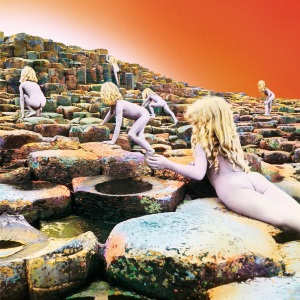
Houses of the Holy by Led Zeppelin
The fifth Led Zeppelin album, recorded at Stargroves with engineer Andy Johns, and the first to feature Jimmy Page's interest in reggae and funk textures alongside the rock canon. The original 1973 Atlantic pressing (SD 7255) has the famous die-cut sleeve designed by Hipgnosis that overlays two children climbing a rock formation. Variations in the sleeve's orange tint distinguish the early pressings; the later "no orange" pressings are less collectible. The album includes "The Rain Song," "Over the Hills and Far Away," and "Dancing Days," and remains one of the band's most-played modern records. The 2014 remaster by Jimmy Page on 180-gram vinyl is the modern sweet spot for collectors. Wikipedia.
Band on the Run by Paul McCartney and Wings
The third Wings album and McCartney's most successful post-Beatles solo record, recorded at EMI's studio in Lagos, Nigeria with producer Paul Mê£Cartney. The original 1973 Apple pressing (SMAS 3419, US gatefold) and the UK pressing (Apple PCS 7100) have the iconic photograph by Clive Arrowsmith of the seven faces against the cell wall. The album reached number one in multiple countries and remains McCartney's most enduring work. The 2010 Hear Music reissue on 180-gram vinyl preserves the gatefold and adds a bonus disc; the 2023 Paul McCartney Archive Collection half-speed remaster by Miles Showell at Abbey Road is the modern audiophile reference and includes unreleased demos. Wikipedia.
Countdown to Ecstasy by Steely Dan
The second Steely Dan album, and the one where Donald Fagen and Walter Becker fully committed to the studio-as-instrument approach. Recorded at ABC/Dunhill studios in Los Angeles with producer Gary Katz, the album includes "My Old School" and "Bodhisattva" - two of the band's most-played live staples. The original 1973 ABC pressing (ABCX 797) has the gatefold with the cover painting by David Goetz and the inner sleeve credits. The 2000 MCA reissue restores the original mix and adds bonus tracks; the 2014 Universal reissue on 180-gram vinyl is the modern audiophile sweet spot. The album has aged into a cult classic and remains a deep-catalog favorite for jazz-rock collectors. Wikipedia.
What makes 1973 special for vinyl collectors
Three things separate 1973 pressings from what came before and after. First, the major labels were still cutting lacquers in their own mastering rooms with engineers who had decades of experience - Bell Studios, Sterling Sound, Artisan Sound, and the in-house engineers at Capitol, RCA, Columbia, and Atlantic all delivered consistent quality. Second, gatefolds and inner-sleeve printing were still the default for any artist who mattered, so even mid-tier releases from the year often have substantial packaging. Third, the pre-digital mastering means that the records from 1973 have a particular "warmth" (controversial term, but real in the context of pre-1975 lacquer cuts) that has been chased by audiophile reissues ever since.
For collectors building a 1973 section of a shelf, the practical advice is to focus on the originals you can grade and inspect personally, then fill the gaps with 180-gram remastered reissues from the last decade. The remastered versions typically come from the original analog tapes, so the music is the same, but the cover art and pressing quality are modern. The originals are where the sleeve variations live.
How to build a 1973 vinyl shelf on a budget
Start with the records that have abundant original pressings: Tubular Bells, Goodbye Yellow Brick Road, Let's Get It On, and Innervisions all have plenty of original UK or US copies in circulation at modest prices. The middle tier - Aladdin Sane, Houses of the Holy, For Your Pleasure, and Countdown to Ecstasy - has original copies that are affordable but require more careful grading because the covers are prone to ring wear. The top tier - The Dark Side of the Moon first UK Harvest, Catch a Fire original lighter-sleeve, and Quadrophenia clean original gatefold - is where you'll spend serious money and want an expert's grading before buying online.
Use What's Spinning to track which 1973 records you actually own and which ones you've auditioned. The app's now-playing card lets you log a record mid-listen, which is how you find out which ones you reach for repeatedly and which ones stay on the shelf.
Frequently asked questions
What is the best-selling album of 1973?
The Dark Side of the Moon by Pink Floyd is the runaway best-selling album of 1973 and one of the best-selling albums of all time, with estimated worldwide sales around 45 million copies by the 50th anniversary in 2023.
Are original 1973 vinyl pressings worth the premium?
Original 1973 pressings are worth the premium for sleeve variations and the historical master tapes, but modern 180-gram reissues from the original tapes usually sound equally good for everyday listening. Buy originals for the cover art and pressing variants; buy reissues for daily players.
Which 1973 album has the best cover art?
Cover art is subjective, but the most iconic 1973 covers include Dark Side of the Moon's prism (designed by Storm Thorgerson at Hipgnosis), Houses of the Holy's die-cut gatefold (also Hipgnosis), and Aladdin Sane's lightning-bolt Bowie portrait by Brian Duffy. All three are still recognizable fifty years later.
How do I store 1973 vinyl records safely?
Store 1973 records vertically in a cool, dry room out of direct sunlight, with poly-lined inner sleeves and the original outer sleeve behind that. The poly lining protects the vinyl from the paper's acidic compounds; the outer sleeve protects the cover art. Keep the room humidity around 45-50% and avoid basements and attics.
Where can I listen to a 1973 album before buying the vinyl?
Most major 1973 albums are available on streaming services for reference listening, but the streaming version is a digital remaster and will not sound like the vinyl pressing. For a more accurate preview, look for the album on Qobuz or Tidal in hi-res, or watch the Discogs database for the specific pressing you want to buy.
A spreadsheet tracks what you own. What's Spinning identifies what's playing.
On-device vinyl ID logs your listening history automatically. 7-day free trial.
Looking for Shazam for vinyl?
What's Spinning identifies what's playing on your turntable on-device, logs history, and AirPlays now-playing to your TV.
Comparing vinyl ID apps?
Analog requires Discogs and is iPhone-first (iPad coming). What's Spinning works without Discogs on iPhone and iPad with AirPlay.
Try What's Spinning Free
Turn your iPad into a live now-playing display. Track every record you spin.
START FREE TRIALThen $4.99/mo or $39.99/yr · Cancel anytime