Best Intro to Post-Punk Albums on Vinyl: 17 Records That Explain the Genre
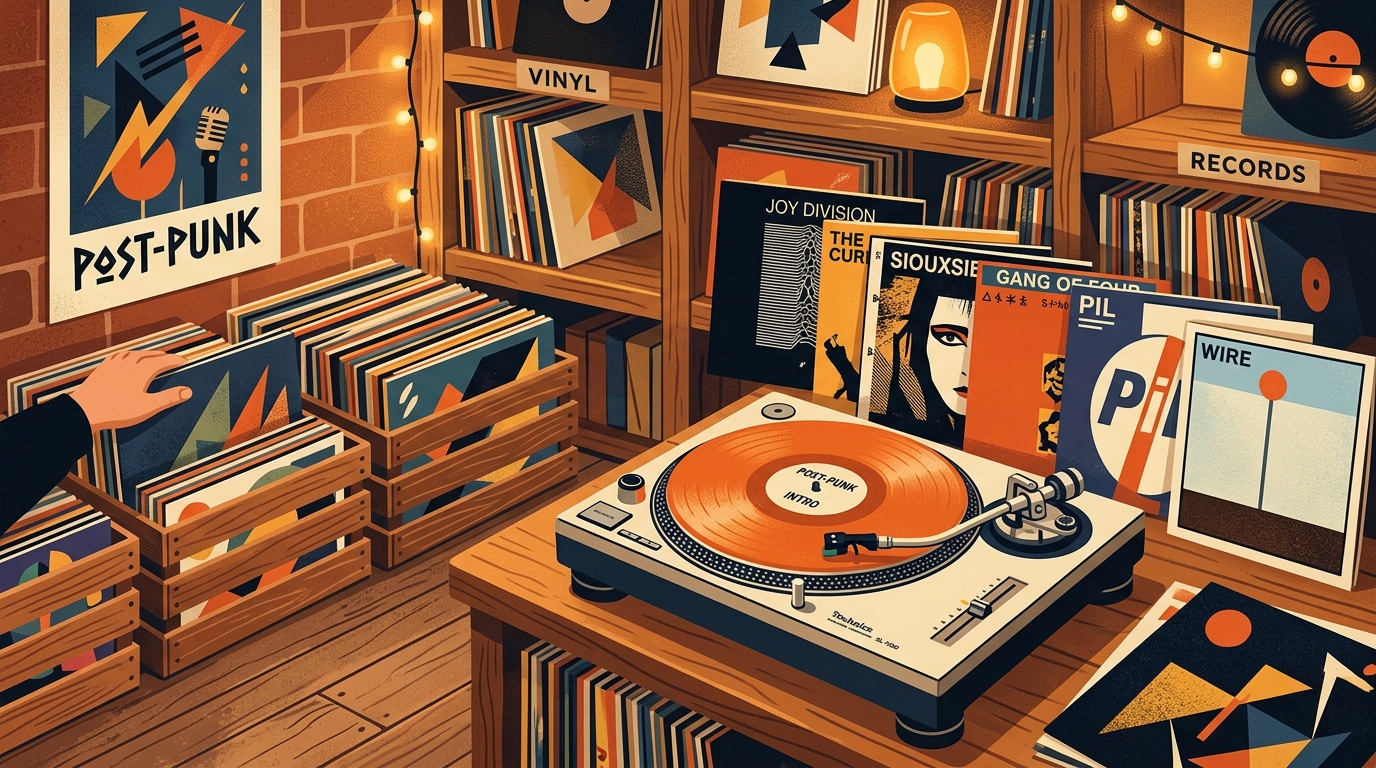
Post-punk is what happened when punk's speed and skepticism met people who wanted stranger rhythms, sharper politics, dub space, funk bass, studio experiments, art-school design, and gloom that did not sound like standard hard rock. For vinyl collectors, that makes it one of the most rewarding genres to learn through albums rather than playlists. Sleeves mattered. Producers mattered. Side breaks mattered. Labels like Factory, Rough Trade, Virgin, Sire, Harvest, Polydor, and Radar helped turn records into complete cultural objects.
This guide is built as a practical first shelf, not a museum wall. Some classics are here because they define the sound; others are here because they explain a branch of the map, from danceable political funk to gothic minimalism to New York guitar architecture. If you use What's Spinning to track what actually gets played, this is the kind of starter stack that quickly shows whether your post-punk taste leans toward bass, atmosphere, experimentation, or songwriting.
One note before the list: post-punk overlaps heavily with new wave, goth, art rock, no wave, and early alternative. That fuzziness is part of the fun. The best intro to post-punk vinyl is not one perfect record, it is a sequence of records that teach your ears what the genre was trying to escape and what it built instead.
Unknown Pleasures, Joy Division, 1979

Start with the sleeve, because Peter Saville's white pulsar waves on black have become a visual shorthand for post-punk itself. Unknown Pleasures was released by Factory Records on 15 June 1979 and recorded over three successive weekends at Strawberry Studios in Stockport, with Martin Hannett using space, delay, and studio treatment to make a guitar band sound colder and more architectural than punk usually allowed. That matters on vinyl because the album is not simply a stack of songs, it is a room. Stephen Morris's drums often feel isolated under glass, Peter Hook's bass carries melodies that other bands would have handed to a guitar, and Ian Curtis sounds trapped inside the production rather than placed on top of it. Factory issued no singles from the album, so a front-to-back listen is the natural format. If you want the first post-punk LP that shows how atmosphere could replace rock swagger, this is the obvious doorway. Source.
Entertainment!, Gang of Four, 1979

A lot of post-punk beginners expect gloom; Gang of Four arrive with a ruler, a knife, and a rhythm section that refuses to sit still. Released in September 1979, Entertainment! drew on punk, funk, reggae, and dub while putting Marxist critique and media suspicion right on the lyric sheet. The guitars are famously dry and percussive, more like warning signals than chords, which makes a clean vinyl copy feel especially physical. Listen to the gaps as much as the attacks. Dave Allen's bass and Hugo Burnham's drums leave spaces that Andy Gill slices through, while Jon King's voice sounds like he is arguing with billboards, romance, and consumer culture all at once. Rolling Stone ranked it number 273 on its 2020 list of the 500 Greatest Albums of All Time, which tells you the canon has caught up with a record that once sounded deliberately anti-commercial. For a collector, this is the political wing of post-punk in one tense, danceable package. Source.
Marquee Moon, Television, 1977

New York post-punk did not always announce itself with gray skies and industrial dread. Television's Marquee Moon, released by Elektra on February 8, 1977, is luminous, wiry, and obsessively rehearsed. The band came out of the same CBGB scene that fed punk, but Tom Verlaine and Richard Lloyd turned away from blunt power chords toward interlocking guitar lines influenced by rock, jazz, and modal patience. On vinyl, the title track is the reason this belongs on an intro list even though it predates much of the British post-punk explosion. Its long build does not sprawl, it tightens, then opens into a guitar solo that feels mapped rather than improvised chaos. Andy Johns engineered the sessions at A & R Recording, and the record still has a startling amount of air compared with many late-70s punk records. If Joy Division shows post-punk as atmosphere, Marquee Moon shows it as nerve, precision, and urban light. Source.
Pink Flag, Wire, 1977

Wire's debut is the album to buy when you want punk reduced to sharp angles, then rebuilt as modern design. Pink Flag arrived on Harvest on 25 November 1977, produced by Mike Thorne and recorded at London's Advision Studios. Its 21 tracks fly by with a severity that makes the LP feel like a gallery wall full of tiny confrontations. Some songs end before another band would have finished the first chorus. That compression is the point, and it is why the record still sounds fresh in a vinyl era that often rewards long-form sprawl. The sleeve's stark flag image fits the music perfectly, plain at first glance and stranger the longer you stare. A beginner should hear this before jumping into Wire's later experiments, because it explains their method: remove the obvious parts, keep the tension, and trust the listener to fill the room. For collectors, UK Harvest originals can be pricey, but modern reissues preserve the essential lesson. Source.
154, Wire, 1979

Two years after Pink Flag, Wire had already changed shape enough to make a second Wire pick feel necessary rather than redundant. 154 takes its title from the number of gigs the band had played by release, and the music sounds like a group sprinting away from its own first language. Slower tempos, fuller structures, guitar effects, synthesizers, and electronics push the album toward art rock without sanding off the unease. It is especially useful for new post-punk listeners because it captures the genre's restless contract with punk: use the energy, reject the rulebook. On vinyl, the sequencing feels like a corridor, with songs opening onto stranger rooms as the sides progress. Tracks such as "Map Ref 41°N 93°W" make the band's intelligence feel playful rather than academic. If Pink Flag is Wire as clipped manifesto, 154 is Wire discovering that the studio could be a set of instruments too. Source.
Y, The Pop Group, 1979

Nobody should pretend Y is an easy first spin, but it is one of the fastest ways to understand how far post-punk was willing to go. The Pop Group's debut was produced by Dennis "Blackbeard" Bovell at Ridge Farm Studios and released by Radar Records on 20 April 1979. Bovell's dub knowledge is crucial: bass, echo, percussion, and empty space are not decorations, they are structural beams. Mark Stewart's vocals often sound less like singing than alarm, and the band treats funk, free jazz, punk, and political dread as compatible materials. The result can feel unstable, which is exactly why it belongs in a serious starter shelf. Pitchfork later placed it at number 35 on its list of the Top 100 Albums of the 1970s, while The Wire included it among the 100 most important records ever made. If your turntable setup reveals low-level detail, this record becomes more legible, because the apparent chaos has carefully placed edges. Source.
Metal Box, Public Image Ltd, 1979

The first pressing of Metal Box is the kind of object that explains why vinyl culture loves formats as much as music. Public Image Ltd issued the album on 23 November 1979 in a round metal film canister containing three 12-inch records, before Virgin reissued it in standard packaging as Second Edition in 1980. The packaging was not a gimmick disconnected from the sound. Jah Wobble's dub-heavy bass, Keith Levene's abrasive guitar tone, and John Lydon's cryptic vocals make the music feel circular, metallic, and difficult to file neatly beside rock LPs. The three-disc format also changes listening behavior, asking you to handle the object more often and re-enter the mood in short, concentrated movements. For a newcomer, a clean Second Edition or reissue is usually the sane buy, because original tins can be expensive and condition-sensitive. Conceptually, though, the tin is the lesson: post-punk could make packaging, production, and ideology part of one argument. Source.
Cut, The Slits, 1979

The Slits were punk participants before Cut, but the debut album catches them refusing the expected pose. Released on 7 September 1979, recorded at Ridge Farm Studios, and produced by Dennis Bovell, it folds reggae, dub, punk, and playground chant into a record that still feels fearless. The famous mud-covered cover has been read many ways, from provocation to refusal, and it works because the music is just as unwilling to behave. On vinyl, the drum and bass relationship is the attraction. Budgie's playing is loose but alert, while the basslines give Ari Up and Viv Albertine room to make the songs wobble, tease, and snap back. A beginner might hear the roughness first; after a few plays, the arrangements reveal how much discipline sits underneath the surface. Cut also broadens the story beyond the usual male, monochrome post-punk narrative. It belongs near Gang of Four and PiL because it made rhythm a way to question power, gender, and genre at once. Source.
Fear of Music, Talking Heads, 1979

Talking Heads made anxiety strangely catchy, and Fear of Music is where that talent turns severe. Released by Sire on August 3, 1979, the album was produced by Brian Eno and Talking Heads after sessions in New York during April and May. It reached number 21 on the U.S. Billboard 200 and number 33 on the UK Albums Chart, proof that post-punk weirdness could still move in the mainstream when hooks were this sharp. The sleeve's black, textured look gives vinyl buyers a tactile clue before the music starts. "I Zimbra" opens the album with language and rhythm knocked loose from ordinary rock grammar, while "Life During Wartime" turns paranoia into motion. The record's best beginner value is that it sits between art-school experimentation and concise songwriting. You can hear Eno expanding the palette, but the band remains compact, funny, and nervous. If Remain in Light is the grand theory, this is the bridge that makes the leap believable. Source.
Closer, Joy Division, 1980

Closer carries a shadow that can distort first listening: it was recorded two months before Ian Curtis died and released two months after his death, on 18 July 1980. That context matters, but the album deserves attention for its construction as much as its tragedy. Martin Hannett's production is even more austere than on Unknown Pleasures, with drums, synthesizer color, and bass figures arranged like architecture around Curtis's voice. The Peter Saville sleeve, using a Bernard Pierre Wolff photograph of the Appiani family tomb in Genoa, gives the record its funerary gravity before side one even begins. On vinyl, Closer benefits from patient side listening because the second half feels like a descent rather than a playlist. It reached number 6 on the UK Albums Chart and was named NME's Album of the Year. For newcomers, buy it after Unknown Pleasures if you want to hear post-punk move from stark excitement toward a colder, more ceremonial form. Source.
Seventeen Seconds, The Cure, 1980

The Cure's second album is not the grand gothic monolith people sometimes imagine from the band's later image. Seventeen Seconds, released on 18 April 1980 by Fiction Records, is lean, chilly, and economical. It marked Robert Smith's first co-production with Mike Hedges, introduced Simon Gallup as an official member after Michael Dempsey's departure, and added keyboardist Matthieu Hartley. Those personnel changes are audible in the negative space. The songs often feel sketched in moonlight, with guitar lines, bass motion, and sparse keyboards creating an atmosphere that is far more powerful than its modest materials suggest. "A Forest" became the band's first UK top 40 single, but the album works best as a full side-to-side mood. For vinyl buyers, the attraction is restraint. Nothing is over-arranged, so surface noise and pressing quality can affect the spell more than they would on a denser rock record. This is the accessible on-ramp to post-punk's darker, more minimal branch. Source.
Remain in Light, Talking Heads, 1980

By 1980, Talking Heads and Brian Eno were no longer just decorating songs with unusual textures; they were rebuilding the writing process around loops and collective groove. Remain in Light was recorded at Compass Point Studios in the Bahamas and Sigma Sound Studios in New York in July and August 1980, then released by Sire on October 8. Drawing influence from Fela Kuti's Afrobeat, the band built instrumental tracks from looping patterns, electronics, funk, and layered rhythm. The cover's digitally treated faces still look unsettlingly modern, which suits an album about identity, information, and overload. Vinyl gives the record useful boundaries. Side one is almost ecstatic in its forward push, while side two grows stranger and more haunted, ending with "The Overload" in a completely different emotional climate. Adrian Belew and other expanded-band players add texture without turning the album into fusion clutter. If you want a post-punk record that points toward dance music, sampling logic, and art-pop ambition, this is essential. Source.
Drums and Wires, XTC, 1979

XTC are sometimes filed under new wave, but Drums and Wires earns its place in a post-punk starter stack because it turns nervous energy into craft. Released by Virgin on 17 August 1979, it was the band's first album issued in the United States and the first recorded with guitarist Dave Gregory after Barry Andrews left. The title points to the album's two obsessions: expansive drum sounds and bright, interlocking guitars. Steve Lillywhite's production gives the rhythm section a forward, almost architectural presence, which makes tracks like "Making Plans for Nigel" feel bigger than standard guitar pop. For collectors, this is a reminder that post-punk was not only bleak or confrontational. It could be witty, melodic, and tightly arranged without losing its odd angles. On a good pressing, the snap of the drums and the dry guitar lines make the record feel handmade and mechanical at once. It is a smart second-wave pick after Wire if you want abstraction with choruses attached. Source.
The Correct Use of Soap, Magazine, 1980

Magazine's third album is a useful corrective for anyone who thinks post-punk had to choose between intelligence and pop form. Released by Virgin in 1980, The Correct Use of Soap contains "A Song from Under the Floorboards," "Sweetheart Contract," and a cover of Sly and the Family Stone's "Thank You (Falettinme Be Mice Elf Agin)." That last choice is not a novelty. It shows how the band could absorb funk and soul vocabulary while keeping Howard Devoto's theatrical unease at the center. It was also Magazine's final album with original guitarist John McGeoch before he joined Siouxsie and the Banshees, which makes it a hinge record for anyone tracing post-punk guitar language. The production is cleaner than many entries on this list, so the vinyl experience is less about murk and more about tension between polish and discomfort. Devoto often sounds too observant to relax, and the band turns that nervous intelligence into hooks. It is literate, sharp, and far less forbidding than its reputation suggests. Source.
Movement, New Order, 1981

The human story behind Movement is impossible to separate from the sound: New Order were recording in the wake of Ian Curtis's death, still close to Joy Division's dark post-punk vocabulary and not yet the electronic pop force they would become. Released by Factory Records on 13 November 1981, the album increased the use of synthesizers while remaining rooted in rock. It only peaked at number 30 on the UK Albums Chart at the time, and contemporary response was muted, which makes it a fascinating beginner record rather than a triumphant one. You can hear a band inventing itself under pressure, unsure whether to continue, transform, or disappear. Peter Saville's cover design reinforces that feeling with clean abstraction instead of rock imagery. On vinyl, Movement sits well after Closer: the grief has not lifted, but new machinery is entering the room. It is the bridge from post-punk austerity to the club-facing future of "Blue Monday" and Power, Corruption & Lies. Source.
Juju, Siouxsie and the Banshees, 1981

If you want the gothic side of post-punk without jumping straight into cliché, Juju is the best first purchase. Recorded at Surrey Sound with Nigel Gray as co-producer and released by Polydor on 19 June 1981, it produced two key singles, "Spellbound" and "Arabian Knights." John McGeoch's guitar work is the central lesson. He does not merely thicken the songs; he sends them spinning, chiming, and lurching around Siouxsie's voice in patterns that countless later bands studied. The rhythm section gives the album its ceremony, but the playing remains agile enough to avoid doom-rock heaviness. The cover art, with its African sculpture imagery, has its own complicated context, and modern listeners should be willing to hear the record critically as well as aesthetically. As a vinyl listen, though, the impact is immediate. The album is dramatic, concise, and deeply influential, a doorway into goth that still belongs firmly to post-punk's experimental early-80s core. Source.
Pornography, The Cure, 1982

Only move to Pornography after Seventeen Seconds if you are ready for the Cure's early darkness at full pressure. Released by Fiction on 3 May 1982, produced with Phil Thornalley, and recorded at RAK Studios from January to April, the album was made during sessions marked by heavy drug use, internal conflict, and Robert Smith's depression. That background is not trivia; it explains the claustrophobic density of the finished LP. Where Seventeen Seconds feels skeletal, Pornography feels flooded, with drums and guitar textures pushing against the walls. It concluded the Cure's early dark phase, after which Simon Gallup left and the group swerved toward a more single-oriented sound. On vinyl, the album is demanding because it offers little relief, but that is also its collector appeal. A strong copy turns the record into an event rather than background. It is post-punk at the threshold of gothic rock, severe enough to scare off casual listening and important enough to earn the effort. Source.
What to buy first
If you want the cleanest three-record path, start with Unknown Pleasures, Entertainment!, and Remain in Light. That trio gives you atmosphere, politics, rhythm, and studio ambition without sending you too far into the deep end. Add Cut for dubwise looseness, Juju for gothic drama, and Metal Box when you want the format itself to become part of the experience.
For budget-minded collecting, do not chase only first pressings. Many post-punk albums have good modern reissues, and clean playback matters more than label bragging rights when the music depends on space, bass, and brittle guitar detail. For original copies, inspect sleeves carefully because the design is part of the collectible value, especially with Factory, PiL, and early Rough Trade-adjacent releases.
FAQ
What is the best first post-punk album to buy on vinyl?
For most listeners, Joy Division's Unknown Pleasures is the best first purchase because it is accessible, historically central, visually iconic, and built like a complete LP experience. If you prefer rhythm and politics over atmosphere, start with Gang of Four's Entertainment! instead.
Is post-punk the same as new wave?
No, although the two overlap. New wave often points toward pop concision, synths, and radio-friendly hooks, while post-punk usually emphasizes experimentation, dub space, angular guitar, darker moods, or political critique. Talking Heads, XTC, and Magazine show how blurry the boundary can be.
Are original post-punk pressings worth it?
Sometimes, especially when the packaging is central to the record, such as Metal Box or Factory sleeves designed by Peter Saville. Still, condition should lead the decision. A noisy original can be less enjoyable than a well-mastered reissue, particularly for albums with quiet space and exposed percussion.
Which post-punk albums are best for goth beginners?
Start with Siouxsie and the Banshees' Juju, the Cure's Seventeen Seconds, and Joy Division's Closer. Those records show the gothic direction forming out of post-punk before it hardens into a later genre formula.
Try What's Spinning Free
Turn your iPad into a live now-playing display. Track every record you spin.
START FREE TRIALThen $4.99/mo or $39.99/yr · Cancel anytime