Free Vinyl Collection Spreadsheet Template for Download
Free Vinyl Collection Spreadsheet
Catalog your records with a simple spreadsheet—or let the app track spins automatically.
Then $4.99/mo or $39.99/yr · Cancel anytime
If your record shelf has quietly become three shelves, then a free vinyl collection spreadsheet template is not nerd homework. It is how you stop buying duplicate copies, remember which pressing you own, and find the record you want before the coffee gets cold. A good spreadsheet does not need to be complicated, but it does need the right columns.
Vinyl is worth organizing because the format is no longer a tiny collector niche. The RIAA's 2023 year-end report says U.S. vinyl revenue grew 10 percent to $1.4 billion, the seventeenth consecutive year of growth, and vinyl albums outsold CDs in units for the second time since 1987. The same report lists LP and EP shipments at 43.2 million units and $1.3502 billion in value. Discogs' public API reports more than 19.3 million releases in its database as of this writing, which explains why two copies of the same album title can have wildly different labels, matrices, countries, and values.
Download the free vinyl collection spreadsheet template
What the template tracks
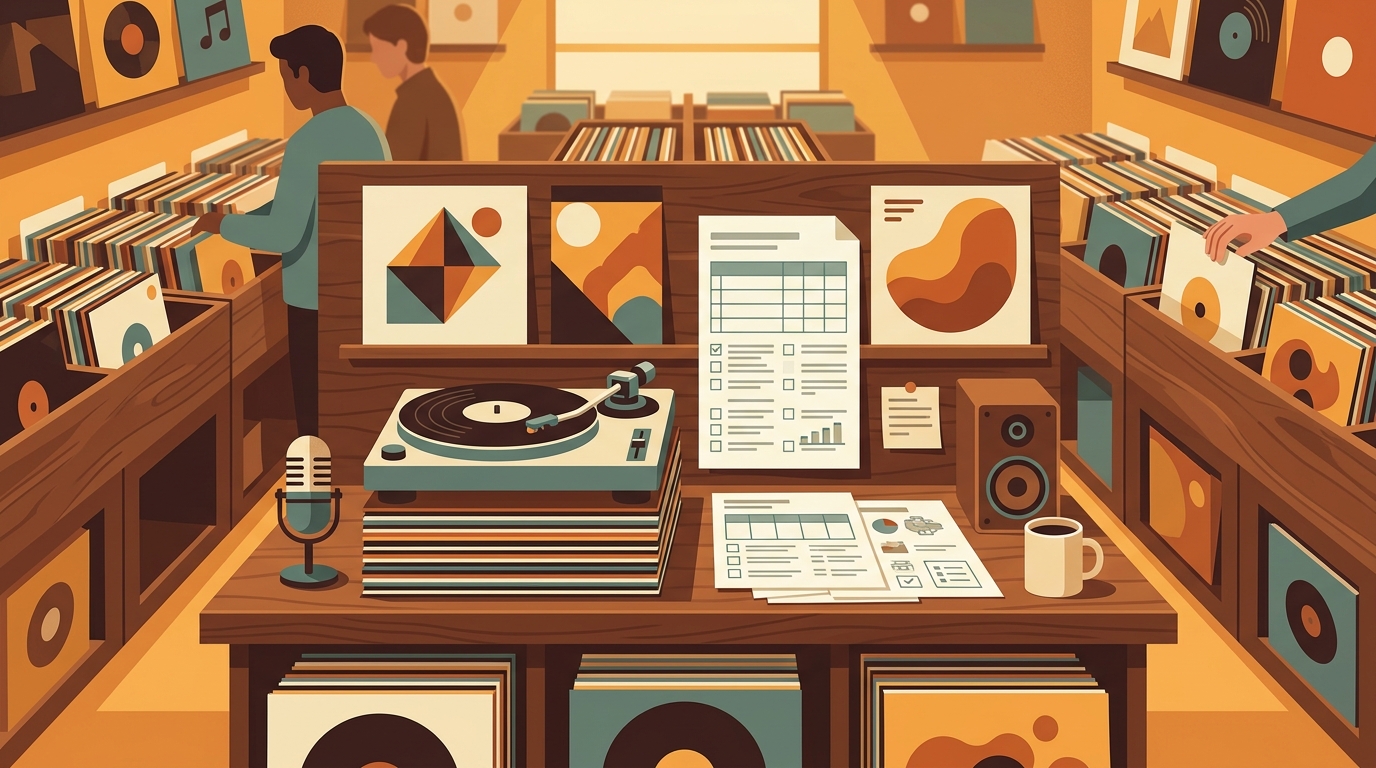
The downloadable CSV includes practical columns for the information collectors actually use: artist, album, year, format, speed, label, catalog number, country, pressing notes, media condition, sleeve condition, color variant, Discogs URL, purchase date, purchase price, current value, storage location, last cleaned, last played, play count, favorite track, and notes. It opens in Google Sheets, Excel, Apple Numbers, LibreOffice, Airtable, or almost any database tool.
The most important fields are not always the obvious ones. Artist and album tell you what the record is, but label, catalog number, country, and pressing notes tell you which version you own. That matters for records with dozens of reissues. A Blue Note jazz LP, a Beatles album, a punk seven-inch, or a modern color variant can change value based on small details printed in the runout, spine, hype sticker, or label rim text.
How to use it without turning collecting into bookkeeping
Start simple. Import the CSV into your spreadsheet app, freeze the header row, then enter ten records you know well. Do not try to catalog a 700-record wall in one heroic Saturday unless you enjoy spreadsheet-induced spiritual damage. Work one shelf at a time. Add a storage location like "Shelf A, cube 3" or "New arrivals bin" so the spreadsheet helps you find music, not just admire your own data discipline.
Condition deserves its own columns for media and sleeve because records and jackets age differently. Many collectors use the common Goldmine and Discogs-style grading language: Mint, Near Mint, Very Good Plus, Very Good, Good Plus, Good, Fair, and Poor. Be honest with yourself. A glossy jacket does not fix groove wear, and a clean-looking disc can still have non-fill, ticks, groove damage, or a tired previous owner's party history baked into it.
Useful columns to add later
Once the basics are working, add columns that match how you collect. If you buy used records locally, add "Store" and "Seller" so you remember who grades conservatively. If you care about sound quality, add "Mastering Engineer," "Pressing Plant," or "Cut By" when that information is available. If you collect variants, add "Color," "Limited Run," and "Numbered Copy." If you sell records occasionally, add "Sold Date" and "Sold Price" instead of deleting the row.
Cleaning and play history are especially useful. The Library of Congress recommends washing and drying hands before handling audiovisual materials, storing and handling them in a clean environment, keeping food and drink away, avoiding contact with playing surfaces, keeping playback equipment clean, and handling grooved discs by the edge and label areas only. A "Last Cleaned" column helps you avoid repeatedly wet-cleaning the same favorites while dusty bargain-bin finds sit untouched.
Spreadsheet plus automatic listening history
A spreadsheet is excellent for ownership details, price history, and pressing notes. It is less fun as a listening diary because manual play logging gets old fast. That is where What's Spinning fits nicely beside the template: keep the spreadsheet for your collection inventory, then let What's Spinning listen to your turntable and track what actually gets played. The difference is revealing. Your most valuable records are not always your most loved records, and your most played albums are often the ones you would forget to brag about.
If you want the cleanest workflow, use the template as your source of truth for ownership and condition, then update it in batches after purchases, cleaning sessions, or trades. Use automatic listening history for behavior. Together, you get the collector view and the listener view, which is much better than pretending one spreadsheet can capture every part of record ownership.
Sources and further reading
- RIAA 2023 Year-End Revenue Statistics
- Discogs public API statistics
- Discogs guide to grading items
- Library of Congress, Care, Handling, and Storage of Audio Visual Materials
- Phonograph record format overview
FAQ
What columns should a vinyl collection spreadsheet include?
Start with artist, album, year, format, label, catalog number, country, pressing notes, media condition, sleeve condition, purchase price, current value, storage location, last cleaned, last played, and notes. Add Discogs URL if you use Discogs for edition matching.
Can I open this template in Google Sheets or Excel?
Yes. Download the CSV file, then import it into Google Sheets, Excel, Numbers, LibreOffice Calc, or Airtable. CSV keeps the template portable instead of locking it to one app.
Should I track every pressing detail?
Track the details that help you identify the exact record you own. Label, catalog number, country, barcode, matrix notes, and color variant are useful for valuable or confusing editions. For common records, artist, album, condition, and location may be enough.
How often should I update my record spreadsheet?
Update it when you buy, sell, clean, or play a record. If that sounds like too much work, use the spreadsheet for ownership details and let a listening tracker like What's Spinning capture play history automatically.
Try What's Spinning Free
Turn your iPad into a live now-playing display. Track every record you spin.
START FREE TRIALThen $4.99/mo or $39.99/yr · Cancel anytime