Crafting the Perfect Vinyl Setup for Apartment Listening
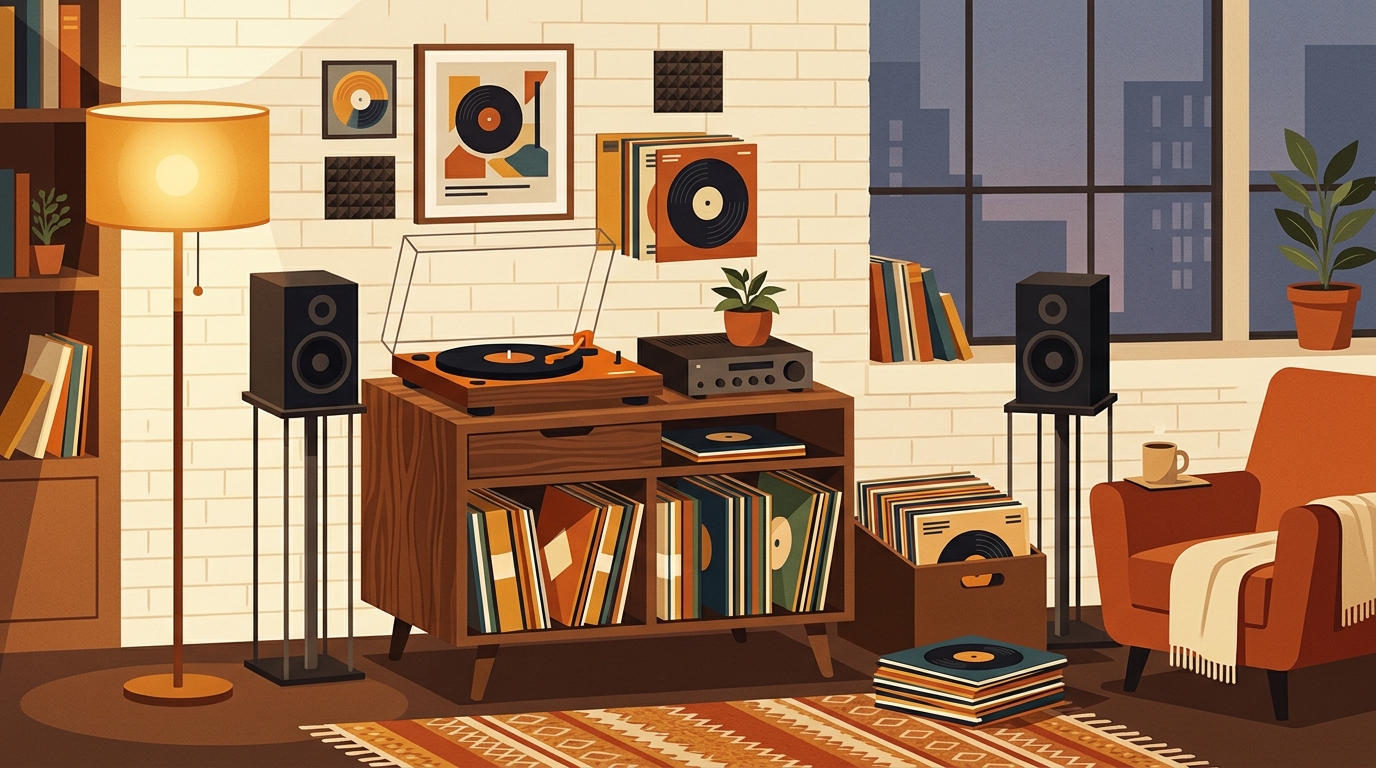
A great vinyl setup for apartment listening is designed around shorter distances, shared walls, and springy floors. Those constraints can produce a focused, intimate system that sounds excellent at neighbor-friendly levels.
The goal is not maximum equipment. It is a clean signal path, stable playback, controlled bass, and a layout that makes you want to play records. Here is how to build it without turning the living room into an audio showroom.
1. Start with the simplest signal path
Every vinyl system needs a turntable, phono preamp, volume control, amplification, and speakers, but those functions do not need five separate boxes. A turntable with a built-in phono stage feeding powered speakers is often the cleanest starting point. An integrated amplifier with passive bookshelf speakers offers more upgrade flexibility but uses more space.
A compact pair of well-placed speakers will usually outperform larger speakers squeezed into corners. If late-night listening matters, choose gear with a proper headphone output. A wired speaker connection also preserves a straightforward signal path.
2. Isolate the turntable before buying upgrades
A cartridge converts tiny mechanical movements into an electrical signal. Unfortunately, it cannot distinguish groove modulation from a bouncing floor or vibrating cabinet. Put the turntable on a rigid, level surface and keep the speakers off that same surface whenever possible. Yamaha's turntable positioning guidance recommends a stable support, speaker isolation when needed, and careful leveling. A small bubble level checked across the platter in two directions is enough to catch a leaning shelf.
If footsteps make the stylus jump, a wall shelf anchored to studs can beat a heavier cabinet on a flexible floor. Otherwise, try a dense platform with compliant isolation feet. Never place the turntable on a subwoofer or block an amplifier's ventilation.
3. Build a nearfield listening triangle
Small rooms reward nearfield listening. Begin with the two speakers and your head forming an approximate equilateral triangle. Genelec's placement guidance uses a 60-degree stereo angle, meaning each speaker sits about 30 degrees to the left or right of the listening position. Aim the tweeters toward seated ear height, then adjust toe-in until vocals lock into the center without making the soundstage feel narrow.
Keep both speakers similarly positioned relative to side walls. Move the chair or speakers a few inches at a time before reaching for tone controls. Avoid sitting exactly halfway between the front and back walls, where room modes can create bass peaks or cancellations.
4. Treat bass as a building problem
Bass is usually what reaches the neighbors first. Corners and walls reinforce low frequencies, so pulling speakers a little away from boundaries can reduce boom. Follow the speaker manufacturer's placement advice because rear-ported, front-ported, and sealed designs behave differently. Isolation pads under speakers can reduce vibration transmitted through furniture and floors, but they cannot stop airborne bass from passing through a wall.
Rugs, curtains, books, and upholstered furniture tame reflections, but they are not soundproofing. New York City's noise guidance explains that structural isolation requires measures such as added mass, air spaces, resilient mounting, and decoupling. In a rental, rely on controlled bass, reasonable hours, and headphones at night.
A subwoofer is optional, not mandatory. If you use one, keep its level modest and experiment with placement away from shared walls. A compact 2.0 system with articulate midbass is often easier to enjoy than a subwoofer that sounds exciting on your sofa and thunderous in the apartment below.
5. Set a repeatable safe volume
Apartment etiquette and hearing safety point in the same direction. The World Health Organization's adult safe-listening reference is an average of 80 dB for up to 40 hours per week. NIOSH uses an occupational reference of 85 dBA for eight hours, with allowable exposure time halving for every 3 dB increase. That makes long sessions at moderate levels a much better habit than brief blasts that leave your ears ringing.
Measure from the listening chair, not beside the speaker. A phone sound-level app can establish a repeatable baseline. Mark a comfortable evening volume, then ask the nearest neighbor whether bass is audible.
6. Protect records in a compact space
Store LPs upright, fully supported, and away from radiators, direct sunlight, and damp exterior walls. The Library of Congress recommends handling discs by the edges and label area, storing them vertically, and using clean inert sleeves. Leave enough room to remove a record without dragging the jacket against its neighbors.
Keep a carbon-fiber brush and stylus brush nearby. Brush the stylus only in the maker's recommended direction, generally from the cartridge rear toward the tip. Ortofon warns that solvents can damage stylus cement or cartridge parts.
A practical apartment layout
Place the turntable on a stable console or wall shelf, speakers on isolated supports, and the chair close enough to form the stereo triangle. Route power cables away from the phono cable when practical. What's Spinning can track what gets played, making it easier to keep a small active rotation near the system.
Then stop shopping for a week. Play familiar records, move the speakers in small increments, and take notes. Apartment audio improves through placement and habits more often than through constant replacement. The perfect setup is the one that keeps the stylus stable, the bass civilized, and both you and your neighbors happy.
Frequently asked questions
Can speakers and a turntable share the same cabinet?
They can when space leaves no alternative, but it is not ideal. Use isolation pads under the speakers, an isolation platform under the turntable, and maximize the distance between them. If you hear rumble, feedback, or skipping as volume rises, separate the surfaces.
Do I need a subwoofer for vinyl in an apartment?
No. Good bookshelf speakers can provide satisfying bass at close range. A subwoofer adds extension, but it also increases the chance of disturbing neighbors and exciting room modes. Add one only if you can place and level it carefully.
What is the best listening volume for an apartment?
There is no universal number because construction and speaker placement vary. Start around normal conversation-to-moderate music levels at the chair, keep long sessions near or below the WHO's 80 dB reference, reduce bass in the evening, and confirm what is audible next door.
How far should apartment speakers be from the wall?
Use the manufacturer's manual as the starting point. Some compact speakers are designed for near-wall use, while others need more breathing room. Move them in small increments and listen for cleaner bass and a stable center image rather than following a single universal measurement.
Sources and further reading
- Yamaha, How to Level and Position Your Turntable
- Genelec, Beginner's Guide to Building a Home Studio
- Genelec, Subwoofer Placement and Bass Management
- World Health Organization, Safe Listening Devices and Systems
- CDC/NIOSH, Noise and Hearing Loss
- NYC DEP, Residential Noise Control Guidance Sheet
- Library of Congress, Care, Handling, and Storage of Audio Visual Materials
- Ortofon, Stylus Care
A spreadsheet tracks what you own. What's Spinning identifies what's playing.
On-device vinyl ID logs your listening history automatically. 7-day free trial.
Looking for Shazam for vinyl?
What's Spinning identifies what's playing on your turntable on-device, logs history, and AirPlays now-playing to your TV.
Comparing vinyl ID apps?
Analog requires Discogs and is iPhone-first (iPad coming). What's Spinning works without Discogs on iPhone and iPad with AirPlay.
Try What's Spinning Free
Turn your iPad into a live now-playing display. Track every record you spin.
START FREE TRIALThen $4.99/mo or $39.99/yr · Cancel anytime
Get it on your iPhone
Open on iPhone