The Best Jazz Albums on Vinyl: 15 Essential Records for Collectors
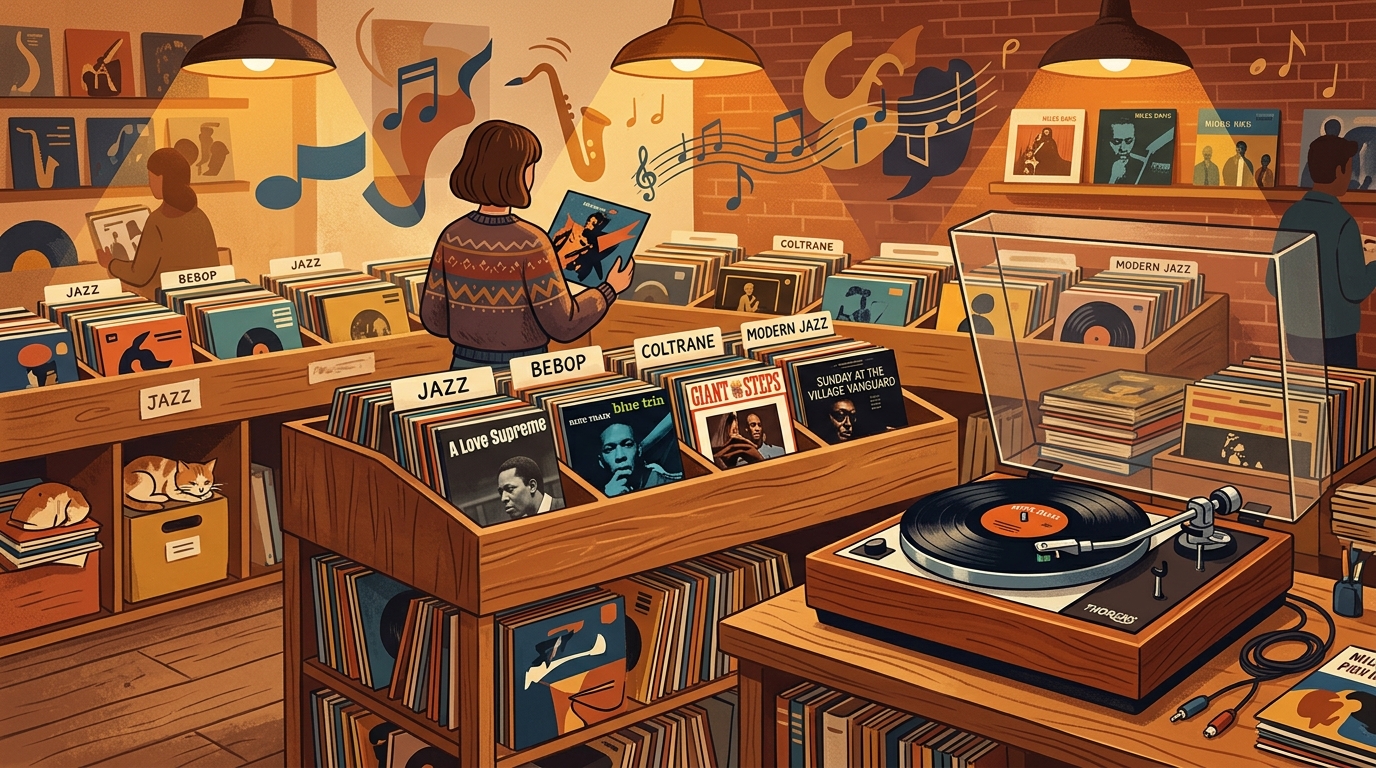
If you are building a jazz shelf, the question is not only which records are historically important. It is which records reward the ritual of vinyl: the cover in your hands, the side break, the room tone, the way a horn sits in space, and the moment when a record makes you stop doing everything else. The best jazz albums vinyl collectors chase are not all rare originals. Some are affordable reissues, some are audiophile staples, and some are albums where a clean 1970s or 1980s pressing can beat an overhyped collectible copy for everyday listening.
Jazz also has unusually strong documentation. Blue Note session dates, Columbia catalog history, Verve studio lineups, RIAA certifications, Grammy records, and label reissue programs all help collectors separate myth from useful buying advice. Miles Davis's Kind of Blue, for example, is certified multi-platinum by the RIAA. Getz/Gilberto won the 1965 Grammy Award for Album of the Year, an extraordinary crossover moment for a jazz LP. The Blue Note catalog became a collector universe partly because of Alfred Lion's production, Rudy Van Gelder's engineering, and Francis Wolff's photography, a combination documented by Blue Note Records and still visible in modern Tone Poet and Classic Vinyl reissues.
This list favors albums that sound great on a turntable, teach you something about jazz history, and remain practical to buy. Use What's Spinning to log which pressings you own and what you actually play; the records below are the kind that reveal patterns in your listening over time.
-

Kind of Blue, Miles Davis, 1959.
Start with the obvious record because it became obvious for good reasons. Kind of Blue is the album many listeners use as the doorway into jazz, but collectors keep coming back because its calm surface hides a radical shift toward modal improvisation. Instead of dense chord changes, Davis gave the band spacious frameworks, which let John Coltrane, Cannonball Adderley, Bill Evans, Paul Chambers, Jimmy Cobb, and Wynton Kelly stretch with unusual patience.
On vinyl, the album is all about placement and air. The ride cymbal on "So What" should feel steady without turning brittle, and the piano should sit inside the group rather than behind a curtain. Original Columbia six-eye pressings are collectible, but they are not the only sane route. The album has been reissued constantly, and a quiet modern copy can be better for regular listening than a noisy prestige pressing. The research angle matters here too: the album's enormous sales and RIAA certifications make it one of the rare jazz LPs that is both canonical and genuinely popular. If your shelf has only one Miles Davis record, make it this one, then let it point you toward the more combustible records later in his catalog.
-
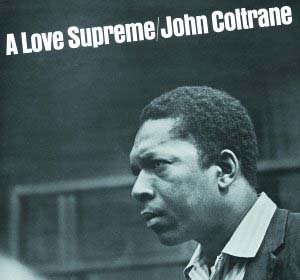
A Love Supreme, John Coltrane, 1965.
Few albums announce their purpose as clearly as A Love Supreme. Recorded at Rudy Van Gelder's New Jersey studio in December 1964 and issued by Impulse!, it turns a four-part suite into a spiritual statement without losing the bite of Coltrane's classic quartet. McCoy Tyner, Jimmy Garrison, and Elvin Jones do not merely accompany him; they create the pressure system that lets the record rise.
Collectors should pay attention to the physical architecture. Side one carries "Acknowledgement" and "Resolution," which means the famous four-note bass mantra has room to become a ritual before the record turns. Side two moves through "Pursuance" and "Psalm," where Jones drives hard and Coltrane's horn becomes almost vocal. The orange-and-black Impulse! design also makes the LP feel like an object from a specific cultural moment: post-bop intensity, civil rights era urgency, and studio precision meeting devotional ambition. Original stereo copies can be expensive, but the album has benefited from careful reissue attention. Buy a clean pressing with strong low-end definition, because Garrison's bass is not background information on this record. It is the spine.
-
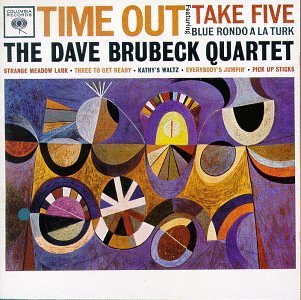
Time Out, The Dave Brubeck Quartet, 1959.
A painted grid on the cover gives away the premise before the needle drops: Time Out is a jazz record built around unusual meters. The Dave Brubeck Quartet turned experiments in 5/4, 9/8, and other patterns into music that became surprisingly accessible, especially through Paul Desmond's "Take Five." Columbia released it in the same landmark year as Kind of Blue and Mingus Ah Um, which makes 1959 feel less like a trivia answer and more like a vinyl buyer's warning: one year can become an entire shelf.
What makes Time Out fun on vinyl is how clearly each side sells the concept without feeling like a lecture. Joe Morello's drumming is the collector's test. A good copy lets the cymbals dance through the odd meters instead of turning them into splashy mush. Desmond's alto tone should sound dry, witty, and almost conversational. Early stereo copies are attractive, but this is another album where availability is your friend. The record sold widely, has been certified by the RIAA, and appears in many used bins. Condition matters more than bragging rights. Groove wear on "Take Five" is common because people actually played the hit.
-

Blue Train, John Coltrane, 1958.
Before Coltrane's later spiritual and avant-garde breakthroughs, Blue Train captured him in hard-bop command. It is his only Blue Note date as the leader, recorded in 1957 with Lee Morgan, Curtis Fuller, Kenny Drew, Paul Chambers, and Philly Joe Jones. That personnel list matters because the album sounds like a brass-and-rhythm engine built to move straight through your speakers.
The title track is a vinyl demonstration piece without acting like one. The horns enter with weight, the blues structure gives every solo a firm floor, and Van Gelder's engineering gives the session the punch collectors associate with Blue Note. Original Blue Note pressings are financially serious objects, especially with desirable address and ear-mark details, but modern Blue Note Classic Vinyl editions make the music reachable. For buyers, the question is not just mono versus stereo or original versus reissue. It is whether the copy preserves the bite of Morgan's trumpet and Fuller's trombone while keeping Chambers's bass articulate. The album cover, with Coltrane's face in blue shadow, has also become shorthand for the label's visual identity. It looks like the record sounds: focused, cool, and built to last.
-

Somethin' Else, Cannonball Adderley, 1958.
Here is the Blue Note album that often tricks new collectors. Cannonball Adderley is the leader, but Miles Davis is the magnetic second voice, and his presence changes the room. Recorded in 1958 with Hank Jones, Sam Jones, and Art Blakey, Somethin' Else balances elegance and tension in a way that makes it one of the most replayable hard-bop LPs.
The opening "Autumn Leaves" is the reason many people buy it, but the record's value is in how the entire set handles space. Davis sounds muted and spare, Adderley answers with warmth and muscle, and Blakey avoids overplaying even though he can detonate whenever he wants. On vinyl, the side-one flow is the story: a familiar standard becomes a slow conversation, then the album moves into blues and ballad territory without breaking the mood. Collectors should know that Blue Note originals are scarce and costly, so reissues are not a compromise by default. The best copies keep the trumpet rounded, the alto present, and the piano from disappearing, which can be a weakness in some Van Gelder recordings. This is not merely a Miles-adjacent purchase. It is a Cannonball record with a rare kind of poise.
-

Moanin', Art Blakey and the Jazz Messengers, 1959.
Bobby Timmons's opening piano figure works like a storefront sign: walk in, this place is alive. Moanin' is hard bop at its most direct, powered by Art Blakey's explosive drumming and a Jazz Messengers lineup that included Lee Morgan, Benny Golson, Jymie Merritt, and Timmons. The album was recorded for Blue Note in 1958 and released as the label's house style was becoming one of jazz's most recognizable collector languages.
This is a record where volume helps, within reason. Blakey's press rolls, cymbal accents, and bass drum punctuation should feel physical. Morgan's trumpet needs sparkle without slicing your ears. Golson brings arrangement intelligence, especially on "Along Came Betty" and "Blues March," so the album is not just a groove machine. It has shape. Used copies can be tricky because party-friendly jazz records often lived hard lives. Watch for distortion on the title track, which was the cut most likely to get repeated. Modern reissues can be terrific daily players, especially if you want the Blue Note energy without paying original-pressing prices. If Kind of Blue is the late-night record, Moanin' is the one that wakes the room up.
-
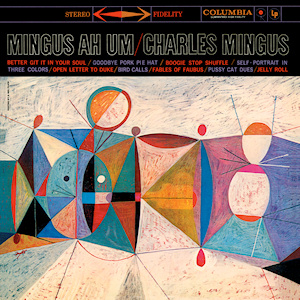
Mingus Ah Um, Charles Mingus, 1959.
Charles Mingus did not make background jazz. Mingus Ah Um is argumentative, funny, mournful, blues-soaked, and brilliantly arranged, sometimes within the same track. Released by Columbia in 1959, it includes tributes, protests, and portraits: "Goodbye Pork Pie Hat" for Lester Young, "Fables of Faubus" in response to Arkansas governor Orval Faubus, and "Better Git It in Your Soul" as a handclapping blast of church and street energy.
Vinyl collectors should care about the edits and versions. Early releases of the album contained edited tracks, while later editions restored longer performances, so the pressing you choose can change the experience. That is not a tiny nerd detail; Mingus's compositions depend on ensemble turns, tempo shifts, and shouted personality. A good copy gives you the bass as a speaking voice, not just a low-frequency foundation. The cover art, with its bold S. Neil Fujita design, also connects the record to Columbia's modern graphic language of the period. If your jazz shelf leans too polite, Mingus Ah Um fixes that immediately. It reminds you that arrangement can be as dramatic as improvisation.
-

The Shape of Jazz to Come, Ornette Coleman, 1959.
The title sounded audacious in 1959, and it still has a little spark of mischief. Ornette Coleman's Atlantic debut with Don Cherry, Charlie Haden, and Billy Higgins removed the piano and loosened the usual harmonic guardrails, which made the quartet sound both exposed and airborne. It is often filed under free jazz history, but the album is more tuneful than its reputation suggests.
For vinyl listeners, the absence of piano creates a distinctive kind of space. Haden's bass lines become unusually important, Cherry's pocket trumpet answers Coleman in bright fragments, and Higgins keeps the music moving with a light touch. "Lonely Woman" is the famous opener, but the record's collector appeal is broader than one track. It documents a moment when Atlantic packaged risk as modern design, giving a challenging album a clean, memorable visual identity. Original mono and stereo copies attract different camps, while later reissues make a sensible entry point. The buying advice is simple: choose quiet vinyl. This music has open air between the instruments, and surface noise can feel more intrusive than it does on a dense big-band record. When the copy is clean, the album still sounds like a door opening.
-

Sunday at the Village Vanguard, Bill Evans Trio, 1961.
A live album can become a memorial without intending to. Sunday at the Village Vanguard was recorded on June 25, 1961, at the New York club, capturing Bill Evans with bassist Scott LaFaro and drummer Paul Motian. LaFaro died in a car accident days later, which turned the trio's conversational approach into one of the most poignant documents in jazz.
The record is a lesson in listening inside a room. You hear audience noise, club ambience, and three musicians refusing the old hierarchy where piano leads and bass follows. LaFaro's bass is melodic and assertive; Motian plays with color rather than constant timekeeping; Evans makes room for both. On vinyl, the intimacy is the attraction. A clean pressing lets the Village Vanguard feel small in the best way, as if the music is happening a few tables away. Riverside originals are prized, but there are many later editions. Avoid copies with persistent ticks during the quieter passages, because the album's spell depends on low-level detail. Pair it with Waltz for Debby, drawn from the same engagement, and you get one of jazz vinyl's essential live-album stories.
-

Getz/Gilberto, Stan Getz and João Gilberto, 1964.
Some crossover albums feel calculated. Getz/Gilberto feels effortless, although its elegance took serious musicianship. Stan Getz, João Gilberto, Antônio Carlos Jobim, Astrud Gilberto, Sebastião Neto, and Milton Banana helped bring bossa nova into American living rooms, and the LP went on to win the Grammy Award for Album of the Year. That made it a rare jazz-associated record with enormous mainstream recognition.
Vinyl suits the album because its drama is mostly micro-dynamic. João Gilberto's guitar is soft but rhythmically exact. Getz's tenor tone is breathy without becoming sentimental. Astrud Gilberto's vocal on "The Girl from Ipanema" is famous, but the record's deeper charm is its unforced pacing. Many used copies exist, and many have groove wear because the album was played at parties for decades. Listen for sibilance on vocals and inner-groove strain near side endings. Verve pressings can be rewarding, and audiophile reissues appeal to listeners who want the quietest possible surfaces. This is a Sunday-morning record, yes, but do not mistake ease for thinness. The arrangements leave nowhere to hide, which is exactly why a good pressing sounds so graceful.
-

Bitches Brew, Miles Davis, 1970.
By 1970, Miles Davis was no longer asking acoustic jazz to behave. Bitches Brew arrived as a double LP full of electric keyboards, multiple drummers, tape edits, long-form grooves, and Teo Macero's studio assembly. The cover by Mati Klarwein is not decoration; it signals that the music is entering a psychedelic, Afro-futurist, rock-adjacent space before the first side begins.
The format matters. As a two-record set, Bitches Brew gives each long performance a side-scale canvas. The title track takes over an entire side, so the listener experiences it less as a song than as weather. Collectors should inspect used copies carefully because double albums invite mismatched wear: one disc may be clean while the other suffered through dorm-room years. Early Columbia pressings have historical pull, but the music's density also benefits from reissues that keep the bass controlled and the percussion separated. This is not the first Miles Davis record to buy for a quiet dinner. It is the one to buy when your jazz shelf starts asking how far the word "jazz" can stretch before it becomes something stranger.
-

Head Hunters, Herbie Hancock, 1973.
Herbie Hancock's Head Hunters is where jazz-funk becomes a collector gateway. Released on Columbia in 1973, it trades the acoustic small-group template for clavinet, ARP synthesizer, Fender Rhodes, electric bass, and deep pocket rhythm. The opening "Chameleon" is so instantly recognizable that it can overshadow how smart the album is as a four-track LP.
What separates Head Hunters from generic fusion is design. The grooves are heavy, but the arrangements keep changing color. "Watermelon Man" reimagines Hancock's own earlier tune with a new rhythmic vocabulary, including the famous beer-bottle intro inspired by Central African pygmy music recordings. On vinyl, this is a low-end test. Paul Jackson's bass should be thick and elastic, not cloudy, while Harvey Mason's drums need snap. The album sold broadly enough that clean vintage copies are possible, though party wear is common. The cover by Victor Moscoso and the Mwandishi-to-Headhunters shift also give collectors a visual timeline of Hancock's 1970s evolution. If you want one jazz record that can sit comfortably near funk, soul, and hip-hop source material, this is the move.
-

The Black Saint and the Sinner Lady, Charles Mingus, 1963.
Mingus called The Black Saint and the Sinner Lady a ballet, and that framing helps. The Impulse! album is not a set of tunes so much as a continuous theatrical work with Spanish tints, Ellingtonian colors, eruptive solos, and ensemble passages that feel choreographed even when they threaten to spill over. It is one of the great examples of jazz composition using the LP as a total form.
The collector hook is intensity plus texture. You want a pressing that can handle dense brass without flattening it, because the album's climaxes can become congested on weak copies or tired playback systems. The quieter passages need room as well, especially when guitar and reeds create uneasy shadows. Impulse!'s gatefold-era presentation suits the music's ambition, and later reissues often make more financial sense than chasing originals in questionable condition. This is not casual background listening, but it is a spectacular record for a focused side-by-side session with friends who think they already know Mingus. Put it after Mingus Ah Um and the leap is dramatic: from brilliant songbook to large-scale psychological theater.
-

Speak No Evil, Wayne Shorter, 1966.
Wayne Shorter's Speak No Evil has the mood of a fairy tale told after midnight. Recorded for Blue Note in 1964 and released in 1966, it features Freddie Hubbard, Herbie Hancock, Ron Carter, and Elvin Jones, which means the lineup alone would justify attention. The writing is the real reason it belongs here. Shorter's tunes are compact, mysterious, and harmonically slippery without sounding academic.
The album rewards vinyl because it works as a sequence of scenes. "Witch Hunt" opens with force, "Fee-Fi-Fo-Fum" moves with strange charm, and the title track feels suspended between hard bop and something more enchanted. Francis Wolff's cover photograph of Shorter's wife Teruko adds to the spell, making the sleeve one of Blue Note's most memorable visual statements. Collectors often talk about Van Gelder sound in broad terms, but this record asks for balance: Hubbard's trumpet can dominate if the pressing or system gets too hot, while Hancock's piano lines deserve clarity. Original copies are expensive, so Blue Note's reissue programs are useful here. Speak No Evil is the Shorter album that turns composition into atmosphere.
-

Ella and Louis, Ella Fitzgerald and Louis Armstrong, 1956.
Not every essential jazz LP needs to push harmony forward or scare the neighbors. Ella and Louis, released by Verve in 1956, is essential because it captures two unmistakable voices meeting with warmth, timing, and respect. Oscar Peterson, Ray Brown, Herb Ellis, and Buddy Rich provide the backing, and producer Norman Granz understood that the concept did not need clutter.
On vinyl, the pleasure is vocal texture. Armstrong's gravelly phrasing and Fitzgerald's clear, buoyant lines should feel close and human, especially on standards like "They Can't Take That Away from Me" and "Cheek to Cheek." This is also a useful reminder that jazz collecting does not have to be a macho hunt for the loudest, rarest, or most difficult record. A clean Verve-style vocal LP can become one of the most played albums in the house. Check used copies for vocal distortion and groove noise during quieter intros. Many reissues exist, and stereo-era compilations sometimes confuse the catalog, so confirm you are buying the original album program if that matters to you. It is the ideal record to play for someone who thinks jazz is homework.
What to buy first
If you are starting from zero, buy in this order: Kind of Blue for the central language, A Love Supreme for spiritual intensity, Moanin' for hard-bop drive, Time Out for rhythmic accessibility, and Getz/Gilberto for vocal and bossa nova warmth. After that, choose your branch. Blue Note collectors should move to Blue Train, Somethin' Else, and Speak No Evil. Fusion-curious listeners should go to Bitches Brew and Head Hunters. If composition and emotional range matter most, buy both Mingus records.
For condition, prioritize quiet surfaces over rarity. Jazz often has exposed bass, cymbal decay, piano overtones, and soft room detail, so surface noise is more distracting than it might be on a loud rock record. If your budget is sane rather than museum-grade, modern reissues from established label programs are often the right call.
Sources and collector notes
Research for this guide used public label and reference sources including Blue Note Records, RIAA Gold and Platinum certification data, Grammy Awards records, Verve label materials, Jazz Discography Project session data, Wikipedia album pages for cover-art references, and Cover Art Archive image records for albums whose artwork is hosted through MusicBrainz-linked archives.
FAQ
Start with Miles Davis Kind of Blue, John Coltrane A Love Supreme, Art Blakey Moanin', Dave Brubeck Time Out, and Stan Getz and João Gilberto Getz/Gilberto. That group covers modal jazz, spiritual jazz, hard bop, odd-meter cool jazz, and bossa nova without becoming too obscure.
Sometimes, but not always. Original Blue Note, Columbia, Impulse!, Riverside, and Verve pressings can be beautiful collector objects, yet condition and mastering matter more for listening. A clean modern reissue often beats a noisy original if your goal is to play the record often.
It depends on the title and pressing. Many late-1950s and early-1960s jazz albums were issued in both mono and stereo, and collectors argue over specific cases. Mono can give horns and rhythm sections more center weight, while good stereo can reveal room placement. Research the album before paying a premium.
Jazz often has quiet passages, exposed cymbals, acoustic bass, piano decay, and lots of space between instruments. Clicks, groove wear, and non-fill can stand out more than they do on dense rock or electronic records. For jazz, a visually clean record and a careful play test are especially valuable.
A spreadsheet tracks what you own. What's Spinning identifies what's playing.
On-device vinyl ID logs your listening history automatically. 7-day free trial.
Looking for Shazam for vinyl?
What's Spinning identifies what's playing on your turntable on-device, logs history, and AirPlays now-playing to your TV.
Comparing vinyl ID apps?
Analog requires Discogs and is iPhone-first (iPad coming). What's Spinning works without Discogs on iPhone and iPad with AirPlay.
Try What's Spinning Free
Turn your iPad into a live now-playing display. Track every record you spin.
START FREE TRIALThen $4.99/mo or $39.99/yr · Cancel anytime