Best Speaker Setup for Vinyl Listening at Home
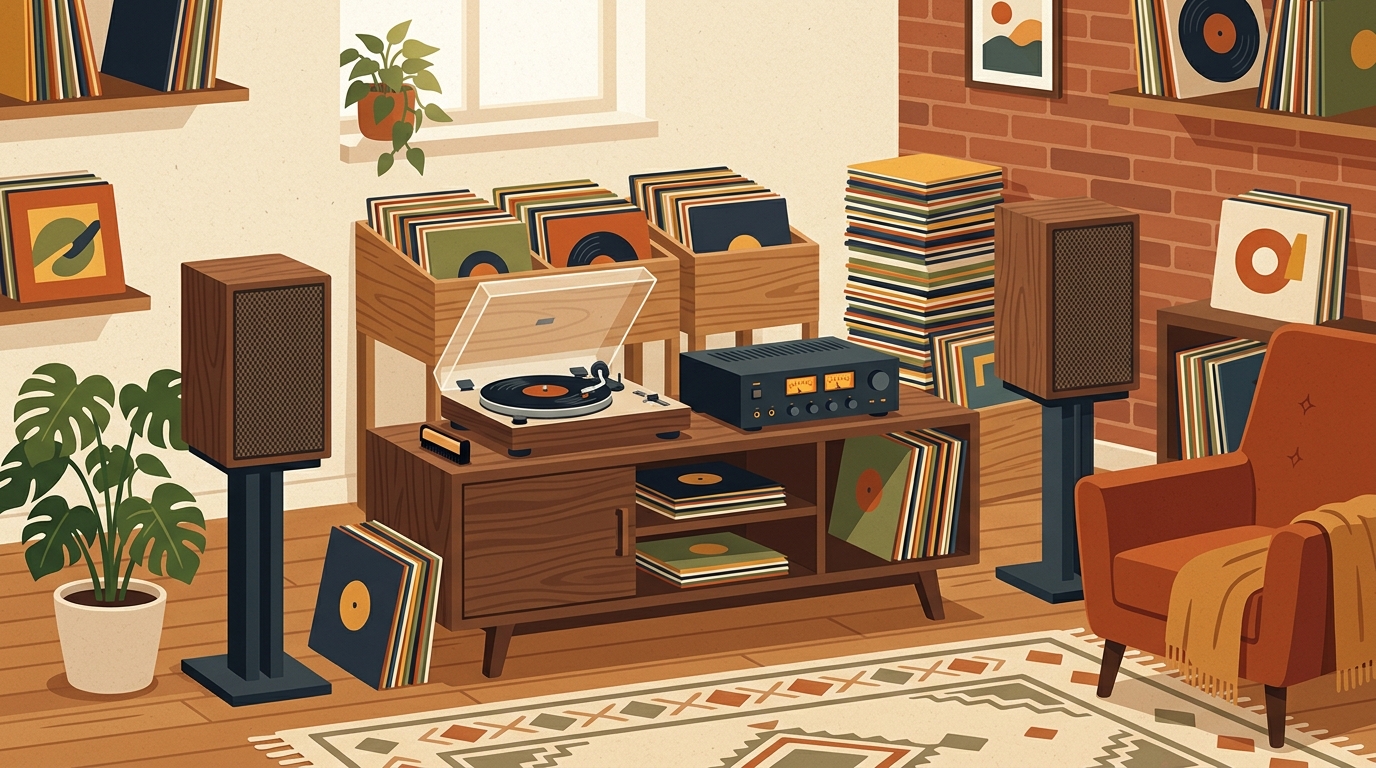
The best speaker setup for vinyl is not the most expensive pair of speakers you can fit in the room. It is the setup that lets a record breathe without feeding vibration back into the turntable. Vinyl is physical playback: a stylus is tracing a groove, a cartridge is producing a very small signal, and your speakers are moving air hard enough to shake furniture. Get the geometry and isolation right, and even a modest system starts sounding calmer, wider, and more believable.
Start with the classic stereo triangle. Stereo reproduction uses two independent channels through two loudspeakers to create a sense of direction and space [1]. ELAC’s speaker placement guide recommends making the distance between the two speakers roughly the same as the distance from each speaker to your listening position, forming something close to an equilateral triangle [2]. In a small living room, that might mean speakers six feet apart and your chair about six feet back. In a larger room, scale the triangle up, but keep the proportions before you start worrying about cables, cartridges, or boutique accessories.
Place the speakers first, then tune the turntable area
Your first practical move is to pull the speakers out from the wall. ELAC suggests keeping speakers at least two to three feet from nearby walls when possible to reduce boundary interference and reflections [2]. That is not always realistic in apartments, but even eight to twelve inches can clean up bloated bass. If the record sounds thick around kick drum and bass guitar, try moving the speakers forward before blaming the pressing.
Next, get the tweeters near ear height. Most bookshelf speakers are designed to image properly when the tweeter is roughly aligned with your ears, which is why stands usually beat actual bookshelves. A bookshelf can work, but the shelf often adds reflections and bass boom. If stands are not an option, bring the speakers to the front edge of the shelf and use isolation pads to reduce cabinet buzz.
Toe-in is the fine adjustment. Aim each speaker slightly toward your listening position, then play a familiar record with a strong center vocal, like a Blue Note jazz title, a well-cut Fleetwood Mac LP, or a clean soul pressing. Too little toe-in can make the center image vague. Too much can narrow the sweet spot and make treble feel sharp. The right setting usually puts the singer in the middle without making the speakers announce themselves.
Keep speaker vibration away from the stylus
The vinyl-specific rule is simple: never treat the turntable like another component on a vibrating media console. A phono cartridge outputs only a few millivolts, and the signal needs both amplification and RIAA equalization before it becomes normal line level [3]. RIAA equalization exists because records are cut with reduced bass and boosted treble, then reversed during playback to improve sound quality and reduce groove problems [4]. In plain English, the beginning of the chain is delicate. Do not put it where the speakers can bully it.
If your speakers are on the same cabinet as the turntable, move them first. Put them on stands, wall shelves, or a separate piece of furniture. Then level the turntable, keep it away from subwoofers, and use a solid platform. You do not need exotic isolation to start. A rigid stand, a level platter, and real distance from the speakers matter more than expensive feet under a flimsy table.
Watch for acoustic feedback. Audio feedback happens when an output is picked up by an input, amplified, and sent back out again, with room acoustics, speaker distance, and resonance all part of the loop [5]. With vinyl, the turntable can become that input. Symptoms include low-end howling, woofer pumping, muddy bass, or a system that sounds fine quietly but falls apart when you turn up the volume.
Powered, passive, and subwoofer setups
For most home vinyl listeners, there are three good paths. The simplest is a turntable with a built-in phono preamp feeding powered speakers. It is compact, clean, and easy to place, especially in a bedroom or apartment. The upgrade path is a separate phono preamp into powered speakers, which gives you more control over cartridge matching and noise. The traditional route is turntable, phono stage, integrated amplifier, and passive speakers. That takes more space, but it also gives you the easiest long-term upgrade path.
A subwoofer is optional, not mandatory. Many records have excellent bass through a well-placed pair of full-range bookshelf or floorstanding speakers. Add a sub only if you can place it away from the turntable and set it conservatively. If the sub makes every record sound bigger but less tuneful, it is too loud. Vinyl bass should feel grounded, not inflated.
A setup checklist that actually works
- Put the speakers on stands or stable furniture separate from the turntable.
- Start with an equilateral triangle between the speakers and your chair.
- Get tweeters close to ear height.
- Pull speakers away from walls as much as the room allows.
- Toe speakers in until the center vocal locks into place.
- Level the turntable and keep it away from bass-heavy corners.
- Confirm that your chain includes a phono stage, either built into the turntable, amplifier, powered speakers, or an external preamp.
- Play three familiar records and make one adjustment at a time.
The best test is not a spec sheet. It is whether you want to keep playing sides. Put on a quiet vocal record, a dense rock record, and a bass-forward soul or electronic record. If the image stays centered, bass notes have pitch, cymbals do not spit, and the turntable does not react when the volume comes up, your speaker setup is doing its job. From there, an automatic listening log like What’s Spinning can help you notice which records you actually reach for after the room is dialed in.
FAQ
Should speakers sit on the same furniture as a turntable?
No, not if you can avoid it. A turntable is a vibration reader. Put speakers on stands or a separate cabinet, and put the turntable on a rigid, level surface that is not being shaken by the speaker cabinets.
Do powered speakers work well for vinyl?
Yes. Powered speakers are a clean solution if they include a phono input or if you add an external phono preamp between the turntable and the speakers. Without that phono stage, many turntables will sound thin and quiet.
How far apart should vinyl speakers be?
Start with the two speakers and your listening chair forming a rough equilateral triangle. If the speakers are six feet apart, try sitting about six feet from each speaker, then adjust for your room.
Is a subwoofer a good idea for records?
It can be, but integrate it gently. Vinyl playback is vulnerable to low-frequency feedback, so keep the subwoofer away from the turntable, set the crossover low, and reduce the level until bass supports the records instead of calling attention to itself.
A spreadsheet tracks what you own. What's Spinning identifies what's playing.
On-device vinyl ID logs your listening history automatically. 7-day free trial.
Looking for Shazam for vinyl?
What's Spinning identifies what's playing on your turntable on-device, logs history, and AirPlays now-playing to your TV.
Comparing vinyl ID apps?
Analog requires Discogs and is iPhone-first (iPad coming). What's Spinning works without Discogs on iPhone and iPad with AirPlay.
Try What's Spinning Free
Turn your iPad into a live now-playing display. Track every record you spin.
START FREE TRIALThen $4.99/mo or $39.99/yr · Cancel anytime