Best Sunday Morning Vinyl Records for a Slow, Perfect Start
The best Sunday morning vinyl records share a rare quality: they slow the room down without putting it to sleep. You want warmth, space, and songs that can handle coffee, sunlight, a half-read book, or the first load of laundry. You also want records that justify the ritual of pulling an LP from the sleeve, lowering the stylus, and letting a side unfold.
That ritual is not a niche fantasy anymore. The RIAA reported that U.S. vinyl revenue grew 7 percent to $1.4 billion in 2024, the format’s 18th consecutive year of growth, and that vinyl albums outsold CDs in units for the third year in a row, 44 million LPs compared with 33 million CDs. Luminate has also reported that U.S. vinyl album sales rose from 13.1 million in 2016 to 49.6 million in 2023. Discogs said more than 11 million records sold through its marketplace in 2023. In other words, a lot of people are still choosing the slower format on purpose.
For this guide, I looked for albums that fit the Sunday test and the collector test. They need to sound inviting at low or moderate volume, reward repeat plays, and offer meaningful vinyl-specific details: original labels, notable studios, chart history, certifications, collectible pressings, or sonic traits that make condition matter. This is not a list of sleepy records. It is a list of records that make a morning feel chosen.
The best Sunday morning vinyl records to own
-

1. Kind of Blue, Miles Davis, 1959
A great Sunday morning record has to do more than sound pretty. It has to make the room feel intentional without turning breakfast into a listening exam. Kind of Blue earns its place because It starts with space instead of volume, and that makes the room feel calmer before the day has gathered speed. The album also has the kind of release history collectors can actually use: the album is certified 5x Platinum by the RIAA, and later chart data lists it at No. 2 on Billboard Top Jazz Albums and No. 63 in the UK. That mix of cultural weight and replay value is what separates a pleasant background LP from one of the best sunday morning vinyl records you can own.
The original vinyl context matters here. The album first appeared as Columbia CL 1355 in mono and CS 8163 in stereo, with production credited to Irving Townsend and recording tied to Columbia 30th Street Studio in New York on March 2 and April 22, 1959. Those details are not just trivia for catalog-number obsessives, although those people are usually more fun at record stores than they get credit for. Studio, producer, and label all shape what you hear on a turntable: microphone placement, tape saturation, side length, cutting decisions, and how much quiet space survives between instruments. On Sunday morning, that is exactly where vinyl earns its keep. You notice the soft attack of a bass note, the air around a voice, and whether the surface noise stays out of the way.
For collectors, the buying advice is practical rather than mystical. Original Columbia six-eye mono and stereo copies are the historical prize, while modern audiophile editions are loved for corrected speed, quiet vinyl, and more consistent playback. If you are choosing between a rare copy and a clean copy, remember that this is music for quiet hours. Groove wear, off-center pressing, non-fill, and noisy vinyl are more obvious before the day gets loud. Ask for play grades, inspect the runout if the pressing matters, and do not overpay for a jacket that looks better than the record sounds. A near-mint modern reissue can be a better Sunday companion than a famous first press that crackles through every intro.
Start your listening test with So What, Blue in Green, All Blues, and Flamenco Sketches. Listen at a real morning volume, not demo-room volume. The best copies keep the center image steady, let vocals sit naturally, and preserve low-level detail without forcing you to lean forward. This is also where a listening log becomes genuinely useful. What’s Spinning can help you remember which albums you actually reach for on slow mornings, then you can add pressing notes in your collection routine so the shelf reflects real listening, not just ambitious buying. Source and release background.
-

2. Getz/Gilberto, Stan Getz and Joao Gilberto, 1964
A great Sunday morning record has to do more than sound pretty. It has to make the room feel intentional without turning breakfast into a listening exam. Getz/Gilberto earns its place because The pulse is relaxed but never sleepy, so it gives the morning movement without asking for attention every second. The album also has the kind of release history collectors can actually use: it reached No. 2 on the Billboard Pop Albums chart and won the Grammy Award for Album of the Year. That mix of cultural weight and replay value is what separates a pleasant background LP from one of the best sunday morning vinyl records you can own.
The original vinyl context matters here. The album first appeared as Verve V-8545 in mono and V6-8545 in stereo, with production credited to Creed Taylor and recording tied to A&R Recording in New York on March 18 and 19, 1963. Those details are not just trivia for catalog-number obsessives, although those people are usually more fun at record stores than they get credit for. Studio, producer, and label all shape what you hear on a turntable: microphone placement, tape saturation, side length, cutting decisions, and how much quiet space survives between instruments. On Sunday morning, that is exactly where vinyl earns its keep. You notice the soft attack of a bass note, the air around a voice, and whether the surface noise stays out of the way.
For collectors, the buying advice is practical rather than mystical. Original Verve mono and stereo copies are core bossa nova collectibles, and quiet surfaces matter because the vocals and saxophone sit close to the listener. If you are choosing between a rare copy and a clean copy, remember that this is music for quiet hours. Groove wear, off-center pressing, non-fill, and noisy vinyl are more obvious before the day gets loud. Ask for play grades, inspect the runout if the pressing matters, and do not overpay for a jacket that looks better than the record sounds. A near-mint modern reissue can be a better Sunday companion than a famous first press that crackles through every intro.
Start your listening test with The Girl from Ipanema, Corcovado, Desafinado, and Para Machucar Meu Coracao. Listen at a real morning volume, not demo-room volume. The best copies keep the center image steady, let vocals sit naturally, and preserve low-level detail without forcing you to lean forward. This is also where a listening log becomes genuinely useful. What’s Spinning can help you remember which albums you actually reach for on slow mornings, then you can add pressing notes in your collection routine so the shelf reflects real listening, not just ambitious buying. Source and release background.
-

3. Blue, Joni Mitchell, 1971
A great Sunday morning record has to do more than sound pretty. It has to make the room feel intentional without turning breakfast into a listening exam. Blue earns its place because It is intimate enough for the first quiet hour of the day, but emotionally substantial enough that it never becomes background wallpaper. The album also has the kind of release history collectors can actually use: it reached No. 15 on the Billboard 200 and No. 3 in the UK, with Platinum certification in the United States and 2x Platinum status in the UK. That mix of cultural weight and replay value is what separates a pleasant background LP from one of the best sunday morning vinyl records you can own.
The original vinyl context matters here. The album first appeared as Reprise MS 2038, with production credited to Joni Mitchell and recording tied to A&M Studios in Hollywood. Those details are not just trivia for catalog-number obsessives, although those people are usually more fun at record stores than they get credit for. Studio, producer, and label all shape what you hear on a turntable: microphone placement, tape saturation, side length, cutting decisions, and how much quiet space survives between instruments. On Sunday morning, that is exactly where vinyl earns its keep. You notice the soft attack of a bass note, the air around a voice, and whether the surface noise stays out of the way.
For collectors, the buying advice is practical rather than mystical. Early Reprise copies and respected audiophile reissues are valued because sparse vocals, dulcimer, and piano make groove wear impossible to hide. If you are choosing between a rare copy and a clean copy, remember that this is music for quiet hours. Groove wear, off-center pressing, non-fill, and noisy vinyl are more obvious before the day gets loud. Ask for play grades, inspect the runout if the pressing matters, and do not overpay for a jacket that looks better than the record sounds. A near-mint modern reissue can be a better Sunday companion than a famous first press that crackles through every intro.
Start your listening test with Carey, Blue, River, A Case of You, and The Last Time I Saw Richard. Listen at a real morning volume, not demo-room volume. The best copies keep the center image steady, let vocals sit naturally, and preserve low-level detail without forcing you to lean forward. This is also where a listening log becomes genuinely useful. What’s Spinning can help you remember which albums you actually reach for on slow mornings, then you can add pressing notes in your collection routine so the shelf reflects real listening, not just ambitious buying. Source and release background.
-

4. Tapestry, Carole King, 1971
A great Sunday morning record has to do more than sound pretty. It has to make the room feel intentional without turning breakfast into a listening exam. Tapestry earns its place because It feels domestic in the best way, like coffee, sunlight, and a record shelf that already knows what you need. The album also has the kind of release history collectors can actually use: it spent 15 consecutive weeks at No. 1 on the Billboard 200, reached No. 4 in the UK, and is certified 14x Platinum by the RIAA. That mix of cultural weight and replay value is what separates a pleasant background LP from one of the best sunday morning vinyl records you can own.
The original vinyl context matters here. The album first appeared as Ode SP 77009, distributed by A&M, with production credited to Lou Adler and recording tied to A&M Studios in Hollywood in January 1971. Those details are not just trivia for catalog-number obsessives, although those people are usually more fun at record stores than they get credit for. Studio, producer, and label all shape what you hear on a turntable: microphone placement, tape saturation, side length, cutting decisions, and how much quiet space survives between instruments. On Sunday morning, that is exactly where vinyl earns its keep. You notice the soft attack of a bass note, the air around a voice, and whether the surface noise stays out of the way.
For collectors, the buying advice is practical rather than mystical. Original Ode copies are common but clean ones remain rewarding, while Mobile Fidelity and other audiophile editions appeal to listeners who want extra vocal presence. If you are choosing between a rare copy and a clean copy, remember that this is music for quiet hours. Groove wear, off-center pressing, non-fill, and noisy vinyl are more obvious before the day gets loud. Ask for play grades, inspect the runout if the pressing matters, and do not overpay for a jacket that looks better than the record sounds. A near-mint modern reissue can be a better Sunday companion than a famous first press that crackles through every intro.
Start your listening test with I Feel the Earth Move, So Far Away, It’s Too Late, Home Again, and You’ve Got a Friend. Listen at a real morning volume, not demo-room volume. The best copies keep the center image steady, let vocals sit naturally, and preserve low-level detail without forcing you to lean forward. This is also where a listening log becomes genuinely useful. What’s Spinning can help you remember which albums you actually reach for on slow mornings, then you can add pressing notes in your collection routine so the shelf reflects real listening, not just ambitious buying. Source and release background.
-

5. Pink Moon, Nick Drake, 1972
A great Sunday morning record has to do more than sound pretty. It has to make the room feel intentional without turning breakfast into a listening exam. Pink Moon earns its place because At under thirty minutes, it respects the morning. It arrives, says exactly what it needs to say, and leaves space behind it. The album also has the kind of release history collectors can actually use: it did not become a chart hit on original release, but later earned BPI Gold certification in the UK and FIMI Gold certification in Italy. That mix of cultural weight and replay value is what separates a pleasant background LP from one of the best sunday morning vinyl records you can own.
The original vinyl context matters here. The album first appeared as Island ILPS 9184, with production credited to John Wood and recording tied to Sound Techniques in London over October 30 and 31, 1971. Those details are not just trivia for catalog-number obsessives, although those people are usually more fun at record stores than they get credit for. Studio, producer, and label all shape what you hear on a turntable: microphone placement, tape saturation, side length, cutting decisions, and how much quiet space survives between instruments. On Sunday morning, that is exactly where vinyl earns its keep. You notice the soft attack of a bass note, the air around a voice, and whether the surface noise stays out of the way.
For collectors, the buying advice is practical rather than mystical. UK Island pink-rim first pressings are the collector target, but any quiet copy is meaningful because surface noise can overwhelm Drake’s soft guitar and voice. If you are choosing between a rare copy and a clean copy, remember that this is music for quiet hours. Groove wear, off-center pressing, non-fill, and noisy vinyl are more obvious before the day gets loud. Ask for play grades, inspect the runout if the pressing matters, and do not overpay for a jacket that looks better than the record sounds. A near-mint modern reissue can be a better Sunday companion than a famous first press that crackles through every intro.
Start your listening test with Pink Moon, Place to Be, Road, Things Behind the Sun, and From the Morning. Listen at a real morning volume, not demo-room volume. The best copies keep the center image steady, let vocals sit naturally, and preserve low-level detail without forcing you to lean forward. This is also where a listening log becomes genuinely useful. What’s Spinning can help you remember which albums you actually reach for on slow mornings, then you can add pressing notes in your collection routine so the shelf reflects real listening, not just ambitious buying. Source and release background.
-

6. Come Away With Me, Norah Jones, 2002
A great Sunday morning record has to do more than sound pretty. It has to make the room feel intentional without turning breakfast into a listening exam. Come Away With Me earns its place because It is polished without feeling sterile, which is exactly the line a Sunday record has to walk. The album also has the kind of release history collectors can actually use: it reached No. 1 on both the Billboard 200 and UK Albums Chart, with RIAA 12x Platinum and BPI 9x Platinum certifications. That mix of cultural weight and replay value is what separates a pleasant background LP from one of the best sunday morning vinyl records you can own.
The original vinyl context matters here. The album first appeared as Blue Note, with the original CD era catalog commonly listed as 7243 5 32088 2 0 and later vinyl editions on Blue Note, with production credited to Arif Mardin, Jay Newland, Norah Jones, and Craig Street and recording tied to Sorcerer Sound in New York City and Allaire Studios in Shokan, New York. Those details are not just trivia for catalog-number obsessives, although those people are usually more fun at record stores than they get credit for. Studio, producer, and label all shape what you hear on a turntable: microphone placement, tape saturation, side length, cutting decisions, and how much quiet space survives between instruments. On Sunday morning, that is exactly where vinyl earns its keep. You notice the soft attack of a bass note, the air around a voice, and whether the surface noise stays out of the way.
For collectors, the buying advice is practical rather than mystical. Classic Records 200 gram pressings and Analogue Productions 45 rpm editions are often discussed by audiophile buyers, while standard Blue Note represses are easy to live with. If you are choosing between a rare copy and a clean copy, remember that this is music for quiet hours. Groove wear, off-center pressing, non-fill, and noisy vinyl are more obvious before the day gets loud. Ask for play grades, inspect the runout if the pressing matters, and do not overpay for a jacket that looks better than the record sounds. A near-mint modern reissue can be a better Sunday companion than a famous first press that crackles through every intro.
Start your listening test with Don’t Know Why, Come Away With Me, Feelin’ the Same Way, and The Nearness of You. Listen at a real morning volume, not demo-room volume. The best copies keep the center image steady, let vocals sit naturally, and preserve low-level detail without forcing you to lean forward. This is also where a listening log becomes genuinely useful. What’s Spinning can help you remember which albums you actually reach for on slow mornings, then you can add pressing notes in your collection routine so the shelf reflects real listening, not just ambitious buying. Source and release background.
-

7. Sunday at the Village Vanguard, Bill Evans Trio, 1961
A great Sunday morning record has to do more than sound pretty. It has to make the room feel intentional without turning breakfast into a listening exam. Sunday at the Village Vanguard earns its place because The applause, room tone, bass resonance, and piano dynamics create the feeling of being out while still staying home. The album also has the kind of release history collectors can actually use: it was not a pop-chart record, but its reputation has grown into one of the central live jazz LPs in the modern vinyl canon. That mix of cultural weight and replay value is what separates a pleasant background LP from one of the best sunday morning vinyl records you can own.
The original vinyl context matters here. The album first appeared as Riverside RLP-376 in mono, with stereo issues commonly listed as Riverside RLP 9376, with production credited to Orrin Keepnews and recording tied to the Village Vanguard in New York City on June 25, 1961. Those details are not just trivia for catalog-number obsessives, although those people are usually more fun at record stores than they get credit for. Studio, producer, and label all shape what you hear on a turntable: microphone placement, tape saturation, side length, cutting decisions, and how much quiet space survives between instruments. On Sunday morning, that is exactly where vinyl earns its keep. You notice the soft attack of a bass note, the air around a voice, and whether the surface noise stays out of the way.
For collectors, the buying advice is practical rather than mystical. Original Riverside deep-groove blue and silver label pressings are valuable, and mono RLP-376 copies are especially prized when the vinyl plays quietly. If you are choosing between a rare copy and a clean copy, remember that this is music for quiet hours. Groove wear, off-center pressing, non-fill, and noisy vinyl are more obvious before the day gets loud. Ask for play grades, inspect the runout if the pressing matters, and do not overpay for a jacket that looks better than the record sounds. A near-mint modern reissue can be a better Sunday companion than a famous first press that crackles through every intro.
Start your listening test with My Man’s Gone Now, Solar, Alice in Wonderland, and Jade Visions. Listen at a real morning volume, not demo-room volume. The best copies keep the center image steady, let vocals sit naturally, and preserve low-level detail without forcing you to lean forward. This is also where a listening log becomes genuinely useful. What’s Spinning can help you remember which albums you actually reach for on slow mornings, then you can add pressing notes in your collection routine so the shelf reflects real listening, not just ambitious buying. Source and release background.
-

8. Astral Weeks, Van Morrison, 1968
A great Sunday morning record has to do more than sound pretty. It has to make the room feel intentional without turning breakfast into a listening exam. Astral Weeks earns its place because It has a drifting quality that suits a day before plans harden, especially when the system lets the acoustic instruments breathe. The album also has the kind of release history collectors can actually use: it was not a major original chart success, but later earned RIAA Gold status in the United States and BPI Platinum status in the UK. That mix of cultural weight and replay value is what separates a pleasant background LP from one of the best sunday morning vinyl records you can own.
The original vinyl context matters here. The album first appeared as Warner Bros. WS 1768, with production credited to Lewis Merenstein and recording tied to Century Sound in New York City across sessions in September and October 1968. Those details are not just trivia for catalog-number obsessives, although those people are usually more fun at record stores than they get credit for. Studio, producer, and label all shape what you hear on a turntable: microphone placement, tape saturation, side length, cutting decisions, and how much quiet space survives between instruments. On Sunday morning, that is exactly where vinyl earns its keep. You notice the soft attack of a bass note, the air around a voice, and whether the surface noise stays out of the way.
For collectors, the buying advice is practical rather than mystical. Original Warner Bros. gold label copies are the collector favorite, with early UK pressings also sought by listeners who want natural acoustic bass and open vocal space. If you are choosing between a rare copy and a clean copy, remember that this is music for quiet hours. Groove wear, off-center pressing, non-fill, and noisy vinyl are more obvious before the day gets loud. Ask for play grades, inspect the runout if the pressing matters, and do not overpay for a jacket that looks better than the record sounds. A near-mint modern reissue can be a better Sunday companion than a famous first press that crackles through every intro.
Start your listening test with Astral Weeks, Beside You, Sweet Thing, Cyprus Avenue, and Madame George. Listen at a real morning volume, not demo-room volume. The best copies keep the center image steady, let vocals sit naturally, and preserve low-level detail without forcing you to lean forward. This is also where a listening log becomes genuinely useful. What’s Spinning can help you remember which albums you actually reach for on slow mornings, then you can add pressing notes in your collection routine so the shelf reflects real listening, not just ambitious buying. Source and release background.
-

9. Tea for the Tillerman, Cat Stevens, 1970
A great Sunday morning record has to do more than sound pretty. It has to make the room feel intentional without turning breakfast into a listening exam. Tea for the Tillerman earns its place because It balances comfort and conscience, so the songs feel gentle without becoming weightless. The album also has the kind of release history collectors can actually use: it reached No. 8 on the Billboard 200 and No. 20 in the UK, with RIAA 3x Platinum certification in the United States. That mix of cultural weight and replay value is what separates a pleasant background LP from one of the best sunday morning vinyl records you can own.
The original vinyl context matters here. The album first appeared as Island ILPS 9135 in the UK and A&M SP-4280 in North America, with production credited to Paul Samwell-Smith and recording tied to Morgan, Island, and Olympic Studios in London from May to July 1970. Those details are not just trivia for catalog-number obsessives, although those people are usually more fun at record stores than they get credit for. Studio, producer, and label all shape what you hear on a turntable: microphone placement, tape saturation, side length, cutting decisions, and how much quiet space survives between instruments. On Sunday morning, that is exactly where vinyl earns its keep. You notice the soft attack of a bass note, the air around a voice, and whether the surface noise stays out of the way.
For collectors, the buying advice is practical rather than mystical. UK Island pink label and early pink-rim pressings are the serious collector copies, while clean US A&M originals remain relatively approachable. If you are choosing between a rare copy and a clean copy, remember that this is music for quiet hours. Groove wear, off-center pressing, non-fill, and noisy vinyl are more obvious before the day gets loud. Ask for play grades, inspect the runout if the pressing matters, and do not overpay for a jacket that looks better than the record sounds. A near-mint modern reissue can be a better Sunday companion than a famous first press that crackles through every intro.
Start your listening test with Where Do the Children Play, Hard Headed Woman, Wild World, Father and Son, and Tea for the Tillerman. Listen at a real morning volume, not demo-room volume. The best copies keep the center image steady, let vocals sit naturally, and preserve low-level detail without forcing you to lean forward. This is also where a listening log becomes genuinely useful. What’s Spinning can help you remember which albums you actually reach for on slow mornings, then you can add pressing notes in your collection routine so the shelf reflects real listening, not just ambitious buying. Source and release background.
-

10. Diamond Life, Sade, 1984
A great Sunday morning record has to do more than sound pretty. It has to make the room feel intentional without turning breakfast into a listening exam. Diamond Life earns its place because The production is sleek, but the bass, percussion, and vocal phrasing still feel human on vinyl. The album also has the kind of release history collectors can actually use: it reached No. 2 in the UK and No. 5 on the Billboard 200, with 4x Platinum certifications in both the UK and the United States. That mix of cultural weight and replay value is what separates a pleasant background LP from one of the best sunday morning vinyl records you can own.
The original vinyl context matters here. The album first appeared as Epic EPC 26044 in the UK and Portrait FR 39581 in the United States, with production credited to Robin Millar and recording tied to Power Plant in London from October to November 1983. Those details are not just trivia for catalog-number obsessives, although those people are usually more fun at record stores than they get credit for. Studio, producer, and label all shape what you hear on a turntable: microphone placement, tape saturation, side length, cutting decisions, and how much quiet space survives between instruments. On Sunday morning, that is exactly where vinyl earns its keep. You notice the soft attack of a bass note, the air around a voice, and whether the surface noise stays out of the way.
For collectors, the buying advice is practical rather than mystical. Clean UK Epic originals with the lyric inner are desirable, and later Sony or Music on Vinyl editions are useful if you want a quieter everyday copy. If you are choosing between a rare copy and a clean copy, remember that this is music for quiet hours. Groove wear, off-center pressing, non-fill, and noisy vinyl are more obvious before the day gets loud. Ask for play grades, inspect the runout if the pressing matters, and do not overpay for a jacket that looks better than the record sounds. A near-mint modern reissue can be a better Sunday companion than a famous first press that crackles through every intro.
Start your listening test with Smooth Operator, Your Love Is King, Hang On to Your Love, and Cherry Pie. Listen at a real morning volume, not demo-room volume. The best copies keep the center image steady, let vocals sit naturally, and preserve low-level detail without forcing you to lean forward. This is also where a listening log becomes genuinely useful. What’s Spinning can help you remember which albums you actually reach for on slow mornings, then you can add pressing notes in your collection routine so the shelf reflects real listening, not just ambitious buying. Source and release background.
-

11. What’s Going On, Marvin Gaye, 1971
A great Sunday morning record has to do more than sound pretty. It has to make the room feel intentional without turning breakfast into a listening exam. What’s Going On earns its place because It sounds like a private conversation that grew into a public statement, which makes it powerful even at low volume. The album also has the kind of release history collectors can actually use: it reached No. 6 on the Billboard Pop Albums chart and No. 1 on the Soul Albums chart, with UK Platinum certification and major U.S. certification history through RIAA listings. That mix of cultural weight and replay value is what separates a pleasant background LP from one of the best sunday morning vinyl records you can own.
The original vinyl context matters here. The album first appeared as Tamla TS310, with production credited to Marvin Gaye and recording tied to Hitsville U.S.A. and Motown studios in Detroit. Those details are not just trivia for catalog-number obsessives, although those people are usually more fun at record stores than they get credit for. Studio, producer, and label all shape what you hear on a turntable: microphone placement, tape saturation, side length, cutting decisions, and how much quiet space survives between instruments. On Sunday morning, that is exactly where vinyl earns its keep. You notice the soft attack of a bass note, the air around a voice, and whether the surface noise stays out of the way.
For collectors, the buying advice is practical rather than mystical. Original Tamla gatefold copies are essential soul artifacts, but reissues can be practical because many early copies were played hard for decades. If you are choosing between a rare copy and a clean copy, remember that this is music for quiet hours. Groove wear, off-center pressing, non-fill, and noisy vinyl are more obvious before the day gets loud. Ask for play grades, inspect the runout if the pressing matters, and do not overpay for a jacket that looks better than the record sounds. A near-mint modern reissue can be a better Sunday companion than a famous first press that crackles through every intro.
Start your listening test with What’s Going On, What’s Happening Brother, Mercy Mercy Me, and Inner City Blues. Listen at a real morning volume, not demo-room volume. The best copies keep the center image steady, let vocals sit naturally, and preserve low-level detail without forcing you to lean forward. This is also where a listening log becomes genuinely useful. What’s Spinning can help you remember which albums you actually reach for on slow mornings, then you can add pressing notes in your collection routine so the shelf reflects real listening, not just ambitious buying. Source and release background.
-

12. Bridge Over Troubled Water, Simon and Garfunkel, 1970
A great Sunday morning record has to do more than sound pretty. It has to make the room feel intentional without turning breakfast into a listening exam. Bridge Over Troubled Water earns its place because It is grander than most morning records, but its best songs open slowly and reward patient listening. The album also has the kind of release history collectors can actually use: it reached No. 1 in both the United States and the UK, with RIAA 8x Platinum and BPI 11x Platinum certifications. That mix of cultural weight and replay value is what separates a pleasant background LP from one of the best sunday morning vinyl records you can own.
The original vinyl context matters here. The album first appeared as Columbia KCS 9914 in the United States, with production credited to Paul Simon, Art Garfunkel, and Roy Halee and recording tied to Columbia studios in New York, Los Angeles, and Nashville. Those details are not just trivia for catalog-number obsessives, although those people are usually more fun at record stores than they get credit for. Studio, producer, and label all shape what you hear on a turntable: microphone placement, tape saturation, side length, cutting decisions, and how much quiet space survives between instruments. On Sunday morning, that is exactly where vinyl earns its keep. You notice the soft attack of a bass note, the air around a voice, and whether the surface noise stays out of the way.
For collectors, the buying advice is practical rather than mystical. US Columbia two-eye 360 Sound pressings are classic finds, and UK CBS copies are also respected when the vinyl is quiet. If you are choosing between a rare copy and a clean copy, remember that this is music for quiet hours. Groove wear, off-center pressing, non-fill, and noisy vinyl are more obvious before the day gets loud. Ask for play grades, inspect the runout if the pressing matters, and do not overpay for a jacket that looks better than the record sounds. A near-mint modern reissue can be a better Sunday companion than a famous first press that crackles through every intro.
Start your listening test with Bridge Over Troubled Water, El Condor Pasa, The Boxer, Cecilia, and The Only Living Boy in New York. Listen at a real morning volume, not demo-room volume. The best copies keep the center image steady, let vocals sit naturally, and preserve low-level detail without forcing you to lean forward. This is also where a listening log becomes genuinely useful. What’s Spinning can help you remember which albums you actually reach for on slow mornings, then you can add pressing notes in your collection routine so the shelf reflects real listening, not just ambitious buying. Source and release background.
-

13. Moon Safari, Air, 1998
A great Sunday morning record has to do more than sound pretty. It has to make the room feel intentional without turning breakfast into a listening exam. Moon Safari earns its place because It brings a soft electronic glow to the room, ideal when acoustic singer-songwriter records feel a little too serious. The album also has the kind of release history collectors can actually use: it reached No. 6 in the UK and No. 41 on Billboard Heatseekers, later earning BPI 2x Platinum certification. That mix of cultural weight and replay value is what separates a pleasant background LP from one of the best sunday morning vinyl records you can own.
The original vinyl context matters here. The album first appeared as Source and Virgin, with LP catalog commonly listed as 7243 8 44978 1 4, with production credited to Jean-Benoit Dunckel and Nicolas Godin and recording tied to Around the Golf and Gang in Paris, with strings recorded at Abbey Road in London. Those details are not just trivia for catalog-number obsessives, although those people are usually more fun at record stores than they get credit for. Studio, producer, and label all shape what you hear on a turntable: microphone placement, tape saturation, side length, cutting decisions, and how much quiet space survives between instruments. On Sunday morning, that is exactly where vinyl earns its keep. You notice the soft attack of a bass note, the air around a voice, and whether the surface noise stays out of the way.
For collectors, the buying advice is practical rather than mystical. Original 1998 European vinyl is collectible because late-1990s LP runs were smaller than CD runs, while reissues make the album easy to recommend. If you are choosing between a rare copy and a clean copy, remember that this is music for quiet hours. Groove wear, off-center pressing, non-fill, and noisy vinyl are more obvious before the day gets loud. Ask for play grades, inspect the runout if the pressing matters, and do not overpay for a jacket that looks better than the record sounds. A near-mint modern reissue can be a better Sunday companion than a famous first press that crackles through every intro.
Start your listening test with La femme d’argent, Sexy Boy, All I Need, Kelly Watch the Stars, and You Make It Easy. Listen at a real morning volume, not demo-room volume. The best copies keep the center image steady, let vocals sit naturally, and preserve low-level detail without forcing you to lean forward. This is also where a listening log becomes genuinely useful. What’s Spinning can help you remember which albums you actually reach for on slow mornings, then you can add pressing notes in your collection routine so the shelf reflects real listening, not just ambitious buying. Source and release background.
-

14. Spirit of Eden, Talk Talk, 1988
A great Sunday morning record has to do more than sound pretty. It has to make the room feel intentional without turning breakfast into a listening exam. Spirit of Eden earns its place because Its pauses are part of the composition, so it turns a room into a listening space rather than a soundtrack zone. The album also has the kind of release history collectors can actually use: it reached No. 19 on the UK Albums Chart and later earned BPI Silver certification. That mix of cultural weight and replay value is what separates a pleasant background LP from one of the best sunday morning vinyl records you can own.
The original vinyl context matters here. The album first appeared as Parlophone PCSD 105, with production credited to Tim Friese-Greene and recording tied to Wessex Sound in London from May 1987 to March 1988. Those details are not just trivia for catalog-number obsessives, although those people are usually more fun at record stores than they get credit for. Studio, producer, and label all shape what you hear on a turntable: microphone placement, tape saturation, side length, cutting decisions, and how much quiet space survives between instruments. On Sunday morning, that is exactly where vinyl earns its keep. You notice the soft attack of a bass note, the air around a voice, and whether the surface noise stays out of the way.
For collectors, the buying advice is practical rather than mystical. Original UK Parlophone vinyl is far more desirable than its modest commercial profile would suggest, largely because the record became a post-rock and ambient touchstone. If you are choosing between a rare copy and a clean copy, remember that this is music for quiet hours. Groove wear, off-center pressing, non-fill, and noisy vinyl are more obvious before the day gets loud. Ask for play grades, inspect the runout if the pressing matters, and do not overpay for a jacket that looks better than the record sounds. A near-mint modern reissue can be a better Sunday companion than a famous first press that crackles through every intro.
Start your listening test with The Rainbow, Eden, Desire, Inheritance, and I Believe in You. Listen at a real morning volume, not demo-room volume. The best copies keep the center image steady, let vocals sit naturally, and preserve low-level detail without forcing you to lean forward. This is also where a listening log becomes genuinely useful. What’s Spinning can help you remember which albums you actually reach for on slow mornings, then you can add pressing notes in your collection routine so the shelf reflects real listening, not just ambitious buying. Source and release background.
-

15. Rumours, Fleetwood Mac, 1977
A great Sunday morning record has to do more than sound pretty. It has to make the room feel intentional without turning breakfast into a listening exam. Rumours earns its place because It is familiar enough to share with anyone in the house, yet detailed enough that a good pressing still surprises collectors. The album also has the kind of release history collectors can actually use: it reached No. 1 in both the United States and the UK, with RIAA 21x Platinum and BPI 17x Platinum certifications. That mix of cultural weight and replay value is what separates a pleasant background LP from one of the best sunday morning vinyl records you can own.
The original vinyl context matters here. The album first appeared as Warner Bros. BSK 3010, with production credited to Fleetwood Mac, Ken Caillat, and Richard Dashut and recording tied to Criteria, Record Plant Sausalito, Wally Heider, Sound City, and other California rooms. Those details are not just trivia for catalog-number obsessives, although those people are usually more fun at record stores than they get credit for. Studio, producer, and label all shape what you hear on a turntable: microphone placement, tape saturation, side length, cutting decisions, and how much quiet space survives between instruments. On Sunday morning, that is exactly where vinyl earns its keep. You notice the soft attack of a bass note, the air around a voice, and whether the surface noise stays out of the way.
For collectors, the buying advice is practical rather than mystical. Early Warner Bros. copies with respected mastering marks are still findable, while premium 45 rpm editions attract listeners who want vocal separation and stronger bass control. If you are choosing between a rare copy and a clean copy, remember that this is music for quiet hours. Groove wear, off-center pressing, non-fill, and noisy vinyl are more obvious before the day gets loud. Ask for play grades, inspect the runout if the pressing matters, and do not overpay for a jacket that looks better than the record sounds. A near-mint modern reissue can be a better Sunday companion than a famous first press that crackles through every intro.
Start your listening test with Second Hand News, Dreams, Never Going Back Again, The Chain, and Gold Dust Woman. Listen at a real morning volume, not demo-room volume. The best copies keep the center image steady, let vocals sit naturally, and preserve low-level detail without forcing you to lean forward. This is also where a listening log becomes genuinely useful. What’s Spinning can help you remember which albums you actually reach for on slow mornings, then you can add pressing notes in your collection routine so the shelf reflects real listening, not just ambitious buying. Source and release background.
What to buy first
If you are starting from scratch, buy clean, affordable copies before chasing trophy pressings. Kind of Blue, Tapestry, Rumours, Come Away With Me, and Getz/Gilberto are strong first buys because they are musically durable and widely available in decent reissues. If your system is already revealing, move toward quieter audiophile cuts of jazz, folk, and vocal records, where surface noise and inner-groove distortion can make or break the mood.
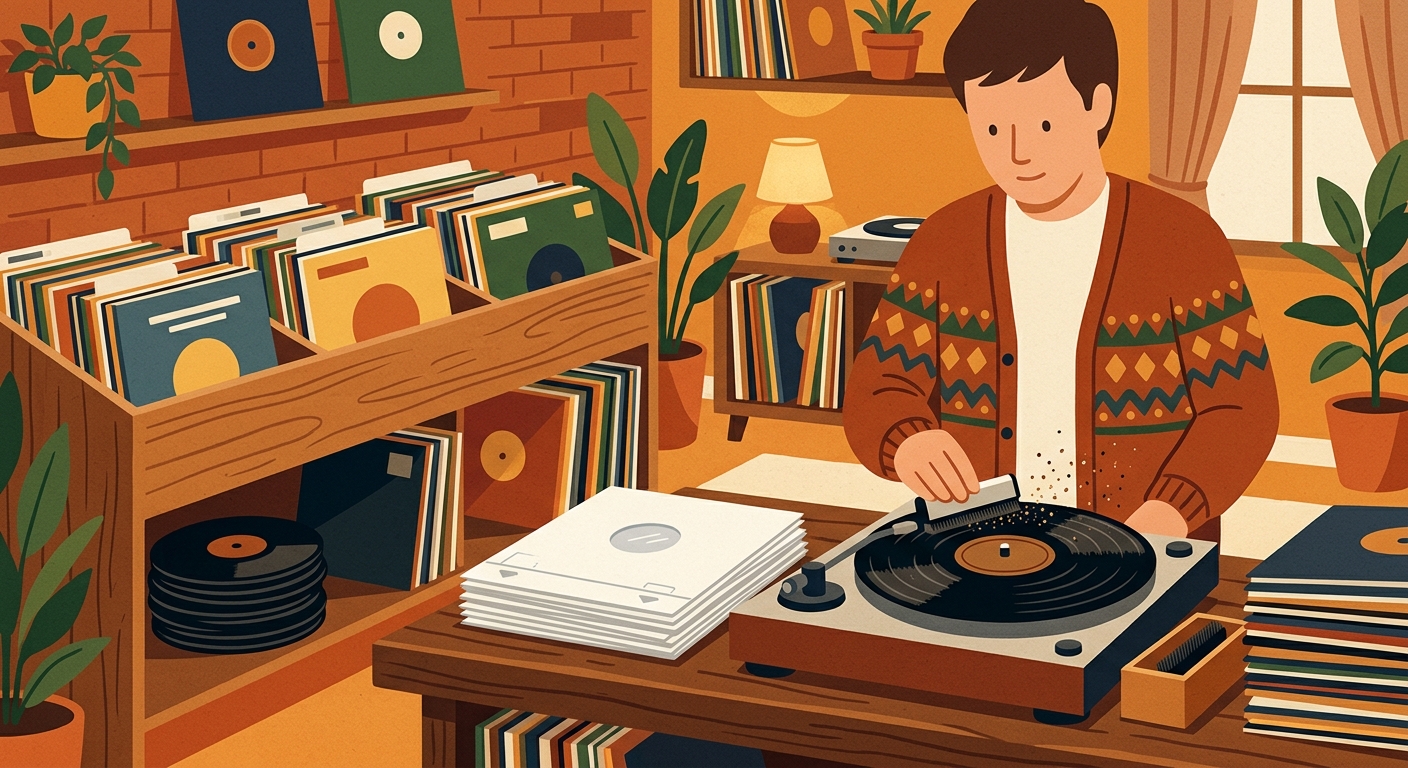
Condition is the whole game for Sunday records. The Library of Congress recommends handling discs only by the outer edge or label area and keeping playback equipment clean, which sounds basic until a quiet piano intro is ruined by dust and fingerprints. Build a small morning shelf, clean those records well, and track what you actually play. A beautiful collection is nice; a collection that tells the truth about your listening life is better.
Sources and further reading
- RIAA 2024 Year-End Revenue Report
- Luminate on vinyl growth and independent record stores
- Discogs 2023 marketplace analysis
- Library of Congress guidance on caring for records
FAQ
What makes a record good for Sunday morning listening?
The best Sunday morning vinyl usually has warmth, room to breathe, and enough musical substance to reward active listening without demanding full attention. Jazz, folk, soul, bossa nova, downtempo, and singer-songwriter records often work well because they sound natural at moderate volume.
Should I buy original pressings for these albums?
Original pressings can be wonderful, especially when the label, mastering, and condition line up. They are not automatically the best choice. For quiet Sunday records, a clean modern reissue often beats a worn original because surface noise is easier to hear in sparse music.
How should I care for Sunday morning vinyl records?
Handle records by the edge and label, keep the stylus and platter area clean, store LPs vertically, and use inner sleeves that do not scuff the vinyl. Quiet records make dust, fingerprints, and groove wear painfully obvious.
How can I track which morning records I play most?
Use a listening log instead of guessing. What’s Spinning listens to your turntable and automatically logs what you play, which makes it easier to see which records are truly part of your routine and which ones are just shelf decoration.
A spreadsheet tracks what you own. What's Spinning identifies what's playing.
On-device vinyl ID logs your listening history automatically. 7-day free trial.
Looking for Shazam for vinyl?
What's Spinning identifies what's playing on your turntable on-device, logs history, and AirPlays now-playing to your TV.
Comparing vinyl ID apps?
Analog requires Discogs and is iPhone-first (iPad coming). What's Spinning works without Discogs on iPhone and iPad with AirPlay.
Try What's Spinning Free
Turn your iPad into a live now-playing display. Track every record you spin.
START FREE TRIALThen $4.99/mo or $39.99/yr · Cancel anytime
Get it on your iPhone
Open on iPhone