Cataloging Rare Vinyl Records with Detailed Metadata

A rare record is not fully cataloged when its entry says only “first pressing, VG+.” For scarce pressings, the value often lives in details that are easy to overlook: a label address, mastering mark, numbered sleeve, missing insert, or runout string that separates an original from a later repress.
Good rare vinyl cataloging metadata should let another collector identify your exact copy without holding it. It should also document its history, condition, and differences from similar editions. Here is a practical system that stays detailed without becoming a research dissertation.
1. Start with the release identity
Record the basics exactly as they appear on the object, not from memory:
- Artist and title
- Label and catalog number
- Country or market
- Release year, or estimated year if uncertain
- Format, size, speed, and disc count
- Mono, stereo, quadraphonic, or other mix
Catalog numbers are especially important because titles are reused. The Beatles’ Yesterday and Today, for example, exists in mono and stereo Capitol editions, plus multiple cover states and label variations. “Beatles, 1966 LP” cannot distinguish them. A useful entry starts with the catalog number, format, country, and cover configuration, then adds the physical identifiers below.
Discogs follows the same release-specific logic. Its database guidelines say each version of a release should be entered separately, while label, catalog number, country, and format are core identifying fields. That makes a release database useful as a starting point, but your private catalog still needs copy-specific information. Discogs Database Guidelines
2. Transcribe the runout, do not summarize it
The dead wax, also called the runout area, is often the strongest evidence for a particular pressing. Transcribe each side separately and preserve spaces, dashes, crossed-out characters, and symbols as closely as practical. Note whether each element is stamped or hand-etched.
A complete record might look like this:
- Side A runout: ST-A-681461-A AT W
- Side B runout: ST-A-681462-B AT W
- Method: matrix stamped, “AT” and “W” hand-etched
- Location: marks read clockwise from the label at approximately 3 o’clock
Do not “clean up” what you see to match an online listing. Discogs distinguishes stamped from etched information and advises entering identifiers in their physical order when possible. A mismatch may reveal a variant or replacement disc. Discogs Barcodes and Identifiers Guidelines
3. Capture pressing clues as structured fields
Collectors often bury crucial evidence in a notes box. That makes the information hard to search later. Create separate fields for:
- Pressing plant mark
- Mastering engineer or studio mark
- Label design and address
- Deep groove, raised rim, or other label geometry
- Vinyl color and transparency
- Jacket printer code or manufacturing credit
- Promo markings, timing strips, stamps, or stickers
- Edition number, autograph, or personalized inscription
If a clue is uncertain, label it as uncertain. “Possible Scranton pressing, triangle mark partly obscured” is better than an overconfident claim. Add the source used to interpret it.
4. Grade the disc and packaging separately
Use a recognized grading vocabulary, then add plain-language observations. Goldmine’s widely used scale runs from Mint through Poor, with Near Mint, Very Good Plus, Very Good, and Good among the practical marketplace grades. Goldmine also recommends grading visually under a strong light, and notes that scratches, groove wear, spindle marks, writing, splits, and other defects affect the grade. Goldmine Record Grading 101
For rare records, store at least four condition fields:
- Media grade: VG+
- Sleeve grade: VG
- Visual notes: two light sleeve scuffs, no feelable scratches
- Playback notes: low crackle during Side B lead-in, no skips
Add the grading date. Condition can change, and a grade assigned ten years ago should not be treated as permanent. If the record is valuable enough to insure, photograph the disc, labels, jacket, spine, inserts, and every notable flaw.
5. Inventory every original component
A rare pressing may be incomplete even when the record and jacket are present. List inner sleeves, lyric sheets, posters, postcards, booklets, obi strips, download cards, hype stickers, and promotional inserts individually. Use “present,” “missing,” “replacement,” or “not applicable” rather than a vague “complete” checkbox.
A Japanese LP without its obi, or a box set missing one booklet, should not inherit the description or value of a complete example.
6. Record provenance and acquisition data
Provenance does not automatically prove authenticity, but a documented ownership trail can support an unusual copy. Save the seller, purchase date, price, receipt, listing URL, and any previous-owner statement. Keep autograph documentation with the catalog entry.
Keep market value separate from purchase price. Discogs explains that its collection estimate is based on the last 30 sales of items in a collection, producing minimum, median, and maximum estimates. That is useful context, but it is not an appraisal and may not capture a rare variant’s precise condition or completeness. Discogs Collection Feature
For your own value field, include the amount, currency, valuation date, source, and comparable sale URL. A number without a date or source ages badly.
7. Add photographs and a physical location
Photograph the exact copy. Capture the covers, labels, runouts, spine, and included extras. Name images consistently, such as collectionID-side-a-label.jpg.
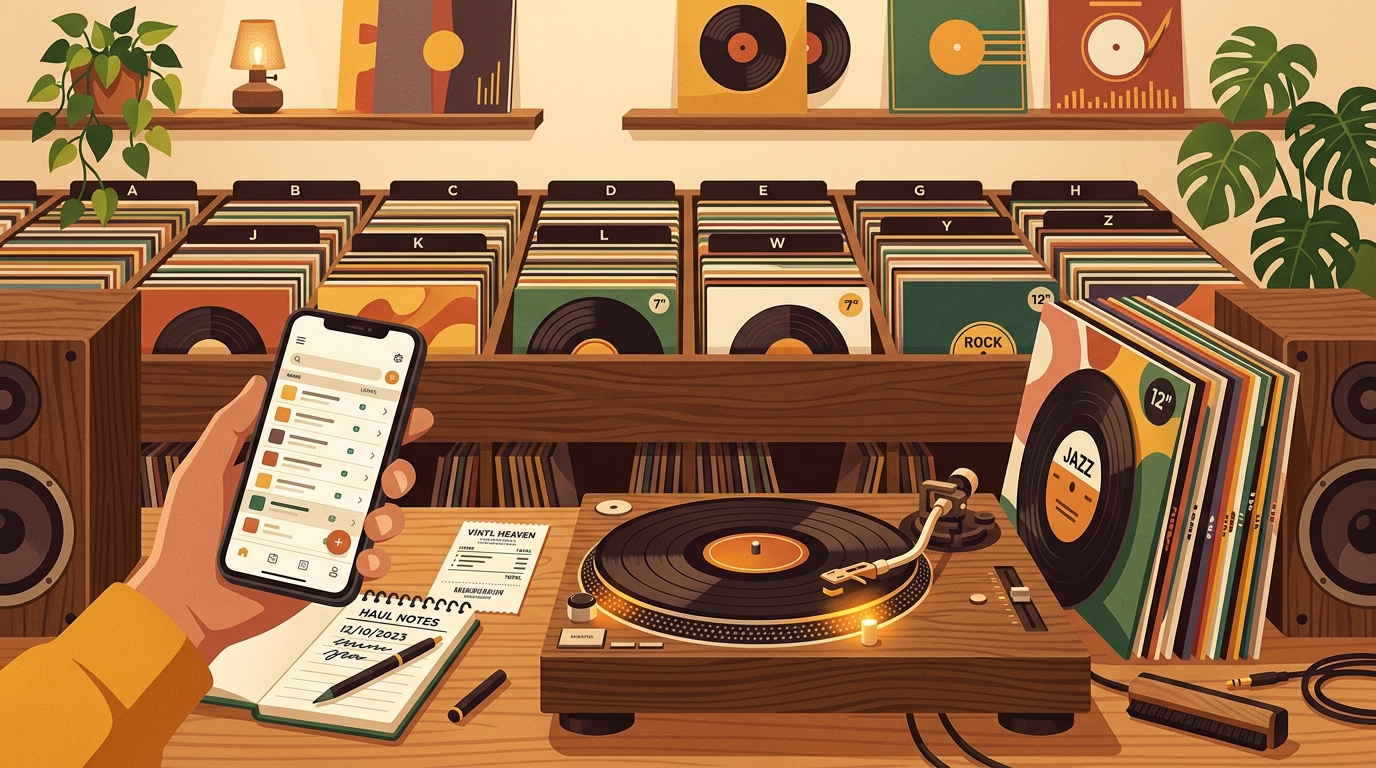
Finally, give the record a location code. “Shelf B, cube 3, box 2” is far more useful than remembering that it is somewhere between jazz reissues and seven-inch singles. What’s Spinning can help keep collection details and listening activity together, but a simple location field is what turns a digital catalog into a practical retrieval system.
A compact rare-record metadata template
- Identity: artist, title, label, catalog number, country, year, format
- Pressing: Side A and B runouts, stamp or etch, plant, mastering marks, label variant
- Condition: media grade, sleeve grade, visual notes, playback notes, grading date
- Completeness: inner sleeve, inserts, obi, stickers, extras
- Provenance: seller, date, price, receipt, prior ownership
- Evidence: photographs, research links, uncertainty notes
- Management: collection ID, location, insurance value, valuation date
The goal is to preserve evidence. When the difference between a routine repress and a scarce edition is one tiny mark in the dead wax, careful metadata becomes part of the record’s value.
Frequently Asked Questions
What is the most important metadata for a rare vinyl record?
Start with the catalog number, country, format, and exact runout inscriptions for both sides. Then document the label variant, pressing or mastering marks, condition, and included components. These fields usually do more to identify a pressing than the artist, title, and year alone.
Should I copy a Discogs release entry into my catalog?
Use it as a reference, but verify every detail against your copy. Online entries describe a release version, while your catalog should describe the physical copy you own. Add copy-specific condition, photos, provenance, location, and any differences you observe.
How should I catalog a record when I cannot identify the pressing?
Record only what you can observe, then mark conclusions as uncertain. Transcribe the runouts, photograph labels and jacket details, and list possible matches with links. An honest “unidentified variant” entry is more useful than a confidently wrong pressing assignment.
How often should rare-record values be updated?
Review high-value records at least annually, and after a major auction result or insurance renewal. Save the valuation date, currency, source, and comparable sale. Market estimates fluctuate, so never overwrite the purchase price or older valuations.
A spreadsheet tracks what you own. What's Spinning identifies what's playing.
On-device vinyl ID logs your listening history automatically. 7-day free trial.
Looking for Shazam for vinyl?
What's Spinning identifies what's playing on your turntable on-device, logs history, and AirPlays now-playing to your TV.
Comparing vinyl ID apps?
Analog requires Discogs and is iPhone-first (iPad coming). What's Spinning works without Discogs on iPhone and iPad with AirPlay.
Try What's Spinning Free
Turn your iPad into a live now-playing display. Track every record you spin.
START FREE TRIALThen $4.99/mo or $39.99/yr · Cancel anytime
Get it on your iPhone
Open on iPhone