Feature Highlight: Vinyl Collection Stats That Make Your Shelf Make Sense
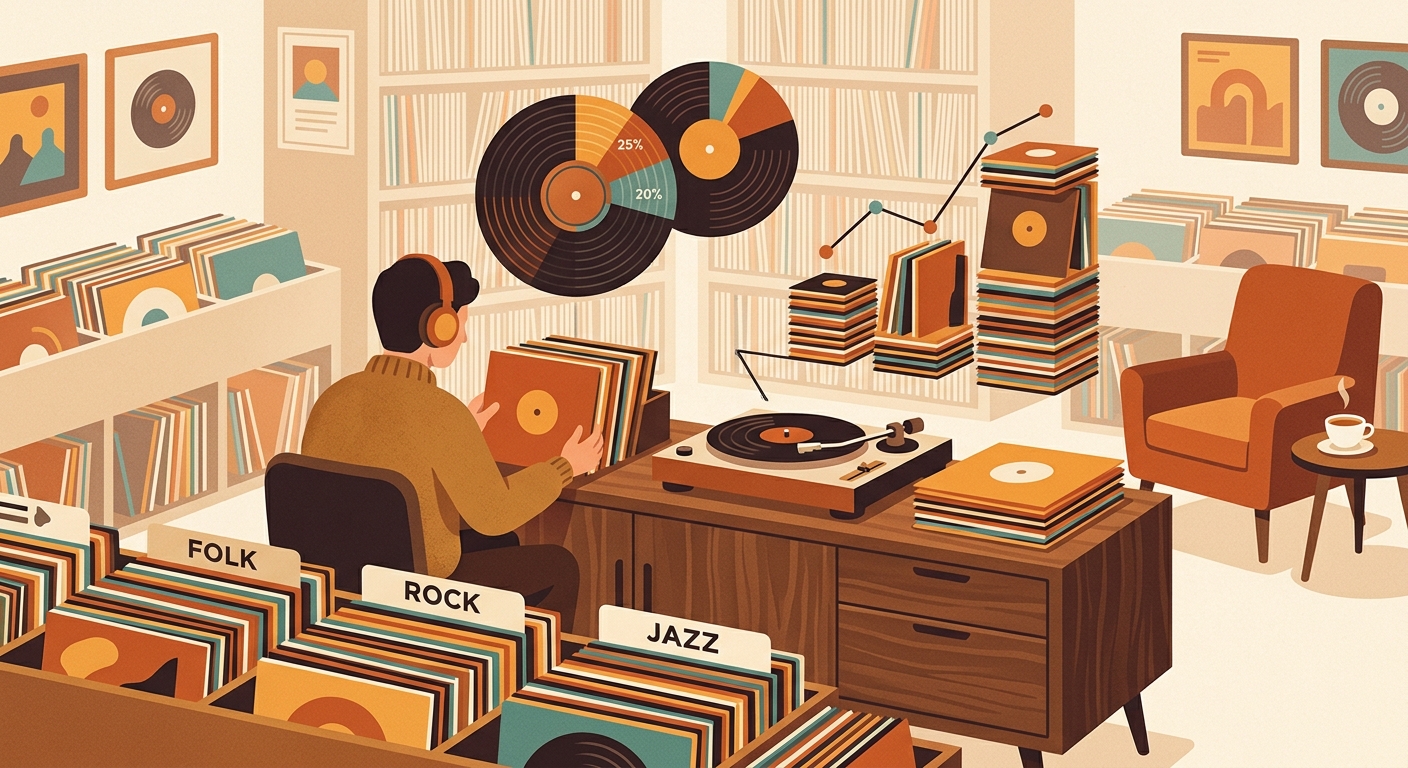
A record collection is easy to romanticize and surprisingly hard to understand. You remember the grails, the lucky thrift-store finds, the albums you play when friends come over, and the records you swear you will revisit soon. But once a shelf gets past a few crates, memory starts to blur. That is where collection stats become useful: they turn a wall of spines into a living map of what you own, what you play, and where your taste is drifting.
This matters because vinyl is no longer a tiny nostalgia corner. In the RIAA's 2023 year-end report, U.S. recorded music revenue hit $17.1 billion, physical formats rose to $1.9 billion, and vinyl revenue grew 10 percent to $1.4 billion, its seventeenth consecutive year of growth. Vinyl also outsold CDs in units for the second year since 1987, 43 million LPs versus 37 million CDs.1 Globally, IFPI reported that recorded music revenues grew 10.2 percent in 2023, paid subscription accounts passed 667 million, and physical revenues rose 13.4 percent.2 Translation: more people are buying records, more records are entering homes, and more collectors need a better way to see the shape of the collection they are building.
What collection stats reveal that shelves cannot
A shelf tells you what fits in a cube. Stats tell you what the shelf means. The most useful collection view starts with simple counts: total albums, recently added records, favorite decades, most-played artists, dominant genres, and albums that have not been played in months.
- Genre balance: Are you actually a jazz collector, or do you just own five Blue Note reissues that make the shelf feel jazzier than it is?
- Decade spread: Is your collection heavy on 1970s rock, 1980s synth-pop, 1990s hip-hop, or newer reissues?
- Listening reality: Which records get played, not just purchased?
- Shelf blind spots: Which artists or styles do you keep meaning to explore but never actually buy?
- Duplicate intent: Are multiple copies serving a purpose, such as mono versus stereo, original versus reissue, or play copy versus archive copy?
That last distinction is important. A collector with three copies of Kind of Blue may be obsessive, but they may also be tracking different masterings, pressings, or condition tradeoffs. Collection stats should not shame that behavior. They should make it legible.
Why play stats are different from ownership stats
Ownership data can flatter you. Play data is more honest. A collection might look adventurous on paper while the turntable mostly gets soul, post-punk, and folk records. That gap is not a problem. It is one of the most useful things a collector can learn.
What's Spinning is built around that distinction. Because the app listens to your turntable and logs what is spinning, it can show stats based on real listening rather than manual enthusiasm. Over time, the app can surface the records you keep returning to, the genres that dominate a month, and the albums that have quietly become background fixtures in your home.
For vinyl collectors, this is more revealing than a generic music-history chart. Streaming services tell you what you clicked on during commutes and work sessions. A vinyl collection stats app tells you what earned the more deliberate act: pulling a record, cleaning it, cueing the stylus, and staying with the side.
Stats make better buying decisions
Collectors often buy with two minds. One buys what the collection needs. The other buys whatever looks irresistible in the bin. Stats help them negotiate.
If your stats show most plays come from soul and funk, that new compilation series might beat another sealed classic-rock reissue. If your most-played records are beat-up originals, that is useful too. It says feel matters as much as condition.
Collection stats are also preservation stats
There is a practical side here that goes beyond taste. The Library of Congress recommends storing grooved discs upright, keeping home collections cool, clean, stable, and relatively dry at about 35 to 40 percent relative humidity, and making sure shelves can support the weight concentration of discs, which it describes as averaging 35 or more pounds per shelf-foot.3 Once your stats show hundreds of records in one room, storage stops being aesthetic and starts being infrastructure.
A good stats view can nudge better care. If a collection is growing quickly, you can plan shelf space before records lean. If certain albums are played constantly, they may deserve better inner sleeves or a dedicated play-copy mindset.
What useful collection stats should include
The best stats are not just big numbers. They should be useful at the moment a collector is deciding what to play, what to buy, or how to organize. A strong vinyl collection stats app should show total collection size, recently added records, most-played artists, genre and decade breakdowns, neglected favorites, listening streaks, and shareable snapshots for friends.
That mix is what makes the feature more than a dashboard. Instead of saying, "I have been listening to a lot of jazz," you can see whether that means five records, twenty plays, or one hard-bop obsession that took over the month.
The real goal: a collection that feels alive
Vinyl collecting can drift toward inventory management if you are not careful. Catalog numbers, sleeve grades, variants, and wantlists all matter, but the heart of the hobby is still listening. Collection stats are at their best when they bring you back to the turntable.
The point is not to optimize your taste like a productivity app. It is to notice patterns. Maybe Sunday mornings are for Brazilian records. Maybe your most-played album is not your rarest one. Maybe the collection you thought was carefully balanced is secretly 40 percent new wave. Great. Now you know yourself a little better, and your next spin can be chosen with more intention.
That is the promise of collection stats in What's Spinning: your records stop being a static archive and start becoming a history of actual listening.
FAQ
What are vinyl collection stats?
Vinyl collection stats are summaries of what you own and what you play: total records, top artists, favorite genres, decade breakdowns, most-played albums, recent additions, and records that have not been played recently.
Why are listening stats better than a manual inventory?
A manual inventory shows ownership, but listening stats show behavior. For collectors, the difference matters because the records you actually play often say more about your taste than the records you bought once and forgot.
Can collection stats help me buy fewer duplicate or impulse records?
Yes. Stats can show which artists, genres, and decades already dominate your shelf. That makes it easier to decide whether a new purchase fills a real gap, upgrades a favorite, or repeats a pattern you already have covered.
Do collection stats replace cataloging pressing details?
No. Pressing details, condition notes, and matrix information are still valuable. Collection stats complement that data by showing how the records are used in real listening, not just how they are described in an inventory.
Sources
Try What's Spinning Free
Turn your iPad into a live now-playing display. Track every record you spin.
START FREE TRIALThen $4.99/mo or $39.99/yr · Cancel anytime