Free Vinyl Collection Tracker Template Download
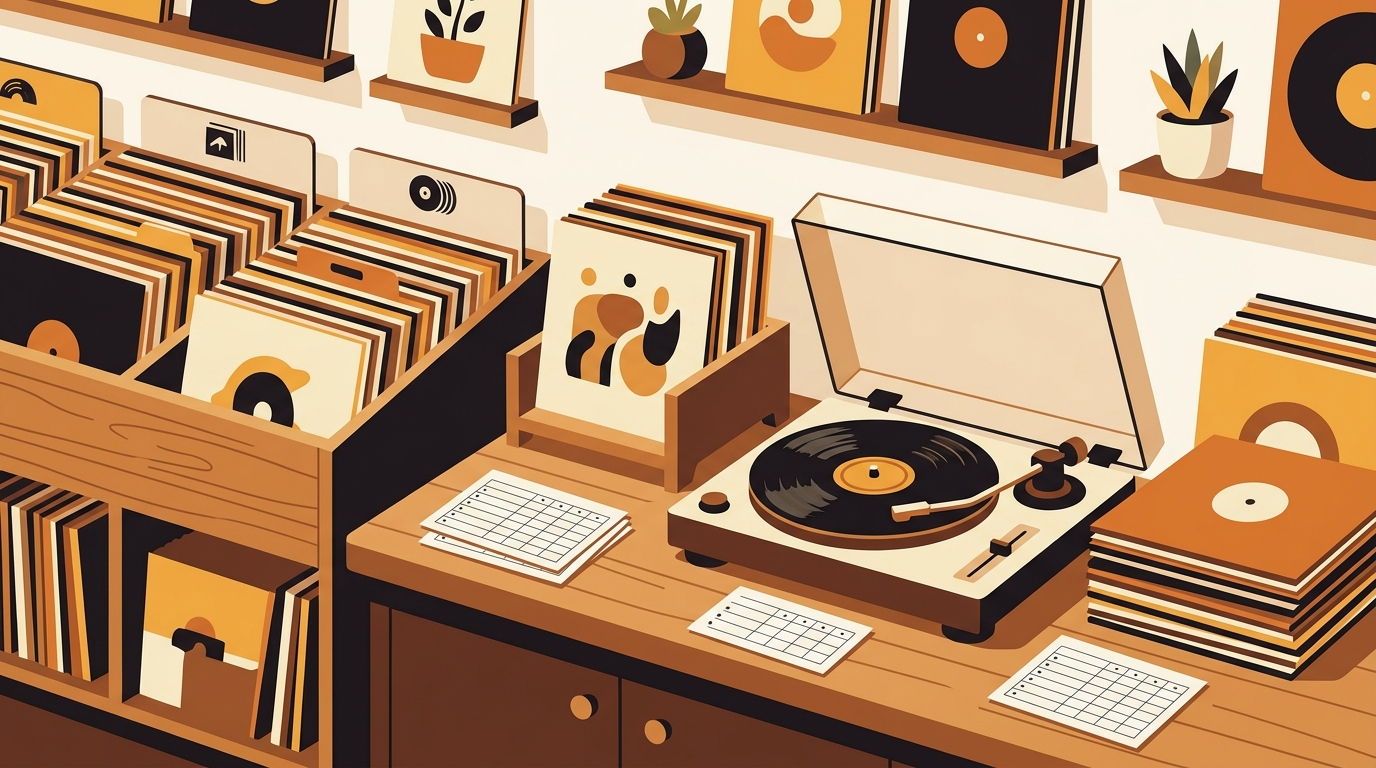
Free Vinyl Collection Spreadsheet
Catalog your records with a simple spreadsheet—or let the app track spins automatically.
Then $4.99/mo or $39.99/yr · Cancel anytime
If your record shelves have reached the point where “I think I own this pressing” is a normal sentence, it is time for a tracker. A good vinyl collection template is a practical map of what you own, what condition it is in, what you paid, where it lives, and what you want to play next.
The need is real. The RIAA’s 2025 year-end report shows U.S. vinyl shipments at 46.8 million units and $1.043 billion in revenue, with vinyl producing more than three times CD revenue that year. Discogs also reported that collectors added 114.2 million items to Collections in 2025, with an average collection of 191 items and an average estimated value of $571.77. Even a “small” collection can turn into a few shelves, multiple variants, and a lot of duplicate-buying risk.
This free vinyl collection tracker template is built for that middle ground: more useful than a plain album list, less fussy than a database you abandon after one Saturday. Copy the fields into Google Sheets, Excel, Numbers, Notion, Airtable, or use them as the import structure for a dedicated tracker like What’s Spinning.
Download the free vinyl collection tracker template
Use this as your spreadsheet header row. Paste it into the first row of a new spreadsheet, freeze the header row, then add one record per line.
Artist,Album Title,Release Year,Format,Label,Catalog Number,Country,Pressing Notes,Discogs Release URL,Barcode,Media Grade,Sleeve Grade,Purchase Date,Purchase Price,Estimated Value,Storage Location,Shelf Code,Genre,Tags,Last Played,Favorite Track,Listening Notes,Wishlist Priority,Duplicate?,For Sale?,Private NotesIf you want a lighter version, start with Artist, Album Title, Release Year, Format, Media Grade, Sleeve Grade, Storage Location, Purchase Price, Estimated Value, and Notes. Those ten columns solve most collector problems without turning the tracker into homework.
Why these fields matter
Collectors usually start with artist and title, then quickly discover that “I own Kind of Blue” is not enough. Which pressing? Mono or stereo? 180 gram reissue or an older Columbia copy? Does the sleeve have a split seam? Is the record VG+ or closer to VG after that thrift-store cleaning experiment?
That is why the template separates media grade from sleeve grade. Discogs’ collection tools allow custom fields and CSV export, and its value estimate is based on the last 30 marketplace sales for a release. But value only means much when the release and condition are accurate. A Near Mint jacket with a noisy disc is not the same item as a clean disc in a worn sleeve.
For condition, use the Goldmine grading language collectors recognize: Mint, Near Mint, Very Good Plus, Very Good, Good Plus, Good, Fair, and Poor. The important habit is grading media and sleeve separately. “VG+ / VG” tells a buyer or future-you far more than a vague “good copy.”
The template columns I would not skip
Catalog number: This is often the fastest way to distinguish pressings. It usually appears on the spine, label, runout area, or back cover. It will not identify every variation, but it narrows the field quickly.
Pressing notes: Use plain language: “blue note label,” “Jacksonville pressing,” “2014 remaster,” “colored vinyl,” “includes booklet,” or “jacket signed at merch table.” These notes turn a list into a collector-grade tracker.
Storage location and shelf code: This is the column that saves time. Use Kallax A3, New Arrivals Bin, Jazz Shelf 2, or Box 04. If you use QR labels, match the shelf code to the label so you can jump from a physical bin to the digital list.
Purchase price and estimated value: Track both. Purchase price tells the story of your collecting habits. Estimated value helps with insurance, estate planning, sales, and trading. Do not obsess over daily price swings, but do keep a rough number for valuable records.
Last played and listening notes: A tracker should encourage listening, not just ownership. Use notes for “side B has non-fill,” “cleaned on 2026-10-10,” or “sounds better with the warmer cartridge.”
How to use the tracker without making it a chore
Start with one crate or one shelf, not the whole room. Add 25 records, then stop. For new purchases, enter the artist, title, format, purchase price, and storage location before the record goes on the shelf. You can fill in pressing details later.
Spreadsheet, Discogs, or a dedicated app?
A spreadsheet is flexible and portable. Discogs is excellent for release identification, marketplace history, wantlists, and exports. A dedicated app such as What’s Spinning is better when you want collection tracking tied to listening history, shelf labels, QR workflows, and quick mobile lookup while digging in stores.
Recommended workflow
Create the spreadsheet, paste the header row, add a shelf code system, enter 25 records, then export a backup. For every new purchase, enter the record before it goes on the shelf. That one habit prevents duplicates and keeps the tracker clean.
Sources
- RIAA 2025 Year-End Recorded Music Revenue Report
- Discogs support: Collection feature and CSV export
- Discogs 2025 collection record announcement via Shore Fire
- Goldmine record grading guide, Tim Neely
FAQ
What is the best free vinyl collection tracker template format?
CSV is the safest format because it works in Google Sheets, Excel, Numbers, Airtable, Notion, and most collection apps. Start in a spreadsheet, then export CSV whenever you want a portable backup.
What columns should every vinyl collection tracker include?
At minimum, include artist, album title, release year, format, label or catalog number, media grade, sleeve grade, purchase price, estimated value, storage location, and notes.
Should I track Discogs release URLs?
Yes. A Discogs release URL gives you a direct reference for the exact pressing, which is especially helpful for reissues, imports, colored vinyl, and albums with many similar versions.
How often should I update my vinyl collection tracker?
Update it whenever you buy, sell, trade, clean, re-grade, or move records. For values, a quarterly refresh is usually enough unless you are actively selling.
Try What's Spinning Free
Turn your iPad into a live now-playing display. Track every record you spin.
START FREE TRIALThen $4.99/mo or $39.99/yr · Cancel anytime
Get it on your iPhone
Open on iPhone