How the Vinyl Record Changed the Way We Listen to Music
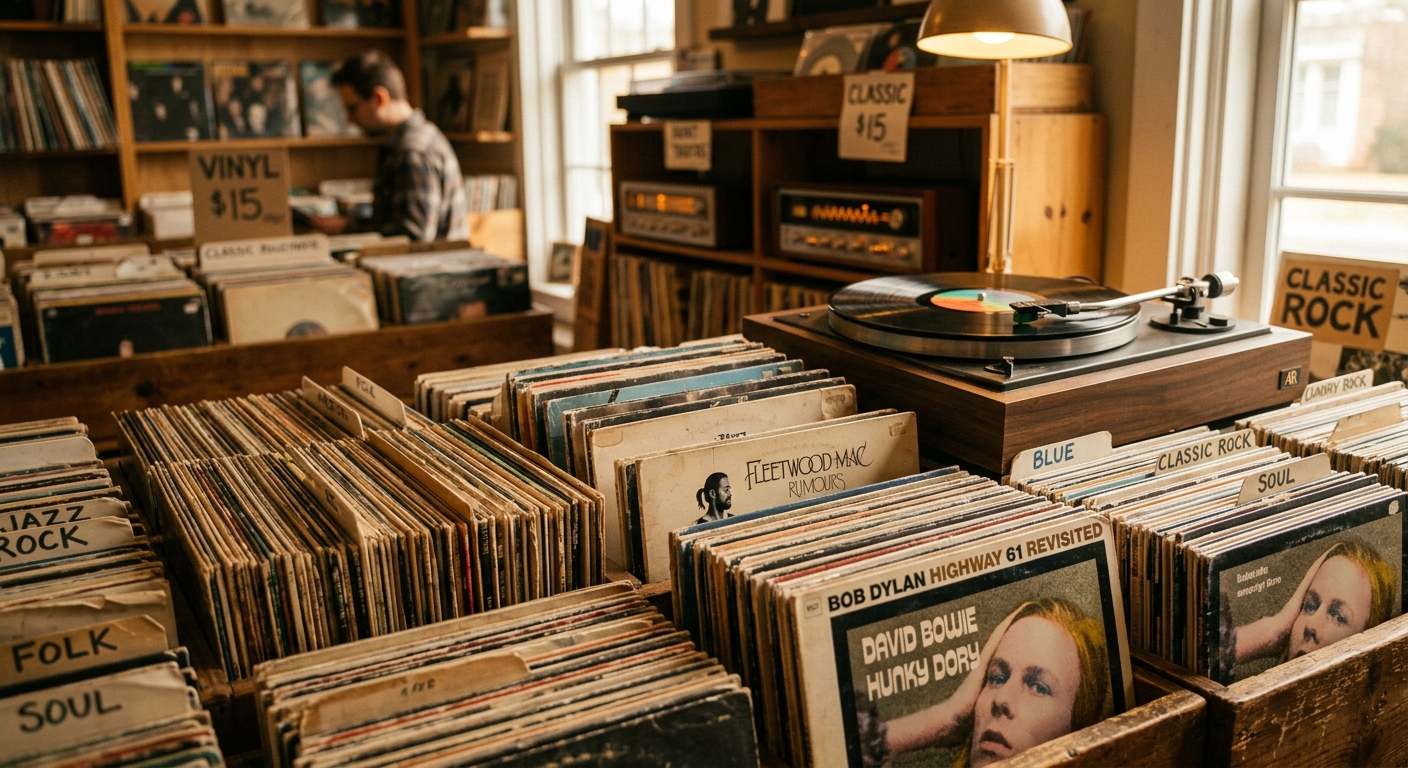
Walk into any record store today and you will find something remarkable: young people hunched over crates of black discs, carefully examining each cover, dropping needles onto surfaces that most of them were not yet born when they were pressed. Vinyl never really went away, but its comeback in the 21st century is one of the more surprising cultural revivals of our time. To understand why these grooves still matter, you have to go back to a room in Philadelphia in the 1880s, where a German-American inventor named Emile Berliner was rewriting the rules of how music could travel through the air.
Before vinyl, there were cylinders. Thomas Edison invented the phonograph in 1877, etching sound onto rotating tubes of tin foil, and for a decade and a half, cylinders were the only game in town. They were fragile, expensive, and could hold only about two minutes of sound per cylinder. Emile Berliner changed all of that. Working out of Montreal and later Camden, New Jersey, Berliner developed a flat disc record that was easier to store, cheaper to produce, and far more durable than its cylindrical predecessor. In 1901, Berliner and his manufacturing partner Eldridge Johnson reorganized their operations into the Victor Talking Machine Company, a name that would dominate living rooms for the next several decades. The disc had arrived, and it was not going anywhere.
The 78 rpm disc, as it came to be known, was the soundtrack of the first half of the 20th century. Shellac was the material of choice, mixed with crushed slate and cotton to create discs that could be cranked out by the millions. A standard 10-inch 78 could hold roughly three minutes of music per side, which meant that popular songs stayed popular precisely because they had to be short. The loudest instruments had to stand fifteen feet from the recording horn. Drums were placed at the back of the room. Jazz bands that wanted to stretch out had to split a performance across multiple sides of multiple records. The medium was shaping the music, whether anyone realized it or not.
Electrical recording changed everything in 1925. Western Electric developed technology that used microphones and vacuum tube amplifiers to capture sound, replacing the old acoustic horns that had funneled sound directly onto diaphragms. Victor and Columbia licensed the new system and recorded their first electrical discs that spring. The difference was immediately apparent. A demonstration at the Waldorf-Astoria Hotel in October 1925 reportedly left John Philip Sousa speechless. "That is a band," he said, according to The New York Times. "This is the first time I have ever heard music with any soul to it produced by a mechanical talking machine." The age of high-fidelity recording had begun, and the record industry had a new reason for people to keep buying players and discs.
The Great Depression nearly killed the whole business. Record sales plummeted, factories closed, and entire record labels vanished. But the industry found ways to survive, including the introduction of inexpensive turntables designed to plug directly into radio receivers, bringing recorded music into homes that might otherwise have done without. When the United States entered World War II, the Armed Forces commissioned thousands of vinyl 78 rpm V-Discs for overseas troops, creating a curious situation in which the plastic that would eventually replace shellac was first deployed at scale for military use rather than civilian entertainment.
The real revolution came in 1948. Columbia Records, led by vice president and chief engineer William Paley (no relation to the broadcasting mogul), introduced the 12-inch Long Playing record, running at 33 and one-third revolutions per minute. Where a 78 could hold three or four minutes per side, the new LP could hold nearly twenty-five minutes. Suddenly, an entire symphony could fit on one side of a record. Concept albums, jazz suites, and extended classical works that had been compressed into artificial time limits could finally breathe. The LP was not just a technical innovation; it was an artistic one. RCA Victor responded the same year with the 45 rpm single, a smaller disc designed for pop songs that could change sides without interrupting a performance. Together, the LP and the 45 defined the two dominant formats for the second half of the 20th century.
Stereophonic sound arrived on commercial discs in the late 1950s, and by the mid-1960s, stereo pressings had become the norm for new releases. The album, as a unified artistic statement rather than a collection of singles, became the format of choice for rock and roll, folk, and every genre in between. Bands like The Beatles, Pink Floyd, and Fleetwood Mac designed their albums as total works of art, complete with gatefold sleeves, lyric sheets, and inner bags. The record had become an object worth owning, not merely a way to hear a song.
The compact disc arrived in the early 1980s promising perfect sound forever, and by 1991, the vinyl record had left the mainstream. Sales collapsed. Pressing plants closed. Record stores shrank their vinyl sections, then eliminated them entirely. For a brief moment, it looked like the format had played its final set.
What happened next still surprises people who tracked the format into near-oblivion. Vinyl never disappeared entirely. Disc jockeys in dance music genres had never stopped spinning records, and a small but devoted community of audiophiles insisted that the warmth and depth of vinyl could not be matched by digital formats. Beginning in the mid-2000s, vinyl sales began a sustained climb that has continued for nearly two decades straight. In 2022, vinyl revenue surpassed CD revenue for the first time since the 1980s. The buyers driving this revival are disproportionately young, many of them experiencing the crackle and pop of a real record for the first time.
The history of the vinyl record is ultimately a story about the relationship between technology and human desire. Every time a new format promised to make records obsolete, something about the ritual of dropping a needle onto a spinning disc kept drawing people back. The record store, the album cover, the liner notes, the physical act of flipping a side, the particular warmth of analog sound: none of it was ever truly replicated by anything that came after. When we talk about vinyl today, we are not just talking about a medium. We are talking about a way of listening, a way of paying attention, that the streaming era has only made more precious.
A spreadsheet tracks what you own. What's Spinning identifies what's playing.
On-device vinyl ID logs your listening history automatically. 7-day free trial.
Looking for Shazam for vinyl?
What's Spinning identifies what's playing on your turntable on-device, logs history, and AirPlays now-playing to your TV.
Comparing vinyl ID apps?
Analog requires Discogs and is iPhone-first (iPad coming). What's Spinning works without Discogs on iPhone and iPad with AirPlay.
Try What's Spinning Free
Turn your iPad into a live now-playing display. Track every record you spin.
START FREE TRIALThen $4.99/mo or $39.99/yr · Cancel anytime