How to Clean Vinyl Records at Home: Practical Tips That Actually Help
Learning how to clean vinyl records at home is one of those collector skills that pays off immediately. A clean record tracks better, sounds quieter, and is kinder to your stylus. A dirty one can turn a good pressing into a parade of clicks, static, and fuzz, which is a shame when U.S. vinyl shipments hit 46.8 million units in 2025 and passed $1.04 billion in wholesale value, according to the RIAA.[5]
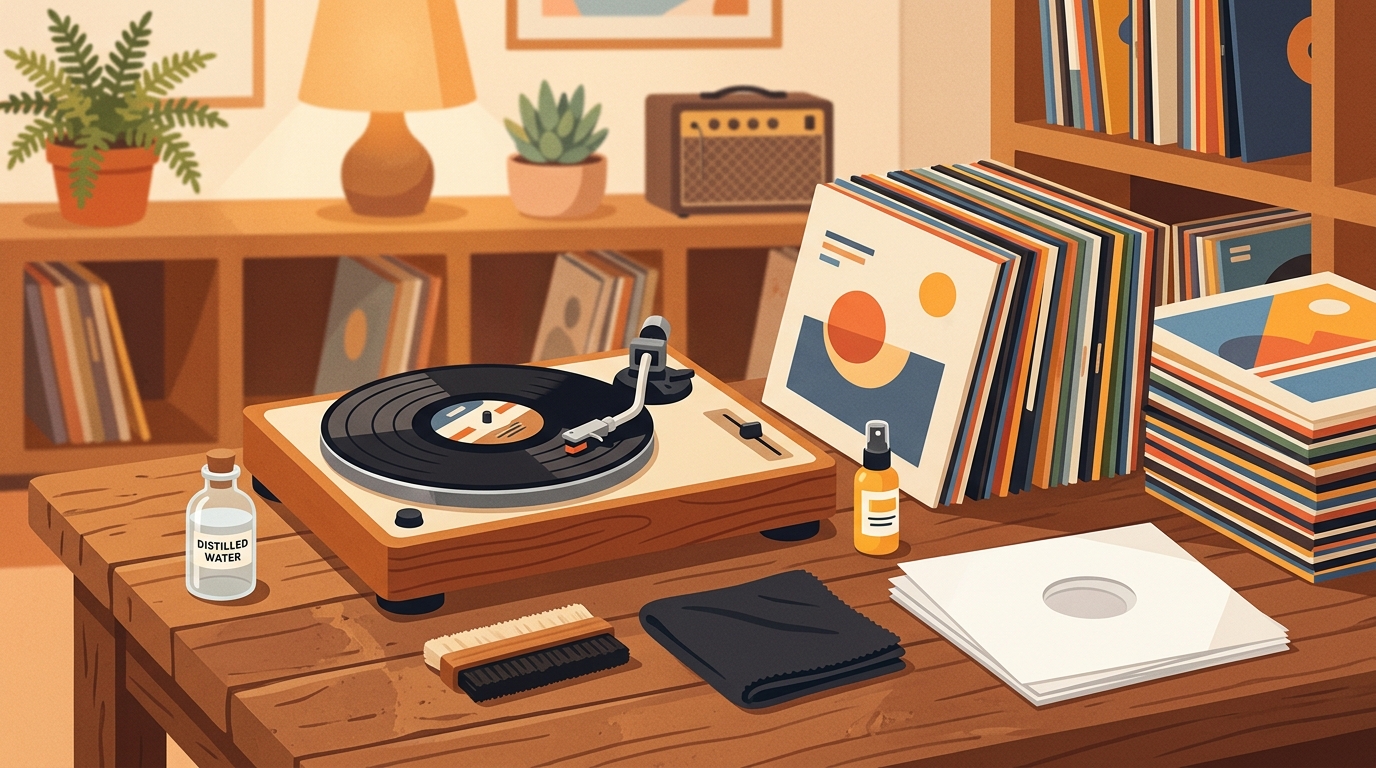
The good news: you do not need a $700 vacuum machine to take care of most LPs. For everyday listening, a carbon fiber brush, distilled water, a gentle record-cleaning solution, clean microfiber, and better sleeves will handle the majority of home collections. The goal is to remove loose dust, skin oil, paper fibers, and old sleeve grit before your stylus drags them through the groove.
Start with prevention: handle and store records correctly
The Library of Congress recommends handling grooved discs by the edge and label areas only, keeping food and drink away, and keeping playback equipment clean.[1] Fingerprints contain oils and salts, and once they sit in a groove, a dry brush usually will not remove them.
Storage matters too. The same Library of Congress guidance says grooved discs should be stored upright, on edge, with sturdy support, and it gives a useful reality check: grooved discs average more than 35 pounds per shelf-foot.[1] Replace dirty paper inners with anti-static polyethylene or rice-paper style sleeves after cleaning, so the record does not go straight back into the dust factory.
For light dust: use a carbon fiber brush before each play
For a clean or nearly clean record, use a dry carbon fiber brush while the platter spins. Audio-Technica describes its anti-static brush as a tool for light cleaning on newer vinyl, with conductive synthetic fibers that remove surface dust from the groove and help discharge static.[2] Hold the brush lightly across the record for a few rotations, then sweep the dust toward the outer edge.
This step is quick, and it prevents the most common problem: loose debris collecting on the stylus during playback. If you hear a side start clean and then grow fuzzy or distorted, check the stylus. A clump of dust on the needle can make a good record sound damaged.
For fingerprints and used-bin grime: wet clean the record
Wet cleaning is for used records, visible fingerprints, smoky sleeves, thrift-store finds, and albums that still crackle after brushing. Use distilled or deionized water, not tap water. NEDCC explains that distilled or deionized water prevents minerals from depositing on the disc surface during rinsing.[3] That matters because anything left behind can dry inside the groove and become tomorrow's surface noise.
A safe home approach is simple: use a dedicated record-cleaning fluid, or mix distilled water with a small amount of record-safe surfactant. CLIR's recorded-sound care guide notes that distilled water leaves no residue and disperses static, while surfactants help water penetrate and remove grease.[4] If you use isopropyl alcohol, keep it modest, avoid shellac 78s completely, and do not soak labels. Many commercial LP fluids use alcohol-free formulas, and those are the safer default if you are unsure what you own.
A step-by-step home cleaning routine
- Inspect first. Look for cracks, warps, mold, or label damage. If a disc looks fragile or historically important, ask a preservation specialist instead of experimenting.
- Dry brush both sides. Remove loose grit before adding liquid, otherwise you can make a muddy slurry and push particles around.
- Protect the label. Keep fluid on the playing surface only. NEDCC protects label areas before wetting discs because labels and markings can be damaged by water.[3]
- Apply fluid sparingly. Put the record on a clean mat. Mist or drip fluid onto a record-cleaning pad, not the label. Work with the groove direction.
- Let the cleaner do the work. For dirtier records, give the fluid a short dwell time, then brush lightly. NEDCC's process lets a surfactant mixture sit for 2 to 5 minutes before a light groove-direction wipe.[3]
- Rinse with distilled water. Use a second clean pad and plain distilled water to remove loosened dirt and cleaning residue.
- Dry completely. Stand the record vertically in a clean drying rack until it is fully dry. NEDCC warns that re-sleeving a wet disc can encourage mold and damage the carrier.[3]
- Use a fresh inner sleeve. The cleanest record in the world will not stay clean inside an old dusty paper sleeve.
What not to use on vinyl records
Avoid tap water, paper towels, household glass cleaner, bleach, acetone, furniture polish, abrasive sponges, and magic erasers on the playing surface. Paper towels shed lint and can leave scratches; household cleaners can leave residues that your stylus then spreads through the groove.
Do not wet-clean shellac 78s with alcohol. Audio-Technica specifically says its LP and EP cleaning kit should not be used on SP 78 RPM shellac records.[2] If you collect older formats, treat them as a separate preservation problem, not just funny-looking LPs.
How often should you clean records?
Brush before each play, wet-clean used records before their first serious listen, and deep clean only when the record needs it. Overcleaning is not a badge of honor. Every wet clean introduces handling risk, drying time, and the possibility of residue if you rush. Keep a simple note in What's Spinning when a record has been cleaned, especially for used purchases, so you do not keep solving the same problem twice.
Finally, clean the playback chain. A dusty mat, dirty stylus, and grimy inner sleeves will undo your work quickly. Record care is a system: clean hands, clean sleeve, clean stylus, clean record.
FAQ
For a rinse, yes, but use distilled or deionized water. For fingerprints and oily grime, water alone is weak because it does not dissolve grease well. A record-safe surfactant or commercial fluid helps lift contamination, followed by a distilled-water rinse.
It can be used cautiously in some vinyl-cleaning formulas, but it is not mandatory and should never be used on shellac 78s. If you are unsure, use an alcohol-free commercial LP fluid or distilled water with a record-safe surfactant.
Usually a dry brush is enough, but some new records arrive with paper dust, static, or pressing residue. If a new LP is noisy after brushing and your stylus is clean, a gentle wet clean can help.
No. Cleaning removes debris and residue, but it cannot repair groove damage. If a click is caused by a scratch or pressing defect, cleaning may reduce surrounding noise, but the defect will remain.
Sources
Comparing vinyl ID apps?
Analog requires Discogs and is iPhone-first (iPad coming). What's Spinning works without Discogs on iPhone and iPad with AirPlay.
Try What's Spinning Free
Turn your iPad into a live now-playing display. Track every record you spin.
START FREE TRIALThen $4.99/mo or $39.99/yr · Cancel anytime