Search Your Entire Vinyl Collection in Seconds

You flip through the shelf for the third time. You know you own that Blue Note jazz record, the one with the tenor sax on the cover, but it is nowhere to be found. Meanwhile your Discogs wantlist keeps growing and your actual shelf feels like a black box. This is the problem that kills record collecting momentum, and it has a fix: good search.
Every serious vinyl collector eventually faces the same wall. The collection grows past the point where memory alone can track it. You own hundreds of records, maybe thousands. You forget what you have until you stumble across it, and you re-buy duplicates at record fairs because you cannot remember if that copy of "Goon" was already on the shelf or still sitting in a to-be-filed pile. The answer is not a better memory. It is a searchable catalog that treats your collection the way a record store treats its inventory.
What a Real Vinyl Search Tool Actually Does
A useful search in a vinyl collection app goes far beyond a basic text box. When you type "Coltrane" you do not want a list of every item in your catalog that happens to contain those letters. You want records led by John Coltrane, or maybe records produced by him, or records in the modal jazz category you have been building. The difference between a shallow search and a deep one is whether the app understands what a record is.
Good vinyl search indexes multiple fields simultaneously. You search by artist, label, year, genre, or format and the results come back ranked by relevance. Some apps let you combine filters, so you can say show me all 1960s Blue Note pressings in my collection that I have not played in the last six months. That kind of query turns your shelf into a living database rather than a static pile of plastic.
The Discogs database, which powers much of the vinyl collecting world, indexes over 50 million releases. When your personal collection is connected to that database, you get access to every pressing variation, every reissue, every country-specific edition. You can search your own catalog against that backdrop and immediately see which version you own and whether it is the original or a later repress. Collectors obsess over these distinctions because the original pressing of "Kind of Blue" can be worth hundreds more than the 1980s Columbia reissue, even if the cover looks nearly identical.
Speed Matters More Than You Think
There is a behavioral reason speed matters so much in collection search. When you are in the middle of a listening session and the record finishes, you want to find the next one quickly. If finding something takes more than ten seconds, you reach for your phone and open Spotify instead. The moment is gone. A fast search bar on your phone, or better yet a quick-lookup feature built into a now-playing screen, keeps you in the record room instead of drifting back to algorithmic streaming.
Researchers who study human-computer interaction consistently find that perceived latency above roughly 300 milliseconds breaks flow state. For a vinyl collector flipping through physical cards in a filing cabinet, the equivalent friction is exactly the same. You want instant. The apps that feel the best are the ones where a few keystrokes pull up exactly what you were thinking before you finished typing.
Search Across Your Whole Library from Anywhere
One underappreciated benefit of a digital vinyl catalog is cross-device search. You might be at a record fair in Portland and spot a pressing you recognize from your own collection. If your catalog is on your phone, you can search your shelves from the stall before you buy, confirming whether you already own the UK first pressing or if this is actually the variant you have been looking for. That five-second search can prevent a duplicate purchase that would have sat unplayed for years.
Cloud sync makes this possible. Your collection lives on a server, not just on the device in your listening room, so every search query hits the complete library regardless of which gadget you are holding. The best vinyl apps treat this as baseline functionality rather than a premium feature, because collectors expect to manage their library from the couch, the store, and the road without thinking about which device they last opened.
Barcode Scanning Adds Another Dimension
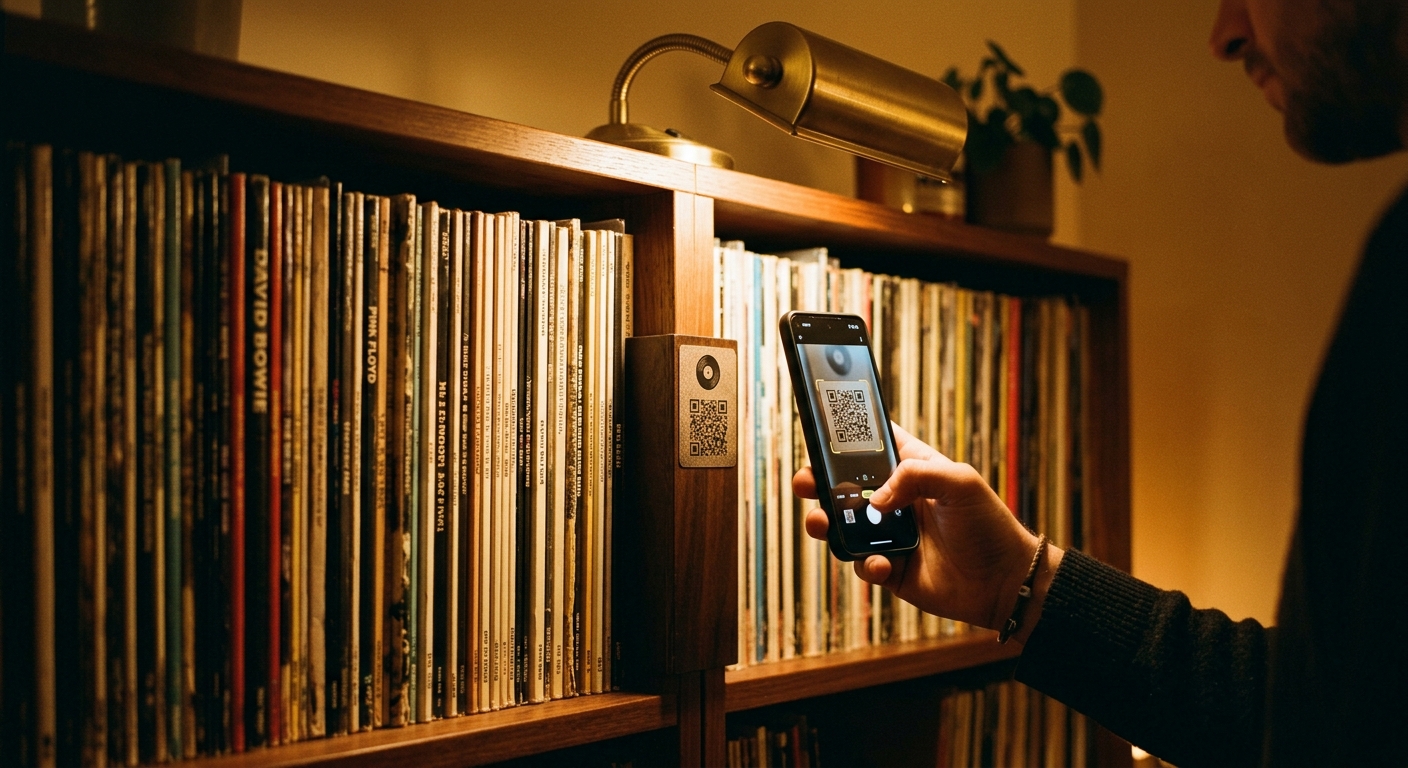
Beyond text search, modern vinyl apps increasingly support barcode scanning via your phone camera. You pull a record off the shelf at a store, scan the back cover barcode, and the app queries Discogs to identify the exact release. If it matches something in your collection, the app tells you. If you already own it, the app notes the pressing variant and current market value. This turns a casual browse into an instant collection audit.
The scanning approach works particularly well for large hauls. When you come home from a record fair with fifteen records, scanning each one takes under two minutes and populates your catalog with verified entries rather than rough manual entries typed from memory. The data quality is higher because it comes directly from the master Discogs database rather than whatever you remember typing.
What Makes Search Feel Native to Vinyl Culture
The best vinyl search experiences borrow visual language from record stores rather than generic database apps. Album art thumbnails in search results are not decoration, they trigger recognition the same way a cover on a shelf does. A collector can scan dozens of thumbnails faster than they can read dozens of text lines. When the artwork loads alongside artist and title, the search feels like browsing rather than querying, which matches how vinyl people actually think about their collections.
Advanced filters for condition, color variant, and pressing country also matter because collectors think in those terms. You do not just own "The Dark Side of the Moon." You own the 1973 US original on Harvest with the tri-color rim print, or the 2016 UK remaster on180 gram vinyl, or the pic disc released exclusively at one concert in 1995. Search that understands these distinctions lets you find exactly the right record instead of the approximate one.
A searchable vinyl collection replaces the frantic shelf翻动 and the unanswered questions at record fairs. When you know exactly what you own, you buy smarter, you play more of what you have, and you stop treating your collection like a mystery box. The records you have gathered over years stop being buried treasure and become a living library you can actually use.
A spreadsheet tracks what you own. What's Spinning identifies what's playing.
On-device vinyl ID logs your listening history automatically. 7-day free trial.
Looking for Shazam for vinyl?
What's Spinning identifies what's playing on your turntable on-device, logs history, and AirPlays now-playing to your TV.
Comparing vinyl ID apps?
Analog requires Discogs and is iPhone-first (iPad coming). What's Spinning works without Discogs on iPhone and iPad with AirPlay.
Try What's Spinning Free
Turn your iPad into a live now-playing display. Track every record you spin.
START FREE TRIALThen $4.99/mo or $39.99/yr · Cancel anytime