Template for Tracking Your Vinyl Wishlist
Free Vinyl Wishlist Template
Track records you're hunting—or let the app log your collection and plays automatically.
Then $4.99/mo or $39.99/yr · Cancel anytime
A good vinyl wishlist is not just a list of albums you might buy someday. It is a buying tool. It keeps you from accidentally grabbing the wrong reissue, overpaying for a noisy copy, or forgetting why a record mattered to you in the first place. If your saved albums are scattered across Discogs, screenshots, text messages, record store notes, and that one sticky note on your desk, this vinyl wishlist template will give the whole thing a useful shape.
The reason it matters now is simple: vinyl is no longer a sleepy niche. The RIAA reported that U.S. vinyl revenue grew 7% to $1.4 billion in 2024, the format's eighteenth straight year of growth, and vinyl made up nearly three quarters of physical music revenue (RIAA 2024 year-end report). More buyers means more competition for clean used copies, limited variants, and affordable originals. A wishlist helps you decide before you are standing in front of a wall of records with five minutes and questionable cell service.
Use this vinyl wishlist template
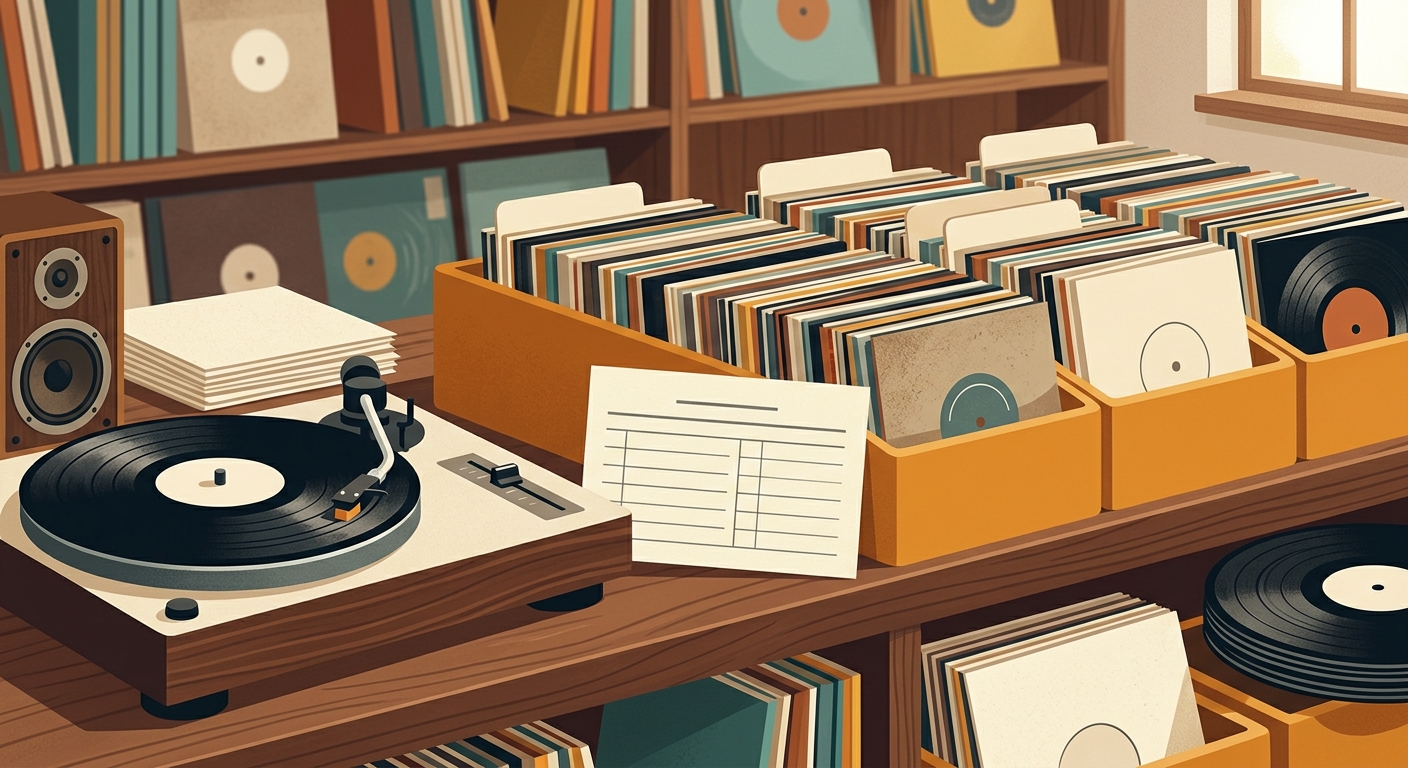
Copy these columns into a spreadsheet, notes app, or collection tool. Keep it simple enough that you will actually update it after a store visit.
| Field | What to track | Example |
|---|---|---|
| Artist and album | The record you want, written clearly | Talk Talk, Spirit of Eden |
| Preferred pressing | Country, year, label, catalog number, or reissue series | UK original, Parlophone, 1988 |
| Format | LP, 2LP, 12-inch single, box set, mono, stereo, colored vinyl | LP, stereo |
| Condition floor | The lowest grade you would accept for media and sleeve | Media VG+, sleeve VG or better |
| Target price | Your realistic buy price before shipping and tax | $35 used, $45 sealed reissue |
| Priority | How badly you want it | 1 = buy on sight, 3 = only if cheap |
| Why I want it | The listening reason, not just the market reason | Late night side-two album, great room record |
| Where to look | Local shops, label store, Discogs, Bandcamp, estate sales | Used bins first, then Discogs |
| Notes | Known issues, mastering preferences, alternate covers | Avoid noisy budget reissues |
The three fields collectors skip, then regret
Preferred pressing is the big one. Many classic albums have dozens, sometimes hundreds, of versions. Discogs maintains monthly public data dumps for releases, artists, labels, and master releases (Discogs Data), and Google search snippets for Discogs' own collecting guides now reference more than 16 million releases in its database. That scale is wonderful for research and brutal for impulse buying. A wishlist entry that says "Blue Note Tone Poet if under $32" is more useful than one that only says "Wayne Shorter album."
Condition floor keeps your budget honest. The Goldmine grading scale uses familiar grades like Mint, Near Mint, Very Good Plus, Very Good, and Good Plus; Goldmine describes eight basic points on that scale (Goldmine Magazine). A VG+ copy may be perfect for a loud punk LP, while a quiet ambient record might need NM media to be satisfying. Write the floor by album, not by ego.
Why I want it sounds soft, but it prevents collector drift. If the reason is "heard it at Chris's house and want that Side A again," you will remember the emotional target. If the reason is only "rare," you may be buying inventory, not music.
A practical priority system
Use a three-level system. Priority 1 records are buy-on-sight if the pressing and condition match your notes. Priority 2 records are worth checking prices before you buy. Priority 3 records are nice to have, which means they should lose to groceries, stylus replacement, and records you will actually play this month.
For target price, track three numbers if you are serious: local price, shipped price, and ceiling price. The ceiling is the number you promise yourself you will not cross after shipping, tax, and the tiny dopamine goblin starts shouting. That goblin has terrible financial judgment.
How to keep the wishlist useful
Review it once a month. Remove records you no longer care about. Move anything you bought into your collection. Update prices when a reissue is announced, when a tour repress appears, or when a local shop starts carrying a label you follow. Discogs' support pages also describe Wantlist and CSV export workflows, so collectors who already use Discogs can periodically export their data and reconcile it against their own spreadsheet or app (Discogs Wantlist help).
If you use What's Spinning, keep the wishlist connected to real listening. The app tracks what you actually play from your turntable, so your future buys can be guided by your habits, not just hype. If your most-played records are quiet jazz, private press folk, and early synth pop, your wishlist should probably reflect that instead of chasing every limited splatter variant that looks good online.
Quick copyable template
Here is the compact version:
- Artist:
- Album:
- Preferred pressing or reissue:
- Format:
- Media condition floor:
- Sleeve condition floor:
- Target price:
- Priority:
- Why I want it:
- Where to look:
- Last checked:
- Notes:
The best wishlist is boring in the right ways. It is specific, current, and grounded in the way you listen. That is what turns a random crate-digging note into a buying system.
FAQ
What should be in a vinyl wishlist template?
At minimum, track artist, album, preferred pressing, condition floor, target price, priority, and notes. If you buy used records often, add catalog number, country, label, and sleeve condition.
Should I track exact pressings or just album titles?
Track exact pressings for records where mastering, packaging, or price varies a lot. For casual wants, an album title is fine, but add a note if there are versions you want to avoid.
What condition should I put on my wishlist?
Use the lowest grade you would still enjoy. For most collectors, VG+ media is a sensible floor for used records, but quieter music may justify holding out for Near Mint.
How often should I update my vinyl wishlist?
Monthly is enough for most collectors. Update sooner if you buy a record, find a new reissue, notice prices changing, or realize you no longer care about an album.
Try What's Spinning Free
Turn your iPad into a live now-playing display. Track every record you spin.
START FREE TRIALThen $4.99/mo or $39.99/yr · Cancel anytime
Get it on your iPhone
Open on iPhone