How to Curate a Themed Vinyl Listening Experience
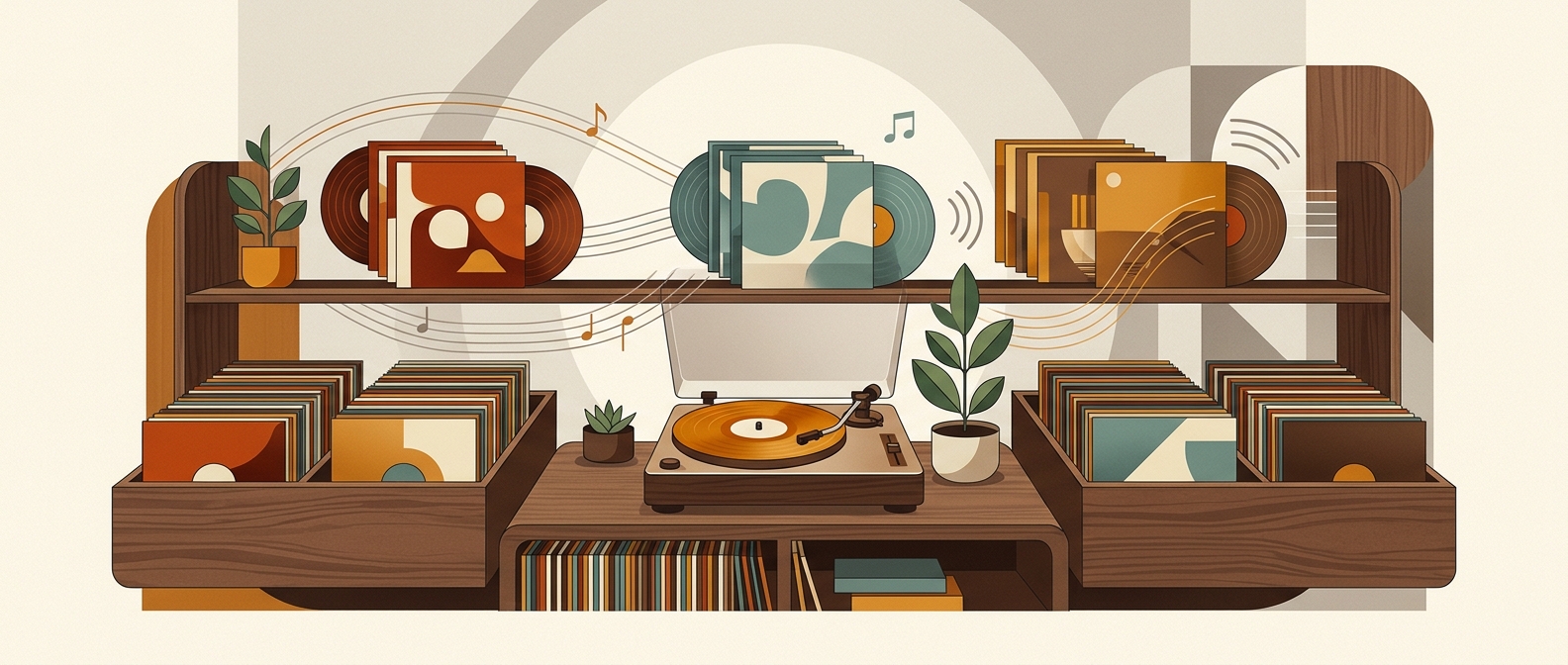
A themed vinyl listening experience turns a stack of records into a programmed evening. You choose a unifying idea, arrange the records for momentum, and make the side changes part of the experience. The theme can be obvious, such as 1970s Philadelphia soul, or personal, such as records inherited from family. If you use What’s Spinning, your own shelves become the starting point rather than an endless streaming catalog.
An LP asks you to hear a fixed sequence, pause at the side break, and make a deliberate choice before the next record. That small amount of friction gives the session shape.
1. Begin with a theme that has a clear boundary
A useful theme should guide your choices but still allow contrast. “Jazz” is too wide for one evening. “Small-group jazz recorded by Rudy Van Gelder in the 1950s and 1960s” suggests a sound, period, and atmosphere. Other frameworks include a city, label, producer, instrument, season, concert memory, or one year across several genres.
Discogs distinguishes broad genres from narrower styles, a helpful model for planning. Start broad, then add one rule. “Electronic music” becomes “ambient records for a winter night.” “Rock” becomes “Manchester albums from 1979 to 1991.” Database fields such as label, year, country, and format offer more routes than genre alone.
2. Choose three to five records with different jobs
For most gatherings, three to five LPs create a satisfying two-to-four-hour arc without turning the evening into an endurance test. Give each selection a role:
- The opener: accessible, inviting, and clear about the theme.
- The deepener: a record that adds history, texture, or a less familiar artist.
- The pivot: a contrasting album that changes tempo, mood, geography, or decade while preserving the central idea.
- The peak: the most energetic, emotionally intense, or sonically impressive choice.
- The closer: something that resolves the mood rather than merely stopping it.
Imagine a “Detroit after dark” session. You might move from Marvin Gaye’s What’s Going On into Donald Byrd’s Places and Spaces, pivot toward a sleek electronic record by Juan Atkins or Model 500, then finish with a spacious Moodymann LP. The styles differ, but the city and the nocturnal atmosphere keep the sequence coherent.
3. Sequence albums by contrast and emotional movement
Great sequencing is not simply putting the quietest album first and the loudest last. Quincy Jones compared sequencing an album to making a movie. On Michael Jackson’s Thriller, he placed “Human Nature” after “Billie Jean” because its harmonic openness released the repetitive intensity of the previous track. Jones and Jackson reportedly considered more than 600 songs before choosing nine.
Apply the same principle at album scale. Listen to the final track on one side and the opening track of the next record. Do they create anticipation, relief, surprise, or an accidental collision? A raw mono soul pressing can sound thrilling after a polished modern reissue, but two similarly compressed, high-energy records may flatten each other.
Abbey Road notes that mastering engineers create cohesion through level, tone, pauses, fades, and transitions. Records from different decades may vary dramatically, so use a side break as a reset. Preserve contrast without forcing guests to reach for the volume control every few minutes.
4. Treat each side as a chapter
Vinyl gives you natural chapter breaks that a digital queue does not. Before the session, note which side endings feel conclusive and which demand that Side B begin immediately. A continuous concept album should usually be played intact. A compilation or dance 12-inch may invite a more modular approach.
You can build a session around one side from several albums. “Tonight we are hearing five great Side Ones” feels intentional, while abandoning albums without explanation feels arbitrary. Place the next sleeve near the turntable so the journey is easy to follow.
5. Prepare the records and playback space
A thoughtful sequence loses its effect when dust or feedback becomes the main event. The Library of Congress recommends handling discs by their edges and label areas, keeping food and drink away, and storing records upright. It notes that grooved discs can weigh more than 35 pounds per shelf-foot, so avoid a precarious stack beside the turntable.
Before guests arrive, remove surface dust with a fine antistatic brush. Ortofon advises brushing a stylus in the direction of the cantilever rather than backward or sideways, and warns against solvents that can damage stylus cement or cartridge components. Confirm the turntable is level, the correct speed is selected, and speakers are not feeding vibration directly into the deck.
6. Add context without turning the evening into a lecture
One memorable fact per record is enough. Mention the studio, producer, local scene, unusual instrument, pressing detail, or connection to the next selection. For a label theme, show how the house musicians or engineers created a recognizable sound. For a single-year theme, explain what changed culturally or technologically across those twelve months.
Invite listeners to respond with a specific prompt: Which transition worked best? Which pressing sounded most different from expectations? What record would extend the theme? Their answers can become the seed for the next session.
7. Save the sequence, then revise it
Afterward, save the order and mark any transition that dragged or record everyone asked about. Discogs supports custom folders and personal notes, so folders such as “Rainy Evening” or “Produced by Quincy Jones” can organize future ideas.
The goal is not a flawless museum presentation. It is a repeatable way to hear familiar records with fresh attention. A strong themed vinyl listening experience makes the connections audible, gives every side a purpose, and leaves one tantalizing path unexplored for next time.
Frequently Asked Questions
How many records should a themed vinyl listening session include?
Three to five LPs works well for most sessions. It provides enough variety for a clear arc while leaving room for conversation, side changes, and an occasional replay. For a focused solo session, two carefully paired albums can be plenty.
Should albums be ordered chronologically or by mood?
Use chronology when the theme is historical, such as the evolution of punk or a label’s changing sound. Use mood when the experience matters more than the timeline. A hybrid approach often works best: begin roughly chronologically, then adjust the order when a musical transition feels stronger.
Can different genres belong in the same themed session?
Yes. A shared city, producer, studio, year, instrument, lyrical subject, or atmosphere can connect records more strongly than genre. Make the link clear and use one contrasting album as a deliberate pivot.
How do I avoid awkward volume changes between records?
Preview the opening track of each album and note major level differences. Place the biggest jump after a side break, lower the amplifier before cueing the next record, and set a comfortable level by ear. Do not assume two pressings of the same album will play at the same apparent loudness.
Sources
- Library of Congress: The Library of Congress Remembers Quincy Jones
- Discogs: Database Guidelines for Genres and Styles
- Discogs: How to Browse and Search the Database
- Abbey Road Studios: What Is Mastering and Why Is It Important?
- Library of Congress: Care, Handling, and Storage of Audio Visual Materials
- Ortofon: Stylus Care
A spreadsheet tracks what you own. What's Spinning identifies what's playing.
On-device vinyl ID logs your listening history automatically. 7-day free trial.
Looking for Shazam for vinyl?
What's Spinning identifies what's playing on your turntable on-device, logs history, and AirPlays now-playing to your TV.
Comparing vinyl ID apps?
Analog requires Discogs and is iPhone-first (iPad coming). What's Spinning works without Discogs on iPhone and iPad with AirPlay.
Try What's Spinning Free
Turn your iPad into a live now-playing display. Track every record you spin.
START FREE TRIALThen $4.99/mo or $39.99/yr · Cancel anytime
Get it on your iPhone
Open on iPhone