The Future of Vinyl Tracking Software: Features Coming Next
Vinyl collecting has outgrown the spreadsheet. The records are physical, but pressing details, play history, value, and loan notes increasingly live in software. That makes the next generation of vinyl tracking less about building a prettier catalog and more about removing work from collecting.
The market is large enough to support that shift. The RIAA reported that U.S. vinyl revenue reached about $1 billion in 2025, up 9.3 percent, marking a nineteenth consecutive year of growth. The United States represented nearly half of global vinyl revenue. The RIAA changed its reporting to wholesale data, so the figure is not directly comparable with older retail-value totals, but collectors clearly need better management tools. RIAA, 2025 Year-End Revenue Report
Tracking will happen while the record plays
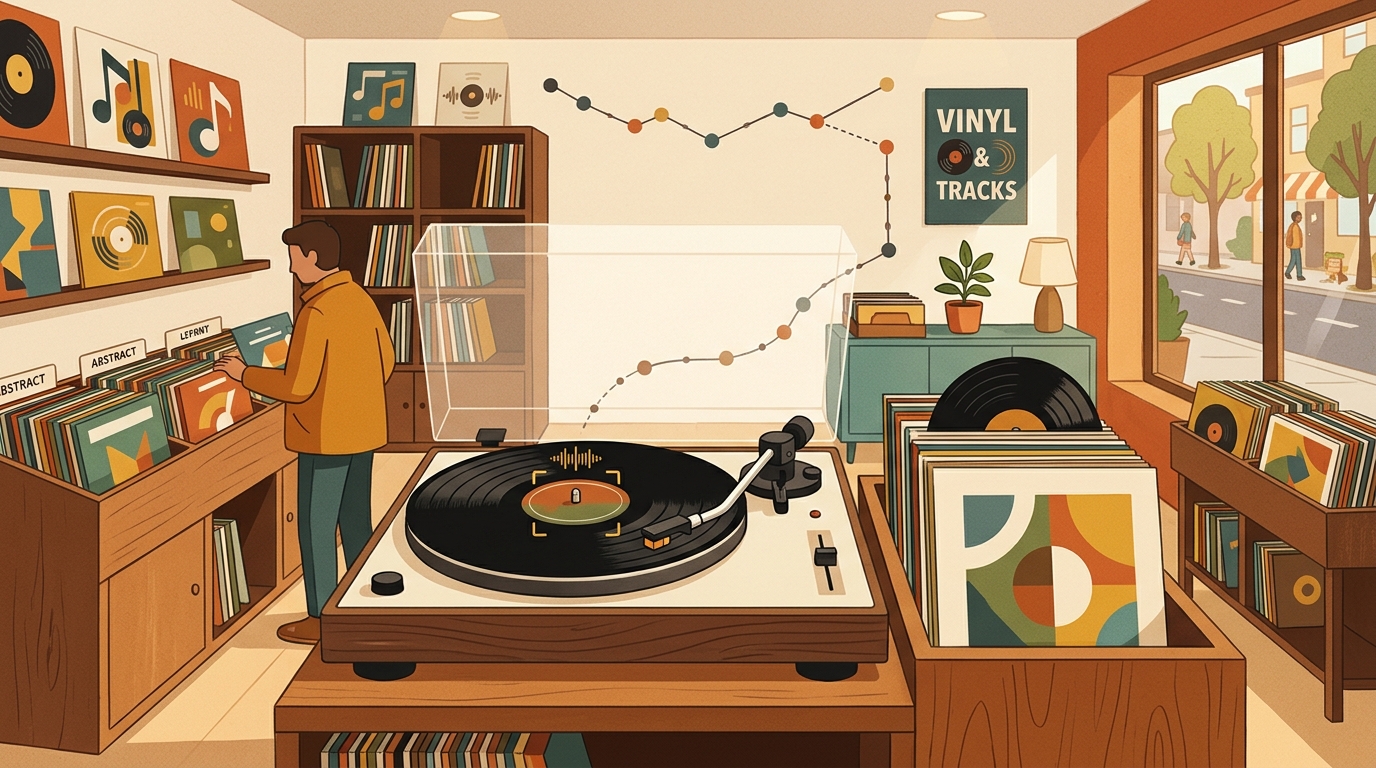
The biggest future feature is also the simplest: less typing. A collector should be able to put on a record and have the software recognize the music, identify the album, start a listening session, and update play history automatically. That turns collection software from a static inventory into a listening journal.
The technical foundation exists. Apple says ShazamKit can match a captured sample against its music catalog or a custom catalog, return song metadata, and locate the match within a recording. Its one-way audio signatures cannot be converted back into the original recording. Custom catalogs can also be matched locally on a device. Apple ShazamKit documentation
For vinyl, the hard part is not merely naming the song. Future systems will need to recognize that a side has ended, distinguish a deliberate replay from a false duplicate, and handle room noise, needle drops, speed changes, and older masterings. When that works reliably, features such as streaks, monthly listening summaries, neglected-record reminders, and accurate favorite-album rankings become nearly effortless. What’s Spinning already points in this direction by listening to the turntable and logging what is playing rather than asking collectors to enter every session manually.
Pressing identification will become multimodal
Barcodes are useful, but they are not enough. Discogs supports barcode scanning in its mobile app, while warning that not every database release includes a barcode. Even when a barcode is present, multiple pressings can share packaging elements or identifiers. Discogs mobile search guide
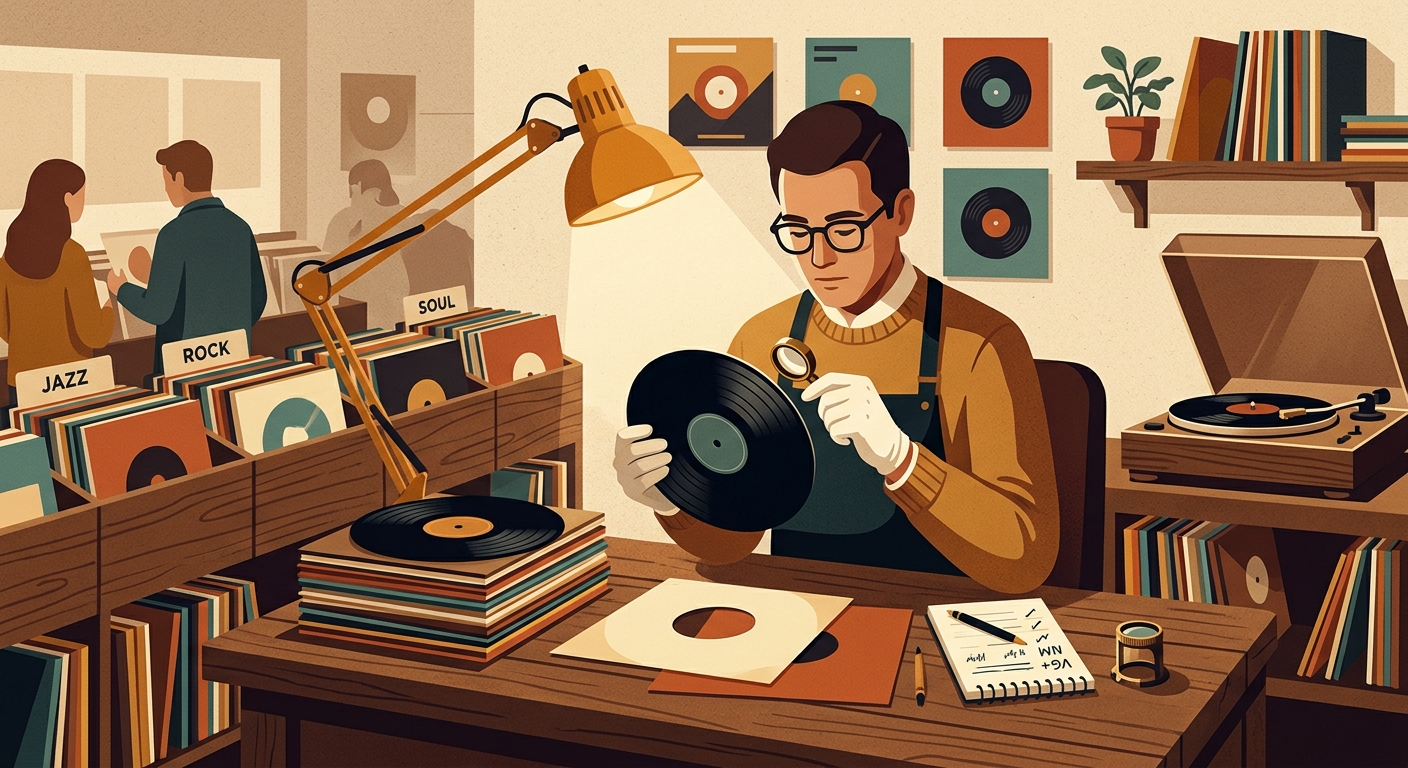
The likely solution is a guided camera workflow that combines several clues: front and back cover art, label design, catalog number, country, vinyl color, and runout markings. Those runouts matter because Discogs defines a matrix number as information etched into the groove area to help identify acetates and stampers. Its guidelines note that runout data can also reveal engineers, studios, manufacturers, and pressing plants. Discogs barcode and identifier guidelines
Camera-based reading is becoming practical on ordinary phones. Google’s ML Kit offers on-device text recognition and can extract structured text from images, although focus, resolution, glare, curved surfaces, and faint handwriting remain serious challenges. Google ML Kit text recognition The best software will not pretend one photograph is infallible. It will rank likely pressings, explain the distinguishing clues, and ask the collector to confirm the uncertain details.
Collections will become active, not archival
Today, many collection tools answer, “Do I own this?” Tomorrow’s software should answer better questions: Which records have I not played in two years? Which albums fit a forty-minute listening window? Do I own duplicate pressings? Which purchases gained or lost value? What should I bring to a listening night?
Expect richer condition histories, purchase receipts, insurance exports, loan tracking, location maps for shelves and crates, and value alerts based on comparable sales rather than a single headline price. Recommendations should also use the collection itself. A useful suggestion engine would understand that owning five Blue Note reissues is different from repeatedly playing them, and that stated condition, pressing quality, and listening behavior all affect what a collector may want next.
Open metadata and portability will matter more
No single database has perfect coverage. MusicBrainz, for example, listed more than 5.8 million releases in October 2026, including over 411,000 12-inch vinyl releases and more than 160,000 7-inch releases. It also exposes release, recording, label, work, disc ID, and collection resources through its web API. MusicBrainz format statistics MusicBrainz API documentation
Future vinyl tracking software will work best when it can reconcile identifiers across open and commercial sources without locking the user into one vendor. Import and export should preserve pressing IDs, custom notes, play history, condition, purchase price, images, and shelf location. A CSV export is a baseline, not a complete portability strategy. Collectors will increasingly expect durable backups and transparent links to the source records used for identification.
Privacy will become a product feature
Automatic listening creates sensitive behavioral data. A play history can reveal when someone is home, daily routines, religious interests, moods, and social habits. Good software should make microphone use visible, capture only what is needed, and let users delete or export their history.
Apple’s ShazamKit guidance recommends recording only as long as necessary, and Apple says audio signatures cannot be inverted. Google’s ML Kit emphasizes on-device processing and offline functionality. Those approaches suggest a strong future pattern: analyze audio and images locally when possible, send compact identifiers rather than raw recordings, and make cloud sync optional or clearly explained. Apple ShazamKit privacy guidance Google ML Kit overview
The winning feature may be confidence, not artificial intelligence
The vinyl tracking software future will certainly use machine learning, but collectors will judge it by trust. A system that confidently assigns the wrong pressing is worse than one that says, “These three editions are likely; photograph the Side B runout to narrow it down.” The strongest products will show their evidence, preserve manual corrections, and separate confirmed facts from estimates.
The goal is not to turn record collecting into database maintenance. It is to let the software handle the clerical work so the collector can keep listening. The closer tracking gets to the natural ritual of choosing a sleeve, lowering the needle, and flipping the record, the more useful it becomes.
Frequently Asked Questions
What features should vinyl tracking software have now?
At minimum, look for pressing-level cataloging, barcode or camera search, collection import and export, custom notes, condition fields, play history, and reliable backups. Automatic now-playing detection is especially useful if you want listening statistics without logging every spin by hand.
Can software identify the exact pressing from the music alone?
Usually not. Audio recognition can identify the song or album, but different pressings often contain substantially the same recording. Exact identification generally requires physical clues such as catalog numbers, labels, country, cover variations, and matrix or runout markings.
Will artificial intelligence replace community-built vinyl databases?
Probably not. AI can speed up image matching, text reading, and candidate ranking, but release databases depend on collector knowledge and physical verification. The more realistic future is AI assisting community data, while users confirm ambiguous pressings and correct mistakes.
Is automatic vinyl listening tracking private?
It depends on the implementation. Prefer software that explains microphone use, processes audio on the device where practical, stores signatures or identifiers instead of raw recordings, and provides controls for history, sharing, export, and deletion.
A spreadsheet tracks what you own. What's Spinning identifies what's playing.
On-device vinyl ID logs your listening history automatically. 7-day free trial.
Looking for Shazam for vinyl?
What's Spinning identifies what's playing on your turntable on-device, logs history, and AirPlays now-playing to your TV.
Comparing vinyl ID apps?
Analog requires Discogs and is iPhone-first (iPad coming). What's Spinning works without Discogs on iPhone and iPad with AirPlay.
Try What's Spinning Free
Turn your iPad into a live now-playing display. Track every record you spin.
START FREE TRIALThen $4.99/mo or $39.99/yr · Cancel anytime
Get it on your iPhone
Open on iPhone