Mastering Vinyl Playback EQ for Different Music Genres
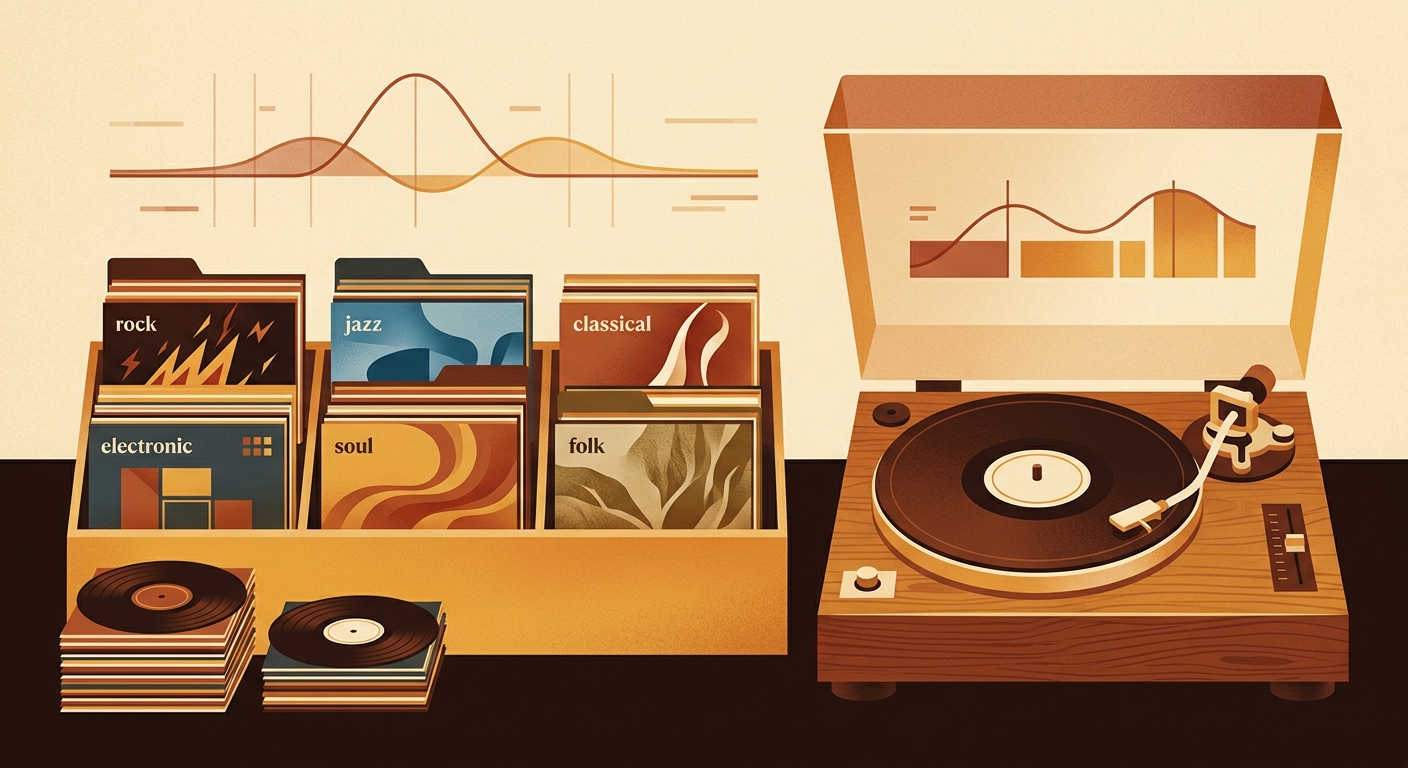
Genre-based EQ can make vinyl playback more satisfying, but the goal is not to repaint every record with a dramatic smile curve. The useful approach is smaller and more disciplined: establish a trustworthy baseline, identify what your room and cartridge are adding, then make gentle changes that suit the production habits of rock, jazz, classical, electronic music, and other styles.
One distinction matters immediately. The phono stage already performs essential playback equalization. Records are cut with bass reduced and treble increased, then the phono preamp applies the inverse curve. An Audio Engineering Society paper on phonograph playback filters explains that the RIAA curve arrived in 1953 and that earlier labels used multiple competing curves. The genre adjustments below are optional tone shaping after correct RIAA playback, not a replacement for it.
Fix the playback chain before touching genre EQ
If every record sounds bright, muddy, or thin, the problem may not be musical taste. A moving-magnet cartridge and phono input form an electrical resonant circuit. Audio-Technica's cartridge glossary notes that load capacitance and impedance affect frequency response, and that manufacturers specify loading values to achieve the most linear result. Before boosting or cutting anything, compare your cartridge's recommended load with the phono stage and include the capacitance of the tonearm cable.
Mechanical matching matters too. Ortofon recommends keeping cartridge and tonearm resonance between 7 and 12 Hz, with 10 Hz as the target. That range sits below most musical bass but above severe record-warp energy. If the arm and cartridge are badly matched, a bass preset can exaggerate a resonance that EQ did not create.
Finally, do not EQ a seating-position problem. Genelec's room-acoustics guide shows that reflections can cancel bass at specific frequencies, and it explicitly warns that equalization does not solve this type of cancellation. Move the speakers or listening chair first. Boosting a deep null often spends amplifier power without restoring the missing note.
A practical method for building vinyl EQ presets
- Start flat. Match the playback volume before comparing settings. Louder usually sounds more exciting, which can make a poor EQ choice seem better.
- Use broad, small moves. Begin with 0.5 to 1 dB. Treat 2 dB as a substantial adjustment. Wide shelves and broad bell filters usually sound more natural than narrow surgical boosts.
- Test several records. A preset earned from one hot remaster may damage five well-balanced pressings. Use three to five familiar albums from different decades.
- Level-match the bypass test. Toggle the EQ on and off at the same perceived loudness. Keep the preset only if the improvement survives that comparison.
- Save by system, not by genre alone. Name a preset "Jazz, living room, VM cartridge," not merely "Jazz." Your speakers, room, and cartridge are part of the setting.
Genre starting points
Rock and metal
For dense guitar records, try a broad 0.5 to 1.5 dB lift around 80 to 100 Hz for kick-drum weight. If distorted guitars become tiring, cut 0.5 to 1.5 dB around 2.5 to 4 kHz. A dull vintage pressing may benefit from a gentle high shelf above 8 kHz, but clean the stylus before assuming the record lacks treble.
Jazz
Acoustic jazz often works best close to flat because tone, room sound, and microphone placement are part of the performance. If the bass feels light, add no more than about 1 dB around 60 to 90 Hz. For a boxy piano or congested small-group recording, try a broad 0.5 to 1 dB cut between 200 and 350 Hz. A subtle lift above 8 kHz can open cymbals, but excessive boost also raises hiss and surface noise.
Classical
Preserve dynamics and resist the urge to make quiet passages constantly impressive. Start flat. If the room adds bloom, reduce 80 to 150 Hz by about 1 dB. Dark orchestral pressings may take a 0.5 dB high shelf from 6 to 10 kHz. Warped discs and large-scale organ or orchestral records also make a subsonic filter useful. SPL notes that RIAA playback amplifies low-frequency turntable rumble, which is why some phono stages provide a switchable filter.
Electronic, dance, and hip-hop
These genres tempt large bass boosts, but vinyl systems can already be vulnerable to low-frequency feedback. Start with a broad 0.5 to 1 dB shelf around 50 to 80 Hz. If the kick and bass line blur together, cut 120 to 250 Hz slightly rather than adding more sub-bass. Watch the woofers between tracks. Large silent pumping points to warp, rumble, or feedback, not useful musical bass.
Soul, funk, and disco
The groove usually lives in the relationship between bass, kick, rhythm guitar, and vocal presence. Try a modest lift around 80 to 120 Hz, then add up to 1 dB around 1.5 to 3 kHz if vocals and guitar need more articulation. Avoid a heavy treble shelf on older copies because it can turn hi-hats, wear, and sibilance into the main event.
Folk, acoustic, and singer-songwriter records
When a close-miked guitar sounds boomy, a broad 0.5 to 1.5 dB cut from 150 to 300 Hz often helps. A small presence lift around 3 to 5 kHz can clarify finger noise and lyrics. If vocal sibilance spikes around 6 to 9 kHz, first check alignment and stylus wear. EQ should not become a disguise for mistracking.
The best preset may still be flat
Well-mastered records should not need genre correction. Think of these settings as diagnostic starting points, not rules. The most valuable preset is often a room correction that stays active for everything, followed by a few gentle taste profiles for difficult pressings. Log the records and settings you actually enjoy in What's Spinning, then revise presets from listening history rather than memory. Small, repeatable changes beat dramatic curves, and the bypass button remains your most honest piece of test equipment.
Frequently asked questions
Should every music genre have its own vinyl EQ preset?
No. Start flat and create a preset only when a repeatable adjustment improves several records in that genre on your system. Pressings, cartridges, speakers, and rooms vary too much for one universal curve.
Where should EQ go in a vinyl playback chain?
Apply optional tone shaping after the phono preamp has performed RIAA playback equalization. A normal line-level EQ, receiver tone control, DSP unit, or powered-speaker app belongs downstream of the phono stage.
Can EQ fix sibilance or inner-groove distortion?
It can soften the symptom, but it cannot repair mistracking. Check stylus condition, alignment, tracking force, anti-skate, and record wear before cutting the treble.
When should I use a subsonic filter?
Use it when warped records or mechanical rumble make woofers pump, or when deep feedback appears at higher volume. A well-designed filter removes energy below the musical bass range while reducing wasted amplifier and speaker movement.
A spreadsheet tracks what you own. What's Spinning identifies what's playing.
On-device vinyl ID logs your listening history automatically. 7-day free trial.
Looking for Shazam for vinyl?
What's Spinning identifies what's playing on your turntable on-device, logs history, and AirPlays now-playing to your TV.
Comparing vinyl ID apps?
Analog requires Discogs and is iPhone-first (iPad coming). What's Spinning works without Discogs on iPhone and iPad with AirPlay.
Try What's Spinning Free
Turn your iPad into a live now-playing display. Track every record you spin.
START FREE TRIALThen $4.99/mo or $39.99/yr · Cancel anytime
Get it on your iPhone
Open on iPhone