Best Vinyl for DJs: A Beginner's Buying Guide
If you are searching for vinyl for djing beginners, the first honest answer is this: you do not need a wall of rare records to learn. You need two reliable decks, a mixer or DJ interface, a small stack of records you know well, and enough patience to practice the physical parts that software usually hides from you. Vinyl DJing is wonderfully direct. The record moves, your hand changes the record, and the room hears the result.
That physical feedback is why vinyl still matters in a streaming world. The RIAA's 2023 year-end report said U.S. LP and EP shipments reached 43.2 million units and $1.35 billion in retail value, with vinyl revenues growing for the seventeenth straight year. In other words, beginners are not learning on a dead format. They are entering a living market with new pressings, used bins, reissues, DJ tools, and plenty of collector competition.
What a beginner vinyl DJ setup actually needs
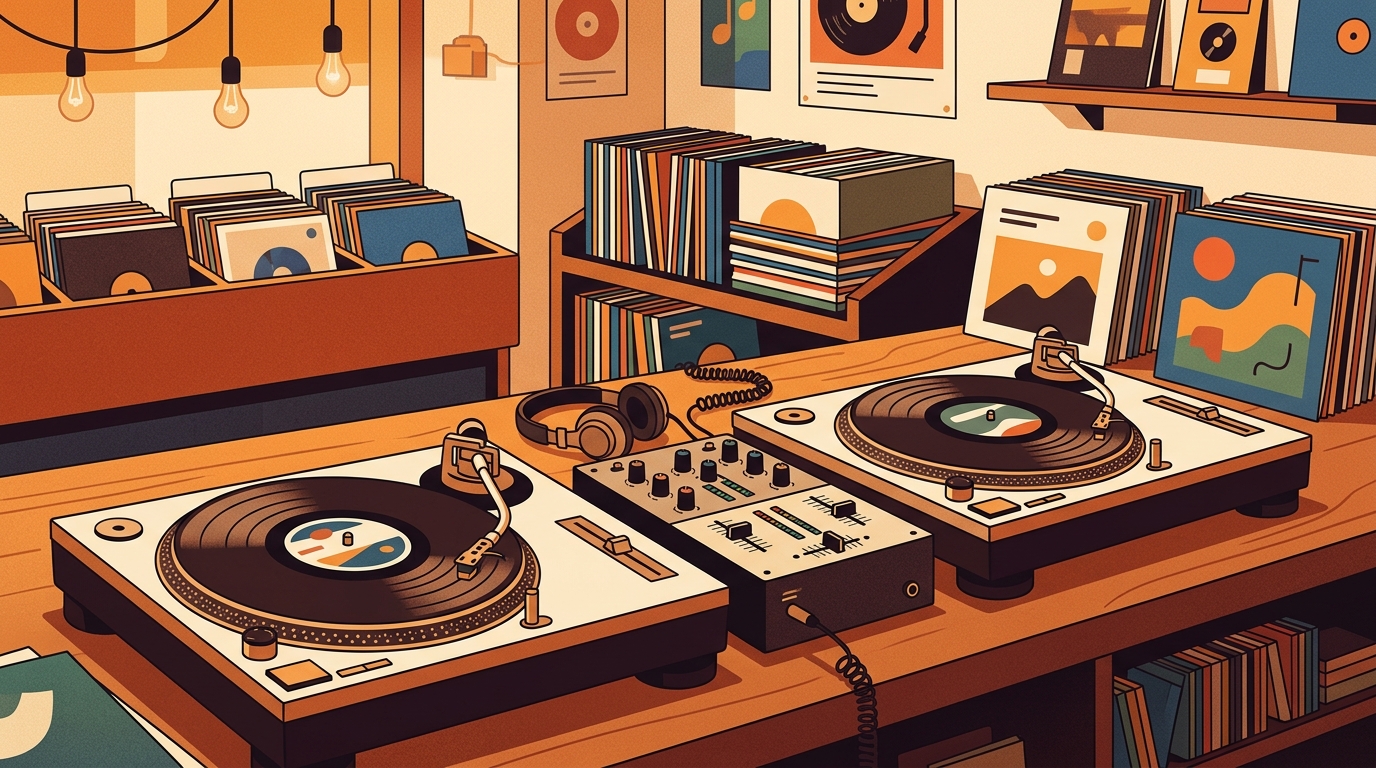
A classic starter setup is simple: two direct-drive turntables, a two-channel mixer, headphones, slipmats, cartridges, and records. Direct drive matters because the platter motor responds quickly when you touch, nudge, stop, or release the record. The Technics SL-1200 family became a DJ reference point for exactly that reason, and the SL-1200MK2, introduced in 1979, is still treated as a design landmark for pitch control and rugged club use. You do not have to buy vintage Technics to begin, but you should understand what that benchmark is teaching you: stability, torque, and a pitch slider are not luxury features for vinyl mixing.
Modern beginner-friendly decks such as the Pioneer DJ PLX-500 follow the same basic idea: direct drive, familiar controls, and a layout designed for mixing rather than casual living-room playback. If your budget is tight, spend less on the record haul and more on a turntable that holds speed accurately. A cheap belt-drive hi-fi deck can play albums beautifully, but it will make beatmatching, cueing, and back-cueing harder than they need to be.
Start with records you can practice on, not trophies
The first records in a beginner DJ crate should be useful, replaceable, and musically familiar. Buy doubles only when you are practicing beat juggling, scratch routines, or old-school hip-hop techniques. For basic beatmatching, you are better off with ten records you genuinely know than fifty impressive titles you barely recognize. House, disco, funk, techno, boogie, hip-hop instrumentals, and 12-inch singles are friendly training material because the grooves tend to give you steady drums, extended intros, and clean mix points.
Use What's Spinning to track what you actually play during practice. That matters because beginner crates can drift toward fantasy fast. Your play history will tell you whether that bargain disco twelve is becoming a workhorse, or whether the expensive reissue is mostly sitting there looking cool. For DJing, the best records are the ones that teach your hands and keep returning to the platter.
Learn the three skills vinyl makes obvious
First, learn cueing. Put the record in your headphones, find the first kick or musical entry point, rock the record gently back and forth, then release it on time. Second, learn pitch. A turntable's pitch slider changes platter speed, so you match tempo by ear instead of by reading a BPM display. Third, learn touch. Small nudges on the spindle, platter, or record edge can pull a track into time; heavy-handed moves sound like panic.
This is also where digital vinyl systems can help without removing the vinyl feel. The Mixxx manual explains that DVS uses timecode records on real turntables, then software reads that signal to control digital files. A typical vinyl control setup still needs two to four turntables, timecode vinyl, phono preamps or line-level outputs, and matching audio inputs. That is useful if you want the feel of records while practicing with a larger digital library, but it is not simpler than learning with real records. It is a hybrid path, not a shortcut.
How to buy beginner DJ vinyl wisely
When shopping, inspect condition more aggressively than a home listener might. Surface noise is annoying in a listening chair, but cue burn, skips, and groove wear are brutal in a mix. Check the lead-in groove, the first minute of each side, and any loud visible scratches. For dance records, look for 12-inch singles where one or two tracks get more groove space per side. They are often louder, easier to cue, and built for club use.
Do not ignore sleeves and labels, either. A plain black sleeve may be fine, but handwritten BPM notes, radio-station stickers, promo stamps, and worn center holes tell you how the record lived. None of those details automatically make a record bad. They help you price risk. For beginners, a clean, common pressing beats a rare record you are afraid to touch.
A practical first-month practice plan
Week one: cue records and start them on the one without touching the pitch slider. Week two: choose two records with similar tempos and practice holding a blend for 16 or 32 bars. Week three: record a 20-minute mix, then listen back without mercy. Week four: add one harder record, maybe a live-drum funk cut or a breakbeat track with a less rigid grid. That is where vinyl becomes a teacher. It exposes timing, phrasing, record condition, and confidence all at once.
The deeper point is that vinyl DJing makes music collecting active. You are not only asking, "Do I like this album?" You are asking, "Can I find the intro, trust the pressing, hear the tempo, and make this record speak to another record?" That is why beginners should start small, practice often, and build a crate around records they can use with their hands, not just admire on a shelf.
FAQ
How many records do I need to start DJing with vinyl?
You can start practicing with 10 to 20 records if they have steady tempos and clear intros. A small, familiar crate is better than a large random one because beginner progress depends on repetition.
Should beginner DJs buy new vinyl or used vinyl?
Both work. New reissues are safer for condition, while used 12-inch singles can be cheaper and more DJ-friendly. Inspect used records carefully for skips, cue burn, warped edges, and worn center holes.
Is DVS better than real vinyl for beginners?
DVS is great if you want turntable feel with a digital library, but it adds audio-interface and software setup. Real vinyl is simpler conceptually, while DVS is more flexible once configured.
What turntable feature matters most for learning to mix?
Choose a direct-drive turntable with stable speed and a usable pitch slider. Those features make beatmatching, cueing, and recovery much easier than learning on a belt-drive hi-fi deck.
A spreadsheet tracks what you own. What's Spinning identifies what's playing.
On-device vinyl ID logs your listening history automatically. 7-day free trial.
Looking for Shazam for vinyl?
What's Spinning identifies what's playing on your turntable on-device, logs history, and AirPlays now-playing to your TV.
Comparing vinyl ID apps?
Analog requires Discogs and is iPhone-first (iPad coming). What's Spinning works without Discogs on iPhone and iPad with AirPlay.
Try What's Spinning Free
Turn your iPad into a live now-playing display. Track every record you spin.
START FREE TRIALThen $4.99/mo or $39.99/yr · Cancel anytime