Vinyl for DJing Beginners: A Practical Guide to Your First Real Set
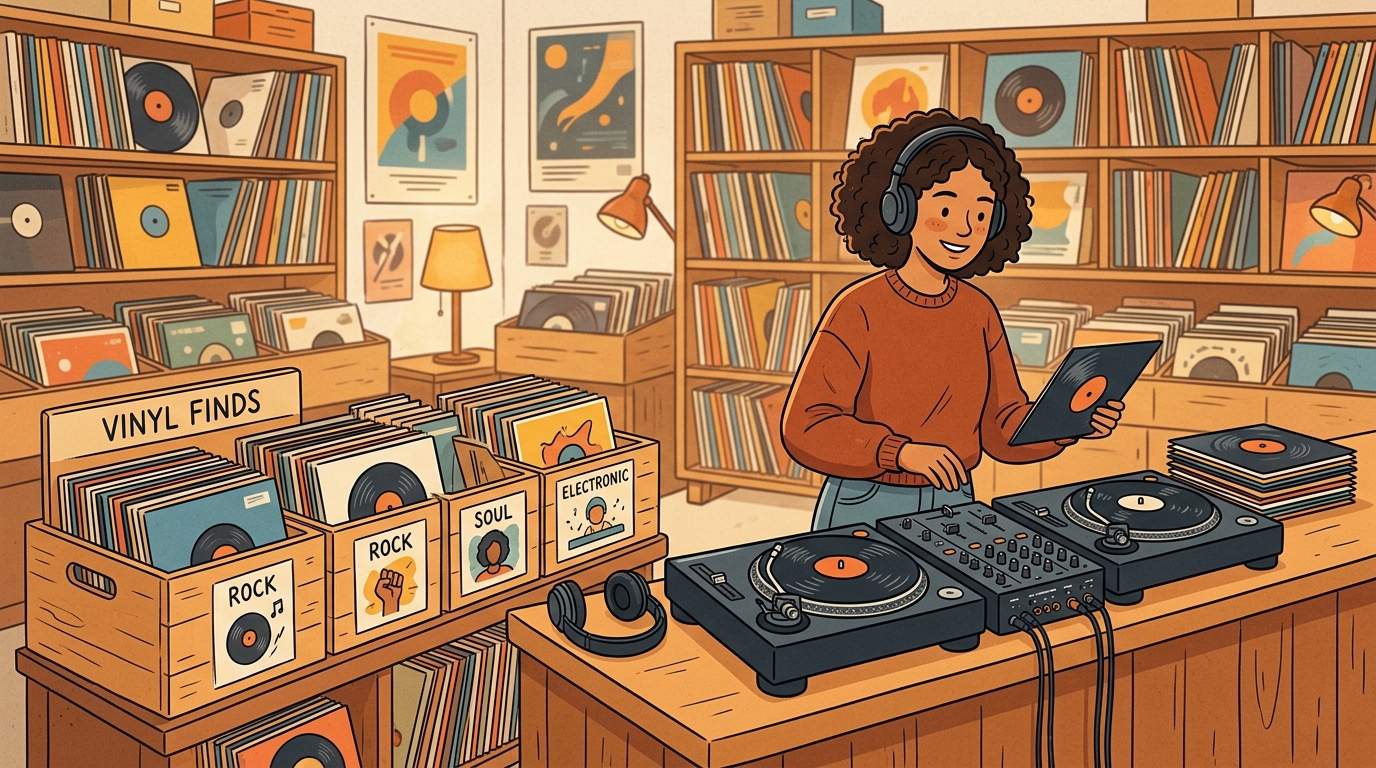
If you are searching for vinyl for DJing beginners, start with this reassuring truth: you do not need a collector's trophy room to play your first set. You need two stable decks, a mixer that accepts phono inputs, a handful of compatible records, and enough patience to let your ears replace the visual grid you may know from digital DJing.
Vinyl is tactile. You touch the record edge, catch the first kick in your headphones, release on the bar, and correct drift by feel. That friction is why many DJs still love it. It teaches timing, phrasing, selection, and restraint, which are useful skills even if you later play CDJs or a controller.
The wider vinyl market is healthy enough that beginners have real choice. RIAA reported U.S. vinyl revenue grew 10% in 2023 to $1.4 billion, the format's seventeenth straight year of growth, and vinyl albums outsold CDs in units, 43 million versus 37 million.RIAA That does not make every pressing a smart buy, but it does mean record shops, marketplaces, and reissue labels are active.
Buy DJ turntables, not just record players
For DJing, choose direct drive turntables. Belt drive decks can be lovely for listening, but DJing asks for torque, quick recovery, and predictable pitch control while you cue and nudge records. Gear4music's beginner guide says a vinyl DJ setup needs direct drive turntables, pitch faders, adjustable tonearms, counterweights, DJ cartridges, slipmats, headphones, and a mixer with phono inputs.Gear4music
The historic reference point is the Technics SL-1200. Technics says the original SL-1200 arrived in 1972 with a rugged die-cast cabinet and a direct drive system that reached rated speed in half a turn. The SL-1200MK2 later added quartz lock and a fader-style pitch controller after Technics studied how club DJs were using decks as musical instruments.Technics You do not have to start with Technics, but you should buy decks designed around the same DJ requirements.
A simple beginner rig is enough: two direct drive decks, a two-channel mixer, DJ cartridges and styli, felt slipmats, closed-back headphones, and speakers placed far enough from the decks to avoid feedback. If you are buying used, check that the pitch controls respond smoothly, the tonearms balance correctly, and the RCA cables are not noisy.
Set up the decks before judging your skill
Many beginner mistakes are setup problems in disguise. Level both turntables, attach ground wires, connect turntables to phono inputs, and make sure any phono/line switches are correct. AlphaTheta's PLX-500 support material covers the same essentials: balance and height-adjust the tonearm, set stylus pressure for the cartridge, adjust anti-skating, connect to a mixer or speakers, and practice with the pitch controls.AlphaTheta
Tracking force should come from the cartridge maker. Ortofon explains that DJ cartridges have both a tracking force range and a recommended value, and that going outside the range can cause unwanted operation. For DJ use, Ortofon recommends anti-skating at 0 because back-cueing asks the stylus to follow the groove whether the record moves forward or backward.Ortofon
Choose records that help you learn
Your first crate should be practical, not impressive. Buy six to ten records in one style and a close tempo range. House around 120 to 130 BPM is forgiving because the kick drum is steady, and Gear4music notes that 120 to 135 BPM house records are easier for beginners to distinguish by ear.Gear4music Disco edits, techno tools, hip-hop instrumentals, and drum-heavy 12-inch singles can also work if they have clean intros.
Avoid the trap of buying twenty unrelated favorites. Your goal is to understand how two records fit together. Look for playable condition, clear structure, and enough intro or outro time to mix. Discogs reported more than 11 million vinyl records sold through its marketplace in 2023, with vinyl remaining its most popular physical format, so there is plenty to dig through.Discogs A used VG+ 12-inch you can practice with is often a better beginner purchase than a rare LP you are afraid to touch.
This is also where What's Spinning is useful. Because it listens to your turntable and logs what you play automatically, your practice history becomes visible. Over time you can see which records you actually use, which pairings keep returning, and which purchases looked exciting in the shop but never make it into a set.
Practice the core vinyl move
Play track A through the speakers. Cue track B in your headphones and find the first clean downbeat. Rock the record gently against the slipmat, release it on the first beat of a bar, then use the pitch fader to make track B faster or slower. If the beats drift, use tiny fingertip nudges on the record edge or platter. ZIPDJ describes the same beginner sequence: choose compatible records, cue the first beat, release on the bar, adjust pitch, then blend with volume, crossfader, and EQ.ZIPDJ
Keep sessions short and specific. Spend ten minutes catching the first beat, ten matching two records, and ten making clean EQ handoffs. Record yourself. The playback will reveal rushed blends, clashing basslines, and the occasional surprisingly clean transition you missed in the moment.
Beginner mistakes to avoid
- Buying turntables with no pitch control or adjustable tonearm.
- Using rubber mats instead of slipmats.
- Plugging phono and line signals into the wrong inputs.
- Practicing with records from unrelated tempos and styles.
- Making huge hand corrections when a light nudge would fix the drift.
FAQ
How much does it cost to start DJing with vinyl?
Costs vary by used market, but the must-haves are two direct drive turntables, a basic mixer, cartridges, headphones, and starter records. Spend on reliable decks and fresh styli before cosmetic upgrades.
Can I learn vinyl DJing with one turntable?
You can learn handling, cueing, pitch control, and bar counting with one deck, but real beatmatching needs two playback sources. A hybrid setup with one turntable and one digital deck can help.
Are belt drive turntables okay for vinyl DJ beginners?
They are fine for listening, but poor for DJ practice. Direct drive decks are the standard because they offer torque, start-up speed, and stable cueing.
What records should a beginner vinyl DJ buy first?
Buy records in one style and tempo range, preferably with clear drums and usable intros. House, disco edits, techno, and hip-hop instrumentals are strong starting points.
Try What's Spinning Free
Turn your iPad into a live now-playing display. Track every record you spin.
START FREE TRIALThen $4.99/mo or $39.99/yr · Cancel anytime