Vinyl Records for Focus Work Music: A Productivity Guide
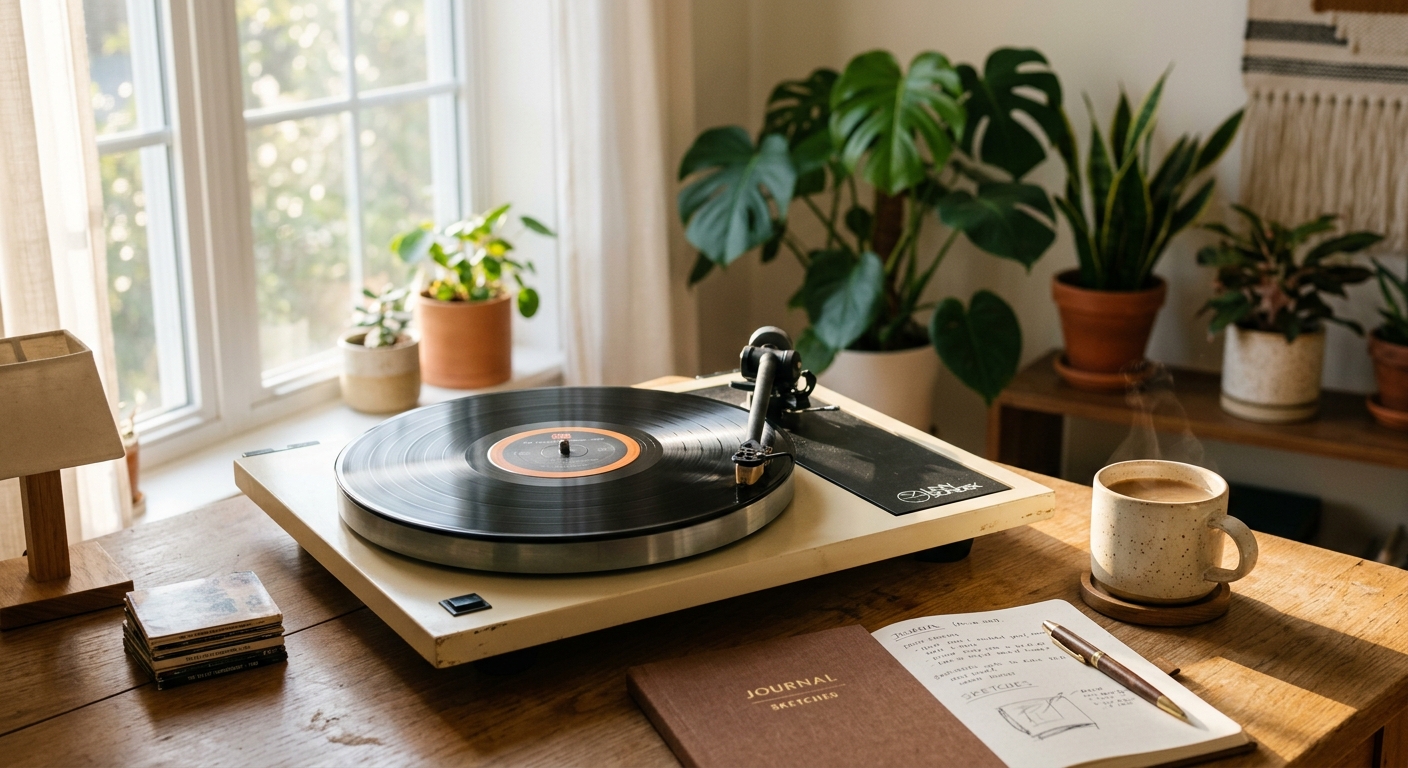
Most people hear "lo-fi beats to study to" and think of a Spotify playlist. But the original lo-fi-the intentional pursuit of calm focus through recorded music-has a far older home. Long before study-girl YouTube loops, vinyl collectors built their workdays around album sides, side flips, and the ritual of putting on a record when they sat down to concentrate. Today the vinyl market is bigger than it has been in decades, RIAA reported $1.4 billion in U.S. vinyl revenue for 2024, with 44 million vinyl units outselling CDs for the third year in a row. Some of that audience is rediscovering the format's quietest use case: vinyl records for focus work music.
Why vinyl works differently than a streaming playlist for focus
A focus playlist optimized by an algorithm is engineered to never break your attention. That sounds like a benefit. In practice it removes friction to the point of frictionlessness itself, which research on listening and task performance has begun to study more carefully. Maria Witek and colleagues at the University of Turku looked into what they call "sensorimotor coupling"-the way listeners physically move along with a regular groove, tapping, nodding, or even bobbing-and reported that audiences tap more accurately with more syncopated, uneven rhythms but enjoy the music more with simpler, more regular grooves. That last category, the regular, predictable groove, is exactly what most people describe as "focus music." So the same property that makes background music feel pleasant is partly what makes a record feel physically pulling you into a rhythm.
Three mechanisms appear to explain why a vinyl record often outperforms a randomized stream during deep work:
- Album-length commitment. A 20-35 minute side gives you a defined sprint. When the run-out groove begins to scratch, that is your cue to stand up, stretch, or close the laptop.
- Forced curation. Picking the record is the setup. Once a side is down, the algorithm cannot change it. You are listening to what you chose, not what the data suggests is most likely to keep you on the platform.
- Side-flip rhythm. A vinyl record also builds the workday around two distinct blocks of sound, which is a natural pacing device between focused output and short breaks.
Best instrumental vinyl albums for deep work
British GQ's October 2025 guide to instrumental albums put it bluntly: instrumental records "work nicely as functional music" because they contain no lyrics pulling attention toward a vocal line. The genres that dominate this list (ambient, post-rock, jazz, electronic, and modern classical) also happen to have unusually strong vinyl pressings right now. Here is a working library broken down by the kind of focus it tends to support.
Ambient and modern classical for sustained concentration
Brian Eno's Music for Airports is the obvious starting point. Pressings on vinyl tend to favor the 1978 Ambient series from Editions EG, but a 2024 reissue from UMR keeps the supply steady. Ryuichi Sakamoto's async (Milan, 2017) and 12 (2023, recorded in the final months of his life and released on 12-inch and double-LP) are the strongest recent additions. Max Richter's Sleep (Deutsche Grammophon, 2015) was built for eight-hour durational playback; if your focus blocks are short, a highlights edit works better. Ludovido Einaudi's solo piano work has remained a default study-and-work listen for two decades; Underwater (2022, Decca) and The Summer Portraits (2024, Decca) are the most recent and easiest to find on vinyl.
Jazz and ambient jazz for analytical thinking
Discogs' recent ambient jazz guide highlights the lineage stretching from Alice Coltrane's Journey in Satchidananda (1971, Impulse!) through Harold Budd's The Pavilion of Dreams (1978, Obscure) into the contemporary ECM catalog and beyond. For deep work that is less rhythmic and more texture-driven, ECM records remain hard to beat. Keith Jarrett's The Koln Concert (ECM, 1975) is a single 66-minute solo piano improvisation that frequently surfaces as a top study album. Pat Metheny's Offramp (1982, ECM) and his collaborations with Lyle Mays sit at the meeting point of jazz, post-rock, and ambient that often produces the best concentration music. Bill Evans' Conversations With Myself (1963, Riverside) layers overdubbed solo piano in a way that invites your attention without demanding it.
Modern ambient, post-rock, and electronic for code and writing
Aphex Twin's Selected Ambient Works Volume II (1994, R&S / 2014 Warp reissue) is the canonical "deep work" record of the last 30 years. Tim Hecker's Ravedeath, 1972 (Kranky, 2011) and Virgins (Kranky, 2013) share the same slow-evolving texture. Tycho's Dive (Ghostly International, 2011) and Awake (2014) are among the most-played records in home-office setups. Boards of Canada's Music Has the Right to Children (Warp, 1998) is radio-ready analogue ambience that never gets annoying. Bonobo's Migration (2017, Ninja Tune) and The North Borders (Ninja Tune, 2013) make great record-side companions for sustained writing.
Setting up a turntable for work sessions
If vinyl is going to work as a focus tool, the setup has to be quiet enough that you can leave it in the room while on a video call.
- Belt-drive over direct-drive if you can avoid skipping. Belt-drive tables like the Pro-Ject T1, Rega Planar 1, or Fluance RT85 run quieter than most direct-drive DJ tables at the same price. They are also easier on the ear at low volumes.
- Isolation platform. A foam mat or, better, a wall-mounted shelf, stops low-frequency thump from transmitting into the floor. The single biggest change in any home-office turntable setup is decoupled isolation.
- Headshell weight and cartridge matching. A heavier headshell paired with a compliant MM (moving magnet) cartridge is easier on warped or dusty pressings than a low-compliance MC (moving coil) setup. Fewer audible skips during work hours means fewer interruptions.
- Track your sessions. If your goal is to use vinyl as work music, knowing what played matters. A simple now-playing view paired with a collection tracker turns a side-flip ritual into a record of which albums actually got you through which project. Pairing the experience with a digital log keeps the analog ritual but solves the "what was playing during that proposal I wrote" question that comes up months later.
The case against vinyl for focus
Honesty matters. Vinyl is not the right tool for every kind of focus work.
- Calls and meetings. Vinyl surface noise, clicks, and pops transmit through open mics. A quiet playlist is better in shared meeting rooms.
- Multi-task days. If your work hours swing between five-minute tasks and ninety-minute ones, a streaming playlist with instant access is faster. The vinyl ritual costs 30-90 seconds per side change plus the initial setup, which kills the value for shallow tasks.
- Shared spaces. A 3 a.m. study session in an apartment building is not the place for vinyl. Choose headphones, neighbors.
Frequently asked questions
What kind of music is best for focus work on vinyl?
Instrumental records with steady rhythms and minimal lyrics work best because the words do not compete with the language centers of your brain. Ambient, modern classical, jazz (especially ambient jazz), slow post-rock, and instrumentals built around long-form textures are good starting points. Lyric-heavy albums pull attention toward vocal lines, which makes them a poor choice when you are reading, writing, or coding.
Is vinyl actually better than a focus playlist?
For some people in some workflows, yes. The album-length commitment, forced curation, and side-flip rhythm create natural pacing that a 200-track playlist cannot replicate. The trade-off is friction: every change requires standing up and physically flipping a side. If you find the act of putting on a record relaxing in itself, vinyl is likely a better focus tool for you. If you find it annoying, an unlimited streaming focus list will suit you better.
Do I need to clean records before a focus session?
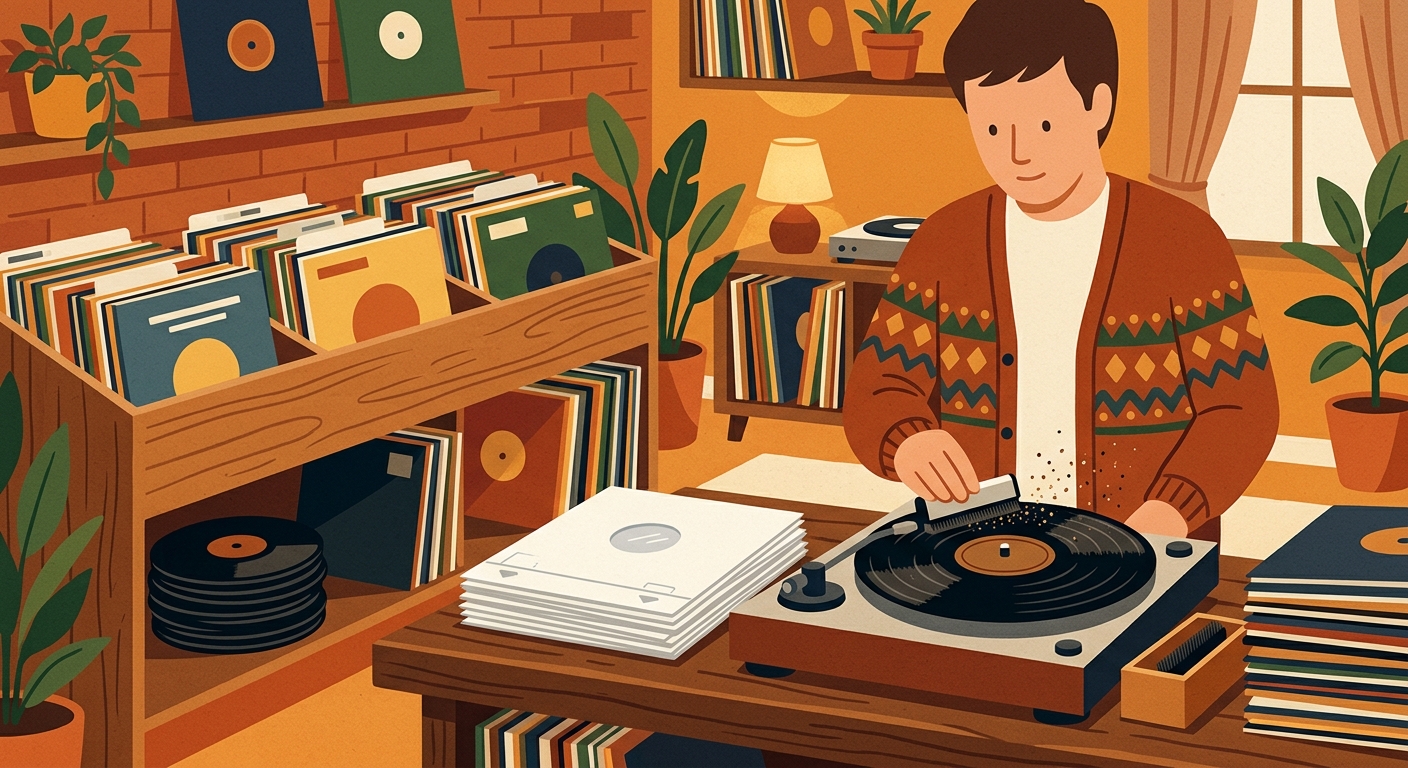
Cleaning is good practice regardless. A clean record reproduces quieter surface noise and lets you run the volume lower, which is easier on a long workday. A simple carbon-fiber anti-static brush before each side is a five-second habit that prevents most audible pops. A deep clean with a record washer or ultrasonic is best done weekly.
Does the RIAA 2024 vinyl sales data support using vinyl for work?
The RIAA's 2024 year-end report shows $1.4 billion in U.S. vinyl revenue and 44 million vinyl units sold, outselling CDs for the third year in a row. That numbers-up environment means more new pressings of focus-friendly genres: ambient reissues, modern classical, jazz reissues, and audiophile-grade instrumental cuts are all easier to find in 2025 than at any point in the last 15 years. The supply side of the equation is in the collector's favor.
How long does a side of vinyl typically play?
A 12-inch LP at 33 1/3 RPM holds roughly 22 minutes per side, give or take a few minutes for quiet classical cuts. A 7-inch single at 45 RPM holds 5-7 minutes per side. A 10-inch record falls in between at roughly 12-15 minutes. For 90-minute deep work blocks, plan on a side-and-flip halfway through or queue two records. Many collectors find that one side of a focused album plus a short stretch of quiet at the desk is the natural end of a focus block.
If you have a stack of records you keep meaning to listen to and a project that needs your attention this afternoon, consider this a friendly nudge. Pick one of the albums above, clean a side, drop the needle, and time the side. The music has been waiting 50 years. The work probably only needs 22 minutes to start.
A spreadsheet tracks what you own. What's Spinning identifies what's playing.
On-device vinyl ID logs your listening history automatically. 7-day free trial.
Looking for Shazam for vinyl?
What's Spinning identifies what's playing on your turntable on-device, logs history, and AirPlays now-playing to your TV.
Comparing vinyl ID apps?
Analog requires Discogs and is iPhone-first (iPad coming). What's Spinning works without Discogs on iPhone and iPad with AirPlay.
Try What's Spinning Free
Turn your iPad into a live now-playing display. Track every record you spin.
START FREE TRIALThen $4.99/mo or $39.99/yr · Cancel anytime
Get it on your iPhone
Open on iPhone