Vinyl vs CD Collection in 2024: Which Format Wins for Collectors?
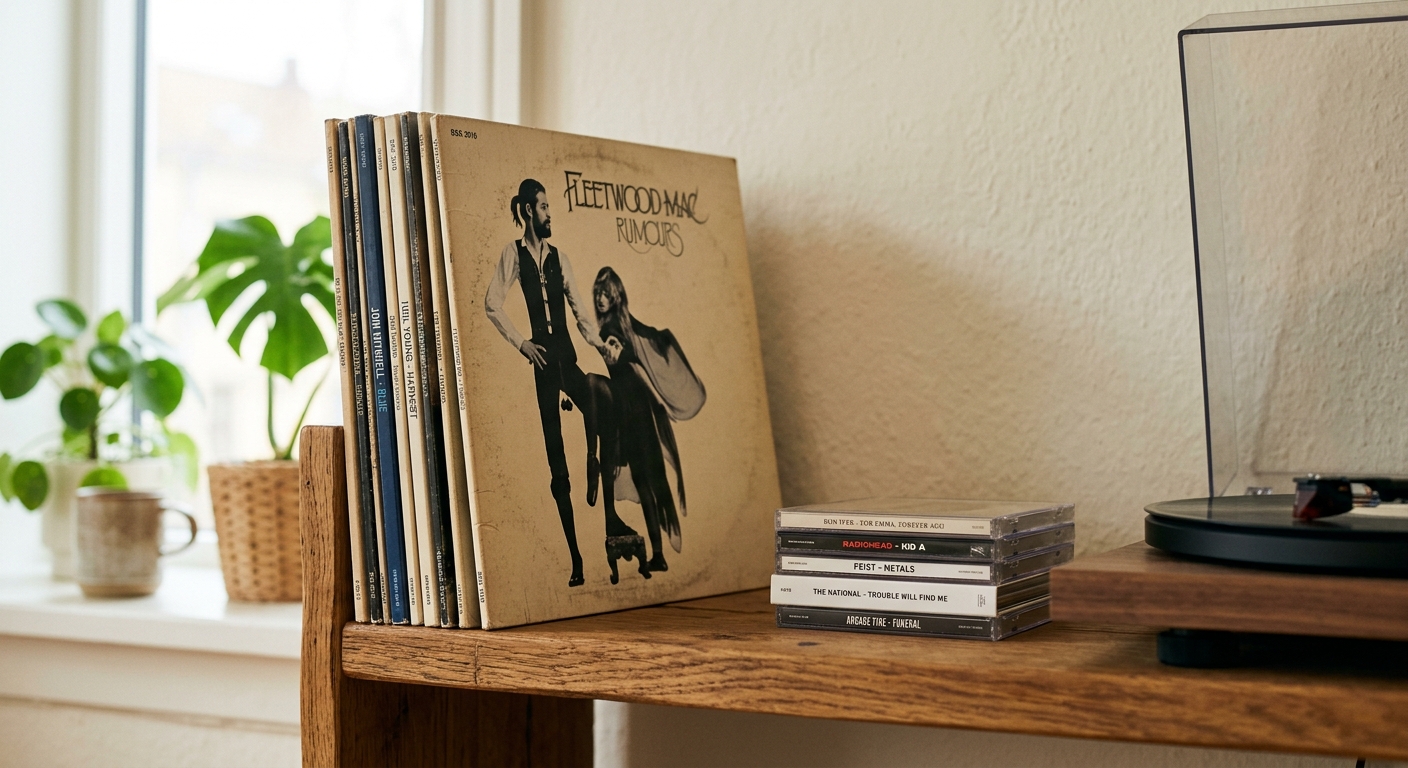
Vinyl and CD collections are not in a fair fight in 2024. They share a shelf, a generation of listeners, and most of the same albums, but they are answering very different questions for the people who still buy them. Vinyl is the format you collect to feel something. CD is the format you collect to keep something. If you are deciding which one to invest in this year, the honest answer comes from the numbers, the listening habits, and what you expect to do with the shelf ten years from now.
The headline is familiar by now. The RIAA reported that US recorded music revenue reached $17.7 billion in 2024 at estimated retail value, the ninth straight year of growth. Within that total, physical formats kept their quiet rebound going. Total physical revenue grew 5 percent to $2 billion. Vinyl grew 7 percent to $1.4 billion, the eighteenth consecutive year of growth, and accounted for nearly three quarters of all physical format revenue. CDs grew a more modest 1 percent to $541 million. For the third year in a row, vinyl outsold CDs in units, 44 million versus 33 million. RIAA 2024 year-end revenue report The gap is widening, but CDs are not collapsing.
1. Revenue and units: vinyl is winning the bigger game
Vinyl sold 44 million units and generated $1.4 billion in 2024. CDs sold 33 million units and generated $541 million. Per unit, that works out to about $33 for an LP and about $16 for a CD. The price gap is partly about format cost, but mostly about what each format is being used for.
Vinyl's higher per-unit price reflects two structural changes. New vinyl releases are increasingly priced as deluxe or collector editions, with multiple color variants, heavyweight 180-gram pressings, and album artwork printed on heavyweight stock. CDs are still sold as functional copies, often bundled with digital download codes that compete directly with streaming subscriptions. The market has split into two distinct products, even when the underlying music is identical.
The mid-year 2024 numbers told a slightly different story. Vinyl revenue grew 17 percent in the first half of 2024 versus the same period in 2023, the fastest growth of any major format, while CD units actually grew 3.3 percent in the same window. Digital Music News on H1 2024 vinyl growth The mid-year bump was driven by new release cycles and tour merchandise tie-ins, not by people rediscovering vinyl for the first time. CD growth was modest but real, mostly from older buyers replacing damaged copies and from new box-set editions priced above the CD standard tier.
2. Sound quality: the honest answer
Vinyl and CD measure sound quality very differently, and the listening experience is shaped by which tradeoffs bother you more.
CDs play back at a fixed 16-bit, 44.1 kHz sample rate, well above the limit of human hearing for frequency response and well within the threshold of perceptible distortion for a properly mastered recording. The signal chain is digital end-to-end. A clean CD on a clean player produces essentially the same audio every time.
Vinyl is a mechanical analog medium. The cutting lathe etches a continuous groove, the stylus traces that groove, and the resulting electrical signal is amplified and sent to the speakers. The same album sounds subtly different depending on the pressing quality, the cartridge tracking force, the VTA adjustment, and the cleanliness of the record. A well-cut, well-played LP can sound remarkably wide and physical. A worn or poorly cut LP can sound harsh on the high end and collapsed on the low end.
Most published listening tests do not show a clear audibility preference for vinyl over CD at matched volume. The differences that do show up are usually small, repeatable, and tied to mastering rather than format. A badly mastered CD sounds worse than a well-cut LP. A badly cut LP sounds worse than a well-mastered CD. The format itself is rarely the deciding factor. If you care about sound quality above everything else, the question is which format is most likely to be well-mastered for the albums you want to own, not which format is theoretically more accurate.
3. Storage and physical footprint
A vinyl record is roughly twelve inches square, weighs about a quarter pound in its jacket, and needs vertical storage with a sturdy shelf. A CD is five inches square, weighs about an ounce with its jewel case, and fits on a standard bookshelf with books.
For roughly the same number of albums, vinyl takes up about three times the linear shelf footage and roughly ten times the weight. A 200-record collection takes a Kallax 2x2 cube and weighs around 70 pounds. A 200-CD collection fits on three feet of linear shelf and weighs around 12 pounds. Both formats require climate control to stay in good shape, but vinyl is more sensitive to heat, warping, and sleeve wear.
If you live in a small apartment or plan to move often, the math favors CDs heavily. A vinyl collection is a moving expense. A CD collection is a couple of banker's boxes.
4. Resale and collector value
This is where vinyl and CD diverge most sharply, and it is the reason a lot of collectors end up owning both formats.
Vinyl has held its resale market better than CDs over the past decade. Original pressings of classic albums, limited run color variants, and box sets from active artists routinely sell for more than their original retail price on the secondary market. Discogs reported more than 9.5 million records for sale on its marketplace in 2024, and its annual State of the Discogs report documented average sale prices above the original retail tier for several major artists. Discogs marketplace Vinyl is not a guaranteed investment, but it is a liquid collector market with documented pricing.
CDs have a much smaller resale market. Most used CDs sell for between $1 and $5 regardless of era, with rare Japanese imports, limited box sets, and out-of-print audiophile editions (Mobile Fidelity, DCC, XRCD) being the main exceptions. The CD market exists, but it is dominated by casual buyers replacing lost copies rather than collectors seeking specific pressings. If you care about resale value, vinyl is the only one of the two with a functioning secondary market.
5. Collecting behavior: who is buying each format
Vinyl buyers in 2024 skew young. According to multiple industry surveys, a meaningful share of new vinyl buyers are under 35 and do not own a CD player at all. They buy vinyl as a way to support artists, own a tangible object, and experience music outside the streaming ecosystem. The CD buyer base skews older, often collects as a complement to a streaming subscription, and tends to replace physical copies they already own rather than discover new music.
This split explains why vinyl revenue keeps growing while CD revenue stays roughly flat. Vinyl is acquiring new collectors. CDs are holding the existing ones. If you are starting a collection in 2024, vinyl is the format where the next ten years of growth are likely to happen. If you are preserving a collection you have already built, CDs remain a stable, durable choice.
6. Which format wins in 2024
It depends on what you mean by winning.
Vinyl wins on revenue, growth rate, collector experience, artwork, and resale value. It is also the format that artists and labels are investing in, with new releases routinely pressed on heavyweight vinyl and often skipped on CD altogether. A pure collector who wants to engage with the format, attend record fairs, and feel ownership of their library should be buying vinyl in 2024.
CDs win on price, storage, portability, and durability. A $15 CD plays anywhere with a digital optical drive, fits in a small bag, and lasts decades with minimal care. A $33 LP needs a turntable, a room to put the turntable in, a sturdy shelf, and thirty minutes of cleaning if you have not played it in a while. For casual listeners and people who want a low-friction physical library, CDs still make sense in 2024.
The honest answer is that most active collectors in 2024 end up with both formats. Vinyl for the albums they want to feel. CDs for the albums they want to keep. Streaming for everything else.
FAQ
Is vinyl really outselling CDs in 2024?
Yes. The RIAA reported 44 million vinyl units sold versus 33 million CD units in 2024, the third consecutive year vinyl has outsold CDs in units. Vinyl also outsells CDs in revenue, $1.4 billion versus $541 million in 2024, by a wider margin than in units.
Is vinyl a good investment in 2024?
Vinyl holds resale value better than CDs, with documented collector markets on Discogs, eBay, and Goldmine. Original pressings and limited variants can appreciate. Most reissues and standard editions do not appreciate meaningfully. Treat vinyl as a hobby that recoups some of its cost, not as a financial instrument.
Should I start a CD collection in 2024?
If you want a low-cost physical library, do not have space for vinyl, or already own a CD player, yes. CDs remain durable, cheap on the used market, and stable in price. They are not the growth format, but they are still a working format.
What about streaming versus vinyl or CD?
Streaming dominates revenue, generating $14.9 billion in the US in 2024, roughly 84 percent of recorded music revenue. Vinyl and CD are physical formats for people who want to own their music. They are complements to streaming, not replacements, for most collectors.
Which format sounds better, vinyl or CD?
A well-mastered CD on a clean player sounds clean and consistent. A well-cut LP on a properly set up turntable sounds wider and more physical. The differences are small compared to mastering and system quality. Most collectors end up choosing based on ritual and ownership, not measurable audio quality.
A spreadsheet tracks what you own. What's Spinning identifies what's playing.
On-device vinyl ID logs your listening history automatically. 7-day free trial.
Looking for Shazam for vinyl?
What's Spinning identifies what's playing on your turntable on-device, logs history, and AirPlays now-playing to your TV.
Comparing vinyl ID apps?
Analog requires Discogs and is iPhone-first (iPad coming). What's Spinning works without Discogs on iPhone and iPad with AirPlay.
Try What's Spinning Free
Turn your iPad into a live now-playing display. Track every record you spin.
START FREE TRIALThen $4.99/mo or $39.99/yr · Cancel anytime
Get it on your iPhone
Open on iPhone