Best Budget Turntables Under $200 for New Collectors (2026 Guide)
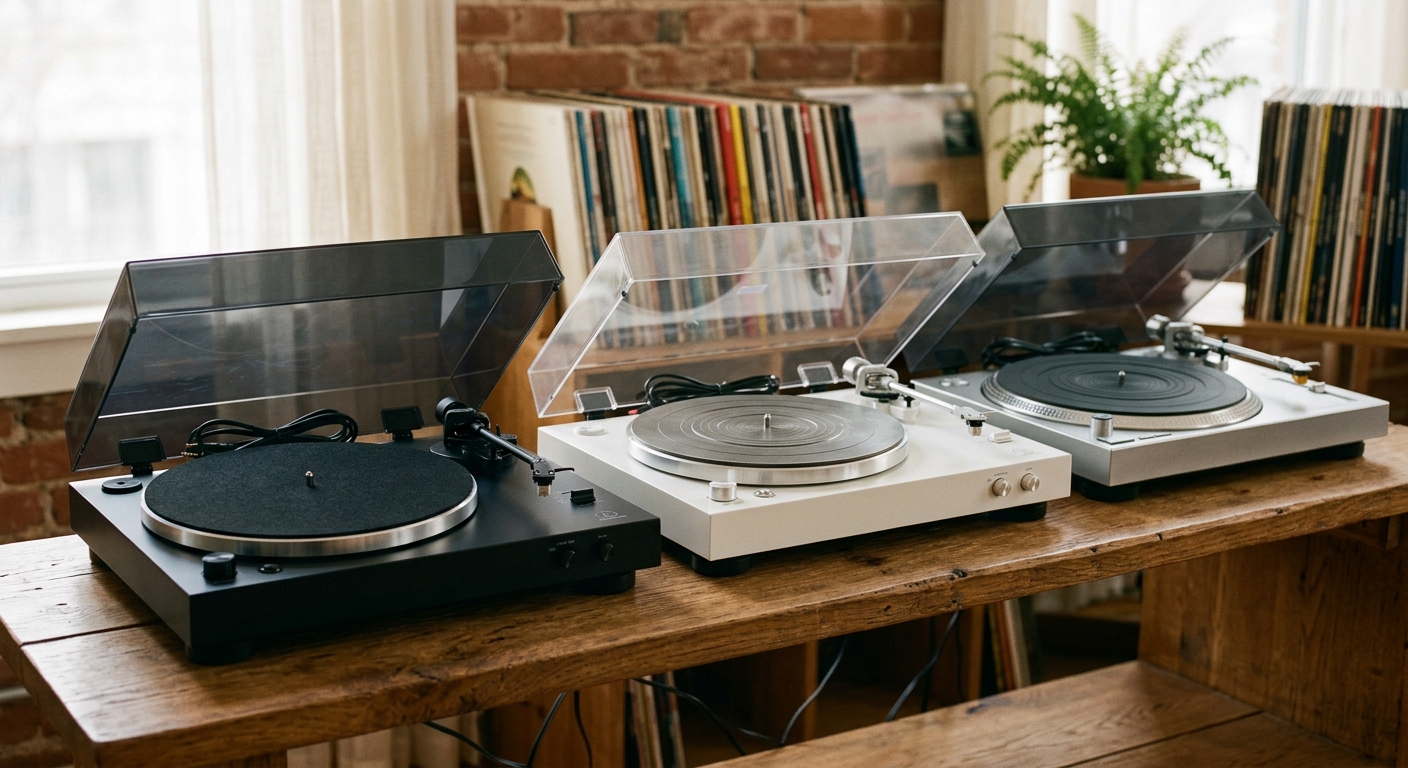
Spending under $200 on your first turntable does not mean accepting bad sound. The current sub-$200 bracket is the most competitive it has been in decades, and the four models below all share the same core engineering decisions that matter for a new collector: a belt-drive motor (quieter than direct drive), a moving-magnet cartridge with a replaceable stylus (so you are not throwing the table away when the needle wears out), and a built-in switchable phono preamp (so you can plug straight into any powered speaker or receiver without buying extra gear).
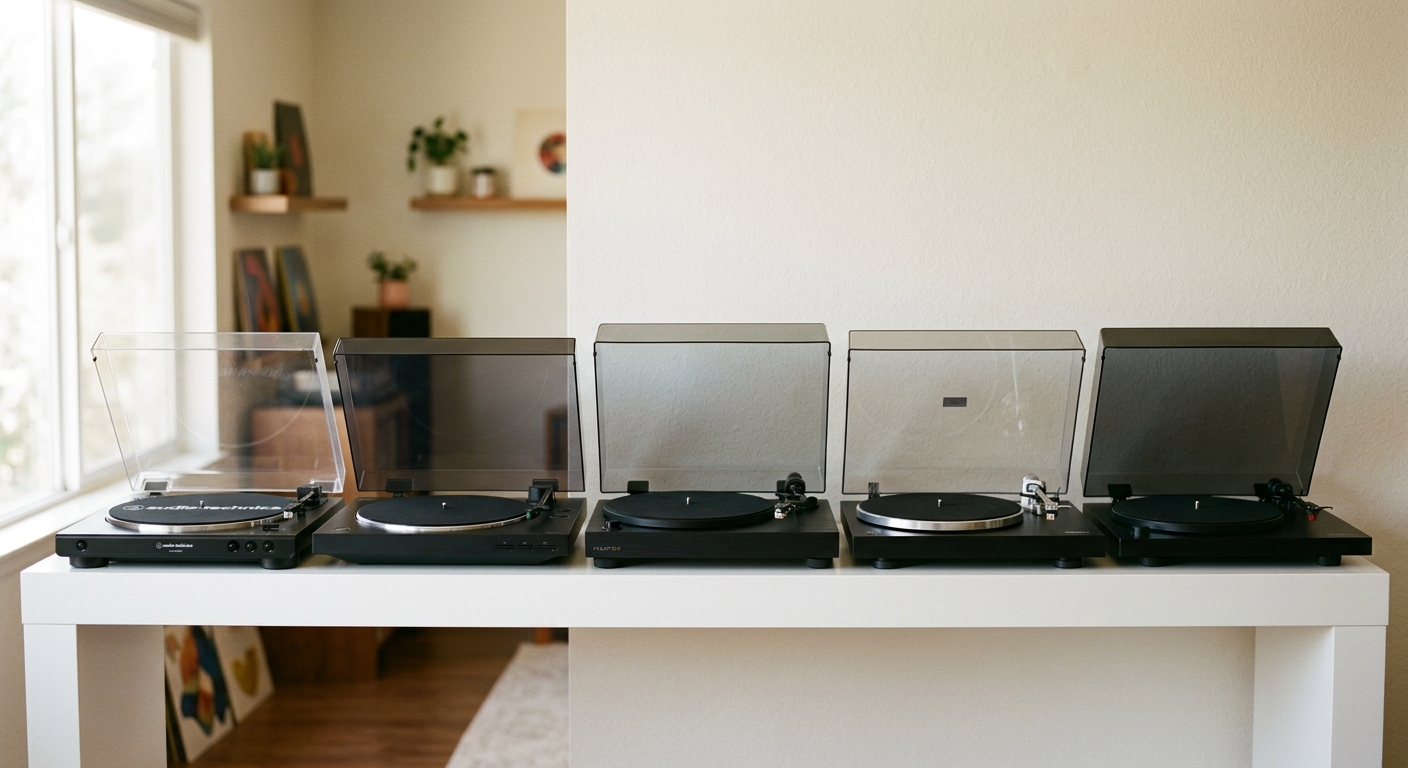
This guide compares four specific models available right now under $200: the Audio-Technica AT-LP60X ($199), the Sony PS-LX310BT ($198 street), the Crosley C6 ($199), and the Insignia NS-BTST21 ($149). All four are belt-drive, all four include a built-in phono preamp, and all four are aimed at the same buyer: someone who owns a small stack of records, has a pair of powered bookshelf speakers or a basic stereo receiver, and wants a deck that will sound good out of the box without forcing them to learn cartridge alignment in week one.
At a glance
| Model | Price | Drive | Cartridge | Bluetooth | Wow & Flutter | S/N Ratio |
|---|---|---|---|---|---|---|
| Audio-Technica AT-LP60X | $199 | Belt | AT-3600L (MM, replaceable) | No | <0.25% | >50 dB |
| Sony PS-LX310BT | $198 | Belt | ATN-3600L (MM, replaceable) | Yes (SBC / aptX) | 0.1% | >50 dB |
| Crosley C6 | $199 | Belt | Audio-Technica AT-91R (MM, upgradeable) | No | 0.15% | 72 dB |
| Insignia NS-BTST21 | $149 | Belt | Audio-Technica AT-3600L (MM, replaceable) | Yes (transmit) | 0.15% | 55 dB |
Audio-Technica AT-LP60X ($199) - the safe default
The AT-LP60X is the turntable most reviewers and most record-store staff will point you toward first, and the reason is consistency: it has been in production since 2018, has gone through two revisions, and Audio-Technica has shipped hundreds of thousands of them. The deck you buy today is the same deck you can get repaired or find parts for in 2030.
The headline spec is the integral Dual Magnet phono cartridge with a replaceable diamond stylus (the ATN3600LC, about $30 to replace). That replaceable stylus matters more than any of the spec-sheet numbers: every cartridge stylus wears out after roughly 1,000 hours of play, and on a fixed-stylus table that means buying a whole new turntable. On the AT-LP60X you pop a $30 stylus into the existing headshell and keep playing.
Operation is fully automatic. Press Start, the tonearm lifts, swings out over the record, lowers into the lead-in groove, and at the end of the side lifts and returns to its rest. That is genuinely useful for someone who has never touched a turntable before and is nervous about dropping the needle. It also means you cannot manually cue the needle mid-side if you want to skip a track on a 1970s pressing that does not have the standard track spacing.
The AT-LP60X has no Bluetooth and no USB output. Audio-Technica sells a separate Bluetooth version (the AT-LP60XBT) for about $50 more. If you plan to run wired RCA into powered speakers or a receiver, the wired LP60X is the right pick.
Who it is for
Someone buying their first turntable, who already owns powered speakers or a receiver, and who wants the safest possible buy: long production run, abundant replacement parts, the most online documentation of any sub-$200 table.
Sony PS-LX310BT ($198 street) - the Bluetooth pick
The PS-LX310BT is Sony's current sub-$200 entry, and the case for it over the AT-LP60X comes down to two features: Bluetooth audio output and a tighter speed spec.
The Bluetooth transmitter supports both the standard SBC codec and Qualcomm's aptX, which preserves more high-frequency detail than SBC when paired with compatible headphones or speakers. For someone whose only listening setup is a pair of wireless headphones or a single Bluetooth speaker on a shelf, this is the model that just works - no extra wires, no separate phono stage, no analog cables running across the room.
Wow and flutter is rated at 0.1%, against 0.25% on the AT-LP60X. Wow and flutter measures how accurately the platter spins: lower is better, and 0.1% is genuinely excellent for the price. Audible wow on a poorly calibrated table sounds like a warbling pitch; on a 0.1% table it is inaudible on any record you would actually own.
Like the LP60X, the PS-LX310BT is fully automatic. The cartridge is Sony-branded but built around the same ATN-3600L stylus as the AT-LP60X, which means the same replacement stylus fits both tables and you can find it in stock at any turntable shop.
Who it is for
Someone whose listening setup is wireless headphones or a Bluetooth speaker, and who wants the most accurate speed stability in this price bracket.
Crosley C6 ($199) - the upgrade path
Crosley has spent a decade building a reputation around suitcase turntables, and the C6 is the company's attempt to break out of that mold and compete in the same bracket as the AT-LP60X. The C6 is the only table in this comparison with an adjustable counterweight on the tonearm, which is a much bigger deal than it sounds.
Tracking force is the downward pressure the cartridge stylus exerts on the record groove. Too little force and the stylus skips out of the groove; too much force and you wear out both the stylus and the record faster than you should. On a fixed-tracking-force table like the LP60X or PS-LX310BT, the manufacturer has set the force in the factory and you cannot change it. On the C6 you dial the counterweight to the exact figure the cartridge manufacturer recommends (typically 2.0 to 2.5 grams for the included Audio-Technica AT-91R), which both sounds better and is gentler on your vinyl.
The C6 also ships with the Audio-Technica AT-91R cartridge, which is the same cartridge that Audio-Technica bundles on its own step-up AT-LP120X and which has a well-known upgrade path (the AT-VM95E elliptical stylus drops in for about $60 and is a clear improvement). The C6 is the only table in this comparison that you can meaningfully upgrade without replacing.
The trade-off: no Bluetooth, no automatic operation (manual cueing only), and Crosley's quality control has historically been more variable than Audio-Technica's. If you buy from a retailer with a generous return policy (Amazon, Crutchfield, Sweetwater all qualify), the C6 is a genuinely interesting alternative.
Who it is for
Someone who wants a turntable they can grow with - who plans to upgrade the stylus in a year, possibly the cartridge later, and who wants adjustable tracking force from day one.
Insignia NS-BTST21 ($149) - the budget pick
The NS-BTST21 is the cheapest deck in this comparison and the only one that comes in at under $150 new. It is also the only one with Bluetooth that can transmit to a wireless speaker or pair of headphones.
The spec sheet is not exciting: 0.15% wow and flutter, 55 dB signal-to-noise, a plastic chassis, the same AT-3600L cartridge as the LP60X. But the practical reality is that for someone whose entire budget for a turntable is $150 and who has no powered speakers on hand, the NS-BTST21 + a $60 pair of powered Edifier speakers is a $210 complete starter system. The same setup with the AT-LP60X costs $260 once you add speakers, and with the PS-LX310BT costs $260.
The catch is real, though: the NS-BTST21 is the only deck in this comparison with no documented upgrade path, the lowest signal-to-noise ratio, and the most plastic in the chassis. It is a turntable to learn on, not a turntable to keep for ten years.
Who it is for
Someone whose total starter budget is around $200, who needs Bluetooth to a wireless speaker, and who is buying a turntable to decide whether they actually like vinyl before investing more.
What to look for in any sub-$200 turntable
Beyond the four models above, the specs that actually matter when you are shopping in this price bracket:
Belt drive vs direct drive. Belt drive uses a rubber belt to spin the platter, which decouples the motor's vibration from the record. Direct drive spins the platter directly off the motor. Direct drive is what DJ booths use (instant start, fast reverse), but for home listening belt drive gives you a quieter background. Every table in this comparison is belt drive.
Replaceable stylus. Every moving-magnet cartridge stylus wears out. If the stylus is not replaceable, you throw the table away when it wears out. On every table in this comparison the stylus is replaceable, and on three of the four the replacement stylus is the same $30 ATN3600LC.
Built-in switchable phono preamp. A phono preamp boosts the very weak signal a turntable cartridge puts out and applies the RIAA equalization curve. Without one, you need a separate phono stage or a receiver with a PHONO input. Every table in this comparison has a built-in switchable phono preamp, so you can plug directly into any LINE-level input on powered speakers, a soundbar, or a receiver.
Wow and flutter under 0.25%. Wow and flutter measures how accurately the platter spins. Above 0.25% you start to hear audible pitch warble on sustained notes. Every table in this comparison is at or under 0.25%.
Bluetooth is optional, not essential. Bluetooth output is convenient, but Bluetooth adds latency, compresses the audio, and means the analog output of the turntable is not what you are listening to. If you already have wired powered speakers, skip Bluetooth and put the savings into better speakers.
Frequently asked questions
Do I need a receiver?
No. All four turntables in this guide have a built-in switchable phono preamp. Plug the RCA cables straight into any powered speaker (Edifier R1280T, Audioengine A2+, Kanto YU2) or any receiver with a LINE / AUX input. You only need a separate phono preamp or a PHONO-input receiver if you turn off the built-in preamp, which is an advanced option that beginners should not touch.
Do I need to buy speakers separately?
Yes. None of these turntables include speakers. Budget $60 to $200 for a pair of powered bookshelf speakers - the Edifier R1280T at $100 is the most common pairing in this bracket.
Can I digitize my records with any of these?
Only if you buy a USB-output model separately. None of the four above have a built-in USB output for recording. The step-up Audio-Technica AT-LP120XUSB at $349 has USB, but at that price you are no longer in the sub-$200 bracket. Software like Audacity (free) handles the recording side once you have the hardware.
How long will the stylus last?
A moving-magnet stylus like the AT-3600L is rated for approximately 1,000 hours of play. If you play one side of a record per day, that is roughly five years. Replacement styli cost $25 to $35 and take about 30 seconds to swap.
Is Bluetooth audio quality good enough?
For casual listening through headphones or a single speaker, yes. For critical listening through a real stereo, no. The SBC Bluetooth codec adds noticeable compression in the high frequencies. If you care about sound quality, run the RCA cables.
Which one would you actually buy?
If you already own powered speakers or a receiver, the Audio-Technica AT-LP60X. If you only have Bluetooth headphones or a Bluetooth speaker, the Sony PS-LX310BT. If you want to upgrade the cartridge later, the Crosley C6. If your total budget is $150 and you are still deciding whether you like vinyl, the Insignia NS-BTST21.
A spreadsheet tracks what you own. What's Spinning identifies what's playing.
On-device vinyl ID logs your listening history automatically. 7-day free trial.
Looking for Shazam for vinyl?
What's Spinning identifies what's playing on your turntable on-device, logs history, and AirPlays now-playing to your TV.
Comparing vinyl ID apps?
Analog requires Discogs and is iPhone-first (iPad coming). What's Spinning works without Discogs on iPhone and iPad with AirPlay.
Try What's Spinning Free
Turn your iPad into a live now-playing display. Track every record you spin.
START FREE TRIALThen $4.99/mo or $39.99/yr · Cancel anytime