Vinyl vs Streaming Sound Quality: The Debate
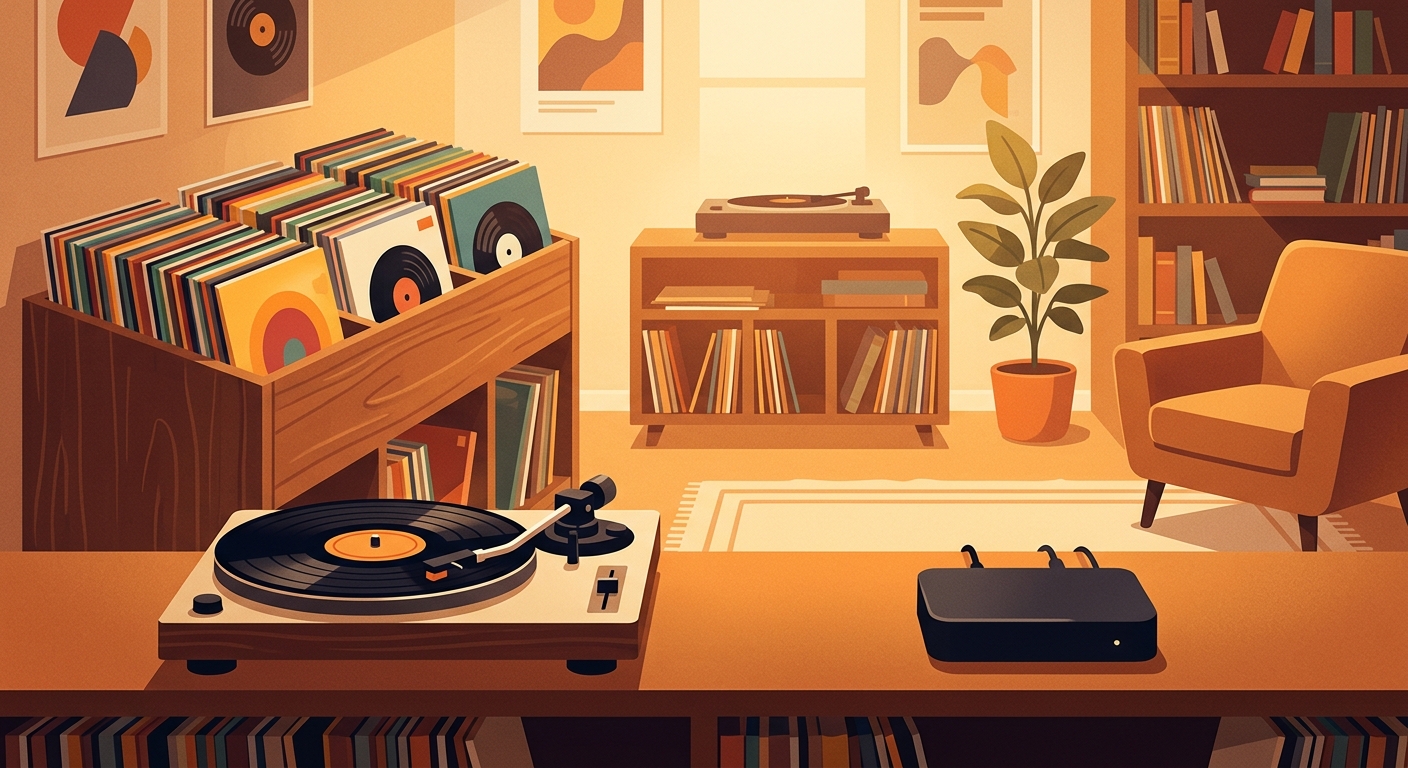
The debate over vinyl vs streaming sound quality usually starts with a simple question: which one sounds better? The useful answer is not tribal. Vinyl and streaming can both sound excellent, but they are excellent in different ways. Vinyl is a physical playback chain, shaped by the record, stylus, cartridge, tonearm, phono preamp, and pressing quality. Streaming is a delivery system, shaped by codec, subscription tier, master, device settings, and the DAC at the end.
That is why two listeners can argue about the same album and both have a point. A clean, well-mastered LP on a properly aligned turntable can feel warm, big, and dimensional. A lossless stream of the same master through a good DAC can be quieter, more accurate, and more consistent. The real question is not which format wins forever. It is what each format does before the music reaches your speakers.
The case for vinyl
Vinyl stores sound as a physical groove. The stylus traces that groove in real time, and the result depends on dozens of mechanical details: record cleanliness, pressing quality, stylus shape, tracking force, cartridge alignment, platter speed, and even where the track sits on the side. Inner-groove distortion is real because the groove passes the stylus more slowly near the label than at the outside edge.
Vinyl also brings surface noise, occasional pops, rumble, channel crosstalk, and wear. Those are measurable flaws. Still, many collectors hear them as part of the medium's character, especially when the record is clean and the system is dialed in. Vinyl also changes behavior. You choose a side, commit to an album, and listen with fewer taps and fewer skips.
The format's comeback is not imaginary. The RIAA reported that in 2023, U.S. vinyl albums outsold CDs for the second time since 1987, with 43 million vinyl units versus 37 million CDs. Vinyl revenue reached about $1.4 billion, compared with $537 million for CDs, while all physical formats reached $1.9 billion (RIAA 2023 year-end revenue report).
The case for streaming
Streaming wins on consistency, access, and technical cleanliness. Spotify's highest Premium quality is approximately 320 kbps, a lossy setting that can still sound very good in normal listening (Spotify audio quality support). Apple Music offers Lossless up to 24-bit/48 kHz and Hi-Res Lossless up to 24-bit/192 kHz, although Apple notes that hi-res playback needs compatible external hardware (Apple Support on lossless audio). Qobuz also offers lossless FLAC and hi-res streaming up to 24-bit/192 kHz (Qobuz audio quality guide).
In measurable terms, a good lossless stream has advantages vinyl cannot match. A CD-quality 16-bit/44.1 kHz file already covers the conventional range of human hearing, and 16-bit audio has a theoretical dynamic range of about 96 dB. A 24-bit file extends the available headroom further, though that matters more during recording and mixing than in most living rooms.
Streaming's weakness is source ambiguity. You may be hearing a newer remaster, a deluxe edition, a loudness-normalized version, or a region-specific file. A stream can be technically clean but musically fatiguing if the master is harsh or overly compressed. Digital accuracy faithfully delivers the source, even when the source is not the best version.
Mastering matters more than format
Collectors eventually learn this the expensive way: mastering often matters more than vinyl versus streaming. A careful LP cut can beat a bad digital master. A lossless stream from a tasteful master can beat a noisy, off-center, worn, or poorly pressed record. Format is the container. Mastering is the meal.
Vinyl masters are sometimes prepared differently because the medium has physical limits. Excessive bass, out-of-phase low frequencies, and long side lengths can make a record harder to cut and track. Engineers may make choices that create a smoother presentation. That can make the LP feel more musical, but it does not prove vinyl is inherently more accurate. It may simply be a different mastering decision.
Where each format shines
Vinyl shines when the whole chain is cared for: clean record, flat pressing, fresh stylus, aligned cartridge, quiet phono stage, and stable speed. It also shines as a collection format. Jacket art, liner notes, label variants, deadwax inscriptions, and pressing history all add context. Apps like What's Spinning help here because the best listening notes are captured while the record is actually playing, not weeks later when the details are fuzzy.
Streaming is unbeatable for discovery and comparison. You can audition an album before buying the LP, compare versions, or jump between scenes in seconds. It is also better for travel, playlists, background listening, and shared systems where convenience matters. For pure low-noise playback, lossless streaming through a solid DAC is very hard to argue against.
So, which sounds better?
If "better" means lower noise, wider theoretical dynamic range, and repeatable fidelity to a digital master, lossless streaming wins. If "better" means physical engagement, album flow, collectability, and the character of a well-set-up analog chain, vinyl can be more emotionally convincing. The smartest approach is to use both: stream widely, buy intentionally, and let your ears decide which records deserve shelf space.
FAQ
Is vinyl actually higher quality than streaming?
Not by measurement alone. Lossless streaming can provide lower noise and greater theoretical dynamic range. Vinyl can still sound wonderful because of mastering choices, playback character, and the physical listening experience.
Can Spotify sound as good as vinyl?
Spotify's highest setting is lossy, about 320 kbps for Premium on supported apps. Many listeners find that very good, but it is not lossless. Whether it beats vinyl depends on the master, playback setup, and condition of the record.
Do I need hi-res streaming if I collect records?
Not necessarily. CD-quality lossless is already excellent for finished music. Hi-res can be worthwhile if you have the hardware and the service offers a better master, but mastering matters more than the sample rate printed in the app.
Why do some vinyl records sound better than their streaming versions?
Often because they use different masters. A vinyl cut may be less compressed or EQ'd differently than the digital version. A clean pressing on a good turntable can also present the music in a way listeners find more natural.
Try What's Spinning Free
Turn your iPad into a live now-playing display. Track every record you spin.
START FREE TRIALThen $4.99/mo or $39.99/yr · Cancel anytime