Vinyl vs Streaming Sound Quality Debate 2024: What Actually Sounds Better?
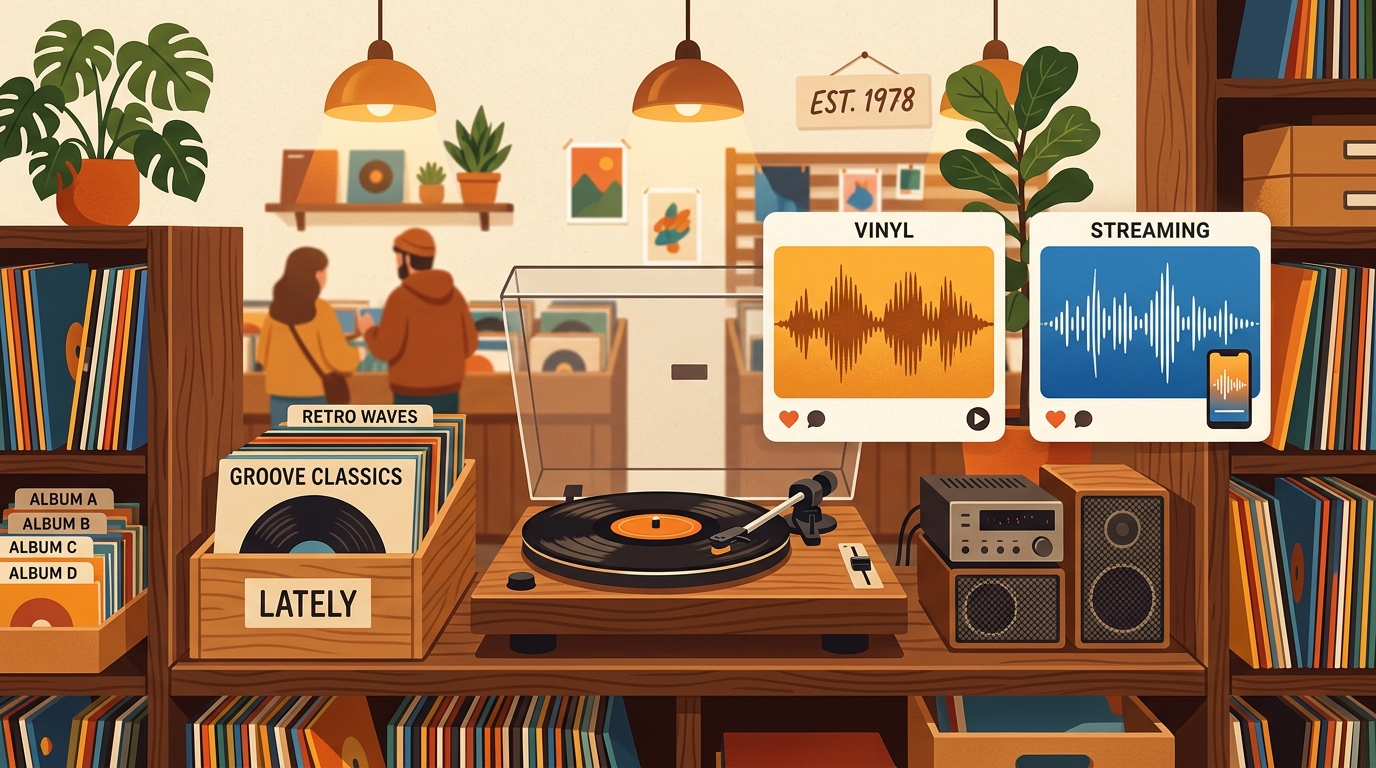
The vinyl vs streaming sound quality debate is easy to turn into a shouting match, mostly because people are often comparing different things. One person means Spotify in a car over Bluetooth. Another means Apple Music Lossless through a good DAC. A third means a clean first pressing on a properly aligned turntable. Those are not the same contest.
So here is the practical 2024 answer for collectors: streaming wins on technical accuracy when it is lossless and played through a decent chain; vinyl wins when the record has a better master, your playback gear is dialed in, or you value the physical listening ritual as part of the sound. If you track pressings in What's Spinning, that last point matters, because two copies of the same album can behave like two different releases.
The market says both formats matter
Streaming is the center of the recorded music business. The RIAA 2024 year-end report says U.S. recorded music revenue reached $17.7 billion at retail value, with paid streaming subscriptions hitting 100 million for the first time. Paid subscription streaming alone rose to $11.7 billion. That tells you how most people listen day to day.
But vinyl is not just nostalgia cosplay. The same RIAA report says vinyl revenue grew 7% to $1.4 billion in 2024, its eighteenth consecutive year of growth, and vinyl represented nearly three quarters of physical format revenue. Globally, IFPI reported that physical formats were worth $5.1 billion in 2023, with vinyl interest still expanding in the streaming era. In other words, streaming owns convenience; vinyl owns commitment.
Streaming's technical advantage is real
A lossless stream can deliver the master to your DAC without groove wear, inner-groove distortion, rumble, off-center pressings, mistracking, dust, static, or cartridge setup problems. Apple says most of the Apple Music catalog is encoded in ALAC from 16-bit/44.1 kHz up to 24-bit/192 kHz. TIDAL's HiRes FLAC documentation similarly describes streams up to 24-bit/192 kHz. Even Spotify's current audio-quality support page lists Very High at about 320 kbps and Lossless up to 24-bit/44.1 kHz FLAC, a sign of how far streaming expectations have moved.
That does not mean every hi-res badge changes your life. The famous AES paper by E. Brad Meyer and David R. Moran, Audibility of a CD-Standard A/D/A Loop Inserted into High-Resolution Audio Playback, found that listeners in their tests generally could not identify when a CD-quality loop was inserted into high-resolution playback. Later research is more nuanced, especially with trained listeners, but the safe takeaway is simple: mastering, speakers, headphones, room, and volume matching usually matter more than whether a file is 16/44.1 or 24/192.
Vinyl's advantage is often mastering, not magic
Vinyl is a mechanical format. That is the charm and the compromise. A stylus traces a groove; the phono preamp applies RIAA equalization; the cartridge, tonearm, platter speed, pressing quality, and record condition all become part of the playback chain. A great setup can sound vivid and dimensional. A bad setup can turn a beloved record into sibilance, mistracking, and left-channel fuzz.
When vinyl beats a stream, the reason is often not that vinyl has superior theoretical resolution. It is that the vinyl release uses a different master. During the loudness-war years, many CD and digital releases were aggressively limited for maximum loudness. Some vinyl editions were cut from less compressed masters because overly hot bass, excessive sibilance, and extreme limiting can make records harder to cut and track. That is why a vinyl copy can sound more open than the stream even if the stream is technically cleaner.
The reverse happens too. Plenty of modern LPs are cut from the same digital master used for streaming, then pressed onto noisy or warped vinyl. In that case, the lossless stream can be the better sounding version by a mile. A $35 colored variant does not automatically beat a good digital master. The wax has to earn it.
Noise, warmth, and what listeners actually like
Vinyl fans often describe warmth, body, and presence. Some of that is musical language for real playback differences: cartridge frequency response, harmonic distortion, channel crosstalk, small speed variations, and the mastering choices used for the cut. Some of it is expectation and ritual. Pulling a record from the sleeve, cleaning it, dropping the needle, and committing to a side changes how you listen.
Streaming has its own traps. Bluetooth can reduce quality before the signal reaches your headphones. Loudness normalization can make quick comparisons misleading. Mobile data settings can quietly lower bitrates. Spatial audio mixes may be different mixes, not just different delivery formats. If you want a fair comparison, turn off unnecessary processing, volume-match carefully, use wired playback or a reliable lossless path, and compare the same master where possible.
What should collectors do in 2024?
Use streaming as your reference library and vinyl as your intentional library. Stream first to discover albums, compare editions, and avoid expensive mistakes. Buy vinyl when the album rewards side-based listening, has strong artwork, has a known great pressing, or simply means enough to own. For sound quality, research the specific release, not just the format. A clean, well-cut Blue Note reissue and a noisy novelty pressing live in different universes.
The real winner is not vinyl or streaming. It is the best available master played on gear that is set up correctly. If you want accuracy, lossless streaming has the cleaner technical path. If you want a tactile, collectible, sometimes better-mastered experience, vinyl still has a powerful case. The smartest collectors use both without pretending one format explains every album.
FAQ
Does vinyl sound better than streaming?
Sometimes, but not automatically. Vinyl can sound better when it uses a better master or when your turntable setup is excellent. Lossless streaming usually has lower noise, lower distortion, and fewer mechanical variables.
Is lossless streaming better than Spotify at 320 kbps?
On revealing gear, lossless can be better because it avoids lossy compression. In casual listening, many people struggle to hear a reliable difference, especially in cars, gyms, kitchens, or Bluetooth headphones.
Why do some vinyl records sound more dynamic?
Often because the vinyl edition was mastered differently, not because the vinyl format has more theoretical dynamic range than digital. Different EQ, limiting, and cutting choices can make an LP feel more open.
Should I buy vinyl if I already stream in lossless?
Yes, if you value the object, artwork, liner notes, collecting, or a specific pressing. If you only want the cleanest signal for the least money, lossless streaming is the easier recommendation.
A spreadsheet tracks what you own. What's Spinning identifies what's playing.
On-device vinyl ID logs your listening history automatically. 7-day free trial.
Looking for Shazam for vinyl?
What's Spinning identifies what's playing on your turntable on-device, logs history, and AirPlays now-playing to your TV.
Comparing vinyl ID apps?
Analog requires Discogs and is iPhone-first (iPad coming). What's Spinning works without Discogs on iPhone and iPad with AirPlay.
Try What's Spinning Free
Turn your iPad into a live now-playing display. Track every record you spin.
START FREE TRIALThen $4.99/mo or $39.99/yr · Cancel anytime