Best Albums of 1989 on Vinyl: 15 Essential Records for Collectors
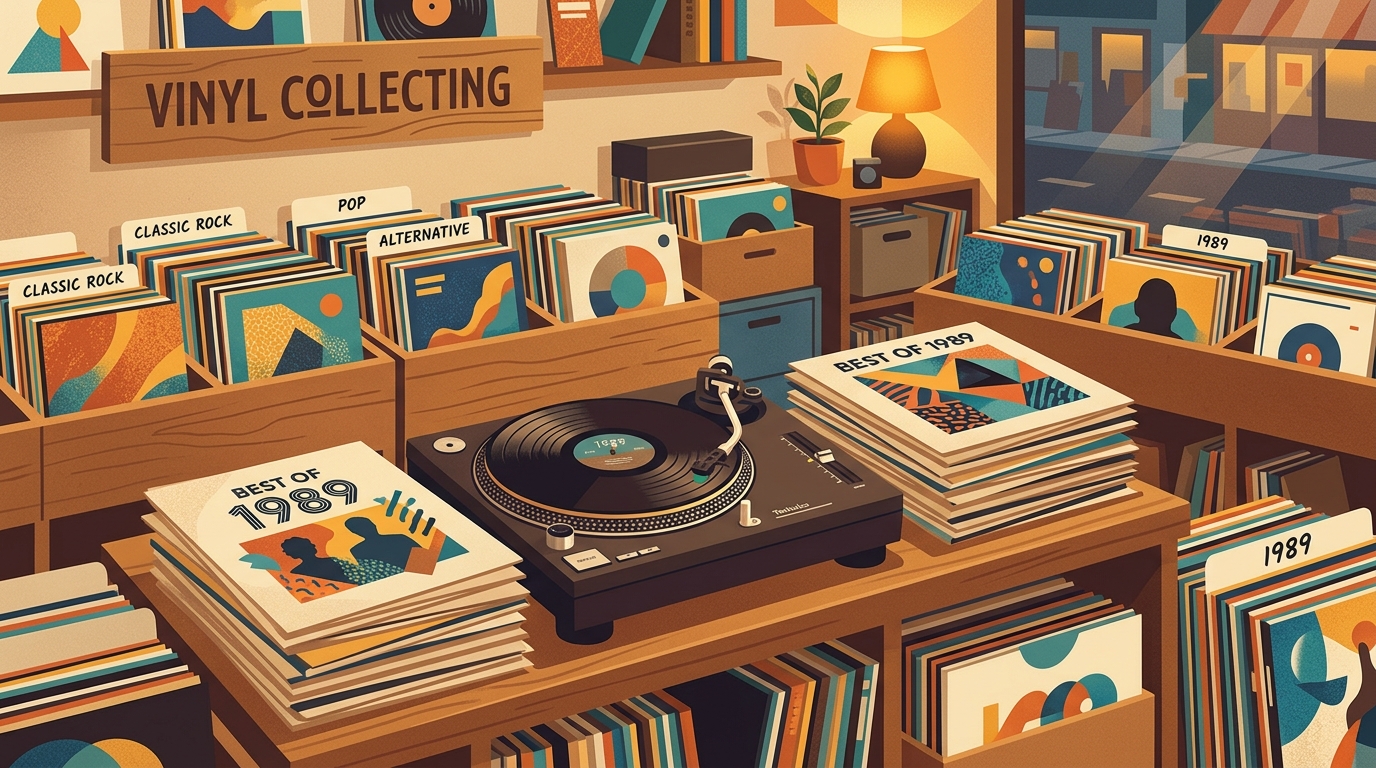
1989 was a strange, generous year for record collectors. Compact discs were already winning shelf space, but many major albums were still conceived with LP sequencing, sleeve art, and side breaks in mind. That tension makes the best albums of 1989 on vinyl especially fun to collect: you get the last years of mass-market analog habit colliding with hip-hop sample collage, alternative rock's commercial rise, industrial pop, dance-rock, blockbuster R&B, and glossy hard rock.
For What's Spinning users, this is exactly the kind of year that rewards notes. Pressing differences, single-LP versus double-LP editions, original covers, sample-clearance histories, and reissue mastering choices can change what you want to buy first. The list below is not a price guide. It is a collector's listening map, built around albums that still make sense as physical records.
Research sources include artist discographies, 4AD, the Library of Congress, MusicBrainz and Cover Art Archive data, Official Charts context, and recording-history references. Cover images are embedded from public album-art sources so the list works visually like a real crate-digging session.
The collector angle also matters because 1989 sits in an awkward manufacturing window. Some titles were pressed in huge numbers, some were easier to find on cassette or CD in certain markets, and some later became expensive because their original vinyl runs were smaller than their cultural afterlife. That is why this guide mixes obvious classics with records whose format stories are part of the appeal, especially for collectors comparing playable copies against display-worthy artifacts at home today.
The best albums of 1989 on vinyl
1. Disintegration, The Cure 1989
Rain is practically an instrument on Disintegration, but the record is not just gothic atmosphere stretched over two sides. The Cure's own discography notes that it was released on 2 May 1989 and recorded at Hookend Recording Studios in Oxfordshire with Robert Smith and David M. Allen producing, which explains the unusual combination of grandeur and control. On vinyl, the album's length is part of the drama. The original CD ran longer than a single LP could comfortably handle, so collectors should pay attention to which pressing they are buying and how the program is spread across sides. The big songs, "Pictures of You," "Lovesong," and "Lullaby," are obvious entry points, yet the reason this belongs near the top of any best albums 1989 vinyl list is the way the deep cuts make the room colder. It is a system test for patience, bass bloom, and whether your setup can keep dense reverb from becoming fog. Source.
2. Doolittle, Pixies 1989
A buzzsaw can be catchy if the teeth are spaced correctly. Pixies made Doolittle with producer Gil Norton for 4AD, and the label's own listing dates the album to 17 April 1989 while noting later high-resolution work from the original analog multitracks. That matters to vinyl buyers because Doolittle is a record of violent contrasts: Black Francis shrieks, Kim Deal cools the temperature, Joey Santiago throws serrated guitar figures across the stereo field, and the rhythm section keeps everything moving before the chaos can congeal. Its 15 songs fit into roughly 38 minutes, a collector-friendly length that keeps side changes brisk and inner-groove punishment manageable. The Vaughan Oliver cover art also remains one of 4AD's great visual objects, half religious iconography, half anatomical unease. A clean copy gives you the pop hooks without sanding off the abrasion, which is exactly the point. Source.
3. 3 Feet High and Rising, De La Soul 1989
Nobody else in 1989 sounded like they had built a hip-hop album out of a schoolyard, a game show, a stack of thrifted records, and a private joke that somehow welcomed everybody in. De La Soul's debut, produced with Prince Paul, entered the Library of Congress National Recording Registry because it challenged the norm and kept rewarding study. For collectors, the story is bigger than nostalgia. Long sample-clearance problems kept the catalog awkwardly absent from digital services for years, so physical copies carried extra cultural weight. The vinyl experience also suits the skits, sudden edits, and tonal jumps because the album behaves like a collage you can hold in your hands. Original Tommy Boy pressings have become desirable, but buyers should check condition carefully since party records often lived party lives. The daisy-age cover can look whimsical at first glance; the music underneath is sharper, stranger, and more structurally ambitious than the shorthand suggests. Source.
4. Paul's Boutique, Beastie Boys 1989
Paul's Boutique is what happens when a record collection becomes architecture. Released by Capitol in July 1989 and produced with the Dust Brothers, the album piled funk, soul, rock, jazz, and found-sound fragments into a dense sample city. Reverb's production history puts the sample count in the broad 100 to 300 range, which feels less like a statistic than a warning to anyone trying to decode it in one sitting. On vinyl, the Lower East Side gatefold fantasy and the long-suite construction of "B-Boy Bouillabaisse" make the album feel closer to a crate-digging travelogue than a normal rap LP. Early listeners expecting another Licensed to Ill were understandably confused. Collectors now hear the pivot as the whole point: three wisecracking MCs figuring out that absurdity, deep musical knowledge, and street-corner timing could coexist inside one wildly expensive legal miracle. Source.
5. The Stone Roses, The Stone Roses 1989
Manchester did not need The Stone Roses to sound heavy; it needed them to sound inevitable. The debut was released by Silvertone on 2 May 1989 and recorded largely with producer John Leckie, with sessions tied to Battery Studios, Konk, and Rockfield in period accounts. The LP is a collector favorite because it balances guitar-pop sparkle with dance-floor elasticity before Madchester became a marketing tag. John Squire's Pollock-influenced lemon artwork gives the sleeve a visual identity as strong as the songs, and on a shelf it still announces itself from across the room. Listen closely to "I Wanna Be Adored" and "Waterfall" on vinyl and the trick is not volume, it is momentum. The band lets grooves form gradually, then trusts the listener to step inside. UK originals can be expensive, so a well-pressed reissue is often the practical way to live with the album rather than merely own a trophy. Source.
6. Pretty Hate Machine, Nine Inch Nails 1989
Before industrial rock became arena-sized, Pretty Hate Machine sounded like a private panic attack wired into a dance sequencer. Nine Inch Nails' own discography lists the 1989 debut and credits Trent Reznor with producers including Flood, John Fryer, Keith LeBlanc, and Adrian Sherwood. That producer spread is audible: synth-pop discipline, machine rhythm, dubwise space, and corrosive guitar all fight for room. Vinyl copies are interesting because the record sits at a crossroads between club music and rock confession, so mastering choices can push it toward body movement or toward claustrophobia. "Head Like a Hole" became the obvious anthem, but the album's collector value lies in hearing Reznor before the 1990s fully caught up with him. The cover's mechanical abstraction also matches the music better than a portrait would have. It is not warm in the usual analog sense; it is warm like overheated circuitry. Source.
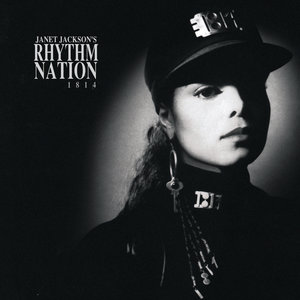
7. Janet Jackson's Rhythm Nation 1814, Janet Jackson 1989
Here is the pop blockbuster that also wants to run drills. The Library of Congress notes that Rhythm Nation 1814 was written and recorded in the Minneapolis studios of Jimmy Jam and Terry Lewis, and that it produced four No. 1 singles plus a record-breaking seven top-five singles. Those numbers are staggering, but vinyl collectors should listen past the chart history. The album is sequenced like a manifesto that keeps being interrupted by immaculate pop craft: social concern, military funk choreography, industrial-edged drums, slow jams, and pristine vocal stacks. Original double-LP copies give the material the breathing room a project this long needs, and the black-and-white cover makes a perfect physical emblem for the era's disciplined visual language. Janet's Control proved independence; Rhythm Nation turned independence into infrastructure. On a good system, the Jam and Lewis low end hits with machine-tooled authority, while the ballads remind you that the record sold millions because it knew how to persuade, not only command. Source.
8. Like a Prayer, Madonna 1989
Madonna's fourth album is often remembered for controversy, but the vinyl case for Like a Prayer starts with craft. Released by Sire in March 1989, it reunited her with Patrick Leonard and Stephen Bray while letting gospel, funk, rock guitar, and confessional balladry push against the clean lines of 1980s pop. The title track's choir is the headline, yet the record's personality comes from how quickly it moves from spectacle to family damage, desire, grief, and self-mythology. Collectors should treat the sleeve as part of the experience, since the denim-and-bare-midriff cover image reduced superstar iconography to a cropped, tactile fragment. Sonically, this is not a shy record; it likes bright choruses and big gestures. A strong pressing keeps those gestures from turning brittle. If you only know the singles, the LP reveals a more unsettled album than its greatest-hits afterlife implies. Source.
9. The Sensual World, Kate Bush 1989
Kate Bush made The Sensual World feel luxurious without making it easy. Released in October 1989 by EMI, the album followed Hounds of Love with a different kind of density: less gothic chase scene, more adult interior weather. The title song famously circles literary desire, while tracks such as "This Woman's Work" and "The Fog" reward listeners who enjoy studio detail as much as melody. On vinyl, the album is a midrange record in the best sense. Voices, strings, pipes, synth textures, and percussion details occupy space with painterly care, so setup quality can change how intimate it feels. The cover, with Bush half-hidden behind flowers, fits the music's mixture of invitation and privacy. Collectors should compare editions if they are sensitive to brightness, but the essential appeal is consistent: this is art pop made by someone who understood the studio as a theatrical set, not merely a room with microphones. Source.
10. Full Moon Fever, Tom Petty 1989
Full Moon Fever sounds casual in the way only obsessively well-made records can. Tom Petty's first solo album arrived through MCA in April 1989 with major help from Jeff Lynne and Mike Campbell, and its clean, chiming production made "Free Fallin'," "I Won't Back Down," and "Runnin' Down a Dream" feel instantly permanent. Vinyl listeners get an extra piece of personality in the famous side-change gag, where Petty politely tells CD listeners to ignore the pause. That little joke captures the album's charm: relaxed, dry, and format-aware without being precious. The record is also useful for collectors because it sits between classic-rock radio familiarity and real studio specificity. Lynne's fingerprints are unmistakable in the stacked acoustics and tidy drums, yet Petty's plainspoken phrasing keeps everything from floating into gloss. A clean LP makes the hooks feel hand-tooled rather than automatic. Source.
11. Dr. Feelgood, Motley Crue 1989
Glam metal rarely sounded more expensive than Dr. Feelgood, and that is a compliment before it is an accusation. Motley Crue entered the album newly sober by their own long-running account, worked with producer Bob Rock, and emerged with their first Billboard 200 No. 1. The vinyl appeal is partly physical impact: huge drums, gang vocals, guitar crunch, and low-slung swagger built for speakers that can move air. It is also a case study in late-80s rock packaging, from the medical snake imagery to the glossy sense that every chorus was engineered for maximum arena reach. Collectors who dismiss the band on taste grounds may still find the production instructive, because Bob Rock's precision helped define what big hard rock would sound like heading into the 1990s. This is not a subtle LP, but subtlety was never the assignment. The assignment was impact, and the title track still arrives like a neon sign thrown through a window. Source.
12. Bleach, Nirvana 1989
The most quoted number attached to Bleach is $606.17, the recording bill for sessions at Reciprocal Recording with Jack Endino. LiveNirvana's session history repeats the figure and ties the work to late 1988 and January 1989, which is why the album still feels like a local document before it feels like a prequel to global fame. On vinyl, Bleach is all pressure points: sludgy riffs, dry drums, Cobain's voice caught between sarcasm and injury, and a Sub Pop aesthetic that makes limitation sound like identity. First pressings are serious collector objects, especially colored variants, but the music itself does not require museum treatment. It benefits from a copy you are willing to play loud. "About a Girl" hints at the pop songwriter hiding inside the noise, while "Negative Creep" and "School" keep the room low-ceilinged and airless. The budget is folklore now; the force is still practical. Source.
13. Technique, New Order 1989
Technique is the sound of a rock band discovering that the club was not a detour from songwriting, it was a new writing room. New Order made much of the album after time in Ibiza, and the Balearic influence gives the record a sunlit pulse even when Bernard Sumner's lyrics remain emotionally guarded. For vinyl collectors, it is one of the cleanest late-80s bridges between indie guitar music and dance culture. The rhythm programming has enough snap to satisfy DJs, while Peter Hook's bass lines keep the human signature unmistakable. The Peter Saville sleeve, with its cherub statue and cool graphic restraint, looks almost too elegant for music this chemically alive. A good pressing should give "Fine Time" club weight without flattening the melodic ache in "Vanishing Point" or "Dream Attack." It is a party record for people who bring complicated feelings to the party, which is to say a New Order record. Source.
14. Freedom, Neil Young 1989
Neil Young opened and closed Freedom with two versions of "Rockin' in the Free World," one acoustic, one electric, as if he wanted the album to argue with itself before anyone else could. After a famously uneven 1980s run, this 1989 LP re-centered him as a songwriter who could sound wounded, furious, funny, and politically alert within the same hour. Vinyl makes the bookend structure especially satisfying because the listener physically travels from the street-corner version into the amplified one. The rest of the album ranges widely, sometimes beautifully, sometimes messily, which is part of its Neil Young logic. Collectors should not expect the seamlessness of Harvest or the monolithic blast of Rust Never Sleeps. Freedom is valuable because it catches an artist regaining traction in public. When the electric closer lands, the earlier wanderings feel less like inconsistency and more like a road map back to nerve. Source.
15. The Seeds of Love, Tears for Fears 1989
Some albums sound costly because they are polished; The Seeds of Love sounds costly because you can hear the ambition refusing to settle. Tears for Fears followed Songs from the Big Chair with a studio-heavy project that pulled Beatlesque color, jazz-soul vocals, political unease, and ornate pop into one oversized frame. "Sowing the Seeds of Love" is the obvious banner, but vinyl rewards the slower reveal of "Woman in Chains," where Oleta Adams changes the emotional scale of the record. The album can be a pressing-dependent listen because the arrangements are crowded, with drums, horns, keyboards, guitars, and layered voices all competing for air. When mastered well, though, that density becomes the appeal. The cover's painted, organic imagery also suits the music better than another glossy band portrait would have. This is late-80s maximalism with a conscience, made by a group willing to risk overreach rather than repeat a formula. Source.
What to buy first
If you are starting from zero, begin with three records that show how wide 1989 really was: Doolittle for alternative rock economy, 3 Feet High and Rising for sample-era imagination, and Rhythm Nation 1814 for blockbuster pop architecture. After that, add Disintegration if your system handles atmosphere well, Paul's Boutique if you love liner-note rabbit holes, and Bleach if you want the raw indie-label document before grunge became a global category.
Budget matters. Some originals have become expensive because of scarcity, format quirks, or fan demand, but not every album here needs a first pressing. For listening, prioritize clean vinyl, trustworthy mastering notes, and jackets that have not been destroyed by decades of tight storage. For collecting, keep an eye on country of origin, label variations, inserts, and whether a reissue changes the side layout.
FAQ
What makes 1989 such a strong vinyl year?
It sits near the end of vinyl's mainstream dominance, so many albums still have LP-era sequencing and memorable sleeves while also capturing new production ideas from hip-hop, industrial, dance music, and digital-era pop.
Should I buy original 1989 pressings or modern reissues?
Buy originals when the condition, price, and packaging matter to you. Buy modern reissues when you mainly want quiet playback, easier availability, or a version spread across more sides for better sound.
Which 1989 albums are usually the hardest to find cheaply?
Clean originals of titles with strong collector demand, such as Bleach, Paul's Boutique, The Stone Roses, and some alternative or hip-hop pressings, can get pricey. Prices move constantly, so check recent sold listings rather than active asking prices.
Are cover-art archive image links safe for a blog list?
They are public album-art endpoints maintained around MusicBrainz release data. For this post, the first three image URLs were specifically verified as returning HTTP 200 before publication, and every album entry includes an image tag with alt text.
A spreadsheet tracks what you own. What's Spinning identifies what's playing.
On-device vinyl ID logs your listening history automatically. 7-day free trial.
Looking for Shazam for vinyl?
What's Spinning identifies what's playing on your turntable on-device, logs history, and AirPlays now-playing to your TV.
Comparing vinyl ID apps?
Analog requires Discogs and is iPhone-first (iPad coming). What's Spinning works without Discogs on iPhone and iPad with AirPlay.
Try What's Spinning Free
Turn your iPad into a live now-playing display. Track every record you spin.
START FREE TRIALThen $4.99/mo or $39.99/yr · Cancel anytime