Best Albums of 1989 for Your Vinyl Collection
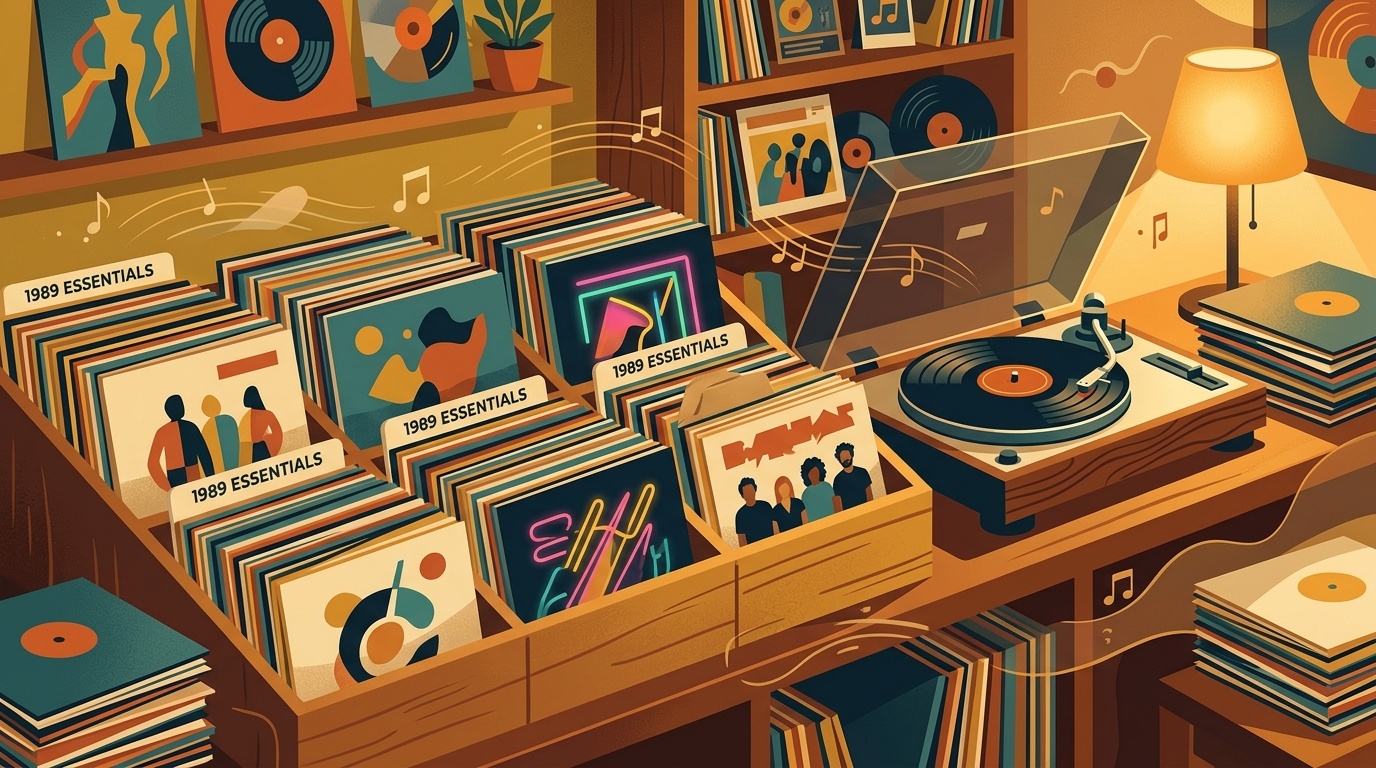
If you are building a shelf around the best albums 1989 vinyl collectors still chase, you are entering one of the most interesting hinge years in modern record collecting. The compact disc was becoming the default retail format, but labels were still pressing LPs for major releases, indie scenes, club records, metal, hip-hop, and college radio. That makes 1989 vinyl especially satisfying: the music points toward the 1990s, while the physical records still belong to the older album culture of covers, side breaks, label designs, and pressing quirks.
The modern market gives this year fresh urgency. The RIAA's 2025 year-end report put U.S. vinyl at 46.8 million units and $1.0429 billion in wholesale value, up 7.9 percent in units from 2024. Luminate's 2025 year-end report counted 47.9 million U.S. vinyl sales, up 8.6 percent, and noted that four in 10 vinyl records were sold at independent record stores. In other words, the bins are crowded again, and knowing which late-80s albums actually reward repeat listening helps you buy with intent instead of nostalgia alone.
This list favors records that matter as albums and as objects. Some are rare original-pressing targets, some are best approached through clean reissues, and some are simply essential because the sequencing, cover art, or production makes more sense when heard as an LP. If you use What's Spinning to track listening history, this is a useful year to test your habits: many of these records are famous, but the keepers are the ones you return to side after side.
Research sources include album pages and cover art from Wikipedia, market data from the RIAA and Luminate, and preservation context from the Library of Congress National Recording Registry.
The best albums of 1989 for vinyl collectors
-
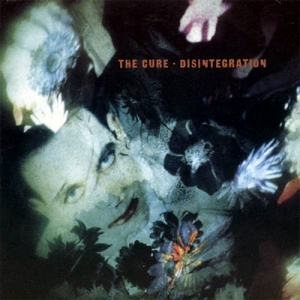
Disintegration, The Cure, 1989
Robert Smith turned dread into architecture on Disintegration. The Cure recorded the album at Hookend Recording Studios with David M. Allen, and the result feels deliberately paced for sides rather than singles. Long intros matter here: drums appear like weather, basslines move with unusual patience, and the guitars smear into a grey-blue halo before Smith steps into the room. For collectors, the original Fiction and Elektra pressings are appealing because the album was issued at the exact point when CDs were taking over, so late-80s vinyl copies can feel like survivors from a changing market. The 2010 remaster and later reissues are useful listening copies, but clean originals have a different aura because they preserve the album as a big, immersive LP object. It is gothic rock at stadium scale without losing the private-room feeling that made the band matter in the first place. Source.
-

Doolittle, Pixies, 1989
A better argument for compact sequencing is hard to find than Doolittle. Pixies made a record where biblical violence, surreal images, surf-rock twang, screaming, sweetness, and joke-black humor all fit inside songs that rarely overstay. Gil Norton's production sharpened the band without sanding off the danger, especially the quiet-verse and explosive-chorus dynamic that later alternative rock would borrow until it became a language of its own. On vinyl, the album benefits from short sides and quick mood changes; it never becomes a slog, and the side break gives the listener a second wind rather than an interruption. Vaughan Oliver's sleeve design is also part of why it belongs in a collection, a 4AD object with visual identity as strong as the sound. Original UK 4AD copies and U.S. Elektra versions both have devoted buyers, but condition still wins. A noisy copy can flatten the tension that makes the soft parts dangerous. Source.
-

Paul's Boutique, Beastie Boys, 1989
Nobody bought Paul's Boutique in 1989 expecting it to become a crate-digger monument. The Beastie Boys and the Dust Brothers built it from a dense sample collage at Matt Dike's apartment and the Record Plant, pulling funk, soul, rock, jazz, television fragments, and jokes into a record that was commercially disappointing before it became legendary. That history matters on vinyl because the album is basically a museum of pre-clearance-era possibility, a world where the LP itself feels like a mixtape that grew a city block around it. The gatefold and panoramic street-corner cover reward inspection, and the grooves reward speakers that can keep bass punch, vocal overlap, and tiny sample details from congealing. Later listeners sometimes call it hip-hop's Sgt. Pepper, but that undersells the humor. It is smarter than its first reputation and sillier than its canonization, which is exactly why it keeps aging well. Source.
-

The Stone Roses, The Stone Roses, 1989
Manchester did not suddenly become mythic because of one LP, but The Stone Roses gave the myth a sleeve, a sound, and a swaggering center. John Leckie's production at Battery Studios let the band sound loose and precise at once: Reni's drumming dances, Mani's bass carries the room, John Squire's guitar sparkles and coils, and Ian Brown sings as if confidence is a form of weather. The record was not an instant blockbuster, yet its reputation grew alongside Madchester and baggy culture, eventually making original Silvertone copies serious collector pieces. The Jackson Pollock-influenced cover art has become inseparable from the music, a splash of color that signals optimism before the first note. On vinyl, the closing stretch into "I Am the Resurrection" gives the album a communal lift that streaming often shrinks. It belongs on a 1989 shelf because it captures indie guitar music discovering dance-floor gravity without abandoning melody. Source.
-

3 Feet High and Rising, De La Soul, 1989
3 Feet High and Rising changed the color palette of hip-hop. De La Soul and Prince Paul made a debut that sounded playful, psychedelic, bookish, suburban, funny, and technically radical, using skits and samples to build an album-length personality rather than a loose bundle of tracks. Its title nods to Johnny Cash's "Five Feet High and Rising," which is the kind of detail that tells you how wide the listening map is. Collectors also know the album's sample history shaped its availability for years; legal tangles around early hip-hop sampling made original pressings and later reissues feel unusually loaded with context. The Library of Congress selected the album for the National Recording Registry, an institutional recognition of what listeners already knew. On vinyl, the skits and transitions make the LP feel like a comic book with a beat, and the bright cover art still jumps out from any record-store wall. Source.
-

Pretty Hate Machine, Nine Inch Nails, 1989
Trent Reznor's debut did not arrive fully armored in arena-industrial menace. Pretty Hate Machine is leaner, synth-driven, sometimes club-shaped, and still hungry enough to make its limitations useful. Reznor played and programmed much of the record, working with producers including John Fryer, Flood, and Keith LeBlanc, which helps explain why the album sits between new wave, industrial dance, and rock confession. For vinyl buyers, the original TVT story is part of the attraction and the headache; label conflict, reissues, and the 2010 remaster all give collectors decisions to make. The cover is not pretty, and that is the point, a late-80s digital bruise rather than a classic rock portrait. "Head Like a Hole" remains the obvious anthem, but the LP rewards full-side listening because the mechanical surfaces keep cracking open into melody. It is a debut with future stadiums hiding inside bedroom spite. Source.
-
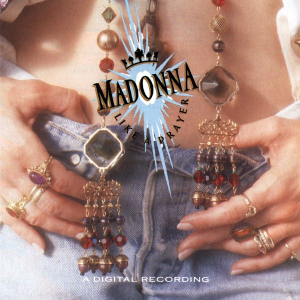
Like a Prayer, Madonna, 1989
Madonna's fourth album is where pop spectacle turned inward without getting small. Like a Prayer dealt with Catholic imagery, family grief, desire, guilt, fame, and self-invention, then wrapped those subjects in rock guitars, gospel force, dance-pop, and ballad craft. Patrick Leonard and Stephen Bray returned as key collaborators, and Prince contributed to the album's strange edges. The original LP has an object story too: the close-cropped denim cover, the patchouli-scented packaging on some early copies, and the controversy around the title track's video all made the album feel like a cultural event before many buyers even played side one. Vinyl gives the record a useful frame because the sequence moves from public provocation to private reckoning. A strong copy should keep the choir lift in the title track huge without turning brittle. For a 1989 collection, this is the mainstream pop album that refuses to behave like disposable product. Source.
-
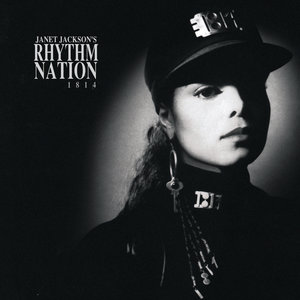
Janet Jackson's Rhythm Nation 1814, Janet Jackson, 1989
Janet Jackson answered the pressure to repeat Control by making a bigger, sharper, stranger pop machine. Working with Jimmy Jam and Terry Lewis in Minneapolis, she built Rhythm Nation 1814 as a socially conscious concept album that could still dominate radio and video rotation. The industrial snap of the title track, the romantic singles, the interludes, and the black-and-white visual identity all make the LP feel designed as a total campaign rather than a casual follow-up. The Library of Congress later selected it for the National Recording Registry, citing its cultural importance, and that fits the way the album joined choreography, fashion, politics, and new jack swing precision. On vinyl, the two-sided shape keeps the manifesto from becoming abstract. Drums hit with factory-line discipline, but Janet's phrasing stays human. It is collectible because it sounds expensive, ambitious, and tightly controlled, yet its message is not trapped in 1989. Source.
-

Technique, New Order, 1989
Ibiza did something productive to New Order. Technique folds Balearic beat and acid house influence into the band's guitar-bass-synth identity, so it feels less like a rock group visiting dance music than a band admitting where its pulse had always been. The album reached number one in the UK, a rare case where commercial recognition lined up with an artistic pivot. Vinyl listeners should pay attention to how the sides balance club momentum with melancholy songwriting: "Fine Time" points toward the dance floor, while "Vanishing Point" and "Dream Attack" keep the emotional weather overcast. Peter Saville's cover is unusually bright for a band associated with severe design, and that visual shift mirrors the music's sunlit surfaces. Original Factory copies are desirable partly because the label itself is inseparable from the story. If your 1989 shelf needs one record that joins indie history to club history, this is it. Source.
-

Hats, The Blue Nile, 1989
Put Hats on after midnight and the room changes temperature. The Blue Nile made a small catalog, but this second album carries the weight of a whole city at closing time: wet pavement, neon, late taxis, and conversations people should have had earlier. Linn Records' involvement gives the album extra hi-fi lore, yet the production is not showy in the demo-disc sense. It is spacious, exact, and emotionally suspended, with Paul Buchanan's voice sitting inside arrangements that leave silence as an active instrument. The album reached number 12 on the UK albums chart and earned intense critical admiration, but it still feels like a secret passed between listeners. Vinyl copies can be expensive because demand exceeds the band's modest output, so reissues are not a compromise for many collectors. The test is quiet surfaces. This record whispers often, and surface noise can turn urban loneliness into mere crackle. Source.
-

Bleach, Nirvana, 1989
Before Nirvana became a global event, Bleach was a low-budget Sub Pop record with a sound thick enough to leave fingerprints. Recorded with producer Jack Endino, the debut leans on sludge, punk, metal weight, and a kind of deadpan sarcasm that had not yet become generational shorthand. The original pressing is famous among collectors because early Sub Pop quantities were limited, and because the album's later explosion turned a regional underground artifact into a historical document. Do not approach it expecting the melodic balance of Nevermind. The point is pressure: bass-heavy riffs, blunt drums, Kurt Cobain's voice cutting through grime, and a cover that looks as raw as the music sounds. Vinyl suits it because the low end gains body, but condition is tricky since many copies were played hard. A later reissue may be the practical copy, while an original is almost archaeological. Source.
-

The Real Thing, Faith No More, 1989
Mike Patton joined Faith No More and immediately made genre categories look underprepared. The Real Thing blends funk-metal snap, keyboard gloss, hard-rock muscle, rap cadence, and oddball theatricality, with "Epic" becoming the crossover hit that made the band's strangeness visible on MTV. The album's vinyl appeal is partly transitional: it captures metal before the 1990s alternative boom fully rearranged the audience, and it shows a band that could be funny without becoming a novelty. The rhythm section is the collector's hook. Billy Gould's bass and Mike Bordin's drums need room, and a good pressing keeps the grooves muscular instead of congested. Original LPs are less common than the CD in many shops, which makes clean copies satisfying finds. The cover image, with its stark blue water and fish, has a weird calm that contrasts with the music's restless switching. It is the sound of a door being kicked open sideways. Source.
-
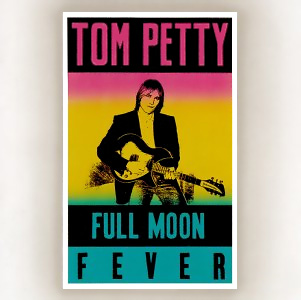
Full Moon Fever, Tom Petty, 1989
Tom Petty's first official solo album is relaxed only if you ignore how perfectly built the songs are. Full Moon Fever, made with Jeff Lynne and featuring Heartbreakers support in places, turns economy into a virtue: clean choruses, bright guitars, tidy arrangements, and hooks that sound effortless because the scaffolding is hidden. "Free Fallin'," "I Won't Back Down," and "Runnin' Down a Dream" became classic-rock fixtures, but the LP works because the lesser-known tracks keep the mood consistent without dragging. Vinyl collectors should listen for Lynne's production signature, crisp acoustic textures and stacked harmonies that can sound glossy but not sterile on the right setup. Original U.S. copies arrived during the CD boom, so the LP has a different desirability than earlier Petty records. It is not rare in the mythic sense, but clean vinyl carries a particular charm: late-80s mainstream rock pressed just before the format stopped feeling automatic. Source.
-
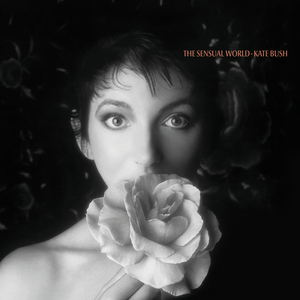
The Sensual World, Kate Bush, 1989
Kate Bush opened The Sensual World by transforming literary desire into breath, rhythm, and studio texture. The album draws from Molly Bloom's final soliloquy in spirit, even though direct use of the Joyce text was not cleared at the time, and that constraint became part of the record's identity. Compared with the grand architecture of Hounds of Love, this LP feels earthier and more tactile: Bulgarian vocal colors, Uilleann pipes, layered percussion, and songs that treat the body as a place of memory. Collectors should pay attention to UK originals, later remasters, and Bush's eventual reworking of the title material as "Flower of the Mountain" after permission from the Joyce estate. On vinyl, the album's details need calm playback. The quiet passages are not empty space, they are where the record's sensuality gathers. It is one of 1989's richest studio albums because its ambition moves inward rather than upward. Source.
-

The Seeds of Love, Tears for Fears, 1989
Expense is audible on The Seeds of Love, but so is obsession. Tears for Fears spent years and serious money following Songs from the Big Chair, moving from streamlined synth-pop toward a lush studio record filled with live drums, soul influence, Beatles references, jazz color, and panoramic arrangements. "Sowing the Seeds of Love" is the obvious psychedelic-pop statement, yet the album's emotional center may be "Woman in Chains," where Oleta Adams' voice changes the scale of the project. For vinyl collectors, this is a late-80s production showcase that can punish poor systems because density needs separation. A good pressing lets the bass, brass, backing vocals, and percussion breathe instead of piling up. The cover's floral symbolism might suggest softness, but the record is full of tension between idealism and fatigue. It is the kind of album that explains why the LP format still mattered even as major labels pushed listeners toward compact discs. Source.
-

Freedom, Neil Young, 1989
Neil Young did not need reinvention in 1989 so much as reclamation. Freedom restored his standing after a famously uneven decade, and it did so by letting acoustic tenderness and electric abrasion sit on the same record. The album opens and closes with different versions of "Rockin' in the Free World," a sequencing move that turns the LP into a loop between street-corner warning and amplifier blast. That bookend structure matters on vinyl because the listener physically travels from one version to the other, hearing the political edge harden across the album. Original pressings are interesting because late-80s Neil vinyl can be less common than earlier Reprise staples, and the cover has the plain, slightly battered look of a dispatch rather than a comeback campaign. The record is not polished into consensus. It is prickly, uneven in the most Neil Young way, and alive with the sound of an artist finding the dangerous part of his voice again. Source.
-
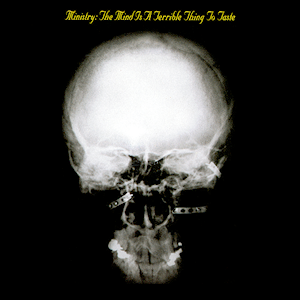
The Mind Is a Terrible Thing to Taste, Ministry, 1989
Ministry's 1989 album is not background music unless your background is a collapsing factory. The Mind Is a Terrible Thing to Taste pushed the band's industrial metal attack into harsher, more physical territory, combining programmed aggression, guitar grind, samples, and vocals that sound transmitted through machinery. Its collector appeal sits in the moment before industrial rock became a 1990s mainstream reference point. This is still abrasive, club-aware, and hostile to easy comfort. On vinyl, the density can be thrilling if the pressing keeps the percussion from smearing; bad playback turns precision into sludge. The cover's medical-mechanical unease fits the sound, a warning label disguised as album art. It is also useful historically beside Nine Inch Nails. Pretty Hate Machine seduces with hooks and confession, while Ministry goes for impact and corrosion. Together they show how wide industrial music's late-80s vocabulary already was. Source.
-
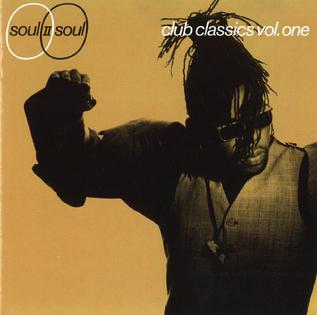
Club Classics Vol. One, Soul II Soul, 1989
The bassline on Club Classics Vol. One does not hurry because it knows the room will come to it. Soul II Soul's debut brought the sound-system sensibility of Jazzie B into the album era, with "Keep On Movin'" and "Back to Life" turning spacious grooves, Caron Wheeler's vocals, and elegant restraint into international pop language. The album is a reminder that 1989 was not only about guitar bands preparing the 1990s. Dance music, R&B, reggae influence, and club culture were reshaping what a mainstream LP could feel like. On vinyl, the low end is the buying test. You want a copy that lets the bass sit deep without swallowing the vocal air. UK pressings carry particular context because the record is tied to British club culture, fashion, and Black London creativity. The sleeve may look understated, but the grooves are social architecture. Few albums from the year make minimal movement feel so luxurious. Source.
-
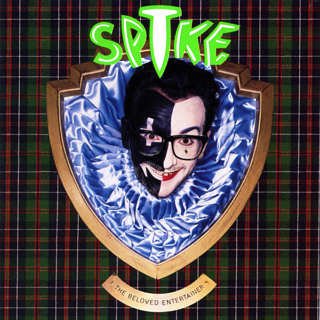
Spike, Elvis Costello, 1989
Spike is the Elvis Costello album that refuses to sit still for the class photo. Recorded across different locations with a wide cast of musicians, it moves through chamber-pop, folk, brass, political bite, balladry, and studio clutter with the confidence of a songwriter who would rather risk mess than repeat himself neatly. Its most famous song, "Veronica," was co-written with Paul McCartney, but treating the album as a one-hit frame misses the pleasure of its unruly range. For vinyl buyers, the record's sprawl is both the draw and the caution. A clean copy lets the arrangements bloom, while a tired one can make the busy tracks feel abrasive. The cover, with Costello's painted grin and sharp color, hints at the theatrical nature of the project. It belongs in a 1989 collection because it represents the literate, restless end of pop craft, where the LP can still behave like a cabinet of strange instruments and grudges. Source.
-
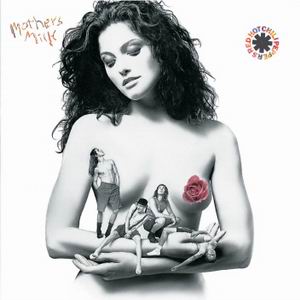
Mother's Milk, Red Hot Chili Peppers, 1989
A band can become famous later and still leave the more revealing record earlier. Mother's Milk introduced John Frusciante and Chad Smith to the Red Hot Chili Peppers' studio story, tightening the band's funk-punk chaos into something heavier and more commercially legible without smoothing away the unruly personality. The Stevie Wonder cover "Higher Ground" gave the album a durable calling card, but the deeper collector interest is hearing a lineup snap into place after grief, turnover, and uneven production history. Vinyl copies carry the late-80s rock problem: original LPs were pressed in a market increasingly focused on CD, so clean copies can be less casual finds than the album's later fame suggests. The cover art also has its own controversy and variant history, which collectors should check before paying a premium. Sonically, look for punch. Flea's bass and Smith's drums need physical attack, while Frusciante's guitar should cut through rather than smear. Source.
What to buy first
If you are starting from scratch, spread your first five purchases across different parts of 1989 rather than buying only guitar canon. Disintegration gives you atmosphere and side-long immersion. Doolittle gives you alternative rock precision. Paul's Boutique gives you sample culture at a pre-clearance peak. Janet Jackson's Rhythm Nation 1814 gives you pop as choreography, production design, and social statement. The Stone Roses gives you the UK indie-dance bridge that shaped a whole scene.
After that, choose by listening environment. Want a quiet late-night record? Buy Hats. Want weight and historical grime? Add Bleach. Want a hi-fi production challenge? Try The Seeds of Love. Want club bass with elegance? Find Club Classics Vol. One. For originals, inspect surfaces carefully; many late-80s LPs were played on budget turntables or ignored while the CD copy got the attention. For everyday use, a well-cut reissue can be the smarter purchase, especially when original prices are driven by scarcity rather than sound.
FAQ
What is the best 1989 album to buy first on vinyl?
Start with Disintegration if you want atmosphere, Doolittle if you want compact alternative rock, Paul's Boutique if you want sample-era hip-hop history, or Rhythm Nation 1814 if you want a pop album with concept-album ambition.
Are original 1989 vinyl pressings hard to find?
Some are. By 1989, CDs were taking more retail attention, so several major albums sold heavily on compact disc while vinyl quantities were smaller than they would have been a decade earlier. Condition and country of origin matter more than age alone.
Why is 1989 such a strong collecting year?
It sits at a hinge point: alternative rock, hip-hop, industrial, dance music, pop, and legacy rock all produced albums that pointed toward the 1990s, while labels were still issuing many titles on LP.
Should I buy originals or reissues for these albums?
Buy originals when the price, condition, and packaging justify it. Buy reissues when you mainly want quiet playback, easier availability, or a clean copy of an album that was scarce or expensive on original vinyl.
A spreadsheet tracks what you own. What's Spinning identifies what's playing.
On-device vinyl ID logs your listening history automatically. 7-day free trial.
Looking for Shazam for vinyl?
What's Spinning identifies what's playing on your turntable on-device, logs history, and AirPlays now-playing to your TV.
Comparing vinyl ID apps?
Analog requires Discogs and is iPhone-first (iPad coming). What's Spinning works without Discogs on iPhone and iPad with AirPlay.
Try What's Spinning Free
Turn your iPad into a live now-playing display. Track every record you spin.
START FREE TRIALThen $4.99/mo or $39.99/yr · Cancel anytime