The Best Blues Albums on Vinyl
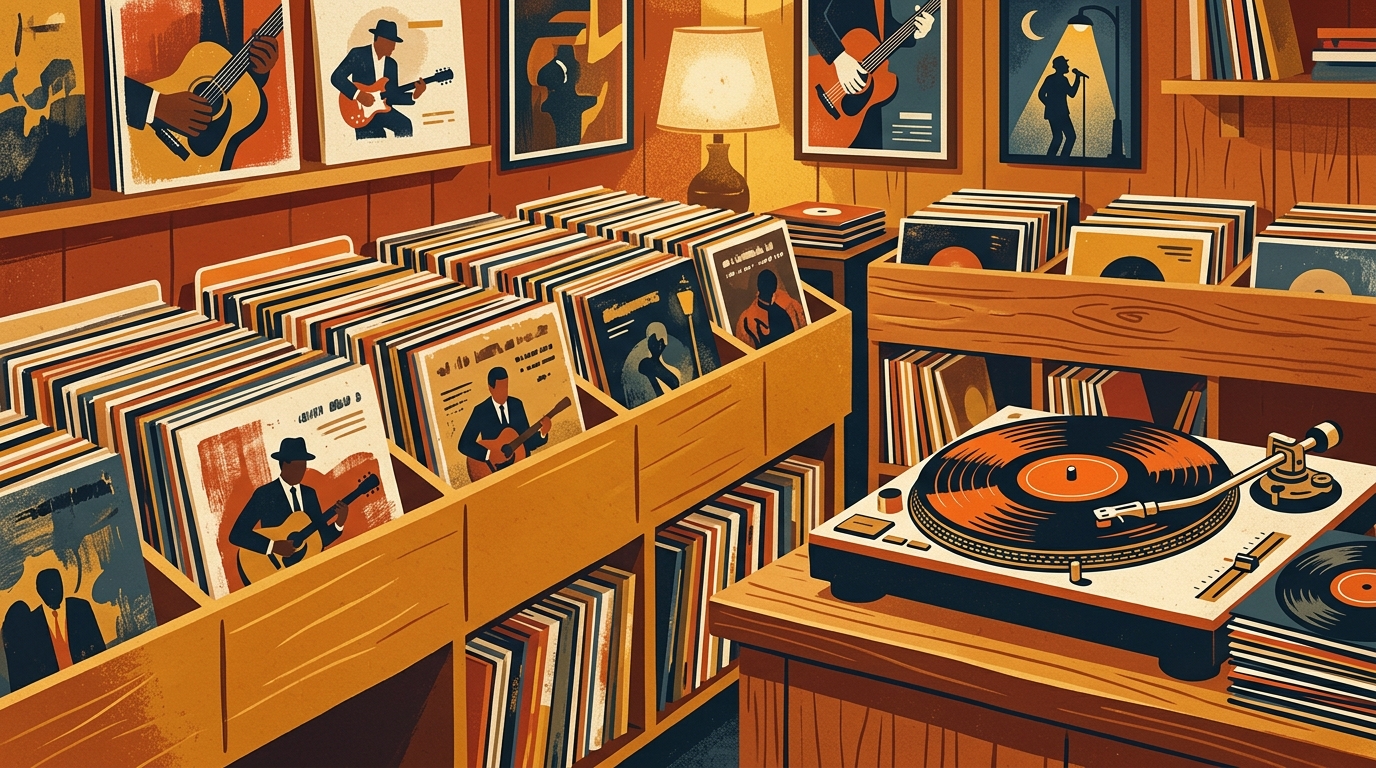
Blues records are some of the most rewarding albums to own on vinyl because the format suits the music’s human scale. A great blues LP is not only a container for songs. It is a time capsule for microphone choices, small-room performances, label history, regional styles, and the moment when singles-era music was repackaged for album-era collectors. The best blues albums on vinyl also teach you how to listen: for touch, breath, amplifier grit, harmonica bite, and the tiny delays that make a groove feel alive.
This guide is built for collectors, not for trophy hunting alone. It includes Delta blues, Chicago electric blues, Memphis soul-blues, folk revival documents, modern guitar records, and a few important crossover LPs. Some titles began as purpose-built albums, while others were assembled from earlier singles or 78s. That distinction matters. Blues history reached the LP format in uneven ways, and the shelf tells that story better than a playlist can.
The timing is good for building a blues shelf. RIAA year-end reporting has documented vinyl’s return as a serious physical format, including vinyl overtaking CDs in U.S. unit sales in 2022 for the first time since 1987. Source: RIAA 2022 year-end report. For collectors using What’s Spinning to track listening, blues is especially revealing because the records you replay often are not always the most expensive ones. Sometimes the keeper is the clean reissue that makes a voice feel three feet away.
1. King of the Delta Blues Singers, Robert Johnson, 1961
Collector fact: Columbia assembled this LP from Johnson’s 1936 and 1937 recordings, introducing many 1960s rock and folk listeners to the Delta blues canon. Source: album reference.
Start with the crackle of history, not with audiophile perfection. King of the Delta Blues Singers is a compilation, but on vinyl it behaves like a single haunted document: voice, guitar, room tone, and myth pressed into 16 sides of American source code. The songs came from Robert Johnson’s brief recording career in 1936 and 1937, and Columbia’s 1961 LP put them in front of a new audience at exactly the moment young guitarists were digging backward for authority.
Collectors should remember that the surface noise is not the story by itself. Good reissues can reveal how precise Johnson’s timekeeping was, how the bass notes snap under the vocal, and how much drama he gets from small rhythmic hesitations. The cover portrait has become almost talismanic, but the strongest reason to own it is musical: Cross Road Blues, Hellhound on My Trail, and Love in Vain still feel close enough to make the room smaller.
2. The Best of Muddy Waters, Muddy Waters, 1958
Collector fact: Chess released the LP in 1958, gathering Waters’s key early electric Chicago sides, including songs recorded with Little Walter and Jimmy Rogers. Source: album reference.
A single Chess compilation can explain why electric Chicago blues became a language other bands kept borrowing. The Best of Muddy Waters collects sides that were originally issued as singles, yet the LP sequence has the authority of a greatest-hits sermon. I Just Want to Make Love to You, Rollin’ Stone, Hoochie Coochie Man, and Mannish Boy are not museum pieces; they are compact performances with rhythm sections that know exactly when to leave space.
The original Chess LP is a collector prize, partly because so many surviving copies were played hard. Reissues are practical, and the better ones keep the harmonica bright without turning it brittle. This is also a sleeve-history record: the plain design looks modest until you understand how much postwar blues power is sitting inside. For a vinyl shelf, it is the gateway between Delta inheritance and amplified urban swagger.
3. Moanin’ in the Moonlight, Howlin’ Wolf, 1959
Collector fact: Chess issued Howlin’ Wolf’s debut LP in 1959, compiling recordings made across the Memphis and Chicago years. Source: album reference.
Howlin’ Wolf does not enter a room quietly, and Moanin’ in the Moonlight is the proof you can file under both terror and joy. The album gathers 1950s singles, including Smokestack Lightning and Moanin’ at Midnight, into a portrait of a singer whose voice sounded older than electricity and somehow perfect for it. The band grooves are simple enough to feel inevitable, which is exactly why the menace travels so well through a turntable.
Original Chess copies are scarce in the condition most listeners want, so this is a title where buying a well-mastered reissue is not a compromise. Listen for the dry punch of the drums, the acidic harmonica, and the way the Wolf’s phrasing can arrive slightly behind the beat without losing command. The cover art, with its lunar blues atmosphere, makes the LP feel like folklore with a backbeat.
4. Hoodoo Man Blues, Junior Wells, 1965
Collector fact: Recorded for Delmark with Buddy Guy on guitar, it is often cited as one of the first fully conceived Chicago blues LPs rather than a singles compilation. Source: album reference.
Most classic blues LPs from the 1950s and early 1960s are compilations, which makes Hoodoo Man Blues feel especially alive. Delmark recorded Junior Wells with Buddy Guy, Jack Myers, and Billy Warren in a setting built around album flow rather than just single sides. You can hear the club logic: harp lines answering guitar stings, vocals leaning into jokes, the rhythm section refusing to hurry.
The collector appeal is not just rarity, it is intent. A clean copy lets Snatch It Back and Hold It and Good Morning Schoolgirl keep their conversational snap, while the slower material benefits from the room-like feel of the recording. If your blues shelf already has Chess anthologies, this is the next step because it shows Chicago blues thinking in LP length. The record feels less like a display case and more like being close to a small band at work.
5. Live at the Regal, B.B. King, 1965
Collector fact: Recorded at Chicago’s Regal Theater on November 21, 1964, this ABC-Paramount LP became a model for live blues guitar albums. Source: album reference.
The audience is practically a second instrument on Live at the Regal. B.B. King recorded it at Chicago’s Regal Theater in 1964, and the crowd response turns every vocal aside and guitar phrase into call-and-response theater. The record is famous among guitar players, but its real vinyl value is pacing: King moves from charm to ache to showmanship with the confidence of someone who can control a room without raising his voice for long.
Pressing quality matters because the album’s excitement depends on the balance between band, Lucille, and audience. Too much noise blurs the cheers into mush; too much treble makes the guitar sting rather than sing. A good copy preserves the snap of Every Day I Have the Blues and the conversational drama of How Blue Can You Get?. For collectors who want one live blues LP that proves why performance context matters, this is still the cleanest answer.
6. Born Under a Bad Sign, Albert King, 1967
Collector fact: Stax released the album in 1967 with Booker T. & the M.G.’s and the Memphis Horns helping define its lean, funky sound. Source: album reference.
The sharpest thing about Born Under a Bad Sign is not just Albert King’s guitar tone, it is the economy around it. Stax surrounded King with Booker T. & the M.G.’s and the Memphis Horns, so the grooves have Memphis discipline instead of jam-band sprawl. The title track is the obvious giant, but Crosscut Saw, Oh, Pretty Woman, and The Hunter make the LP a study in how much force can fit inside concise arrangements.
Collectors often talk about King’s left-handed, upside-down stringing because it shaped his bends, but the vinyl lesson is broader. This record needs a copy with clean midrange, since the horns and guitar both live where bad mastering can get crowded. Original Stax copies have magic and cost, while modern reissues can be excellent play copies. It is blues, soul, and electric guitar vocabulary in one brutally efficient package.
7. At Newport 1960, Muddy Waters, 1960
Collector fact: Captured at the Newport Jazz Festival, the album helped introduce Waters’s electric Chicago band to a wider festival and college audience. Source: album reference.
Festival albums can feel polite; At Newport 1960 does not have that problem. Muddy Waters brought electric Chicago blues into a setting associated with jazz audiences and turned the occasion into a career-expanding document. The band does not over-explain itself. It simply hits I Got My Brand on You, Hoochie Coochie Man, and Got My Mojo Working with the authority of musicians who know the songs can survive brighter lights.
On vinyl, the attraction is the event energy. The recording captures an audience meeting a style in public, and that makes the applause feel historically useful rather than decorative. Buyers should favor copies that keep the vocal and harmonica forward without flattening the rhythm section. It is not as raw as a club tape and not as polished as a studio greatest-hits set, which is exactly why it earns a place here. It is the blues crossing a boundary in real time.
8. Folk Singer, Muddy Waters, 1964
Collector fact: Chess recorded the mostly acoustic session in 1963 with Buddy Guy, Willie Dixon, and Clifton James, then released it as Folk Singer in 1964. Source: album reference.
Folk Singer is the record to play when someone thinks Muddy Waters is only about electric Chicago muscle. Chess framed him in a mostly acoustic setting, with Buddy Guy on guitar, Willie Dixon on bass, and Clifton James on drums. The result is spacious, deliberate, and unusually revealing. You hear the wood of the instruments, the force of Waters’s voice, and the way silence can make a blues phrase heavier.
Because the recording is so exposed, it has become a favorite among hi-fi listeners and reissue labels. That reputation is deserved, but do not treat it like a sterile test disc. My Home Is in the Delta and Good Morning Little School Girl have emotional weight beyond their sonic reputation. A quiet pressing helps because the album leaves so much air between notes. It is a rare case where an audiophile favorite also deepens the artist’s story.
9. The Paul Butterfield Blues Band, The Paul Butterfield Blues Band, 1965
Collector fact: The Elektra debut featured Paul Butterfield, Mike Bloomfield, Elvin Bishop, Jerome Arnold, and Sam Lay, linking Chicago blues knowledge with a rock-era album audience. Source: album reference.
White blues revival records can age badly when they sound like costumes. This debut works because the band had done homework in Chicago clubs and because the rhythm section, Jerome Arnold and Sam Lay, brought direct Howlin’ Wolf band experience into the room. Paul Butterfield’s harmonica is tough, Mike Bloomfield’s guitar is fluent without being tidy, and the Elektra production keeps the band direct.
The album matters to vinyl collectors because it is a hinge record. It does not replace the Black artists who created the language, and it should never be filed as if it does. Its value is in documenting how the blues crossed into the mid-1960s LP market that would feed folk rock, psychedelic rock, and guitar hero culture. Clean stereo copies have bite, while mono copies can feel more compact. Either way, Born in Chicago still jumps out of the speakers.
10. The Natch’l Blues, Taj Mahal, 1968
Collector fact: Released by Columbia in 1968, the album includes Jesse Ed Davis on guitar and shows Taj Mahal widening blues LP language beyond revival orthodoxy. Source: album reference.
Taj Mahal sounds relaxed on The Natch’l Blues, but the record is quietly ambitious. Instead of treating blues as a sealed museum room, he lets country blues, soul, Caribbean color, and rock-era studio ease breathe together. Jesse Ed Davis’s guitar lines are part of the charm: conversational, lyrical, and never desperate to prove authenticity by overcrowding the song.
This is a rewarding vinyl buy because it often sits outside the most overheated collector lanes. The Columbia pressing style gives the rhythm section enough body, and the cover has late-1960s earthiness without turning the music into period wallpaper. She Caught the Katy and Left Me a Mule to Ride became the best-known doorway, but the whole album has a friendly confidence that rewards repeat plays. It is the blues as living vocabulary, not as reenactment.
11. I Do Not Play No Rock ’n’ Roll, Mississippi Fred McDowell, 1969
Collector fact: Capitol released the album in 1969, capturing McDowell’s North Mississippi guitar style during the blues revival years. Source: album reference.
The title is a warning and a sales pitch. I Do Not Play No Rock ’n’ Roll catches Mississippi Fred McDowell in the late 1960s, when rock audiences were borrowing heavily from blues while older players were being rediscovered on festival stages and LP racks. McDowell’s slide guitar does not need the volume tricks that rock bands added later. It drones, cuts, and dances with a rhythm that feels older than the studio around it.
Collectors should treat this as a performance record more than a polished production record. The value is in touch: the vocal grain, the slide attack, the way a repeated figure can change pressure without changing shape. Original Capitol copies have period appeal, but a quiet reissue makes the hypnotic parts easier to hear. It belongs on this list because it keeps the rural source close while the market around blues was changing fast.
12. The London Howlin’ Wolf Sessions, Howlin’ Wolf, 1971
Collector fact: Recorded in London with players including Eric Clapton, Steve Winwood, Bill Wyman, and Charlie Watts, the LP became part of Chess’s transatlantic blues series. Source: album reference.
This could have been a celebrity traffic jam. Instead, the best parts of The London Howlin’ Wolf Sessions reveal a fascinating power imbalance: the British rock stars are famous, but Howlin’ Wolf is the gravity. He sounds older, rougher, and more commanding than the room’s guests, which gives the album its peculiar tension. The record is not purist Chicago blues, and that is part of the point.
Collectors may argue over whether it belongs beside the earlier Chess LPs, but it absolutely belongs in a vinyl conversation about blues influence. The jacket practically sells the transatlantic handoff, while the grooves show how difficult it is to accompany a singer with that much personality. Pressings vary, and some mixes can feel a little polite compared with Wolf’s 1950s sides. Still, as a document of blues meeting the rock audience it helped create, the LP is hard to ignore.
13. Ice Pickin’, Albert Collins, 1978
Collector fact: Alligator Records released the album in 1978, helping bring Collins’s Telecaster attack to a new generation of blues buyers. Source: album reference.
Albert Collins made the Telecaster sound like it had been stored in a freezer overnight. Ice Pickin’ captures that stinging tone in a late-1970s setting that is cleaner than the Chess era but far from slick. Alligator Records knew how to present modern blues without sanding off too much personality, and this LP has the label’s practical strengths: strong band, clear sound, and enough punch to survive loud playback.
The record is a smart buy because original Alligator pressings can still be more attainable than the obvious 1950s and 1960s trophies. Listen for the clipped attack, the comic timing, and the way Collins leaves room before a bend so the note arrives like a punchline. It also broadens the list beyond canonical origin stories. Blues on vinyl did not stop being interesting when the British Invasion discovered it; records like this kept the guitar language sharp.
14. Texas Flood, Stevie Ray Vaughan and Double Trouble, 1983
Collector fact: Released by Epic in 1983, Vaughan’s debut with Double Trouble brought blues-rock guitar back into mainstream rock visibility during the MTV era. Source: album reference.
By 1983, a loud blues guitar record could have sounded like nostalgia. Texas Flood avoided that by making Stevie Ray Vaughan’s tone feel urgent in its own decade. The trio format keeps the focus on touch, volume, and momentum. Pride and Joy had single power, but the title track is the deeper vinyl argument: slow blues stretched into a showcase for control rather than speed alone.
Original Epic copies are not impossibly rare, though condition still matters because many were owned by guitar fans who played them often. The production has more 1980s clarity than a 1960s blues LP, which makes setup flaws easier to spot. Too much brightness can make the Stratocaster bite turn glassy; a balanced copy keeps the rhythm section muscular. It is essential because it documents a revival that reached beyond collectors and put blues phrasing back into arena-scale rock vocabulary.
15. The Healer, John Lee Hooker, 1989
Collector fact: The Grammy-winning album paired Hooker with guests including Carlos Santana, Bonnie Raitt, George Thorogood, and Robert Cray. Source: album reference.
Late-career guest albums can feel like award-show seating charts, but The Healer works because John Lee Hooker’s time feel bends every collaboration toward him. The 1989 LP brought him fresh commercial attention without hiding the essential Hooker traits: the one-chord trance, the conversational growl, and a rhythmic sense that treats bar lines as suggestions.
The vinyl version is interesting because it sits at the edge of the CD era, when LP pressings for some releases were no longer the dominant format. That can make clean copies desirable, while modern reissues offer easier access. The title track with Carlos Santana is the gateway, but the Bonnie Raitt duet I’m in the Mood is the emotional center for many listeners. Own it as a reminder that blues history was not finished in black-and-white photographs. Some artists kept rewriting their own public story decades later.
16. Father of Folk Blues, Son House, 1965
Collector fact: After being rediscovered during the folk-blues revival, Son House recorded new material for Columbia in 1965. Source: album reference.
Father of Folk Blues has the sound of survival built into it. Son House had recorded in the 1930s, disappeared from the commercial music world, then returned during the 1960s revival when researchers and fans found him living outside the spotlight. The Columbia LP is not youthful virtuosity. It is testimony, memory, and a voice that can make a line feel carved rather than sung.
For collectors, this record raises a different question than most audiophile favorites. You are not chasing gloss; you are listening for presence. The guitar can feel rough, the performances can feel exposed, and that is the strength. A quiet copy helps the emotional force land without distraction. Place it near Robert Johnson and Muddy Waters and the family tree becomes easier to hear. House is not background for later greatness; he is one of the sources.
What to buy first
If you are starting from zero, buy musically useful copies before you chase rare label variations. A sensible first five would be The Best of Muddy Waters for Chicago essentials, Live at the Regal for live electricity, Born Under a Bad Sign for Memphis punch, King of the Delta Blues Singers for Delta roots, and Hoodoo Man Blues for a coherent Chicago studio album.
After that, follow your system and your habits. If your speakers love midrange presence, Folk Singer and Father of Folk Blues will reward quiet vinyl. If you want guitar tone, move toward Ice Pickin’, Texas Flood, and Albert King. If you like records with historical friction, The London Howlin’ Wolf Sessions is more interesting than its mixed reputation suggests because it captures blues elders and rock disciples negotiating space on the same LP.
FAQ
What blues album should I buy first on vinyl?
Start with The Best of Muddy Waters if you want the Chicago electric foundation, Live at the Regal if you want a live performance that feels communal, or Born Under a Bad Sign if your ear leans toward guitar, soul, and compact Stax grooves.
Are original blues pressings worth the money?
They can be, but only when condition and provenance make sense. Many blues LPs were played hard on heavy-tracking turntables, so groove wear is common. A clean modern reissue often beats a noisy original as a daily play copy.
Why are so many classic blues LPs compilations?
Many important blues recordings were originally released as 78s or singles. LPs such as King of the Delta Blues Singers and The Best of Muddy Waters gathered those sides for album-era buyers, which is why compilations can still be essential blues vinyl.
What should I check before buying used blues records?
Check for groove wear, off-center pressings, seam splits, and noisy recycled vinyl, especially on older budget reissues. If possible, preview the quiet passages and vocal peaks. Blues records often sound best when the midrange is clean and the rhythm section has body.
A spreadsheet tracks what you own. What's Spinning identifies what's playing.
On-device vinyl ID logs your listening history automatically. 7-day free trial.
Looking for Shazam for vinyl?
What's Spinning identifies what's playing on your turntable on-device, logs history, and AirPlays now-playing to your TV.
Comparing vinyl ID apps?
Analog requires Discogs and is iPhone-first (iPad coming). What's Spinning works without Discogs on iPhone and iPad with AirPlay.
Try What's Spinning Free
Turn your iPad into a live now-playing display. Track every record you spin.
START FREE TRIALThen $4.99/mo or $39.99/yr · Cancel anytime