Best Budget Record Cleaning Machines: A Collector's Guide to $80-$500 RCMs
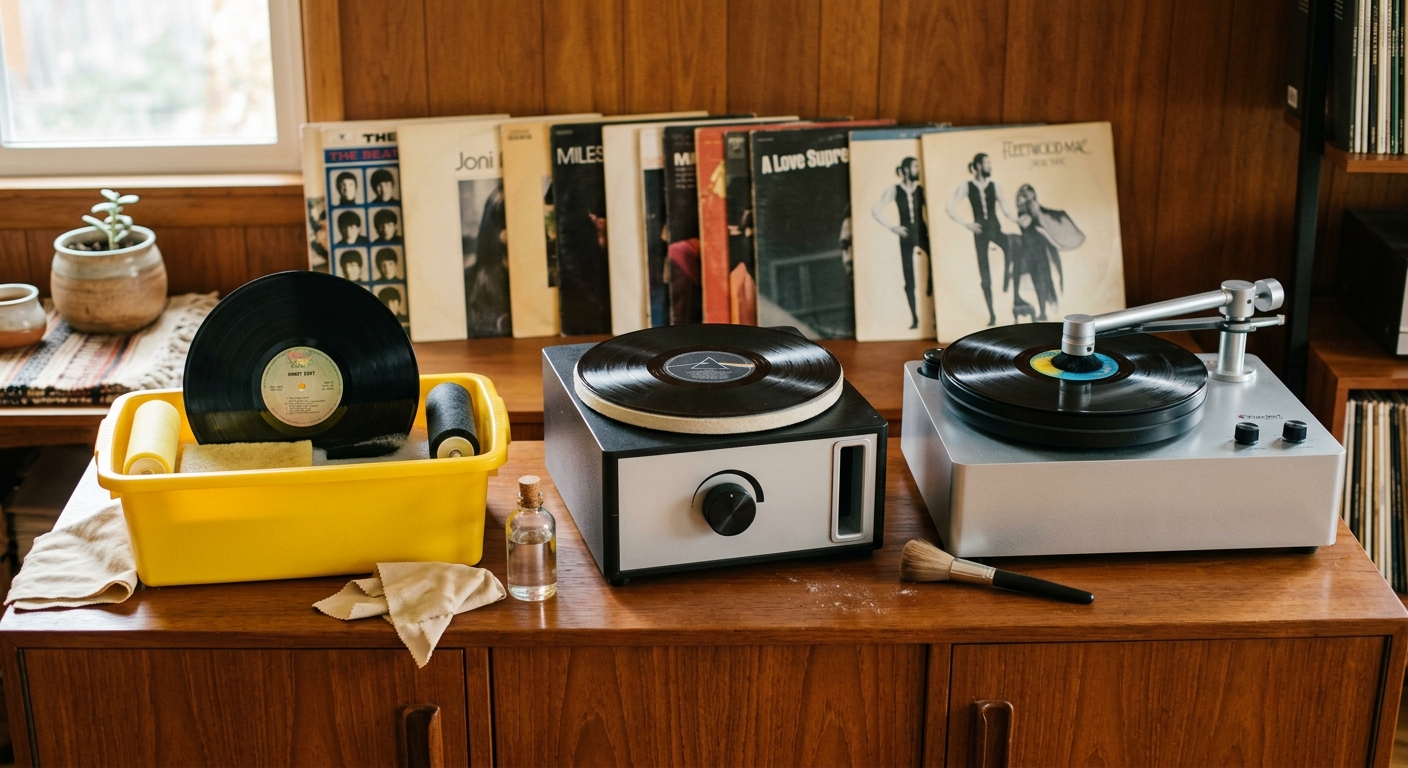
Dirty records are the single biggest source of pops, crackles, and stylus wear in any vinyl setup. A record cleaning machine (RCM) is not an audiophile luxury anymore, it is the most cost-effective upgrade you can make to a turntable you already own. This guide walks through every meaningful budget RCM between roughly $80 and $500, with the specs, real-world cleaning quality, and noise tradeoffs so you can pick one without overpaying.
Why a dedicated RCM beats hand cleaning
A carbon-fiber anti-static brush removes surface dust but cannot reach the bottom of the groove where micro-debris and static-bound particles sit. Wet cleaning with a proper machine flushes the groove, lifts embedded grime, and removes the static charge that re-attracts dust the moment the record leaves the brush. The audible difference is not subtle: properly cleaned records routinely reveal detail, bass articulation, and channel separation that was being masked by surface noise.
Cleaning by hand with a cloth and fluid is messy, inconsistent, and risks pushing debris deeper into the groove. A machine with paired brushes (Spin-Clean style) or a vacuum slot (Record Doctor and up) does both sides of the record at once in a controlled, repeatable way.
The three tiers of budget record cleaning machines
Budget RCMs split into three practical tiers based on how they handle the drying step, which is what actually separates a cleaning machine from a bath toy.
Tier 1: Manual bath washers (under $100)
These submerge the record in a fluid bath and use opposing brushes to scrub both sides simultaneously. You dry the record by hand with a microfiber cloth. They are cheap, durable, and surprisingly effective.
Spin-Clean Record Washer MKII ($79-$80): The default starting recommendation. Hand-built in Pittsburgh since 1975, the MKII cleans LPs, 45s, and 78s in a yellow basin using two sets of brushes and a bottle of alcohol-free fluid that is enough for roughly 700 records. The basin is 6 inches wide by 15 inches long by 6 inches high, requires no power, and the whole unit weighs under five pounds. You get three clockwise and three counter-clockwise rotations, then dry with the supplied microfiber cloths. Alan Sircom's review for HiFi+ summed it up: the dark grey gunk at the bottom of the basin after a few "clean-ish" records tells you everything you need to know about how much was hiding in the grooves. Limited lifetime warranty on parts, excluding brushes. This is the right answer for most collectors who clean 10-30 records a month.
Downside: you hand-dry, and the fluid needs to be changed every 50 records or so. Cross-contamination between records in the same bath is the main quality complaint and is real, but solvable by changing fluid more often than the manual suggests.
Tier 2: Manual vacuum RCMs ($200-$350)
These add a vacuum slot that pulls the cleaning fluid off the record as you hand-rotate it. Drying is faster, more complete, and the vacuum removes the suspended grime that a cloth leaves behind. The trade is noise and price.
Record Doctor VI ($299.95): The current version of the platform Michael Fremer reviewed twice for AnalogPlanet. It uses a Pangea-sourced applicator brush, a fluid-resistant anodized aluminum top plate, and a motor-driven vacuum slot. You hand-rotate the record over the vacuum while fluid is applied. About 95 dB at standing distance, which means earplugs for serious cleaning sessions. The VI added a cover, a larger injection-molded turner, and a new roller bearing compared to the original V. The hand grip completely covers the label, which is the kind of detail that matters when you are doing a hundred records at a time. Drain plug at the bottom for the storage tank.
KAB EV-1 ($169): A manual vacuum RCM that requires you to bring your own shop vacuum. Cheaper upfront than the Record Doctor but adds the cost and storage of a wet/dry shop vac (around $20-$60 for a basic 1.5-2 HP unit). Best for collectors who already own a shop vac or who want to disassemble the cleaning station between sessions.
Squeaky Clean Mark III ($145 plus vacuum): The DIY-favorite manual vacuum RCM. Compact, breaks down into its shipping box for storage, and you supply your own shop vac. Comes with adapters for 7" and 10" records. The reviews on Steve Hoffman and Vinyl Engine are consistent: it works, and it works well, but the noise from a small shop vac is brutal. One owner measured his 3 HP shop vac as "ungodly loud" and recommended a smaller 1.75 HP unit instead. The Squeaky Clean is the budget pick if you want vacuum cleaning without paying Record Doctor prices.
Tier 3: Automatic vacuum RCMs ($400-$700)
These spin the record automatically and run the vacuum arm over the surface. You apply fluid by hand, push a button, and the machine does both sides in 1-2 rotations. This is the sweet spot for collectors cleaning 50+ records per session.
Pro-Ject VC-E2 ($449 USD / $480 / 450 EUR): Pro-Ject's compact automatic vacuum RCM. 30 RPM cleaning speed, magnetic clamp that seals the record label, 0.5-liter internal waste tank, and the new Wash it 2 alcohol-free pre-mixed cleaning fluid in the box. 6.5 kg, 310 x 266 x 210 mm. Dries a record completely in two rotations. The aluminum composite cabinet is 5 mm thick and resists fluid spills. Released in March 2023 as the successor to the original VC-E, this is the right pick for collectors with limited shelf space who still want motorized rotation.
Pro-Ject VC-S3 ($649 USD / $745 / 699 EUR): Pro-Ject's flagship in the budget range and the most-respected automatic vacuum RCM under $1,000. Same 30 RPM cleaning speed as the E2 but with a more powerful motor (cataphoretic surface treatment for longevity), a larger 2.5-liter waste tank that "almost never needs to be emptied" when using Wash it 2 because the fluid evaporates in the tank, and a heavier 8 kg / 17.6 lb chassis. Marc Henshall's review concluded: if you have the space and budget, the larger VC-S3 is still the flagship Pro-Ject record cleaning machine. The S3 is the standard against which every other sub-$1,000 RCM gets measured.
HumminGuru HG01 Ultrasonic ($379-$394): The first budget-priced ultrasonic cleaner that is not a kit. Ultrasonic cleaning uses 40 kHz sound waves to create cavitation bubbles in a water bath, which physically dislodge contaminants without any brush contact. The HG01 weighs 3 kg, measures 13.5 x 6 x 11 inches, has dual 40 kHz transducers, and runs a clean and dry cycle in 7-15 minutes. Auto-drains to an internal tank, dual fans for drying, and thermal protection that cuts power at 131 degrees F. Positive Feedback measured the original HG01 going for as little as $379. This is the right pick if you have records with deep groove contamination that brush-based machines cannot fully address, and you do not mind the longer cycle time.
Okki Nokki One ($500-$600): The Dutch-made alternative to the Pro-Ject VC-S3 at similar money. Quieter than the VC-S3 (82 dB versus higher on the S3 depending on cycle), similar cleaning quality, and a loyal following among collectors who prefer the form factor. The Savvy Tune head-to-head concluded both are defensible choices and the difference between them is ergonomics, not cleaning quality. Used Okki Nokki units regularly sell on the Steve Hoffman forums for $385-$450, which is the value play in this tier.
Side-by-side specs comparison
| Machine | Price (USD) | Type | Drying | Cycle per LP | Noise |
|---|---|---|---|---|---|
| Spin-Clean MKII | $79-$80 | Manual bath | Hand cloth | ~2 min | Silent |
| Squeaky Clean Mark III | $145 + vac | Manual vacuum | Vacuum slot | ~3 min | Very loud |
| KAB EV-1 | $169 | Manual vacuum | Vacuum slot | ~3 min | Very loud |
| Record Doctor VI | $299.95 | Manual vacuum | Vacuum slot | ~3 min | 95 dB |
| HumminGuru HG01 | $379-$394 | Automatic ultrasonic | Dual fan | 7-15 min | Quiet |
| Pro-Ject VC-E2 | $449-$480 | Automatic vacuum | Vacuum arm | ~1 min | Moderate |
| Pro-Ject VC-S3 | $649-$745 | Automatic vacuum | Vacuum arm | ~1 min | Moderate |
| Okki Nokki One | $500-$600 | Automatic vacuum | Vacuum arm | ~1 min | 82 dB |
Which one matches your collection
Under 50 records, no recent purchases: A carbon-fiber brush and a quality cleaning spray are enough. Skip the machine.
50-300 records, occasional used buys: The Spin-Clean MKII at $80. The bath washer approach handles the steady-state cleaning of a personal collection at the lowest possible cost per record. Pair it with distilled water and you'll get years of service.
300-1,000 records, regular used-record or thrift-store hunting: The Record Doctor VI at $300. Vacuum drying matters when you are cleaning a dozen records at a time, and the hand-rotation is tolerable at this volume. The 95 dB noise is the real cost; budget for earplugs or run sessions when neighbors are not home.
1,000+ records, deep groove contamination, or 7-inch and 10-inch cleaning: The Pro-Ject VC-S3 at $649-$745. Automatic rotation and a vacuum arm remove the manual labor bottleneck. If budget is tight, the used Okki Nokki market at $385-$450 is the value play in this tier. If you specifically need ultrasonic-grade cleaning for vintage or mold-affected records, the HumminGuru HG01 at $379 is the only sub-$500 option.
Cleaning fluid, fluid costs, and what to avoid
Alcohol-based cleaning fluids strip mold-release compound from older vinyl and can damage shellac 78s. The new generation of alcohol-free, pre-mixed fluids (Pro-Ject Wash it 2, Spin-Clean MKII fluid, HumminGuru fluid) are designed to clean without attacking the vinyl. Stick with the manufacturer's fluid unless you have a specific reason to mix your own. The 25% isopropyl alcohol, distilled water, and a drop of dish soap recipe still works and is cheap, but it is harder on the records over time and not worth the savings at the volumes most collectors clean.
Distilled water is mandatory in any bath washer. Tap water leaves mineral deposits in the grooves that are worse than what you started with. A gallon of distilled water costs about $2 at any grocery store and is good for roughly four Spin-Clean refills.
Frequently asked questions
How often should I clean a record? Every 10-25 plays for general listening records, before every play for archival or rare records. New vinyl out of the sleeve can usually use a clean before first play because of the static charge it accumulated during manufacturing and shipping.
Does cleaning actually improve sound? Yes, measurably. The reduction in surface noise reveals detail and dynamics that were masked. Audiophile reviewers consistently rank a properly cleaned record ahead of an identical dirty one, every time, in blind tests.
Can I use a Spin-Clean if I already own a Record Doctor? Many collectors do. The Spin-Clean is faster for bulk cleaning, the Record Doctor is better for one-off deep cleans. They are complementary, not competing.
Are ultrasonic cleaners safe for vinyl? Yes, when used as designed. The HumminGuru HG01 uses 40 kHz cavitation which is below the threshold that damages vinyl. Do not substitute a generic jewelry ultrasonic cleaner for a record-specific unit because the frequencies and basin designs are not matched to LP geometry.
What about DIY methods like a wet shop vac on the rug? They work in a pinch but are messy, inconsistent, and risk damaging records. A dedicated RCM is safer and faster once you clean more than a handful of records per month.
Pick the tier that matches your collection size, factor in the noise cost of any vacuum-based machine, and budget for distilled water and proper cleaning fluid. Anything from the Spin-Clean MKII upward will pay for itself in stylus life alone within the first year.
A spreadsheet tracks what you own. What's Spinning identifies what's playing.
On-device vinyl ID logs your listening history automatically. 7-day free trial.
Looking for Shazam for vinyl?
What's Spinning identifies what's playing on your turntable on-device, logs history, and AirPlays now-playing to your TV.
Comparing vinyl ID apps?
Analog requires Discogs and is iPhone-first (iPad coming). What's Spinning works without Discogs on iPhone and iPad with AirPlay.
Try What's Spinning Free
Turn your iPad into a live now-playing display. Track every record you spin.
START FREE TRIALThen $4.99/mo or $39.99/yr · Cancel anytime