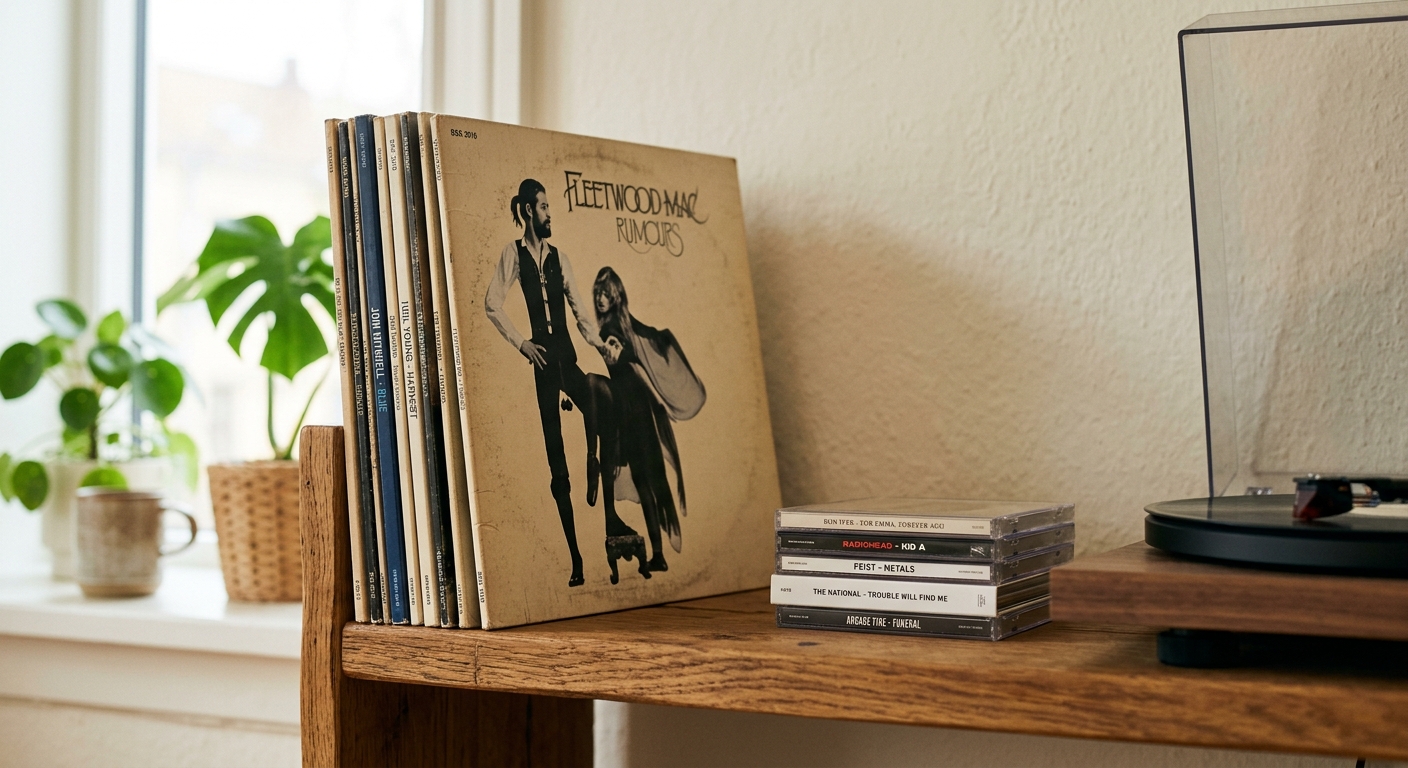
Vinyl vs CD Sound Quality: A Comparison Explained
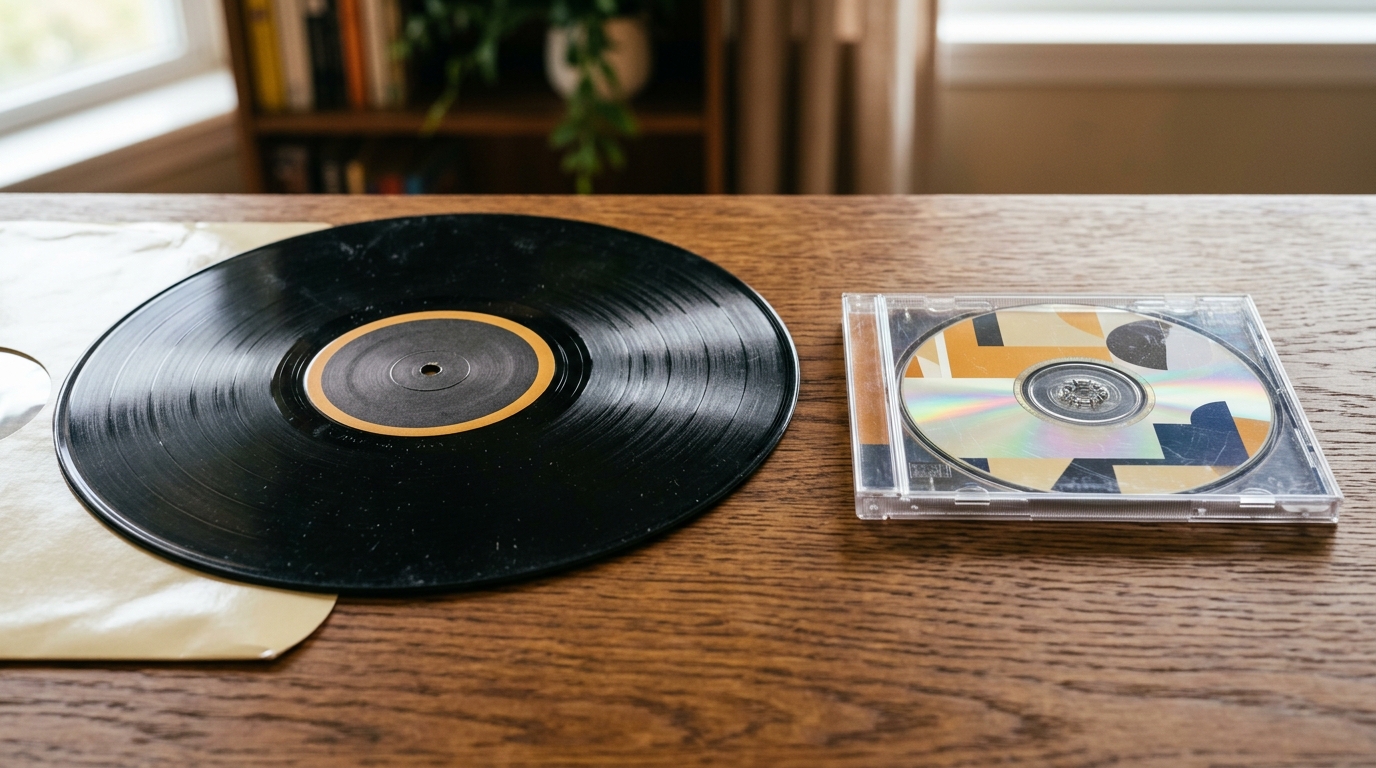
Vinyl and CD are both physical music formats still bought in serious quantities in 2025, but they take completely different routes from a studio master to your ears. Vinyl stores an analog waveform as a physical groove cut into PVC. A CD stores 44,100 sixteen-bit samples per second per channel as pits and lands on a polycarbonate disc, read by an infrared laser. The two formats share no common engineering assumptions about what a recording should sound like, and that gap is where the entire vinyl vs CD sound quality conversation lives.
What the specs actually say
Measured head-to-head, a Red Book CD wins on every fidelity benchmark. A 16-bit, 44.1 kHz CD has a theoretical dynamic range of about 96 dB, and in real-world playback sits at roughly 90 to 95 dB. A clean vinyl LP manages about 55 to 70 dB in practice, because surface noise, rumble, and groove geometry each eat into the usable window. That gap looks stark on a spec sheet, and most of the loudness comparisons people quote online come straight from it.
Channel separation tells a similar story. A good phono cartridge returns about 20 to 30 dB of left-right separation at 1 kHz, dropping to 10 to 15 dB at 12 kHz, because both stereo channels are physically carved into the same groove wall. A CD keeps the channels fully discrete until the DAC, so separation comfortably exceeds 90 dB. Vinyl also adds harmonic distortion that CDs do not: total harmonic distortion on a well-pressed LP runs roughly 0.05 percent or higher, while CD playback sits around 0.002 to 0.003 percent. Add in wow and flutter (vinyl turntables drift by up to about 0.05 percent, CDs are clocked to a crystal oscillator with effectively zero), and the measurement table is one-sided.
Why vinyl still wins blind listening tests
If CDs win on paper, why do so many listeners prefer vinyl in level-matched, blind A/B tests against their own digital counterpart? The answer is mostly about mastering, not the format itself. Most labels cut a separate vinyl master from a separate CD or streaming master, because the physical limits of the groove force different choices. RIAA equalization (in place since 1954 with time constants of 3180, 318, and 75 microseconds) requires bass to be attenuated and treble boosted at the cutting stage, then re-equalized in reverse at playback. Cutting engineers also tame extreme sub-bass, fold very low frequencies to mono for groove stability, and de-ess sharp sibilance to keep the stylus tracking cleanly. Those choices shape the final sound.
The other big factor is the so-called loudness war. CDs have so much headroom that producers began pushing levels hard with brickwall limiters in the 1990s to win radio play. A peak-limited digital master flattens dynamics and exposes listener fatigue. Many vinyl releases of the same album used a less-compressed master because extreme limiting can throw the cutting stylus out of the groove. As a result, a vinyl pressing of, say, Kind of Blue or Remain in Light often sounds more dynamic than the same album's standard CD reissue, even though the medium is technically noisier. A cleaner master plus a noisier format sometimes beats a louder master plus a quieter format.
The harmonic and crosstalk story
Vinyl playback is non-linear. The stylus tracing the groove adds small amounts of low-order harmonic distortion, especially second harmonic, that the ear reads as warmth rather than error. Studios spend money on analog-modeling plugins specifically to recreate that character. CDs do not add such harmonics at normal listening levels, so they sound more neutral, which some listeners describe as clinical and others describe as accurate. The same even-order distortion also gives vinyl its softer transient behavior: analog circuits tend to round peaks gradually instead of clipping abruptly, which can reduce perceived harshness on dense mixes.
Crosstalk works in vinyl's favor in an unexpected way. Because both channels share one groove, a small amount of left signal bleeds into right and vice versa, lowering measured separation. In a real room, your left ear already hears a bit of the right speaker and vice versa, so a small amount of crosstalk actually mimics natural crossfeed and can make a recording sound more cohesive rather than locked hard to one speaker. CD channels are nearly perfectly isolated, which is technically better but can sound more sterile on wide-panned material.
Where the market actually is in 2025
The RIAA's 2025 year-end revenue report, released March 16, 2026, put vinyl at $1.04 billion in U.S. wholesale revenue on 46.8 million units sold. That is the first time the format has crossed $1 billion since 1983, and it represents 19 consecutive years of growth. CDs, by comparison, generated $312.4 million on 29.5 million units, an 11.6 percent revenue decline year over year. Vinyl now outsells CDs by units (46.8M to 29.5M) and generates more than three times the revenue. Globally, vinyl grew 13.7 percent in 2025. Brazil's vinyl revenue jumped 136 percent in 2023, Japan's volume rose 14 percent in 2024, and the UK hit £196 million on 6.7 million discs in 2024.
Streaming still dominates total revenue at $9.47 billion (82 percent of the U.S. recorded music market), and paid subscriptions grew to 106.5 million accounts. CDs are losing share mostly because streaming is more convenient, not because of any specific sonic failing. Vinyl's growth is being driven by listeners who were not even born the last time the format was this popular, treating records as both a listening experience and a collectible object.
How to choose between them
If your priority is technical accuracy, the lowest noise floor, the widest dynamic range, and the cheapest price per album, a CD (or a CD-quality FLAC rip) is the right pick. A modern $100 DAC and a careful rip will outperform nearly any vinyl rig at the same price, because analog playback is unforgiving of cheap cartridges and tonearms. To match a mid-priced CD player with vinyl, you typically need to spend at least double on the analog side, including a turntable, cartridge, phono preamp, and proper isolation.
If your priority is the listening ritual, large-format artwork, and the often gentler mastering that vinyl receives, vinyl remains genuinely compelling. New vinyl costs roughly twice as much as new CDs on average, and well-mastered reissues (180-gram pressings from labels like Mobile Fidelity, Analogue Productions, and Music Matters) tend to sound noticeably better than their CD counterparts because of the mastering choices, not the format itself. Many serious listeners own both formats and pick based on the album and the session.
The honest summary: vinyl and CD sound different not because one is fundamentally more accurate, but because they are mastered differently and use different playback chains. A CD pressed from a brickwalled 1990s master can lose to a well-cut vinyl pressing of the same album. A vinyl pressing cut from the same flat digital master offers no inherent advantage. If you care about sound quality, master quality matters more than format choice. If you care about the experience of listening, both formats still earn a place on a shelf in 2025.
Frequently asked questions
Does vinyl actually sound better than CD?
Not in measurable fidelity terms. A 16-bit CD delivers roughly 96 dB of dynamic range against vinyl's 55 to 70 dB, has a far lower noise floor, and exhibits significantly less distortion. Vinyl can sound subjectively more pleasant because it is often mastered with more dynamic range than the same album's CD, and the playback chain adds low-order harmonic distortion that many listeners perceive as warmth. The advantage comes from mastering and the playback experience, not from the medium itself.
Is CD quality the same as high-resolution audio?
No. CD quality is 16-bit at 44.1 kHz, the Red Book standard set in 1980. High-resolution audio starts at 24-bit and 96 kHz and extends up to 24-bit, 192 kHz or higher. CD quality already covers the full range of human hearing (20 Hz to 20 kHz) and offers about 96 dB of dynamic range, which exceeds the 95 dB span from a quiet studio to the threshold of pain. Controlled blind tests rarely show audible differences between CD quality and high-resolution formats for human listeners.
Why are vinyl records making a comeback?
Vinyl sales have grown for 19 consecutive years through 2025, reaching $1.04 billion in U.S. wholesale revenue on 46.8 million units, the highest level since 1983. Drivers include large-format album artwork, the listening ritual, often more dynamic mastering than CD counterparts, and a collector market that has expanded well beyond older audiophiles. The growth is in addition to streaming, not a replacement for it.
Is it worth buying a CD player in 2025?
Yes, if you already own CDs or buy used ones cheaply, or if you want lossless digital audio without paying a streaming subscription. A budget CD player and a $100 DAC will deliver full Red Book quality from any disc. The format itself is mature and unforgiving of equipment choices, unlike vinyl, so the gap between cheap and expensive CD playback is much smaller than the gap between cheap and expensive turntable setups.
A spreadsheet tracks what you own. What's Spinning identifies what's playing.
On-device vinyl ID logs your listening history automatically. 7-day free trial.
Looking for Shazam for vinyl?
What's Spinning identifies what's playing on your turntable on-device, logs history, and AirPlays now-playing to your TV.
Comparing vinyl ID apps?
Analog requires Discogs and is iPhone-first (iPad coming). What's Spinning works without Discogs on iPhone and iPad with AirPlay.
Try What's Spinning Free
Turn your iPad into a live now-playing display. Track every record you spin.
START FREE TRIALThen $4.99/mo or $39.99/yr · Cancel anytime
Get it on your iPhone
Open on iPhone