Vinyl vs CD Sound Quality: The Debate Explained
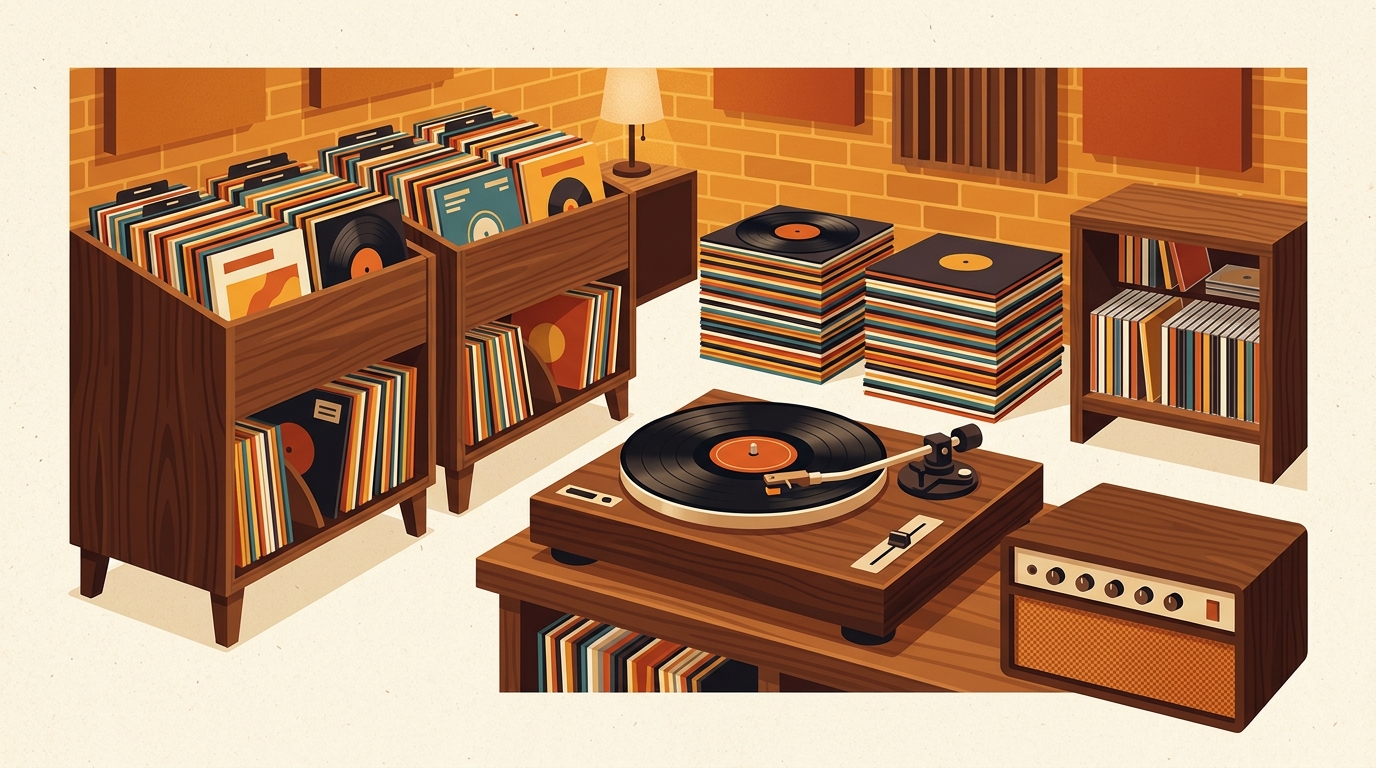
The vinyl vs cd sound quality debate never dies because it is really two debates pretending to be one. One question is technical: which format can reproduce a master recording with less noise, distortion, and loss? The other is personal: which format makes music feel more alive in a real listening room, with a real collection, on a real Saturday night?
The honest answer is satisfying and a little annoying. A well-made CD is the more accurate carrier. A well-made record can still be the version you prefer. If you collect music, that distinction matters more than picking a team.
What CD gets right
Compact Disc Digital Audio uses 16-bit linear PCM at 44.1 kHz. That sample rate can represent frequencies up to 22.05 kHz under the Nyquist limit, safely covering the usual human hearing range, and 16-bit audio gives roughly 96 dB of theoretical dynamic range. In plain English, a CD can be very quiet, very clean, and very consistent from the first track to the last. It does not care whether the song is near the center label, whether your stylus is worn, or whether a previous owner dragged a needle across the chorus.
That consistency is why engineers tend to give CD the technical win. SoundGuys notes that CD-quality digital audio uses 44,100 samples per second and 16 bits per sample, while digital files can offer much more dynamic range than vinyl before noise becomes the limiting factor [1]. Disc Makers makes the same broad point, citing CD dynamic range as high as about 96 dB and explaining why the 44.1 kHz sampling rate is enough for audible frequencies [2].
Where vinyl fights back
Vinyl is not a clean room format. It is a mechanical system: groove, stylus, cantilever, cartridge, tonearm, phono stage, amplifier, speakers. That chain adds variables, and some of those variables are exactly what listeners love. A cartridge can slightly soften the top end. A phono stage can add pleasing color. A good pressing can make drums feel physical and vocals feel human. Surface noise can even create a small sense of space before the music starts.
The catch is that these pleasures come with compromises. Records have surface noise. They can warp. They wear. Bass has to be managed during cutting. Very bright sibilants and inner-groove passages can become tricky. Channel separation is usually far lower than CD, and dynamic range is often quoted around 55 to 70 dB in practical vinyl playback, depending on the pressing, groove location, setup, and condition. Audioholics summarizes the engineering argument bluntly: even standard Red Book CD has a large dynamic-range advantage over vinyl, plus better stereo separation and no wow and flutter from the medium itself [3].
The master often matters more than the format
Here is where the internet arguments usually go sideways. People compare a beloved 1970s LP with a harsh 1990s CD reissue and conclude that vinyl beats CD. Or they compare a mint early CD with a noisy modern novelty pressing and conclude that vinyl is a scam. Neither comparison proves much.
Mastering can overwhelm format differences. A CD mastered with tasteful dynamics can sound excellent. A record cut from a compressed digital master can sound flat. The reverse can also happen: a vinyl edition may use a less aggressive master because the cutting engineer has to keep groove velocity, side length, and tracking in mind. That is why collectors compare specific releases, not just formats. The question is not simply “LP or CD?” It is “which mastering, which pressing, which condition, and which playback setup?”
Why collectors still care about both
The market shows that this is not a purely technical argument. RIAA’s 2025 year-end report says vinyl remained the leading physical format in the United States, selling 46.8 million units compared with 29.5 million CDs, and generating more than three times CD revenue [4]. That does not mean vinyl is objectively better. It means people value the object, the artwork, the scarcity, the ritual, and the collectibility.
CD has its own collector case too. Used CDs are often affordable, they preserve booklets and bonus tracks, and they can be ripped bit-perfectly for a library you actually control. For some 1980s and early 1990s releases, an early CD can be the most honest, least hyped version available. For long albums, CD also avoids the compromises of squeezing too much music onto one LP side.
So which sounds better?
If “better” means lower distortion, lower noise, wider dynamic range, and closer repeatability, CD wins. If “better” means a more involving object, a playback ritual you enjoy, and a particular tonal character from your system, vinyl can win in your room. That is not a contradiction. It is two different definitions of quality.
A practical collector should keep both ideas in play. Use CD when you want reliable fidelity, low cost, portability, and clean playback. Choose vinyl when the pressing is known to be strong, the artwork matters, the album length suits the format, and you enjoy the turntable experience. If you use What's Spinning to track listening habits, note the exact pressing or CD edition when one version clearly beats another. Your ears may remember the feeling, but your future self will appreciate the data.
Buying advice for the real world
- For quiet music, inspect vinyl condition carefully. Surface noise matters more on jazz, folk, ambient, classical, and singer-songwriter records.
- For loud modern rock and pop, compare mastering notes. The CD may be compressed, but the LP is not automatically better.
- For long albums, CD often has the advantage unless the vinyl is spread across two LPs.
- For rare releases, do not confuse price with sound quality. Scarcity and fidelity are different things.
- For a fair test, level-match carefully. Louder usually sounds better at first, even when it is not better.
The best answer to the vinyl vs CD question is not a slogan. CD is the cleaner measuring format. Vinyl is the more interactive format. Great music collectors learn when each one serves the album.
FAQ
Does vinyl sound better than CD?
Sometimes it can feel better, especially if the vinyl was mastered with more care or you enjoy the physical playback chain. Technically, CD has lower noise, wider dynamic range, and cleaner channel separation.
Why do some records sound warmer than CDs?
Warmth can come from mastering choices, cartridge response, phono preamp color, harmonic distortion, and the way vinyl handles very loud or bright material. It is real as a listening experience, but it is not automatically higher fidelity.
Can a CD copy sound worse than a vinyl copy?
Yes. If the CD uses a harsh, heavily compressed master and the LP uses a more open master, the vinyl can be the more enjoyable release even though the CD format itself is technically stronger.
Which format should collectors buy first?
Buy the format that matches your habits. CD is usually cheaper, compact, and consistent. Vinyl is tactile, collectible, and rewarding when the pressing, setup, and condition are right.
A spreadsheet tracks what you own. What's Spinning identifies what's playing.
On-device vinyl ID logs your listening history automatically. 7-day free trial.
Looking for Shazam for vinyl?
What's Spinning identifies what's playing on your turntable on-device, logs history, and AirPlays now-playing to your TV.
Comparing vinyl ID apps?
Analog requires Discogs and is iPhone-first (iPad coming). What's Spinning works without Discogs on iPhone and iPad with AirPlay.
Try What's Spinning Free
Turn your iPad into a live now-playing display. Track every record you spin.
START FREE TRIALThen $4.99/mo or $39.99/yr · Cancel anytime