Best Budget Turntables Under $100: Top Picks for New Vinyl Collectors
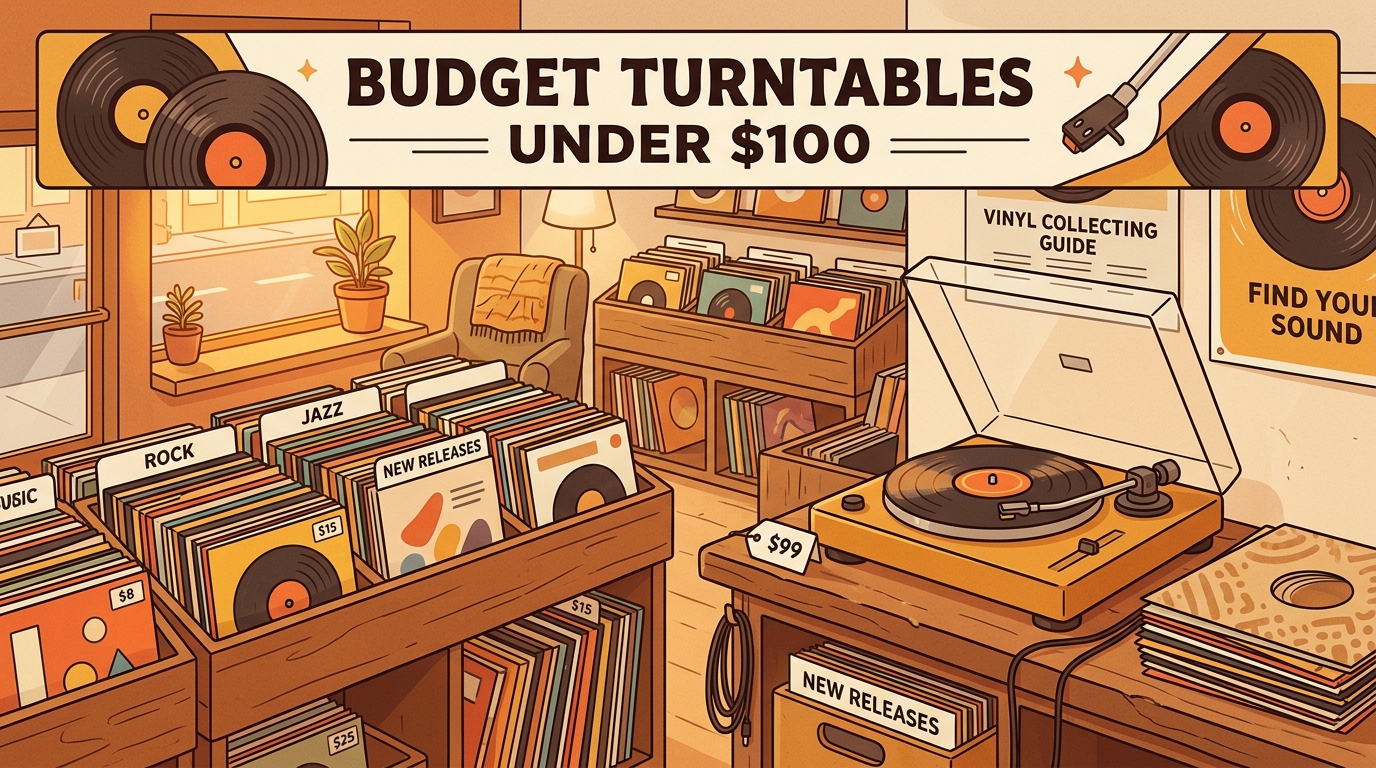
Shopping for the best budget turntables under 100 is the vinyl version of digging through the clearance bin. There are bargains, a few compromises, and a lot of things that look fun until you imagine playing a $35 reissue on them every week. The good news is that a careful under-$100 setup can absolutely start a real collection. The honest news is that the best buys are usually used, open-box, or sale-priced models rather than shiny new suitcase players.
That distinction matters because vinyl is not a nostalgia sideshow anymore. The RIAA's 2023 year-end report put U.S. vinyl revenue at $1.4 billion, up 10%, and said vinyl albums outsold CDs in units for the second year in a row, 43 million to 37 million. If you are buying records at current prices, your first turntable should protect them, play at stable speed, and leave room for better speakers later. What's Spinning can handle your listening log once the record is on the platter, but the turntable still has to do the mechanical job.
Quick comparison
| Pick | Best for | Why it stands out | Watch-outs |
|---|---|---|---|
| Used Audio-Technica AT-LP60X | Simple first setup | Fully automatic belt drive, built-in preamp, 33 1/3 and 45 rpm playback | Usually above $100 new, limited adjustment |
| Insignia NS-BTST21 | Feature hunters | Adjustable counterweight, anti-skate, Bluetooth output, phono or line output | Often $129.99 new, setup matters |
| Crosley C6 | Manual deck on sale | Two-speed belt drive, adjustable tonearm, more serious design than suitcase Crosleys | Version and cartridge vary, check accessories |
| Suitcase player | Decoration or casual novelty use | Cheap, compact, built-in speakers | Weak speakers, light platters, little upgrade path |
What makes a sub-$100 turntable worth buying?
Start with the cartridge and tonearm. A moving magnet cartridge with a replaceable stylus is preferable to the generic ceramic cartridges found in many all-in-one players. You also want either an adjustable counterweight or a well-calibrated factory tonearm. Tracking force is not audiophile trivia; too much force can accelerate stylus and groove wear, while too little can cause mistracking and skipping.
A built-in phono preamp is useful at this price because it lets the turntable plug directly into powered speakers, a soundbar with aux input, or a receiver line input. Belt drive is common in this tier and perfectly fine for home listening. Built-in speakers are convenient, but tiny cabinets usually mean narrow stereo image and weak bass. If the budget forces a choice, buy the better turntable now and use modest powered speakers until you can upgrade.
Best overall under $100: used Audio-Technica AT-LP60X
The Audio-Technica AT-LP60X is the safest recommendation if you can find one used, refurbished, or open-box under $100. New pricing is commonly closer to $179, so it does not honestly belong in a new-only under-$100 list. As a secondhand buy, though, it is exactly what many beginners need: fully automatic operation, two-speed playback for 33 1/3 and 45 rpm records, and a built-in switchable phono preamp.
The AT-LP60X is not for tinkerers. You do not get the adjustable counterweight and cartridge flexibility found on better manual decks. The upside is ease. Press start, let the arm cue itself, and focus on record condition, cleaning, and speaker placement. For a first collection, that simplicity can prevent more problems than it creates.
Best sale pick: Insignia NS-BTST21
The Insignia NS-BTST21 is the budget deck to watch when Best Buy discounts it or lists open-box units. During research it showed at $129.99 with a 4.4-star customer rating from 569 reviews, so it is not always under $100, but its feature set is unusually strong near this range. Best Buy lists Bluetooth output, a belt-drive design, adjustable counterweight and anti-skate, a switchable preamp for phono or line output, and 33 1/3 and 45 rpm support.
Those features make it more upgrade-friendly than most ultra-cheap players. They also make setup more important. If the counterweight is wrong, the best spec sheet in the world will not save the record. Buy it only if you are willing to balance the arm, set tracking force, and check that the platter speed is steady.
Best manual option if discounted: Crosley C6
The Crosley C6 is the model that proves the Crosley name alone is not enough information. This is not the same category as the brand's suitcase players. Crosley's own C6 pages describe a manual, two-speed, belt-driven turntable with 33 1/3 and 45 rpm playback and an adjustable tonearm counterweight. Some C6 listings also mention an Audio-Technica AT3600L-style cartridge, which is a much better starting point than a mystery ceramic cartridge.
The catch is version drift. Retailers have sold different C6 variants over the years, and accessories matter. Before buying, confirm the cartridge, dust cover, belt, power supply, and stylus condition. A $90 deck plus a missing belt and dead stylus is not a $90 deck anymore.
What to avoid
Most suitcase record players are better treated as lifestyle objects than collection foundations. They are cheerful and portable, but the usual compromises are small speakers, lightweight platters, limited tonearm control, and little path to better sound. If you only want to play beat-up thrift records twice a month, that may be fine. If you are building shelves of records you care about, spend the same money on a used component-style turntable and separate speakers.
Final recommendation
For most new collectors, the best under-$100 move is a used Audio-Technica AT-LP60X from a seller with a return window. If you prefer a manual deck and can handle setup, watch for the Insignia NS-BTST21 or Crosley C6 on sale. The real goal is not winning a spec sheet contest. It is getting a stable, record-friendly setup that lets you enjoy albums now and upgrade pieces later.
FAQ
Can a turntable under $100 damage records?
It can if it uses a poor cartridge, excessive tracking force, or a tonearm with no useful adjustment. Occasional playback is not instant destruction, but repeated plays on a badly set up player can accelerate wear.
Is Bluetooth bad for vinyl?
Bluetooth is convenient, but it compresses the signal and adds another digital step. It is fine for casual listening. For best sound, use wired line or phono output into powered speakers, an amplifier, or a receiver.
Should I buy new or used?
Under $100, used is usually smarter. Ask about stylus age, check that both speeds work, confirm the platter spins steadily, and make sure the tonearm cues smoothly.
What should I upgrade first?
Speakers usually make the biggest audible difference. After that, consider a fresh stylus, a carbon-fiber brush, anti-static inner sleeves, and a stable stand that keeps vibration away from the turntable.
A spreadsheet tracks what you own. What's Spinning identifies what's playing.
On-device vinyl ID logs your listening history automatically. 7-day free trial.
Looking for Shazam for vinyl?
What's Spinning identifies what's playing on your turntable on-device, logs history, and AirPlays now-playing to your TV.
Comparing vinyl ID apps?
Analog requires Discogs and is iPhone-first (iPad coming). What's Spinning works without Discogs on iPhone and iPad with AirPlay.
Try What's Spinning Free
Turn your iPad into a live now-playing display. Track every record you spin.
START FREE TRIALThen $4.99/mo or $39.99/yr · Cancel anytime
Get it on your iPhone
Open on iPhone