Best Vinyl Cartridge Under $200: Expert Picks for Better Sound
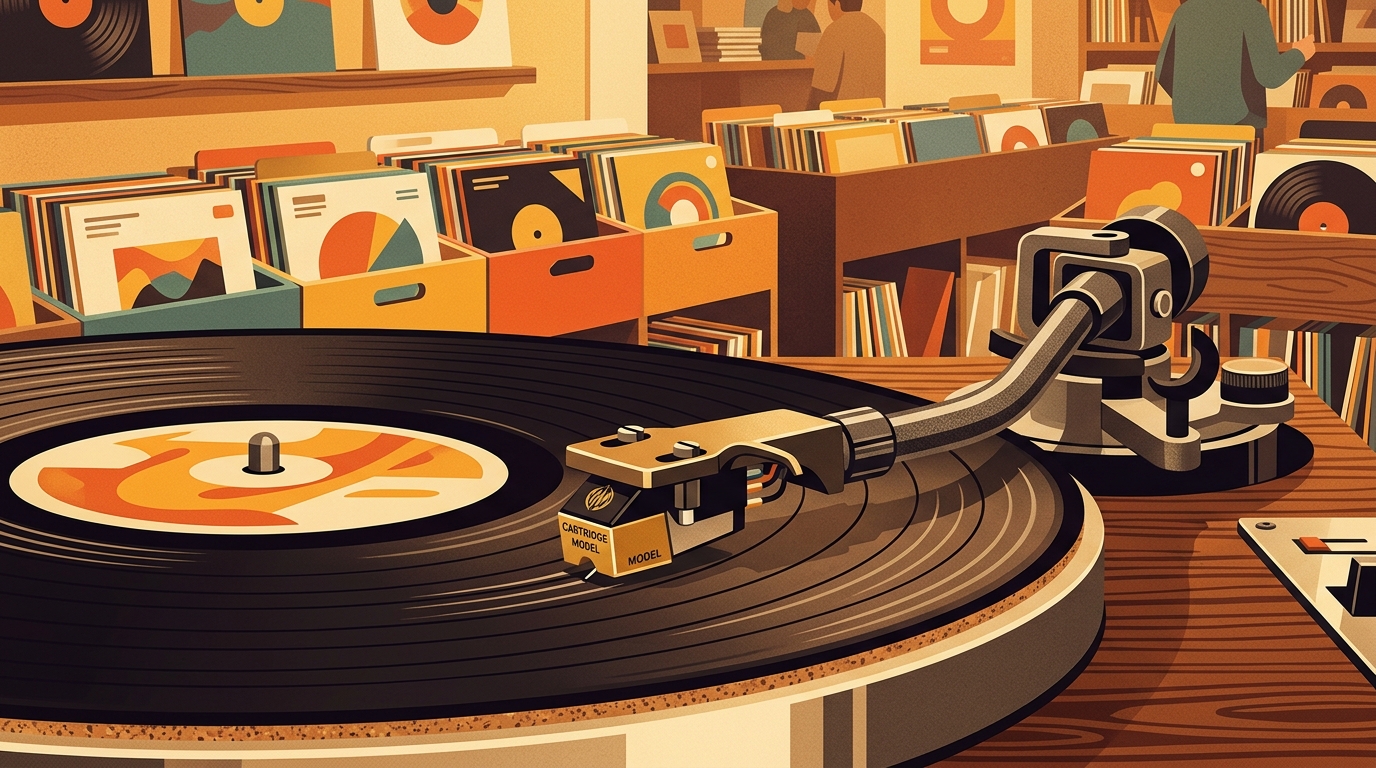
If you want the biggest audible upgrade under $200, start at the tiny diamond riding in the groove. A good cartridge will not fix a warped record or a bad pressing, but it can lower distortion, improve tracking, pull cleaner detail from inner grooves, and make worn bargain-bin LPs less tiring to hear. That matters more than ever because vinyl is no longer a niche format. The RIAA's 2025 year-end report says U.S. vinyl shipments reached 46.8 million units, versus 29.5 million CDs, and vinyl passed $1 billion in annual revenue for the first time since the early 1980s. More records in circulation means more systems that deserve a sensible cartridge upgrade.
For this comparison, I focused on cartridges that work with normal MM phono inputs, list or sell below $200 at mainstream U.S. retailers, and fit standard half-inch mounts. I also favored cartridges with easy stylus replacement, because a cartridge is not a one-time purchase. If you track plays in What's Spinning, stylus life and setup notes are worth logging next to your most-played records.
Quick picks
| Pick | Best for | Typical price checked | Stylus |
|---|---|---|---|
| Audio-Technica AT-VM95ML | Best overall | $179 at Crutchfield and Turntable Lab | Nude MicroLinear |
| Nagaoka MP-110 | Warm, forgiving listening | $169.78 at LP Gear | Bonded elliptical |
| Sumiko Rainier | Upgradeable MM body | Usually around the mid-$100s | 0.3 x 0.7 mil elliptical |
| Grado Prestige Green4 | Rich midrange | $140 direct from Grado | Elliptical |
| Ortofon 2M Red | Easy matching and lively sound | €99 direct from Ortofon, often near $99 in the U.S. | Elliptical |
1. Audio-Technica AT-VM95ML, best overall under $200
The AT-VM95ML is the cartridge I would recommend first to most collectors because it puts the budget where it counts: the stylus profile. Crutchfield lists it at $179 and notes a 2.2 x 0.12 mil MicroLinear stylus, 20 Hz to 25 kHz frequency response, 3.5 mV output, 23 dB stereo separation, and 1.5 dB channel balance. Audio-Technica's own manual identifies the stylus as a nude MicroLinear design. In plain English, that shape can trace tight inner-groove information more cleanly than a basic bonded elliptical when alignment is right. The tradeoff is that setup matters. Do not eyeball it, use a protractor, set tracking force correctly, and keep records clean. If you can do that, this is the value champ.
2. Nagaoka MP-110, best for warmth and older records
The MP-110 has earned its following because it sounds relaxed without turning dull. Nagaoka specifies 5 mV output, 20 Hz to 20 kHz frequency response, 23 dB channel separation, 1.5 dB or better channel balance, 47 kOhm loading, and 1.5 to 2.0 g tracking force. LP Gear listed the cartridge at $169.78 when checked. The stylus is a bonded 0.4 x 0.7 mil elliptical, so it does not have the tracing advantage of the Audio-Technica MicroLinear, but the tonal balance can be kinder to bright systems, used LPs, and long listening sessions. If your speakers already lean analytical, the MP-110 may be the smarter match.
3. Sumiko Rainier, best upgrade path
Sumiko's Rainier is the practical pick if you want to start modestly and upgrade later without realigning a whole new cartridge. Sumiko states that the Rainier, Olympia, Moonstone, Wellfleet, Amethyst, and RS 78 styli are interchangeable on the family body. The Rainier itself uses a moving magnet design with a 0.3 x 0.7 mil elliptical stylus, 6.7 g body mass, 5.0 mV output, 25 dB channel separation, 15 Hz to 20 kHz frequency response, and a 2.0 g recommended tracking force. It is not the most forensic cartridge here. Its appeal is body, ease, and a sensible path to a better stylus later.
4. Grado Prestige Green4, best midrange character
Grado has moved its entry Prestige line to the Green4, Red4, and Gold4, with the Green4 at $140 direct. The company describes the Prestige models as user-replaceable stylus designs built around its flux-bridger moving iron principle, high-purity OCC copper coils, and die-injection molded bodies. Grado cartridges have a loyal audience for vocals, jazz, soul, and acoustic music because they tend to emphasize flow and midrange color over etched brightness. Two cautions: some turntable motor layouts can produce hum with unshielded Grado bodies, and the softer presentation will not suit everyone. If your system is lean, though, the Green4 can be wonderfully listenable.
5. Ortofon 2M Red, best plug-and-play crowd pleaser
The 2M Red is popular for a reason. Ortofon specifies 5.5 mV output, 22 dB channel separation, 20 Hz to 20 kHz frequency response, a bonded elliptical stylus, and 1.8 g recommended tracking force. Its high output and standard 47 kOhm loading make it easy to pair with common phono stages. Compared with the AT-VM95ML, the Red can sound punchier and more forward, but it is less refined on difficult inner grooves. Its best argument is convenience: easy availability, strong compatibility, and a familiar upgrade path to the 2M Blue stylus if your budget grows.
How to choose
Match the cartridge to your table and your records, not to internet tribalism. For a clean, well-aligned medium-mass tonearm, the AT-VM95ML is the best technical buy. For thrift-store rock, older jazz, and slightly hot systems, try the Nagaoka. If you own a Pro-Ject or Sumiko-equipped deck and want a simple stylus ladder, the Rainier is appealing. For voice-first listening, the Grado is the character pick. For a lively cartridge that nearly every shop understands, the 2M Red remains useful.
One rule: keep $20 to $30 for setup tools. A $200 cartridge aligned properly can beat a pricier one installed crooked.
Sources
- RIAA 2025 Year-End Recorded Music Revenue Report
- Crutchfield, Audio-Technica AT-VM95ML listing
- Audio-Technica AT-VM95ML manual
- Nagaoka MP-110 specifications
- LP Gear, Nagaoka MP-110 listing
- Sumiko Rainier specifications
- Grado Prestige cartridge lineup
- Ortofon 2M Red specifications
FAQ
What is the best cartridge under $200 for most vinyl listeners?
The Audio-Technica AT-VM95ML is the safest all-around pick because its MicroLinear stylus tracks inner grooves better than most elliptical cartridges in this price range, and replacement styli are easy to find.
Is a cartridge upgrade worth it on an entry-level turntable?
Yes, if the turntable has adjustable tracking force, anti-skate, and a standard half-inch mount. If your turntable has a fixed cartridge or no counterweight, spend the money on a better turntable first.
Do I need a new headshell when I buy a cartridge?
Not always. If your arm uses a removable SME-style headshell, a pre-mounted cartridge can save setup time. If not, buy the cartridge only and align it carefully with the proper protractor for your tonearm.
How often should I replace the stylus?
Many elliptical styli are commonly replaced after several hundred hours, while advanced shapes can last longer when clean and aligned. Always follow the maker's guidance, keep records clean, and replace immediately if you hear mistracking or visible damage.
A spreadsheet tracks what you own. What's Spinning identifies what's playing.
On-device vinyl ID logs your listening history automatically. 7-day free trial.
Looking for Shazam for vinyl?
What's Spinning identifies what's playing on your turntable on-device, logs history, and AirPlays now-playing to your TV.
Comparing vinyl ID apps?
Analog requires Discogs and is iPhone-first (iPad coming). What's Spinning works without Discogs on iPhone and iPad with AirPlay.
Try What's Spinning Free
Turn your iPad into a live now-playing display. Track every record you spin.
START FREE TRIALThen $4.99/mo or $39.99/yr · Cancel anytime