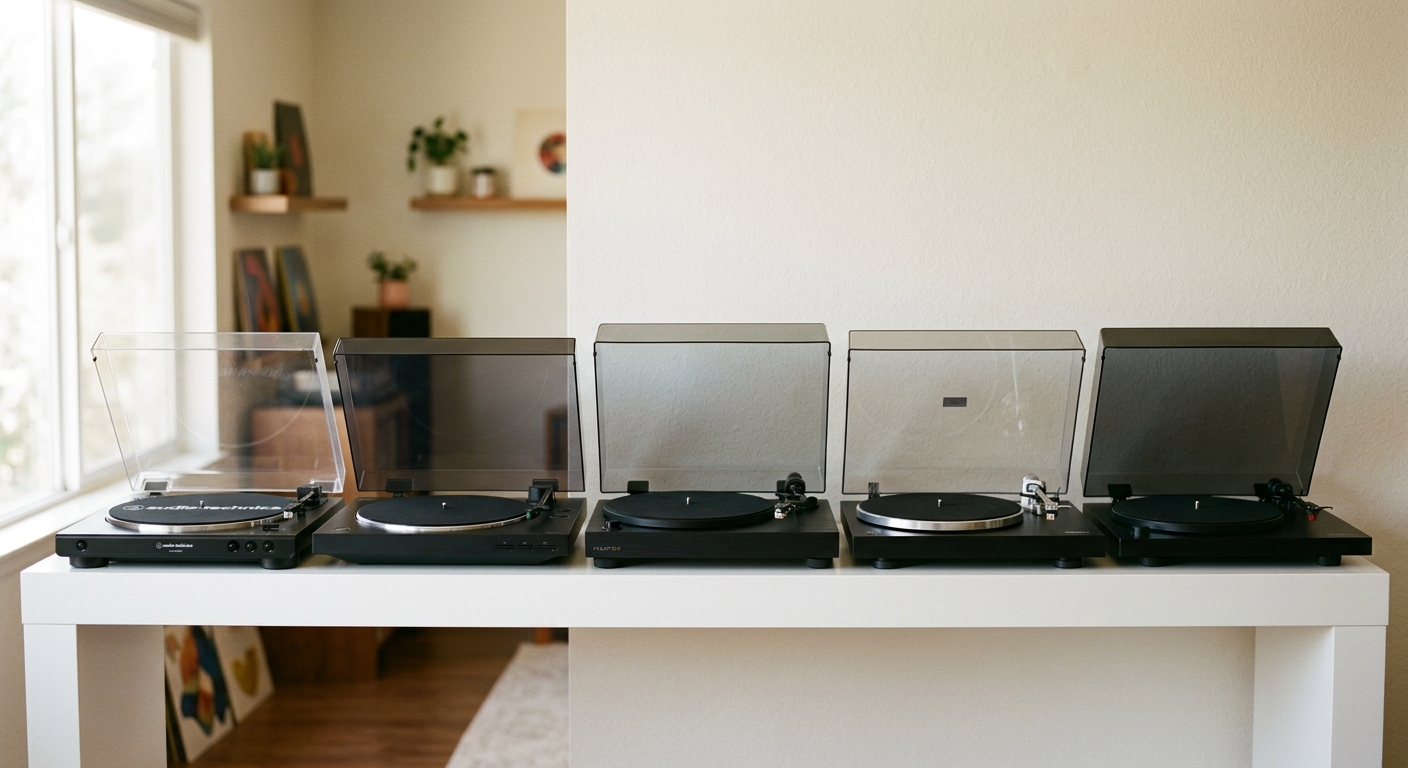
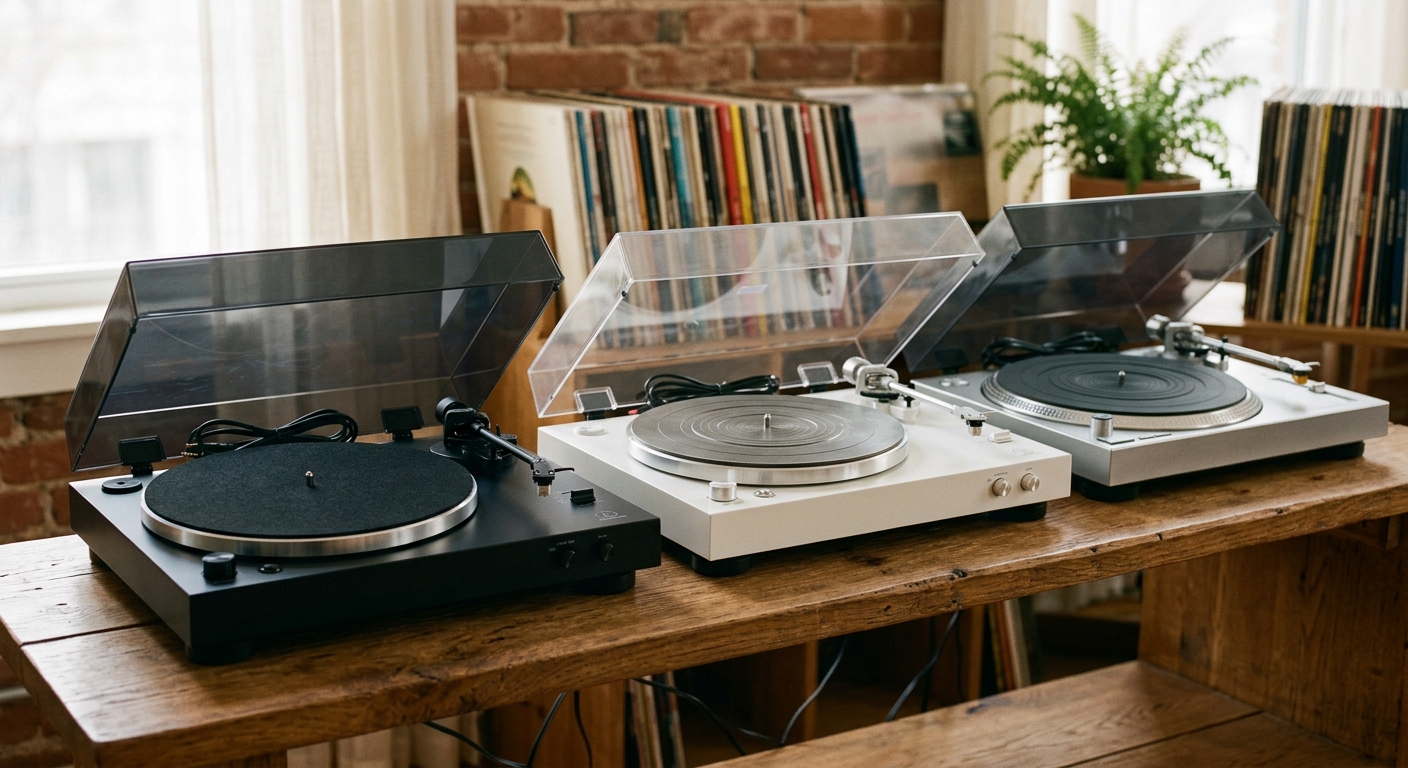
Best Entry-Level Turntables for Newbies: A Practical Comparison
If you are shopping for the best entry-level turntables, the goal is not to buy the most expensive deck you can justify. The goal is to avoid the beginner traps: suitcase players with heavy tracking force, plastic tonearms that cannot be adjusted, and all-in-one units that make clean records sound smaller than they should. A good first turntable should be easy to set up, gentle on records, stable at 33⅓ and 45 RPM, and upgradeable enough that you do not outgrow it immediately.
Vinyl is not a tiny niche anymore. The RIAA’s 2024 year-end report found that physical music revenue in the United States grew again, with vinyl still leading physical formats by revenue. That matters for new collectors because the starter market is finally crowded with decent choices. You can buy automatic operation, Bluetooth, a built-in phono preamp, or a sound-first manual deck depending on how you actually listen. And if you use What’s Spinning to log records as you play them, a reliable everyday turntable helps your collection history become useful instead of random.
Quick picks
- Best simple automatic pick: Audio-Technica AT-LP70X
- Best Bluetooth convenience pick: Sony PS-LX310BT
- Best sound-first starter pick: Fluance RT82
- Best minimalist manual pick: Pro-Ject E1
- Best made-in-USA upgrade path: U-Turn Orbit Basic
- Best stretch pick: Rega Planar 1
How to compare beginner turntables
Start with the stylus, cartridge, and tonearm. The stylus is the part touching your record, so a replaceable cartridge from Audio-Technica, Ortofon, Rega, or another real hi-fi maker is a major plus. Next, check whether the turntable has a built-in phono preamp. If it does, you can plug into powered speakers, an AUX input, or a receiver line input. If it does not, you need a receiver with phono input or an external phono stage.
Automatic operation is not cheating. Auto start and auto stop can prevent stylus drops and end-of-side panic. Manual turntables often sound better for the money because the budget goes into the platter, motor, tonearm, and cartridge instead of automation. Bluetooth is convenient, but wired RCA into good powered speakers is still the cleaner path.
Audio-Technica AT-LP70X: best beginner-friendly automatic turntable
The AT-LP70X is one of the easiest recommendations for someone who wants vinyl to feel welcoming on day one. Audio-Technica lists it as a fully automatic belt-drive turntable with 33⅓ and 45 RPM playback, a switchable built-in phono preamp, and the company’s AT-VM95C cartridge platform. That cartridge matters because the stylus is replaceable, and the VM95 family gives you a sensible upgrade path without replacing the whole deck.
Sony PS-LX310BT: best for Bluetooth and apartment listening
Sony’s PS-LX310BT removes friction. It is fully automatic, supports Bluetooth output, includes a built-in phono preamp, and plays both 33⅓ and 45 RPM records. For a dorm room, apartment, or living room where wired speakers are awkward, that combination is genuinely useful.
Fluance RT82: best sound quality under the serious-starter line
The Fluance RT82 is where entry-level starts to feel like real hi-fi. Fluance specs it with an Ortofon OM 10 cartridge, a servo-controlled motor, and an optical speed sensor designed to help maintain speed stability. Unlike some cheaper starter decks, it does not include a built-in phono preamp, so you will need a receiver with phono input or a separate phono stage.
That missing preamp is not a flaw, it is the point. More of the budget goes into the turntable itself. For new collectors buying used jazz, soul, classic rock, or electronic pressings and wanting records to sound spacious instead of merely nostalgic, the RT82 is a strong sweet spot.
Pro-Ject E1: best minimalist manual deck
Pro-Ject’s E1 is built for beginners who want a proper manual turntable without turning setup into homework. The core appeal is simple: clean belt-drive layout, minimalist design, and fewer automatic parts. Depending on configuration, it can also be bought with a phono stage or Bluetooth.
U-Turn Orbit Basic: best simple upgrade platform
U-Turn’s Orbit Basic keeps things intentionally stripped down. U-Turn lists a belt-drive design, manual speed change for 33 and 45 RPM, and an Audio-Technica AT91B cartridge. The attraction is not a huge feature list. It is the clean design, accessible parts, and clear upgrade ladder.
If you want your first table to grow with you, the Orbit makes sense. You can start basic, then consider a better platter, cartridge, or built-in Pluto phono preamp depending on the configuration. The manual speed change is less convenient if you play a lot of 45s, but many LP-focused collectors will barely notice.
Rega Planar 1: best stretch pick for long-term listening
The Rega Planar 1 costs more than most beginner decks, but it is often the first turntable that feels like a long-term audio purchase. Rega lists it with the RB110 tonearm and factory-fitted Carbon cartridge. It is deliberately simple, with the engineering emphasis on the arm, bearing, plinth, and motor system rather than lifestyle extras.
So, which one should a newbie buy?
If you want the safest recommendation, buy the Audio-Technica AT-LP70X. It balances convenience, record safety, and upgradeable stylus options better than most beginner decks. If Bluetooth is essential, choose the Sony PS-LX310BT. If sound quality matters more than convenience, start with the Fluance RT82 and a decent phono preamp. If you want a clean manual deck, compare the Pro-Ject E1 and U-Turn Orbit Basic. If vinyl is clearly becoming a real hobby, stretch to the Rega Planar 1.
The best entry-level turntables are not the ones with the most features. They are the ones that keep your records safe, make setup painless enough that you keep listening, and leave room for better speakers, a better stylus, and a deeper collection later.
FAQ
Should a beginner buy a turntable with a built-in preamp?
Usually, yes. A built-in phono preamp makes setup much easier because you can connect directly to powered speakers or a standard line input. If you are building a more serious hi-fi system, an external phono stage gives you more flexibility.
Is Bluetooth bad for vinyl?
Bluetooth is convenient, but it is not the highest-fidelity way to listen. It converts the analog signal to digital, compresses it, then sends it wirelessly. For casual listening it is fine. For the best sound, use a wired RCA connection.
Are suitcase record players really that bad?
Many are. The biggest issues are heavy tracking force, limited stylus options, small built-in speakers, and poor isolation. They can be fun as novelty players, but they are not the best way to protect records you care about.
What should I upgrade first after buying a beginner turntable?
Upgrade speakers first. Better speakers usually make a bigger difference than a cartridge swap on a starter system. After that, consider a better stylus, an external phono preamp, and a record cleaning routine.
A spreadsheet tracks what you own. What's Spinning identifies what's playing.
On-device vinyl ID logs your listening history automatically. 7-day free trial.
Looking for Shazam for vinyl?
What's Spinning identifies what's playing on your turntable on-device, logs history, and AirPlays now-playing to your TV.
Comparing vinyl ID apps?
Analog requires Discogs and is iPhone-first (iPad coming). What's Spinning works without Discogs on iPhone and iPad with AirPlay.
Try What's Spinning Free
Turn your iPad into a live now-playing display. Track every record you spin.
START FREE TRIALThen $4.99/mo or $39.99/yr · Cancel anytime