Best Starter Vinyl Records: Your First Collection
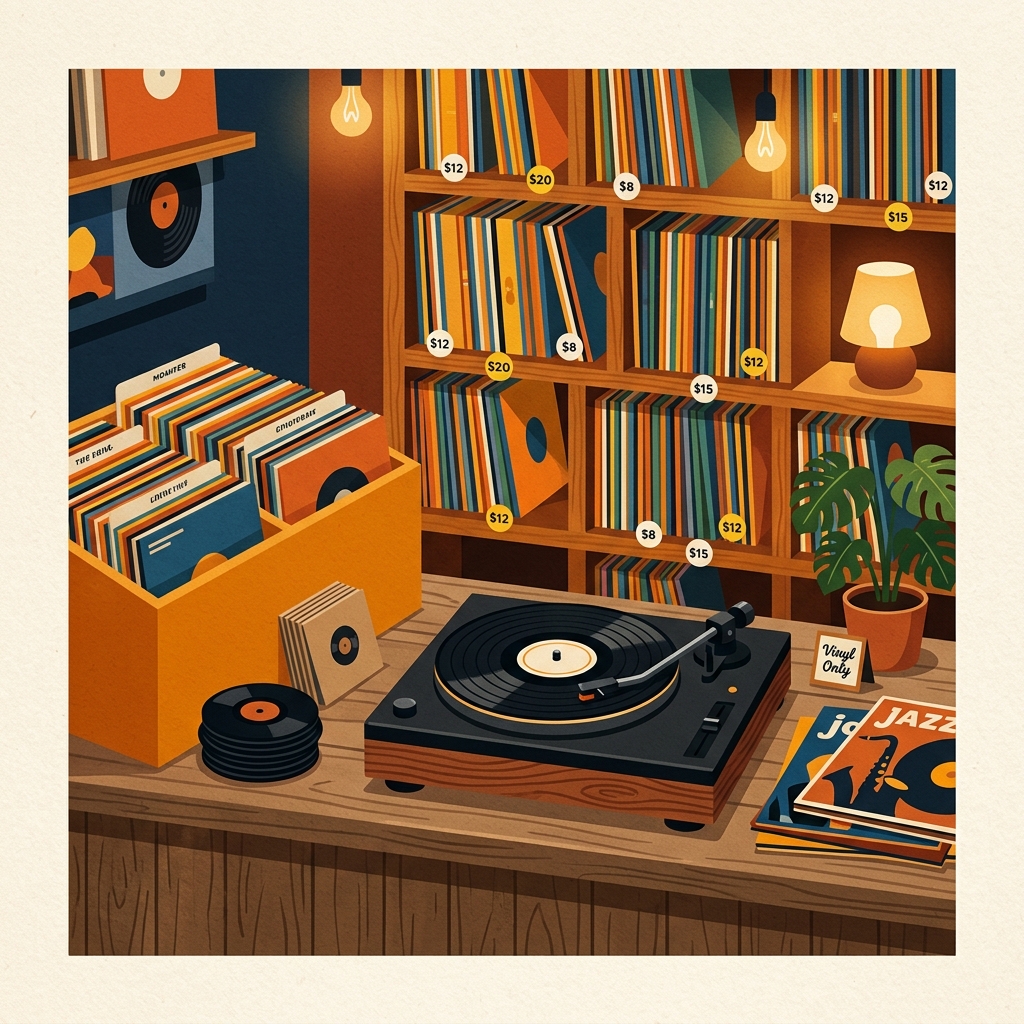
The best starter vinyl records are not the rarest albums, the most expensive pressings, or the records someone on the internet says you must own to be legitimate. A good first collection should teach you what vinyl does well: side-long sequencing, cover art, bass you can feel, quiet songs that reward clean surfaces, and records you want to replay instead of merely display.
There is a practical reason to be selective. Vinyl is healthy again, but it is not cheap. The RIAA reported that U.S. vinyl revenue grew 10% to $1.4 billion in 2023, the format’s seventeenth consecutive year of growth, and that LPs and EPs shipped 43.2 million units compared with 37.0 million CDs. RIAA The UK told a similar story, with Official Charts noting that 2023 was the sixteenth straight year of vinyl growth and the strongest annual level since 1990. Official Charts Demand is real, prices reflect that demand, and a beginner can burn money quickly by buying famous sleeves without thinking about listening habits.
Use this list as a balanced first shelf: jazz, soul, rock, pop, hip-hop, reggae, singer-songwriter craft, and a few records that test your turntable in different ways. Before you buy, track what you own and what you want. Discogs recommends learning release pages, condition grading, wantlists, and storage basics; the difference between a master release and a specific pressing can change both value and sound. Discogs If you want a simple way to remember what you played and what still needs a clean inner sleeve, use What's Spinning as your listening log, then let the records below teach you where your taste actually goes.
The 15 best starter vinyl records
Kind of Blue, Miles Davis, 1959
Start with the jazz record that never sounds like homework. Miles Davis cut Kind of Blue at Columbia’s 30th Street Studio with John Coltrane, Cannonball Adderley, Bill Evans, Wynton Kelly, Paul Chambers, and Jimmy Cobb, then built most of the session around modal sketches rather than dense chord changes. That matters for a beginner because the music breathes. The famous first side, with So What and Freddie Freeloader, teaches you how a quiet record can still fill a room. On vinyl, the bass has space, the horns sit in distinct positions, and the cymbals tell you whether your setup is tracking cleanly. You do not need an expensive original six-eye Columbia pressing to enjoy it. The common Legacy reissues are affordable, easy to find, and musically convincing. Buy a clean copy, play it late, and notice how the format rewards patience.
Rumours, Fleetwood Mac, 1977
Few starter records solve as many problems as Rumours. It is familiar enough to make a new collector feel immediately at home, yet the production is polished enough to show why people still care about LP playback. Fleetwood Mac made it while the band’s relationships were collapsing, but the album itself is almost unnervingly controlled: layered harmonies, dry drums, careful guitar figures, and hooks placed with surgical confidence. The sequencing is also perfect for a first shelf. Side one runs from Second Hand News to Songbird without wasting a groove, while side two opens with The Chain and keeps tightening. Used copies are common, but condition varies because this album lived on turntables for decades. If you buy used, inspect for groove wear on Dreams and Go Your Own Way. If you buy new, the recent Rhino editions are a safe, sensible starting point.
Abbey Road, The Beatles, 1969
Abbey Road earns its place because side two explains vinyl better than any lecture. The Beatles were effectively nearing the end, George Martin was back in the producer’s chair, and the album turns a group in fragments into a continuous suite that still feels inevitable. Beginners often arrive knowing Come Together or Here Comes the Sun, but the real lesson starts when You Never Give Me Your Money begins its long glide toward Golden Slumbers, Carry That Weight, and The End. A record side forces that architecture into focus. The 2019 remix is widely available and cleanly pressed in many copies, while older UK pressings can get expensive fast. Do not make your first Beatles purchase a condition gamble unless you can inspect it in person. Buy a playable copy and spend your attention on the medley, the bass lines, and Ringo’s only recorded Beatles drum solo.

What's Going On, Marvin Gaye, 1971
Marvin Gaye’s masterpiece is the soul album to buy before you start collecting soul albums. Motown had been built around singles, but What’s Going On moves like a conversation, with voices drifting in and out, bass lines carrying moral weight, and strings that feel less decorative than haunted. Its concerns, war, police violence, addiction, ecology, and spiritual exhaustion, were specific to 1971 and still uncomfortably current. For a vinyl beginner, the important thing is how unified it feels. The title track does not simply end so the next song can start. The album keeps passing the mood along, and side one becomes a suite about anxiety, compassion, and social conscience. Clean originals are beloved but not necessary. A good modern Motown reissue will give you the shape of the record, which is the point. Put it near your turntable because it will be reached for often.
Blue, Joni Mitchell, 1971
Blue is the record that teaches a new collector the value of quiet surfaces. Joni Mitchell left very little between the listener and the song: voice, piano, dulcimer, guitar, and the emotional precision of a writer who refuses to blur the edges. Because the arrangements are so exposed, condition matters more than it does on a loud rock record. A scratched copy will announce itself during River or A Case of You, and a clean one can feel almost private. That makes Blue a useful buying lesson as much as a musical one. Do not accept a trashed bargain unless you enjoy crackle as percussion. The album also proves that vinyl collecting is not only about big drums and famous riffs. Sometimes the most format-friendly record is the one that makes you lower the volume, sit closer, and listen to the room around the music.
The Dark Side of the Moon, Pink Floyd, 1973
A beginner collection needs at least one album that treats the studio as an instrument, and The Dark Side of the Moon is the obvious candidate because it still works. Alan Parsons engineered the sessions at Abbey Road, tape loops and synthesizers were woven into the band’s patient playing, and the record’s heartbeat, clocks, cash registers, voices, and reprises make more sense when you hear them as two sides rather than isolated tracks. The cover also matters. Hipgnosis gave the album a sleeve that turns a shelf into a tiny design museum, which is part of why used copies rarely stay in shops for long. Be careful, though. This record sold in enormous numbers, which means many used copies were played hard. A new copy is a perfectly respectable first buy. If you want to test a setup, Time will tell you about dynamics, sibilance, and whether your speakers can handle a record getting suddenly huge.
Thriller, Michael Jackson, 1982
Thriller is not here because it is famous. It is here because Quincy Jones and engineer Bruce Swedien made a pop record with absurd craft at every level. The grooves are clean, the bass is disciplined, the guest spots are purposeful, and the track order keeps changing the room: Wanna Be Startin’ Somethin’ opens like a command, Billie Jean becomes a study in tension, Beat It crosses into rock without sounding like a marketing meeting, and Human Nature glows. For a first vinyl shelf, it also raises a useful question: when an album is this common, do you buy used or new? Used copies can be inexpensive, but many were party records and show damage around the hits. Reissues are simple to find. Either way, Thriller gives your collection a benchmark for eighties production that still sounds expensive.
Songs in the Key of Life, Stevie Wonder, 1976
Some starter lists avoid double albums because they cost more and take longer to absorb. Make the exception for Songs in the Key of Life. Stevie Wonder’s classic is generous in the old-fashioned sense: sprawling, melodic, political, devotional, funny, and technically dazzling. The original release even came with an extra EP, which is a reminder that vinyl can be a package, not just a disc. As a listening experience, it teaches stamina. You will not fully digest Sir Duke, I Wish, Pastime Paradise, Knocks Me Off My Feet, and As on the first play, and that is the point. A collection should contain at least one album that keeps opening up. When buying used, confirm that all discs are present and the sides match the jacket. Missing bonus discs and mismatched copies are common enough to check before paying.
Nevermind, Nirvana, 1991
Nevermind is a useful first alternative record because it is both raw and highly produced. Butch Vig captured the force of Nirvana as a band, then the final mix made the hooks undeniable enough for pop radio. That tension is why it still plays well on vinyl. Smells Like Teen Spirit is the obvious entrance, but the album’s deeper value is pacing: In Bloom tightens the melodic grip, Come as You Are cools the room, Lithium builds its release valve, and Something in the Way closes with a kind of exhausted hush. Early original pressings are collector items now, so do not chase one casually. Standard reissues are the practical buy. Use this record to learn that loud guitar albums need not be blurry. A good pressing keeps the fuzz, the bass, and Dave Grohl’s drums from collapsing into one gray block.
Back to Black, Amy Winehouse, 2006
Back to Black gives a beginner something older records cannot: a modern album that deliberately argues with the past. Mark Ronson and Salaam Remi drew on girl-group drama, sixties soul, ska, and hip-hop-era low end, while Amy Winehouse wrote with a bluntness that keeps the arrangements from becoming costume work. On vinyl, the appeal is not nostalgia. It is contrast. Rehab snaps into place, You Know I’m No Good struts, Love Is a Losing Game narrows to heartbreak, and the title track sounds like the room got colder. Pressing quality can vary because the album has been reissued many times and demand stays high. Read recent buyer notes when ordering online. A clean copy belongs in a starter collection because it bridges vintage sonics and twenty-first-century songwriting without requiring a history lesson first.
The Miseducation of Lauryn Hill, Lauryn Hill, 1998
If your first shelf skips hip-hop and R&B, it is not a starter collection, it is a museum tour of rock canon. The Miseducation of Lauryn Hill fixes that immediately. The album blends rap, soul, reggae, gospel, and classroom interludes into a personal statement about love, faith, motherhood, fame, and self-possession. Its vinyl appeal comes from scale. Ex-Factor and Nothing Even Matters reward close listening, while Doo Wop can still move a room, and the interludes make more sense when you are not skipping around. Many copies are spread across two LPs, which means flipping more often, but that also protects sound quality by avoiding sides cut too long. Check the track listing of the version you buy, since some editions handle bonus material differently. This is the record that reminds beginners that album culture did not stop in the seventies.
Illmatic, Nas, 1994
Illmatic is short, dense, and almost perfectly built for vinyl. At roughly forty minutes, it never overstays its welcome, and its producer lineup, DJ Premier, Pete Rock, Large Professor, Q-Tip, and L.E.S., gives the album a New York sound that changes texture without losing identity. Nas was a teenager when he recorded much of it, but the writing is cinematic without becoming bloated. For a beginner, Illmatic is also a corrective to the idea that vinyl is only for analog-era music. Samples, drums, and voice can sound fantastic on a decent system when the pressing is cut well. The World Is Yours and N.Y. State of Mind are familiar entry points, but One Love is the one that shows the album’s storytelling power. Buy a standard black pressing before worrying about anniversary variants. The music matters more than the color of the disc.
Legend, Bob Marley and the Wailers, 1984
A compilation in a list of albums can feel like cheating, but Legend is the exception most real-world collections make. It has introduced generations of listeners to Bob Marley and the Wailers, and it remains one of the easiest reggae records to find in clean condition. The beginner value is practical: one LP gives you enough of the songwriting, groove, and vocal blend to decide where to go next. If Three Little Birds and One Love are the warm welcome, then I Shot the Sheriff and Redemption Song point toward deeper catalog listening. Once Legend clicks, buy Exodus, Catch a Fire, or Natty Dread. On vinyl, pay attention to bass. Reggae pressings can expose weak speakers, poor placement, or a turntable sitting too close to the sound source. That physical low end is part of the lesson.
A Love Supreme, John Coltrane, 1965
A Love Supreme is not the jazz record to put on as background music while making dinner. It is a four-part spiritual suite, recorded by John Coltrane’s classic quartet with McCoy Tyner, Jimmy Garrison, and Elvin Jones, and it carries a devotional intensity that can surprise new listeners. That is exactly why it belongs near the beginning, not the end. A collection should challenge you a little. The opening acknowledgement theme is memorable enough to hold onto, and Elvin Jones’s drumming gives the music a rolling force that translates beautifully through speakers. If Kind of Blue teaches space, A Love Supreme teaches commitment. Many respected reissues exist, including versions cut from strong source tapes, so beginners do not need to chase originals. Buy it when you are ready to sit still for a side and let the quartet define the terms.
Purple Rain, Prince and the Revolution, 1984
End the first fifteen with Purple Rain because it makes a room feel like a room again. Prince and the Revolution built an album that moves from arena rock to synth funk to gospel-scale melodrama without asking permission from genre boundaries. The vinyl sequencing is part of the thrill. Let’s Go Crazy opens with a sermon and a detonation, Computer Blue turns restless and strange, When Doves Cry strips pop down to nerves, and the title track spends almost nine minutes earning every second of its finale. Used copies are common, but the purple cover often hides records that were played at parties, on cheap changers, or with worn styli. Inspect carefully, especially for scratches near the beginning of side two. A good copy reminds a new collector that records are not only artifacts. They are invitations to turn the lights down and make the living room theatrical.
What to buy first if you only have room for five
If you are starting with five records instead of fifteen, choose Kind of Blue, Rumours, What's Going On, Illmatic, and Blue. That set gives you jazz, pop-rock, soul, hip-hop, and singer-songwriter intimacy, which is enough range to learn what your room, speakers, and ears respond to. If you mostly buy new, budget roughly $25 to $40 per title for widely available reissues. If you buy used, start with VG+ copies from a trusted local shop, then clean each record before the first play.
Do not chase first pressings yet. Your first goal is not investment-grade collecting. It is building a shelf that gets played. Once you know which of these records you keep returning to, the next purchases become obvious: more Blue Note and Impulse if the jazz albums hit, more Motown and Stax if Marvin opens the door, more nineties hip-hop if Nas and Lauryn Hill take over your evenings.
FAQ
How many vinyl records should a beginner start with?
Start with 5 to 10 records if your budget is tight, or 15 if you want a fuller genre spread. That is enough variety to learn what you actually play without creating a pile of expensive, unplayed records.
Should starter vinyl records be new or used?
Either works. New reissues reduce condition risk and are easy to replace. Used records can be cheaper and more interesting, but beginners should inspect the vinyl under bright light, avoid deep scratches, and learn basic grading before buying online.
Are original pressings worth it for a first collection?
Usually not. Original pressings can be wonderful, but they add cost and condition risk before you know your taste. Start with clean, reputable reissues or fairly priced used copies, then upgrade favorite albums later.
What genres should a first vinyl collection include?
Aim for range: one jazz record, one soul record, one rock or pop classic, one hip-hop album, one singer-songwriter album, and one record that simply means something personal to you. A varied shelf teaches the format faster than fifteen records from one lane.
A spreadsheet tracks what you own. What's Spinning identifies what's playing.
On-device vinyl ID logs your listening history automatically. 7-day free trial.
Looking for Shazam for vinyl?
What's Spinning identifies what's playing on your turntable on-device, logs history, and AirPlays now-playing to your TV.
Comparing vinyl ID apps?
Analog requires Discogs and is iPhone-first (iPad coming). What's Spinning works without Discogs on iPhone and iPad with AirPlay.
Try What's Spinning Free
Turn your iPad into a live now-playing display. Track every record you spin.
START FREE TRIALThen $4.99/mo or $39.99/yr · Cancel anytime