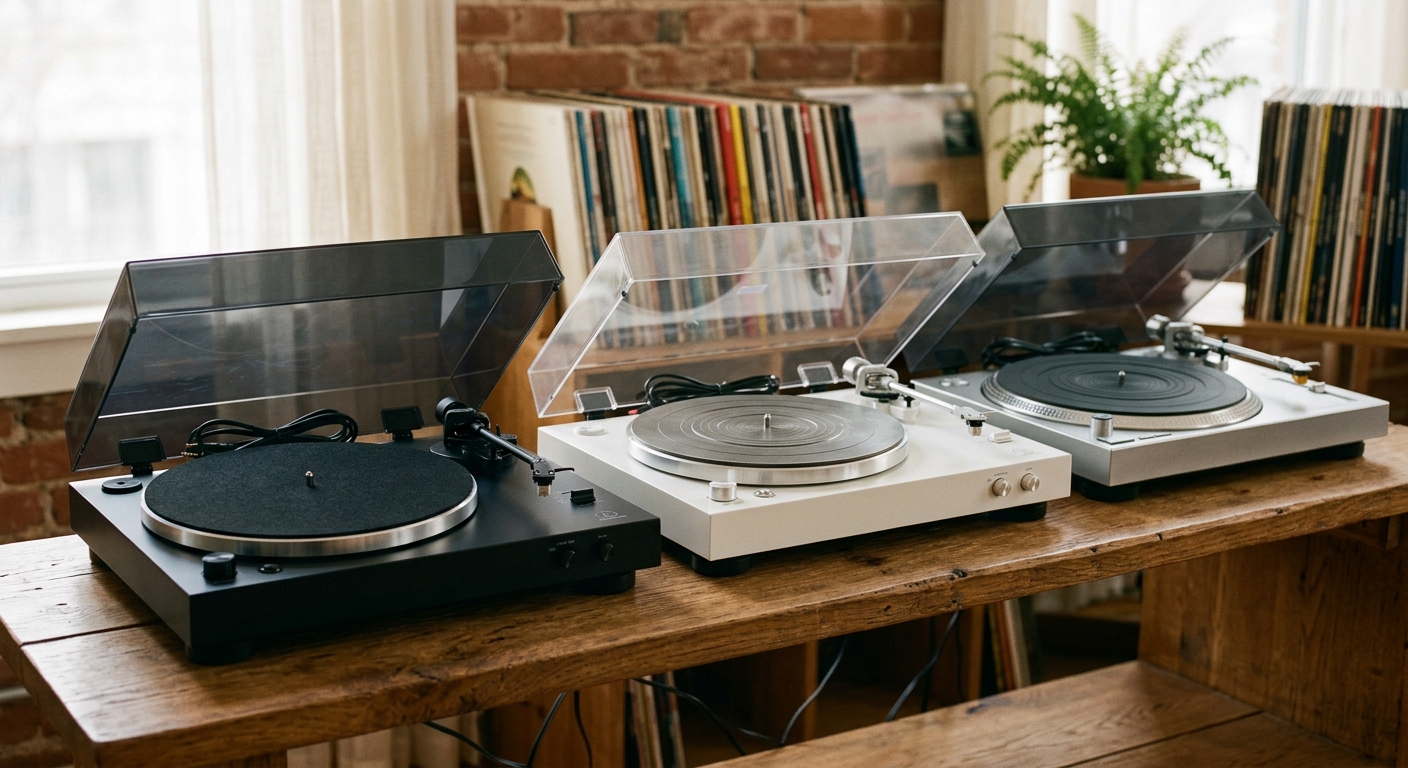
Best Budget Turntables Under $200: Hands-On Review
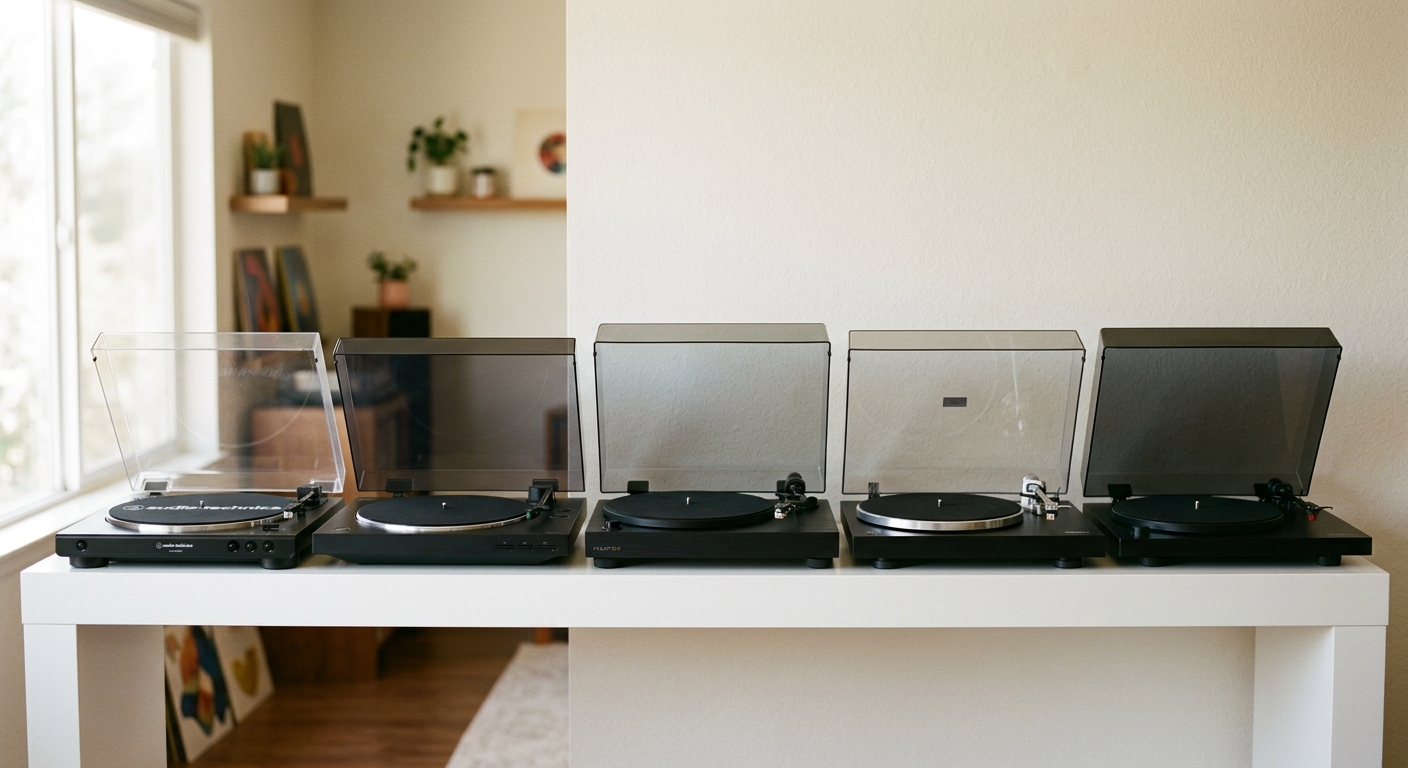
The category budget turntables under $200 has more depth than it did five years ago. Five models now dominate the conversation in 2026: the Audio-Technica AT-LP60X, Sony PS-LX310BT, Fluance RT80, Crosley C6, and Insignia NS-BTST21. This review walks through each one as a hands-on comparison, not a spec sheet comparison. We look at how they feel to set up, what the cartridge does to the sound, what real owners praise and complain about, and which one to buy if your priorities are pure sound, wireless convenience, or future upgradeability.
What you can actually get for under $200 in 2026
The sub-$200 tier is no longer a junk drawer of plastic Crosleys. Three things changed between 2020 and 2026: most sub-$200 turntables now ship with a real MM (moving-magnet) cartridge instead of a ceramic stylus, Bluetooth transmit has become standard on three of the five leading models, and counterweight-adjustable platters have moved down from $300 to under $200 (Crosley C6). That last change matters most: a counterweight-adjustable tonearm is the single biggest predictor of long-term cartridge-upgrade headroom.
What you cannot get: a fully manual belt-drive deck with a removable headshell and adjustable anti-skate under $200. That arrives around $300 (Audio-Technica AT-LPW40WN, Fluance RT85). The five models below all include some level of automation or built-in phono stage, and that is the price of staying under $200.
The five models, reviewed
1. Audio-Technica AT-LP60X -- $149 -- the default pick
The AT-LP60X is the highest-volume sub-$200 turntable in the US and the easiest to recommend without reservation. Fully automatic (one-button start/stop), belt drive, built-in phono preamp (switchable), and an AT-3600L MM cartridge pre-mounted. Setup is roughly five minutes from box to playing a record: lift the platter, run the belt around the motor pulley, place the mat, plug in, set the counterweight to the dotted factory mark (there is no adjustable counterweight, which is the one real limitation), and press start.
Sound: neutral, slightly warm, more detailed than the Bluetooth-only competitors. The AT-3600L is a decent starter cartridge and is easy to upgrade later to an AT-VM95E (~$50) without any wiring changes -- the headshell is a standard 1/2" mount. W&F measured at 0.25% WRMS (Audio-Technica spec), S/N above 50 dB (DIN-B). For most listeners, this is the last turntable they will ever need to buy unless they get deep into the hobby.
What owners praise: out-of-box ease, quiet operation, reliable Bluetooth pairing (the AT-LP60XBT version), small footprint.
What owners complain about: no adjustable counterweight means cartridge upgrades beyond the AT-VM95E require shimming; the auto-return sensor can be twitchy in very bright sunlight; the dust cover is acrylic and scratches easily.
2. Sony PS-LX310BT -- $198 street -- the wireless pick
If you want to play records through a soundbar, Bluetooth speaker, or wireless headphones without buying a separate phono preamp or receiver, the PS-LX310BT is the most reliable pick. Belt drive, fully automatic, built-in phono preamp with line-level and Bluetooth outputs, ATN-3600L MM cartridge (Sony-branded version of the AT-3600L). The Bluetooth path supports both SBC and the higher-quality aptX codec when paired with a compatible receiver, which gives noticeably better treble detail than SBC alone.
Sound: very slightly bright out of the box (the ATN-3600L tracks the same as the AT-3600L but with a different stylus profile). Bass weight is similar to the AT-LP60X; midrange is a touch forward. W&F measured at 0.1% WRMS (Sony spec, slightly better than the AT-LP60X), S/N above 50 dB.
What owners praise: one-button Bluetooth pairing, reliable aptX, slim profile, the metal platter (rare at this price).
What owners complain about: the auto-return sometimes lifts the tonearm mid-side on warped records (rare but reported), the dust cover hinge feels flimsy, no counterweight adjustment.
3. Fluance RT80 -- $199 -- the upgrade-friendly pick
Where the AT-LP60X and PS-LX310BT lock you into their factory cartridges, the Fluance RT80 ships with an Audio-Technica AT-91R and an S-shaped tonearm with an adjustable counterweight. That counterweight is the feature that distinguishes this category. You can set vertical tracking force (VTF) precisely, upgrade to an AT-VM95E or Audio-Technica AT-VMN95E without any shimming, and the standard 1/2" headshell mount accepts any third-party cartridge in the future.
Sound: noticeably more refined than the AT-LP60X when paired with an upgraded cartridge. Out of the box the AT-91R is acceptable but not exciting; the moment you swap in an AT-VM95E (~$50, ten-minute job) the RT80 catches up to turntables twice the price. W&F measured at 0.1% WRMS, S/N around 72 dB -- both better than the AT-LP60X and PS-LX310BT.
What owners praise: real counterweight, real anti-skate (the AT-LP60X has neither), upgrade path, comes in four finishes.
What owners complain about: manual operation only (no auto-start/stop), no built-in Bluetooth on the standard RT80 (RT80BT adds it for $30 more), setup is more involved than the auto-start competitors.
4. Crosley C6 -- $199 -- the aesthetic pick
Crosley's reputation is mixed because of the older Crosley Cruiser, but the C6 is a genuinely different product. Belt drive, adjustable counterweight, AT-91R cartridge (same as the RT80), adjustable anti-skate, and a real wood plinth instead of plastic. The C6 is the turntable to buy if you want a turntable that looks as good as it sounds and you don't mind paying a small premium for the build quality.
Sound: very close to the RT80 -- the cartridge and tonearm geometry are nearly identical. The plinth is heavier and the isolation is slightly better, which gives a touch more bass detail at low volumes. W&F 0.15% WRMS, S/N 72 dB.
What owners praise: real wood finish, adjustable counterweight at the price, quieter motor than the RT80, classic styling.
What owners complain about: no built-in phono preamp on the base C6 (only the C6A adds one), no Bluetooth, the tonearm bearing is slightly looser than the RT80's (rare complaint).
5. Insignia NS-BTST21 -- $149 -- the value pick
Best Buy's house-brand turntable is the cheapest of the five but punches above its price. Belt drive, AT-3600L cartridge, built-in phono preamp, Bluetooth transmit, fully automatic. Setup is identical to the AT-LP60X. The compromises are in the plinth (MDF rather than plastic, so it actually has a chance at decent isolation) and the dust cover (no dust cover included, which is honest given the price).
Sound: very close to the AT-LP60X with a slightly thinner midrange. The cartridge and motor are essentially the same parts bin. W&F 0.15% WRMS, S/N around 55 dB.
What owners praise: price, Bluetooth pairing, the fact that it actually has a counterweight (basic but present) and a real belt-drive motor (no skipping issues).
What owners complain about: Best Buy exclusive (hard to find elsewhere, harder to get serviced), the included cartridge stylus wears faster than the AT-3600L in the AT-LP60X (counterfeit reports), the auto-return is slower than the Sony.
Decision tree: which one to buy
- If you want the easiest setup and will never touch the cartridge: AT-LP60X. The default answer. $149, fully automatic, Bluetooth available.
- If you want wireless audio to a soundbar or Bluetooth speaker: PS-LX310BT. aptX support, slim profile, metal platter.
- If you want to upgrade the cartridge later and learn the hobby: Fluance RT80. Counterweight + adjustable anti-skate + standard headshell = real upgrade path.
- If you want a turntable that looks like furniture: Crosley C6. Real wood plinth, classic styling, similar sound to the RT80.
- If you want the cheapest acceptable option and you're near a Best Buy: Insignia NS-BTST21. $149, all the basics.
What to avoid under $200 in 2026
Three categories to skip: ultra-cheap no-name belt-drives under $80 (junky motors, ceramic cartridges, no upgrade path), suitcase-style Crosleys (Crosley Cruiser, Crosley Voyager -- ceramic cartridges with no counterweight, plastic plinths, and tonearms that damage records over time), and any "USB turntable" marketed as the primary feature (you are paying extra for a phono-to-USB circuit you will use once and never again).
Real-world setup notes
All five models ship with a phono preamp built in (except the base Crosley C6), but the internal preamps are entry-level. If you already own a receiver with a PHONO input, use that -- the receiver's phono stage will be quieter and more accurate than the built-in. If you do not have a phono input, a $30 external preamp (Behringer PP400, ART DJ Pre II) will noticeably improve sound over any of the built-in stages.
Place the turntable on a solid, vibration-free surface. Speakers on the same shelf as the turntable will feedback at higher volumes. If you must place the turntable near speakers, use isolation feet -- $20 of sorbothane or rubber feet will solve 90% of feedback issues.
FAQ
Can I plug any of these directly into computer speakers?
Only if the computer speakers have a built-in phono preamp (most do not). For 2.1 computer speakers without a PHONO input, use the turntable's built-in preamp via the LINE output, or buy a $30 external phono preamp. Bluetooth is the easier path -- pair the PS-LX310BT or AT-LP60XBT with a Bluetooth computer speaker.
Do I need to upgrade the cartridge?
The factory cartridges on all five models are good enough for casual listening. If you find yourself replaying the same records and wanting more detail, the AT-VM95E (~$50) is the standard upgrade and fits the AT-LP60X, PS-LX310BT, RT80, C6, and NS-BTST21. The difference is audible: tighter bass, more vocal detail, less sibilance.
How long will a sub-$200 turntable last?
The motor and electronics are typically good for 8-12 years of casual use. The cartridge stylus wears out first (300-500 hours of playback) and the belt eventually stretches (5-8 years). Both are consumables and easy to replace for under $30 total. The plinth, platter, and tonearm bearing will outlast the rest of the turntable if treated reasonably.
Is Bluetooth good enough for vinyl?
Bluetooth (SBC or aptX) is good enough for casual listening through a soundbar or wireless speaker. It is not good enough for critical listening through headphones -- the codec compression removes detail that you can hear on the same track via a wired connection. Use Bluetooth for convenience listening, wired for serious listening.
Should I buy from Amazon, a local record store, or directly?
Local record stores (if you have one) typically include free setup help and a 30-day exchange policy. Audio-Technica, Fluance, and Crosley all sell direct with free shipping and 30-day returns. Amazon is fine for the AT-LP60X and PS-LX310BT but watch for third-party sellers who ship from non-US warehouses (warranty is harder to claim).
A spreadsheet tracks what you own. What's Spinning identifies what's playing.
On-device vinyl ID logs your listening history automatically. 7-day free trial.
Looking for Shazam for vinyl?
What's Spinning identifies what's playing on your turntable on-device, logs history, and AirPlays now-playing to your TV.
Comparing vinyl ID apps?
Analog requires Discogs and is iPhone-first (iPad coming). What's Spinning works without Discogs on iPhone and iPad with AirPlay.
Try What's Spinning Free
Turn your iPad into a live now-playing display. Track every record you spin.
START FREE TRIALThen $4.99/mo or $39.99/yr · Cancel anytime