Best Turntables for Apartment Living
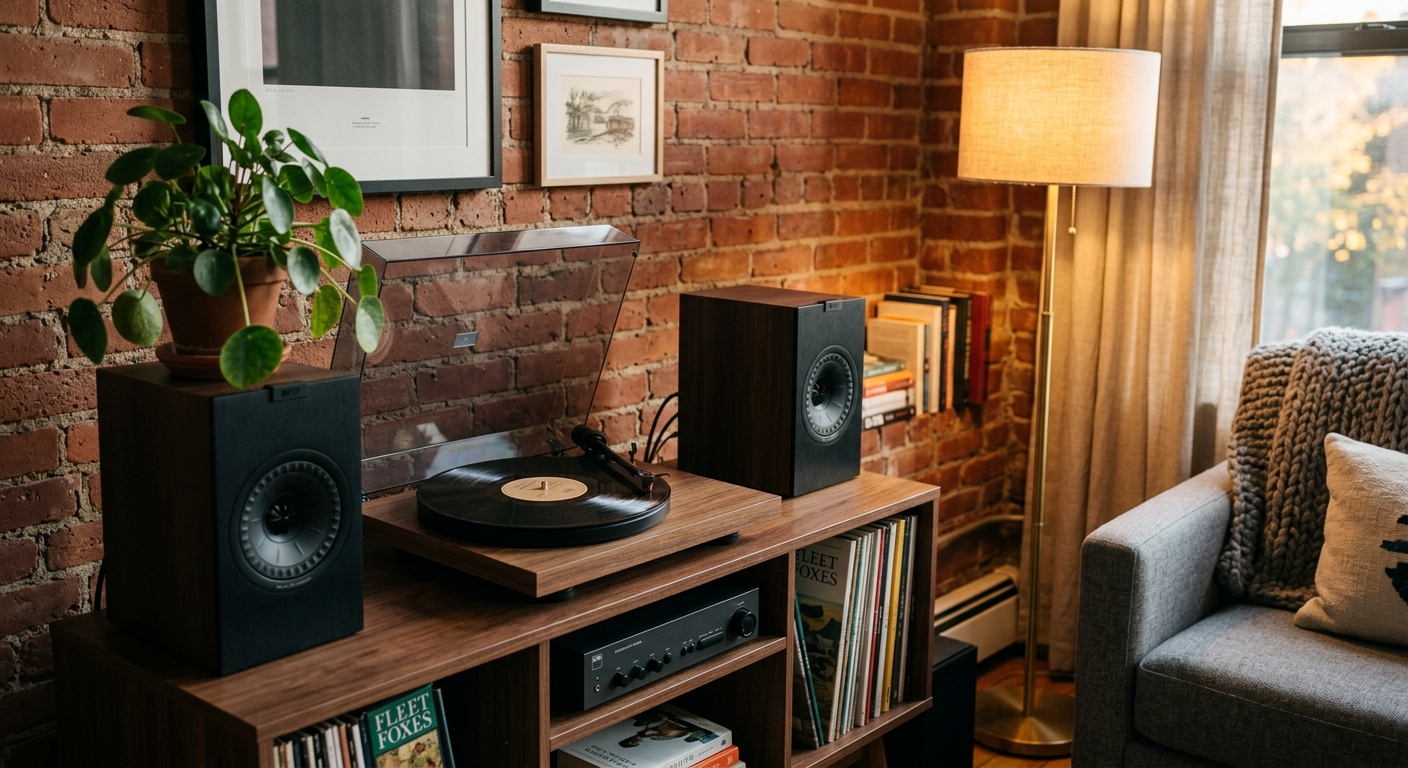
Choosing a turntable for an apartment is a different problem than choosing one for a dedicated listening room. The shelf and the speakers matter, but the walls, the neighbors, and the furniture you already own matter more. A great apartment turntable is compact, quiet enough to run after 10 p.m., light on vibration, and ready to play through whatever bookshelf speakers or headphones you have already set up. The wrong one moves too much air through the floor, picks up footfall noise from upstairs, and frustrates everyone in the building.
Vinyl sales crossed 1.4 billion dollars in the U.S. in 2023 according to the RIAA, and the fastest-growing segment of new buyers lives in apartments and small condos. Most product reviews still assume a detached room with a carpet and a dedicated rack. This comparison focuses on what actually changes when you live six inches from a neighbor's wall: motor noise, tonearm mass, dustcover rattle, automatic features, and how the table behaves on a real shelf next to a real receiver.
What an apartment turntable has to do well
Five traits separate a good apartment deck from a great one. The first three are mechanical; the last two are about how it fits into a shared wall.
- Low motor noise. A direct-drive or heavy-platter design masks motor hum. A lightweight belt-drive with a cheap DC motor can broadcast a 50 Hz whine through a suspended wood floor. Look for AC motors or designs where the motor is decoupled from the chassis.
- Light, isolated chassis. An MDF or composite plinth absorbs speaker vibration instead of passing it back through the stylus. A solid aluminum plinth looks beautiful but rings like a tuning fork on a shelf.
- Built-in phono stage with a real bypass switch. Most apartment beginners do not own a separate phono preamp. A quality built-in stage with a switch to bypass it when you upgrade later saves a future purchase.
- Auto-start or sensor-based cueing. When you listen at 11 p.m. or when a roommate is sleeping, dropping the needle manually is the loudest part of the session. A cueing lever or sensor that lowers the arm is dramatically quieter.
- A real dustcover that closes flush. Open-frame decks look great in photos but collect dust on the stylus within a week. A dustcover that closes flush keeps the cartridge clean between sessions and quiets the deck when not in use.
The five turntables worth comparing for apartment living
These five models cover the realistic price and feature spread for someone setting up a first or second deck in an apartment. They are all currently shipping, all use MM cartridges that are easy to replace, and all have built-in phono stages that can be bypassed.
Audio-Technica AT-LP60X (around $200)
The LP60X is the cheapest fully automatic turntable worth recommending for a small apartment. It is fully automatic, which means the arm cues itself and returns at the end of the side. That single feature matters more for shared-wall living than any spec on the box: the loudest moment of a late-night record session is no longer the cue, it is the fade.
The chassis is plastic and the platter is aluminum. Motor noise is acceptable at arm's length but can be heard through a shared wall in a quiet building. The integrated phono stage is fixed (no bypass), so upgrading later means replacing the whole table or routing through an external phono preamp at line level. The bundled cartridge is the AT-3600L, which is functional but tracks lighter than the AT-VM95E that Audio-Technica ships on its higher models.
The honest summary: this is a 7/10 turntable for $200. It plays records, it does not annoy neighbors, and it is the right answer when the budget for the whole system is under $500.
Pro-Ject T1 Phono SB (around $500)
The T1 is the cheapest Pro-Ject with a real aluminum tonearm and a built-in phono preamp that you can actually switch off. Pro-Ject's ultra-light-mass tonearm design reduces tracking force and lets the cartridge read the groove with less wear. The SB in the model name refers to the speed box, which is an electronic speed controller that holds 33 and 45 RPM more accurately than the all-mechanical Primary line.
The plinth is MDF, not aluminum, which is what you want for an apartment shelf. The motor is a synchronous AC motor decoupled from the chassis by a rubber belt suspension. Noise through a shared wall is noticeably quieter than the LP60X. The deck comes with an Ortofon OM 5E cartridge, which is a clear step up from anything Audio-Technica bundles.
The honest summary: the T1 is the most apartment-friendly sub-$500 deck on the market. The phono bypass switch means an apartment listener can buy a separate phono preamp in two years without abandoning the table.
Rega Planar 1 (around $475 without cartridge)
Rega does not bundle a phono preamp on the Planar 1 by default in most markets, which is a friction point for a first apartment setup. The deck itself is the best-built sub-$500 belt drive on the market: a phenolic resin platter, an RB110 tonearm, and a hand-assembled chassis. Speed stability and wow-and-flutter numbers beat every competitor at this price.
The motor is a 24 V synchronous unit decoupled from the chassis. Through a shared wall, the Planar 1 is quieter than the LP60X and roughly tied with the T1. The catch is the manual cueing: there is no automatic start, and the stock cueing lever is firm. Late-night cueing in a quiet apartment means a small but real clunk.
The honest summary: best sound-per-dollar at this price if you already own a phono preamp or active speakers. Not the right first deck if you do not.
Pro-Ject Debut Carbon EVO (around $900)
The Debut Carbon EVO is what happens when Pro-Ject takes the apartment-friendly formula and pushes it. The carbon-fiber tonearm reduces effective mass to roughly 6 grams, which means a wider choice of MM and high-output MC cartridges. The platter is a 1.7 kg aluminum die-cast unit driven by a synchronous motor through a flat belt. Speed stability is audibly better than the T1.
The phono bypass switch is on the back, and the built-in phono stage is the same quality as the T1. The deck comes with a 2M Red from Ortofon in most markets, which is one of the better moving-magnet cartridges you can buy under $300. The chassis is MDF with a satin finish, and the optional dustcover closes flush. Total weight is about 6 kg, which matters: a heavier deck is less sensitive to footfall noise from upstairs.
The honest summary: the Debut Carbon EVO is the right answer when the budget covers a serious first system and the apartment has to host the listening spot for the next five years. The 2M Red alone is worth a few hundred dollars of the price.
Technics SL-1500C (around $1,200)
The SL-1500C is the only direct-drive turntable worth considering for an apartment setup. Direct drive has a reputation for motor noise, but the SL-1500C uses a coreless DC motor with a digital speed controller. The motor is inaudible from more than a foot away, and the start-up torque is instant. There is no waiting for a belt to spin up when you press the start button.
The deck comes with an Ortofon 2M Red and a built-in phono stage with a bypass switch. The tonearm is a static-balanced S-shape with adjustable counterweight and anti-skate. The build quality is the best of the five: 9.6 kg total weight, die-cast aluminum chassis, and a real dustcover that closes flush.
The honest summary: the SL-1500C is the deck to buy if you want the last analog source you will need for a decade. It also plays 78 RPM shellac with the right cartridge swap, which the others cannot do.
Side-by-side comparison
- Audio-Technica AT-LP60X: $200, fully automatic, fixed phono stage, plastic chassis, AT-3600L cartridge. Best for budget apartment first setups.
- Pro-Ject T1 Phono SB: $500, manual cueing, bypass-able phono stage, MDF chassis, Ortofon OM 5E cartridge. Best apartment value under $500.
- Rega Planar 1: $475, manual cueing, no built-in phono, phenolic platter, no cartridge in most markets. Best sound-per-dollar if you already own phono amplification.
- Pro-Ject Debut Carbon EVO: $900, manual cueing, bypass-able phono stage, MDF chassis, Ortofon 2M Red. Best long-term apartment deck under $1,000.
- Technics SL-1500C: $1,200, manual cueing, bypass-able phono stage, direct drive, Ortofon 2M Red. Best deck if the budget covers a 10-year analog source.
What changes if you own a subwoofer or live above someone with a subwoofer
Speaker vibration is the bigger apartment problem than turntable choice. A 12-inch sub on a wood floor three feet from the deck will feed vibration back through the stylus as a low roar during quiet passages. Two practical fixes: place the deck on a separate wall-mounted shelf rather than on the same furniture piece as the speakers, and add a sorbothane or cork isolation pad under the platter. The shelf-mounted isolation reduces the feedback loop more than any turntable upgrade will.
Frequently asked questions
Do I need a built-in phono preamp in an apartment turntable?
For most apartment setups, yes. Built-in phono stages remove the need for a separate box, a separate power supply, and a separate set of cables. The Pro-Ject T1, Debut Carbon EVO, and Technics SL-1500C all include bypass-able built-in stages, which is the right design for an apartment.
Are belt-drive or direct-drive turntables quieter in apartments?
Modern direct-drive decks like the Technics SL-1500C are quieter than older direct-drive designs and roughly tied with mid-range belt-drives. Below $500, belt-drive wins for noise. Above $1,000, direct-drive catches up.
How important is automatic cueing for apartment listening?
Very important if you ever listen after 10 p.m. The cue is the loudest mechanical moment of playing a record, and an automatic cue eliminates it.
Should I get a dustcover?
Yes. A closed dustcover keeps the stylus clean and quiets the deck when it is not in use. All five comparison models ship with one except the Rega Planar 1, which requires a $60 add-on.
Sources
A spreadsheet tracks what you own. What's Spinning identifies what's playing.
On-device vinyl ID logs your listening history automatically. 7-day free trial.
Looking for Shazam for vinyl?
What's Spinning identifies what's playing on your turntable on-device, logs history, and AirPlays now-playing to your TV.
Comparing vinyl ID apps?
Analog requires Discogs and is iPhone-first (iPad coming). What's Spinning works without Discogs on iPhone and iPad with AirPlay.
Try What's Spinning Free
Turn your iPad into a live now-playing display. Track every record you spin.
START FREE TRIALThen $4.99/mo or $39.99/yr · Cancel anytime