Understanding Different Turntable Drive Systems
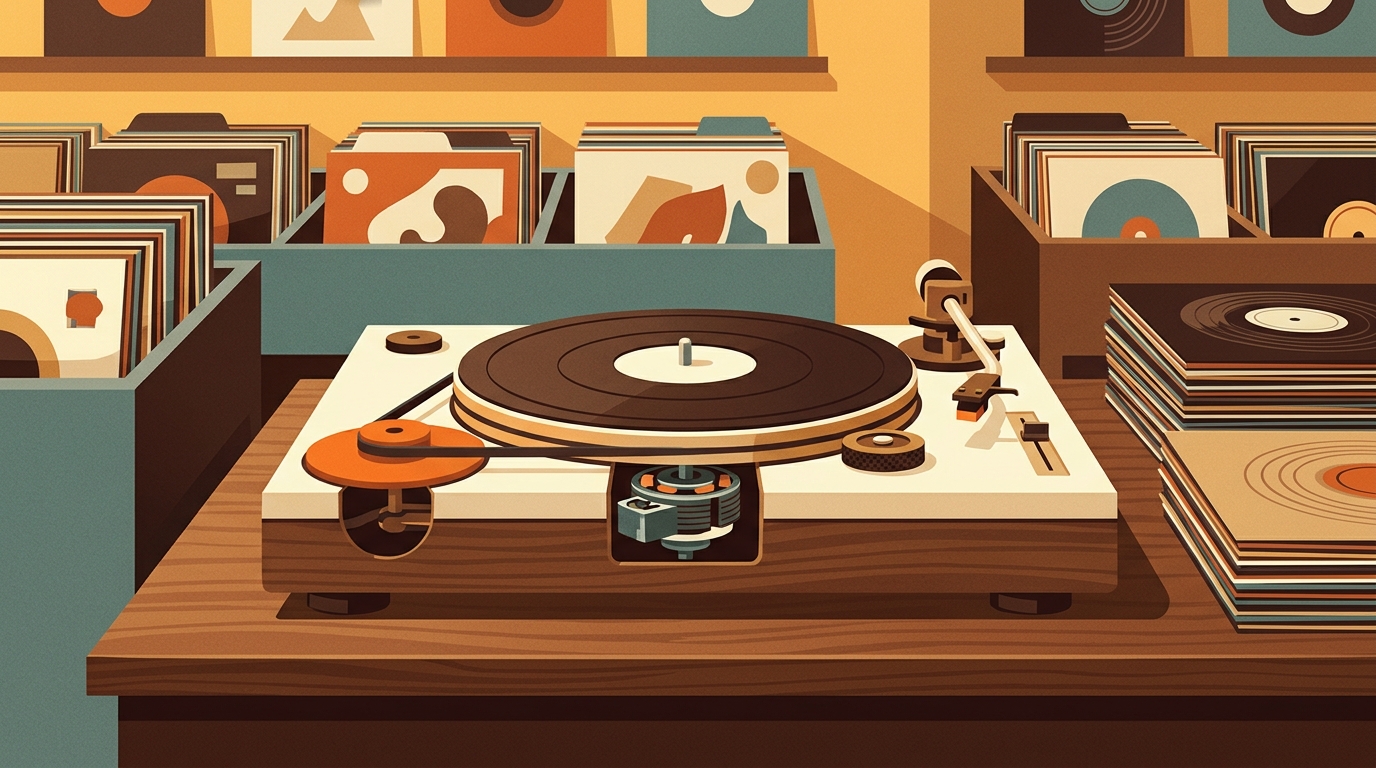
The drive system is the mechanical link between a turntable’s motor and its platter. It sounds like a small detail, but it affects startup speed, pitch stability, vibration control, maintenance, and even how a deck feels in daily use. Most turntables fall into three families: belt drive, direct drive, and idler drive. None is automatically best. The engineering around the motor, bearing, platter, plinth, tonearm, and speed controller matters just as much.
For collectors who use What’s Spinning to keep a listening history, the practical question is simple: which system best suits the way you play records? This guide explains the mechanics, tradeoffs, and real-world examples behind each design.
Belt drive: simple isolation between motor and platter
On a belt-drive turntable, the motor turns a small pulley connected by an elastic belt to the platter or a smaller subplatter underneath it. The belt acts as a flexible coupling. Pro-Ject describes this arrangement directly: the belt decouples the motor from the subplatter, reducing the amount of motor vibration that can reach the stylus.[1]
That isolation is the main attraction. A phono cartridge is an extremely sensitive vibration sensor, so keeping motor energy away from the record groove can lower unwanted noise. Belt drive is therefore common on listening-focused models from Rega, Pro-Ject, Fluance, and many other hi-fi brands.
The tradeoffs are mechanical. Belts stretch, glaze, loosen, or slip with age. Rega notes that drive belts can stretch over time and cause minor speed variations.[2] Some turntables also require moving the belt to a different pulley step when switching between 33 1/3 and 45 rpm, although electronic speed selection is increasingly common.
Performance varies widely. The Pro-Ject Debut Carbon EVO, for example, is a belt-drive design with electronic speed control, a 1.7 kg steel platter, and published wow and flutter figures of plus or minus 0.17 percent at 33 rpm and plus or minus 0.15 percent at 45 rpm.[3] Those figures illustrate why specifications must be read alongside the stated measurement method rather than compared blindly across brands.
Direct drive: the motor turns the platter directly
In a direct-drive turntable, the platter is effectively part of the motor assembly. There is no belt or intermediate wheel. This gives the system strong torque, quick startup, electronic braking, and tight speed control, all useful traits for broadcasting and DJ work.
Technics introduced the SP-10 in 1970 and identifies it as the world’s first direct-drive turntable. The company says it was adopted by broadcast stations and helped establish direct drive as an alternative to belt and idler systems.[4] The later SL-1200 series became closely associated with club culture because its platter reached speed quickly and tolerated cueing, back-cueing, pitch adjustment, and heavy use.
A current example shows what that means numerically. Technics specifies the SL-1200MK7 at 0.18 N m of starting torque, 0.7 seconds to reach 33 1/3 rpm, and 0.025 percent WRMS wow and flutter.[5] That fast response is difficult to achieve with a lightly powered belt-drive design.
Older direct-drive motors were sometimes criticized for cogging, a small variation in rotational force as a motor moves between magnetic poles. Modern designs address this through improved motor geometry and control electronics. Technics, for example, introduced a coreless direct-drive motor in 2016 specifically to reduce cogging.[6]
Direct drive also eliminates belt replacement, but it is not maintenance-free. Bearings, capacitors, pitch controls, and electronic speed circuits can still age. A well-designed direct drive can be superb for home listening, while a cheap one can be noisy or poorly isolated. The drive label alone does not determine sound quality.
Idler drive: torque through a rubber wheel
An idler-drive turntable places a rubber-rimmed wheel between the motor shaft and the inside edge of the platter. The motor spins the idler, and the idler transfers that motion to the platter. This was a major design approach in the 1950s and 1960s, especially in record changers, studio decks, and transcription turntables.
Classic examples include the Garrard 301 and 401. Garrard’s current heritage material dates the 301’s serious hi-fi debut to 1954, while period designs used a substantial motor, heavy platter, and retracting intermediate wheel.[7] Collectors often value these decks for their fast startup, strong torque, and substantial mechanical character.
The catch is condition. A hardened, polished, misshapen, or contaminated idler wheel can create rumble or inconsistent speed. Motor mounts, lubrication, bearings, and plinth construction also matter. A restored idler deck can be impressive, but an unrestored example may need specialist work before it performs as intended. This is the least beginner-friendly of the three systems, unless buying from a trusted restorer.
How to compare drive systems intelligently
Start with two measurements. Wow and flutter describe unwanted speed variation that can make sustained piano notes, strings, or vocals waver in pitch. Lower is generally better. Rumble is low-frequency mechanical noise from the motor, bearing, drive parts, or record itself. Published numbers help, but measurement standards and weighting methods differ, so compare like with like whenever possible.
- Choose belt drive if you want a straightforward listening deck, value motor isolation, and do not mind occasional belt replacement.
- Choose direct drive if you want fast startup, stable electronic speed control, easy speed changes, DJ features, or low routine maintenance.
- Choose idler drive if you enjoy vintage engineering and are prepared to restore and maintain a more complex mechanical system.
Do not ignore the rest of the turntable. Cartridge alignment, tracking force, platter bearing quality, isolation from speakers and footfalls, and the condition of the record can outweigh small theoretical differences between drive types. Buy the complete design, not the slogan printed beside the speed switch.
Frequently asked questions
Does direct drive sound worse than belt drive?
No. Poor direct-drive designs can transmit motor artifacts, and poor belt-drive designs can suffer from speed drift or belt problems. High-quality examples of both systems can deliver excellent pitch stability and low noise. Judge the complete turntable and its measured performance.
How often should a turntable belt be replaced?
There is no universal interval. Replace it when the platter starts slowly, speed becomes inconsistent, the belt slips, or the rubber looks loose, shiny, cracked, or misshapen. Keeping a correct replacement belt on hand is sensible for an older deck.
Why do DJs usually prefer direct drive?
Direct drive provides strong torque, rapid startup, electronic braking, stable speed, and pitch adjustment. It also tolerates cueing and platter manipulation better than most belt-drive designs.
Are idler-drive turntables still worth buying?
Yes, if you want a classic Garrard, Thorens, Dual, Lenco, or another well-regarded vintage model and understand the restoration needs. Budget for inspection of the idler wheel, motor mounts, lubrication, bearing, wiring, and plinth.
Sources
A spreadsheet tracks what you own. What's Spinning identifies what's playing.
On-device vinyl ID logs your listening history automatically. 7-day free trial.
Looking for Shazam for vinyl?
What's Spinning identifies what's playing on your turntable on-device, logs history, and AirPlays now-playing to your TV.
Comparing vinyl ID apps?
Analog requires Discogs and is iPhone-first (iPad coming). What's Spinning works without Discogs on iPhone and iPad with AirPlay.
Try What's Spinning Free
Turn your iPad into a live now-playing display. Track every record you spin.
START FREE TRIALThen $4.99/mo or $39.99/yr · Cancel anytime
Get it on your iPhone
Open on iPhone