Best Used Vinyl Buying Guide: Tips for Collectors
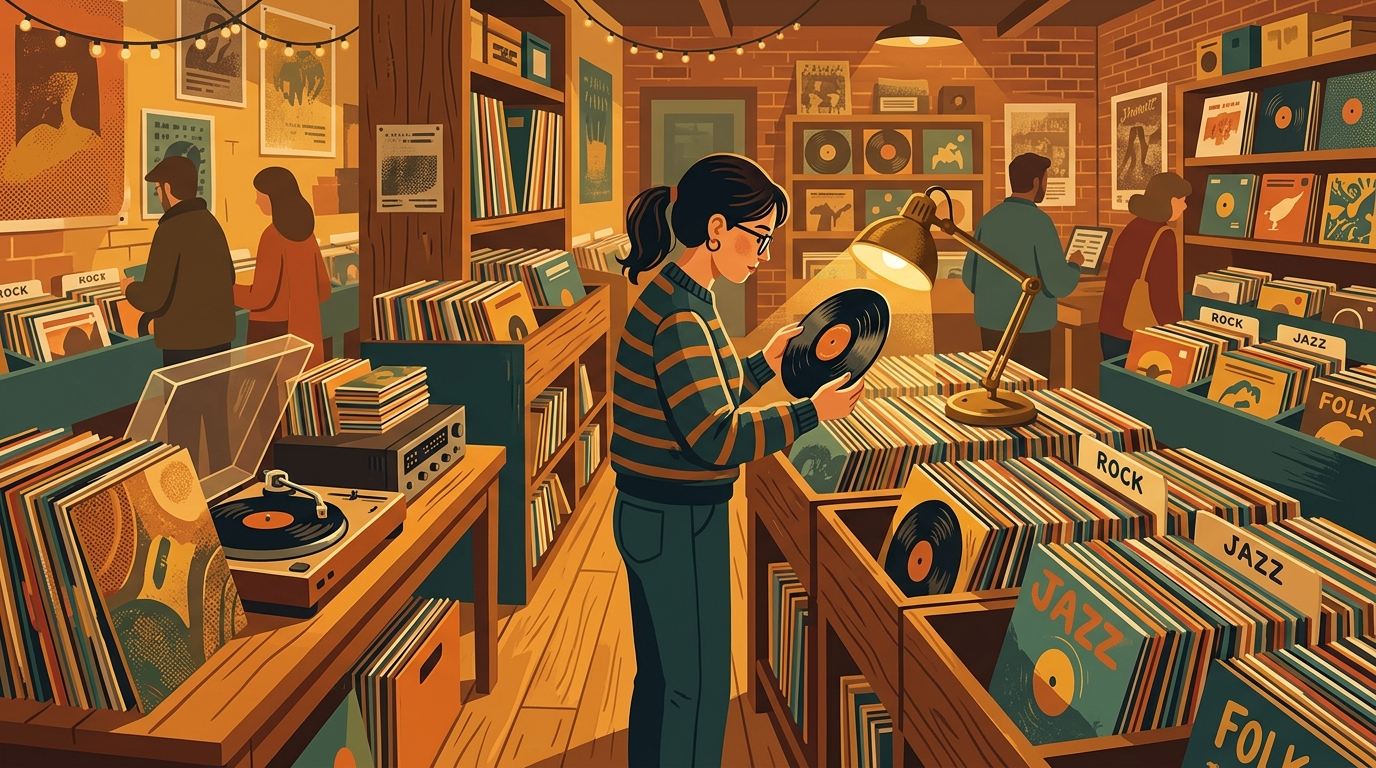
Used vinyl is where record collecting gets interesting. New reissues are clean, convenient, and sometimes excellent, but the used bins hold the stories: a first owner who played one side to death, a radio station promo with timing strips, a club edition hiding in plain sight, a bargain jazz reissue that sounds better than its price tag, or a classic album whose jacket has lived a harder life than the record inside. A good used copy can be a daily player, a piece of music history, and a smarter purchase than a sealed record you are afraid to open.
This best used vinyl buying guide is written for collectors who want fewer surprises and better records. It is not about chasing only museum-grade copies. Most collections are built from practical decisions: knowing which defects matter, which ones are cosmetic, when to trust a seller, when to walk away, and how to connect a purchase to your actual listening life. If you use What's Spinning to track what you play, used buying gets even more useful because your listening history shows which artists, labels, and genres deserve more crate-digging attention.
The market is big enough now that casual guesses can get expensive. The Recording Industry Association of America reported that vinyl remained a major physical format in its recent U.S. revenue reporting, with LP and EP revenue around the billion-dollar mark in recent years, while Discogs, Goldmine, Record Collector, and local shops continue to shape how collectors talk about condition and value. Meanwhile, preservation guidance from the Library of Congress still gives the most useful everyday reminder: handle grooved discs by the edge and label, store discs upright, and keep playback equipment clean. The practical lesson is simple. Buy with your ears, inspect with your eyes, and think like the future owner who has to store and play the thing.
Before you shop, decide what kind of collector you are being today
Collectors get into trouble when every trip to the bins becomes every goal at once. Are you looking for a playable copy of an album you love? A specific pressing? A rare variant? A cheap discovery? A gift? A wall piece? Those are different missions. A ring-worn jacket may be perfectly fine for a listening copy, but it matters a lot for a high-value original. A budget copy with light crackle may be romantic on a blues record and maddening on a quiet piano record. A sealed old record can be exciting, but it may also hide warping, storage damage, or an ordinary later pressing.
The best habit is to set the buying standard before the record is in your hand. If you want a clean daily player, prioritize a glossy disc, quiet surface, and honest grading over jacket perfection. If you want a collectible pressing, slow down and confirm the matrix, label design, inserts, hype sticker, catalog number, and country of manufacture. If you want to explore, set a price ceiling and let curiosity win. That mental separation keeps the hobby fun instead of turning every purchase into courtroom evidence.
15 used vinyl buying tips that actually save money
 Start with the record, not the jacket. A beautiful sleeve can seduce you into forgiving a damaged disc, especially on albums with famous cover art. Pull the record out and inspect both sides under strong angled light. Look for scratches that cross the grooves, dull gray patches, groove wear near loud passages, and cloudy marks that may indicate heat or chemical damage. Paper scuffs are common and often harmless, but a scratch you can feel with a fingernail usually deserves caution. Jackets matter for value, but the disc determines whether the album earns shelf space as music instead of decoration.
 Learn the grading language, then distrust it politely. Most sellers use a version of the Goldmine-style scale, Mint, Near Mint, Very Good Plus, Very Good, Good, and Fair or Poor. Discogs publishes condition guidance for marketplace sellers, and Record Collector has its own grading tradition in the U.K. The important part is not memorizing every adjective. It is understanding that Very Good does not mean very good in normal English. It often means obvious wear, surface noise, and flaws that may still play through. Treat the grade as a seller's summary, not a verdict. Then use photos, description, and play grading to decide whether the price makes sense.
 Use angled light to separate scuffs from groove damage. A record can look clean in flat store lighting and reveal a battlefield when you tilt it near a window or bright lamp. Rotate slowly and watch how marks behave. Hairlines that sit on the surface often disappear at certain angles. Deeper scratches cast sharper lines and may be felt. Groove wear can show up as a dull, silvery patch, especially on loud inner tracks where mistracking happened. This is why a tiny flashlight belongs in a serious crate digger's pocket. It turns a vague condition guess into a clearer risk calculation.
 Ask whether the seller has play-tested the exact copy. Visual grading is useful, but records are mechanical objects. A copy can look VG+ and still have non-fill, off-center pressings, groove burn, inner-groove distortion, or a skip from a nearly invisible defect. If you are spending real money, ask whether it was play-tested and on what kind of setup. A shop with listening stations gives you a huge advantage. Online, seller notes like "plays with light noise between tracks" are more meaningful than a grade alone. Silence in the description is not proof of silence in the grooves.
 Match the pressing to your reason for buying. Original pressings can be wonderful, but they are not automatically the best value. Some later reissues used excellent metalwork. Some originals were pressed in huge numbers and are common. Some audiophile reissues fix noisy original vinyl. Other reissues are cut from indifferent sources or pressed carelessly. Before paying an original-pressing premium, check whether collectors actually prefer that version. For many albums, the sweet spot is a clean early reissue, a well-reviewed modern cut, or a domestic pressing that avoids the collector tax attached to a famous first label.
 Check the matrix, runout, label, and catalog number when value depends on edition. The spine and front cover rarely tell the whole story. Pressing plants, lacquer cuts, recuts, club editions, and represses can share similar jackets. The dead wax, the smooth area near the label, often carries matrix numbers, initials, and plant marks that identify the actual cut. If a seller claims a first pressing, confirm it against a reliable database or label guide. This matters most for Beatles, Blue Note, punk, private press, metal, early hip-hop, and any album where a specific cut drives the price. A ten-second matrix check can prevent a very expensive assumption.
 Price against sold copies, not wishful listings. Asking prices are not market value. A rare record listed for a wild number can sit for years, while recent sold copies show what buyers actually paid. Compare the same country, pressing, grade, completeness, and shipping situation. A local VG+ copy at $32 might be a better buy than a $25 online copy once shipping, tax, and return hassle are included. Also remember that stores price for overhead and curation. You are paying partly for the ability to inspect the record now. That premium is fair when it saves you from mail-order disappointment.
 Do not ignore the jacket, inner sleeve, and inserts. Collectibility often lives in the paper. Posters, lyric sheets, custom inner sleeves, booklets, obi strips, hype stickers, postcards, and original company sleeves can change value dramatically. A record can be musically identical but financially incomplete without them. Check for seam splits, water damage, writing, cut corners, saw marks, drill holes, sticker tears, and mildew smell. A cutout mark is not always bad; it may simply mean old discounted stock. Mold, however, is a hard stop for many collectors because it can contaminate storage and create a cleaning problem you did not sign up for.
 Treat colored vinyl, picture discs, and novelty pressings as case-by-case buys. Modern colored vinyl can sound excellent, and some labels press it with real care. Older picture discs and novelty formats are more likely to be purchased as artifacts than reference listening copies. Do not assume color means worse, but do not pay only for color unless that is the point of the purchase. Look for pressing reviews, plant reputation, and whether the same mastering exists on standard black vinyl. If the album is quiet, dynamic, or acoustic, surface quality matters more. If it is loud garage rock, you may tolerate more character.
 Watch for warps before you fall in love. Hold the record at eye level and look across the edge. A mild dish warp may play fine with a clamp or weight, but an edge warp can throw the tonearm and cause audible pitch movement. Heat damage can also create a ripple that is not obvious from the front. Sealed records are not immune; shrink wrap can tighten over years and warp the disc or bend the jacket. In a shop, ask whether returns cover warps on sealed vintage stock. Online, ask the seller to confirm that the record lies reasonably flat.
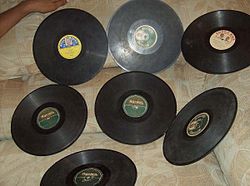 Know when older formats are not LPs. Crate digging turns up 78s, 10-inch records, transcription discs, and other formats that need different playback gear and care. A standard LP turntable setup is not automatically appropriate for shellac 78 rpm records, which require a different stylus size and often different equalization. If you buy older records because the label looks beautiful, make sure you can play them safely. The history is fascinating, but the wrong stylus can damage both the record and the listening experience.
 Smell the record before buying a problem. It sounds odd until mildew enters your shelves. A musty jacket can signal damp storage, and damp storage can mean mold, paper deterioration, and hidden sleeve damage. You can clean vinyl, replace inner sleeves, and quarantine suspect purchases, but severe mold is often not worth the savings. Smoke odor is another personal threshold. Some collectors tolerate it, some do not, and some jackets never fully recover. Used buying is not only visual grading. It is environmental detective work.
 Budget for cleaning supplies and new inner sleeves. A used-record budget that ignores cleaning is incomplete. At minimum, plan for anti-static inner sleeves, a carbon fiber brush, and a safe cleaning method. The Library of Congress recommends careful handling, clean environments, and keeping equipment well maintained. Many collectors add a manual wet-cleaning system or record-cleaning machine as their shelves grow. Do not clean shellac 78s with standard vinyl fluid, and do not assume alcohol-based solutions are safe for every material. For ordinary modern LPs, a clean record and clean stylus often reduce noise more than another upgrade.
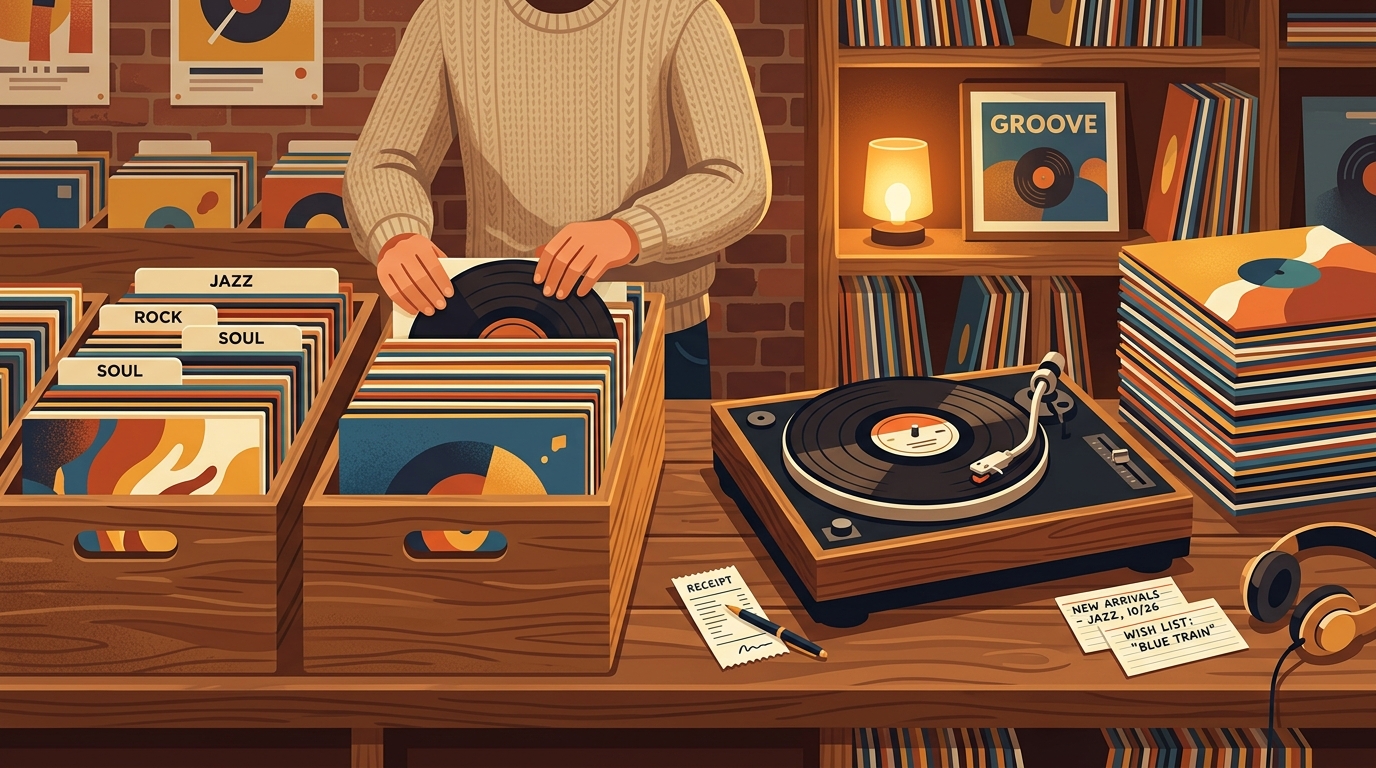
 Build relationships with local shops. The best used vinyl buying guide cannot replace a good store owner who learns your taste. Shops may set aside records, warn you about noisy copies, explain pressing differences, or give realistic condition advice. Be honest, polite, and decisive. If a store grades conservatively, support it. If every VG copy looks punished and every price copies the top online listing, move on. Local stores also let you buy music in context, jazz near soul, punk near local seven-inches, bargain bins near new arrivals. That browsing geography is part of the education.
 Keep notes on what you actually play. The smartest buying data is your own listening behavior. If you buy five expensive psych records and only replay the soul comps, the next dig should respond to that. Track pressing notes, condition surprises, shops, prices, and which records become regular plays. This is where a listening log beats memory. A collection should become more personal over time, not just larger. The goal is not to win the internet's shelf photo contest. The goal is to bring home records that keep earning another spin.
How to inspect a used record in five minutes
First, remove the disc carefully by touching only the edge and label area. That handling rule comes straight from preservation practice and protects the playing surface from oils and grit. Second, inspect side one and side two under angled light, not only overhead store light. Third, check for warps by sighting along the edge. Fourth, compare the label and runout to the jacket details if pressing identity matters. Fifth, look through the paper: inner sleeve, inserts, booklet, posters, seams, and spine. If the record costs more than an impulse buy, ask about playback. A polite question like "Has this been play-graded?" is normal collector behavior, not fussiness.
When shopping online, translate the same routine into questions. Ask for photos of both sides of the vinyl, the jacket front and back, the spine, the label, and any inserts. If a listing says "looks unplayed" but the photos are blurry, treat the claim as decoration. If the seller gives detailed flaws, that can be a good sign. A listing that admits "light crackle during the quiet intro" may be safer than one that shouts "RARE NM" with no detail. The best sellers know that condition specificity reduces returns and builds trust.
Condition problems ranked from cosmetic to serious
Not all flaws are equal. Light paper scuffs are often cosmetic. Ring wear hurts jacket value but not playback. A small corner ding may be irrelevant on a player copy. Surface dust is fixable. Old price stickers are annoying, but sometimes historically charming. Seam splits can be repaired by a professional or tolerated if the record is cheap enough.
More serious problems include feelable scratches, repeated ticks, skips, groove wear, non-fill, off-center pressings, severe warps, heat damage, mildew, and water-damaged jackets. Groove wear is especially frustrating because it can hide behind shine. It often sounds like fuzzy distortion on loud vocals, horns, guitars, or inner tracks. A record can be visually attractive and still damaged by a bad stylus from decades ago. That is why the highest-confidence purchase is a clean visual copy from a seller who can describe playback.
Where to buy used vinyl
Independent record stores are the best classroom. You can inspect records, ask questions, and learn the local pricing ecosystem. Record fairs are excellent for volume and specialty dealers, but they reward preparation because sensory overload is real. Thrift stores and estate sales can still produce finds, though competition is much stronger than it used to be. Online marketplaces are unbeatable for specific pressings, but grading variance, shipping risk, and return friction make discipline essential.
For online purchases, the seller matters almost as much as the record. Look for feedback that mentions grading accuracy and packing quality. Records should be shipped outside the jacket when appropriate to prevent seam splits, with sturdy mailers and pads. A seller who photographs the actual copy is preferable to one using stock images. If the album is valuable, ask questions before buying, not after it arrives. Good sellers expect informed questions. Bad sellers resent them.
Cleaning, storage, and the hidden cost of bargain records
A cheap record is not cheap if it needs new sleeves, cleaning, return shipping, and emotional negotiation with yourself. Build a small maintenance budget into used buying. Replace paper inners that shed dust or have grit. Store records upright, not leaning heavily, and avoid heat. The Library of Congress notes that grooved discs are heavy, averaging more than 35 pounds per shelf-foot, and recommends sturdy shelving with dividers every 4 to 6 inches that support the full face of sleeved discs. That is not collector fussiness. It is physics.
Cleaning is also part of playback quality. Dust can create ticks, static can pull more dust onto the surface, and dirty records can transfer grime to the stylus. Start conservatively. Use a carbon fiber brush before play, keep the stylus clean according to the cartridge manufacturer's instructions, and use a proper vinyl cleaning solution for wet cleaning. Avoid household cleaners. Avoid heroic rescue attempts on moldy records unless you know what you are doing. The safest bargain is still the one that was stored well before it reached you.
What to buy first
If you are building a used collection from scratch, begin with records you will play often, not records that only look impressive. Buy a clean copy of a favorite album, a cheaper compilation in a genre you want to explore, a classic record with plentiful used copies, and one local-shop recommendation that costs less than dinner. That mix teaches condition, taste, and risk without turning the hobby into a spreadsheet. After that, pick one lane to study more deeply: a label, producer, scene, city, instrument, decade, or mastering engineer. Used vinyl becomes easier when your knowledge has edges.
The real prize is confidence. Once you know how grades translate to sound, how sellers describe flaws, how to spot pressing details, and which imperfections you personally tolerate, you can move faster through the bins and still make better decisions. That is the quiet skill every collector develops. You stop buying every record that seems important and start buying the copies that make sense for your ears, your room, and your shelves.
Sources and further reading
- Library of Congress, Care, Handling, and Storage of Audio Visual Materials
- Discogs, standard condition grades for marketplace listings
- Discogs, how to grade items
- Goldmine, record grading guide
- LP record history and format background
- RIAA U.S. recorded music sales database
FAQ
What is the safest grade to buy for used vinyl?
For most collectors, Very Good Plus is the practical sweet spot. Near Mint is safer but often much more expensive, while Very Good can be enjoyable if the price is right and the seller describes the noise honestly. Use the grade as a starting point, then inspect the actual disc, jacket, and seller notes.
Can a dirty record look damaged when it is only dusty?
Yes. Dust, fingerprints, paper scuffs, and inner-sleeve residue can make a good record look worse than it is. The reverse is also true, a glossy copy can still have groove wear from a mistracking stylus. That is why visual inspection, seller reputation, and a play test matter together.
Should beginners buy original pressings or reissues?
Beginners should buy the copy that matches the listening goal. A clean modern reissue can be better than a noisy original if you simply want to play the album often. Original pressings are more interesting when the mastering, packaging, label variation, or historical context matters to you.
How do I avoid overpaying in a record store?
Check recent sold prices, not only asking prices. Compare the exact pressing, condition, completeness, and shipping cost. In person, remember that a local store copy includes the advantage of inspection and no mail risk, so a small premium can be fair.
A spreadsheet tracks what you own. What's Spinning identifies what's playing.
On-device vinyl ID logs your listening history automatically. 7-day free trial.
Looking for Shazam for vinyl?
What's Spinning identifies what's playing on your turntable on-device, logs history, and AirPlays now-playing to your TV.
Comparing vinyl ID apps?
Analog requires Discogs and is iPhone-first (iPad coming). What's Spinning works without Discogs on iPhone and iPad with AirPlay.
Try What's Spinning Free
Turn your iPad into a live now-playing display. Track every record you spin.
START FREE TRIALThen $4.99/mo or $39.99/yr · Cancel anytime