How to Find Local Record Stores Using Your Collection Data
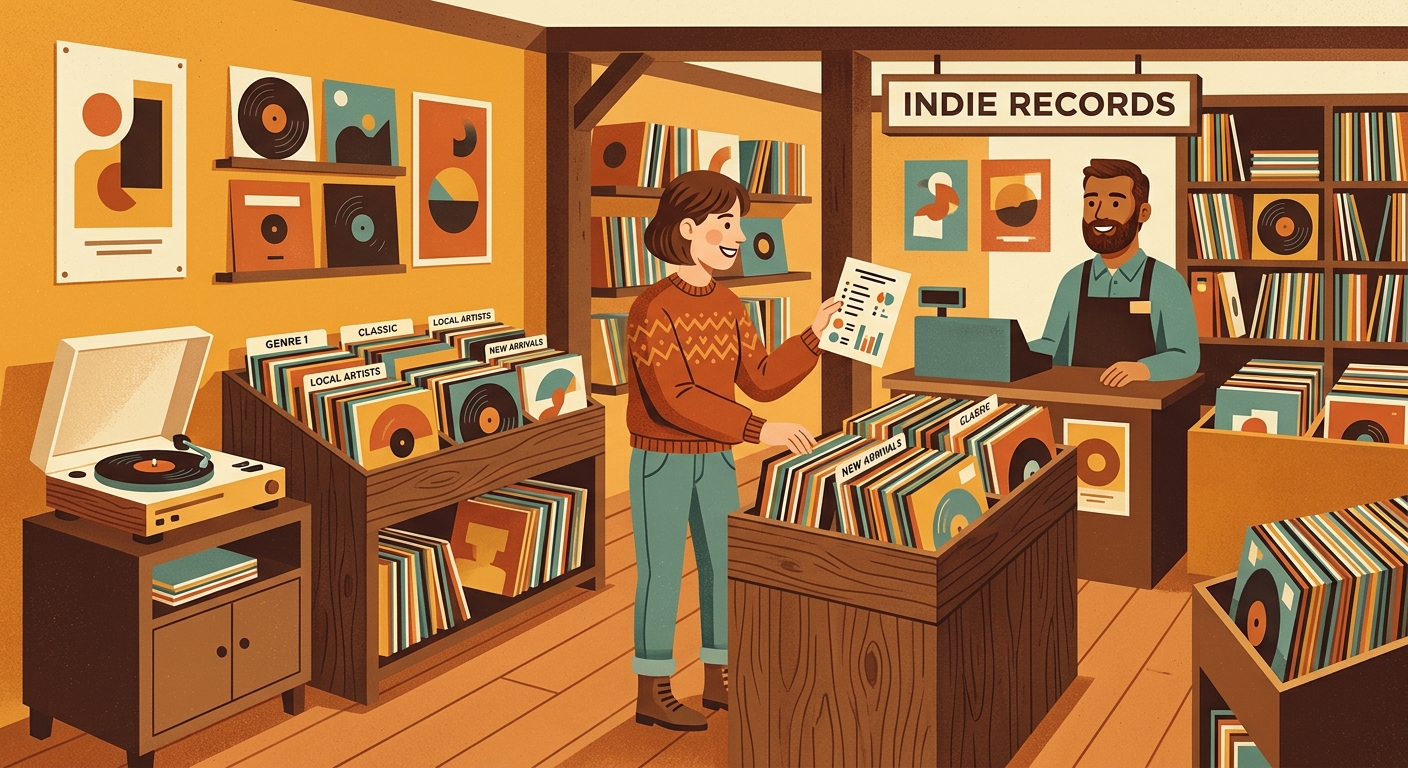
Searching “record stores near me” tells you what is close. It does not tell you which shop is likely to have the records you actually want. Your collection already contains a better set of clues: the artists you return to, labels you trust, decades you favor, formats you buy, and gaps you keep hoping to fill. Put those clues to work and a generic map becomes a personalized record-store guide.
This is a good moment to shop locally. The RIAA reported that U.S. vinyl revenue reached about $1 billion in 2025, up 9.3 percent, marking 19 consecutive years of growth. It also estimated that the United States represented nearly half of global vinyl revenue [1]. More demand means more shops, pop-ups, specialist sellers, and mixed online-offline inventories, but it also makes choosing the right stop more valuable.
Start with a collection profile, not a list of stores
You do not need advanced analytics. Pull five simple summaries from your collection: top genres or styles, top labels, releases by decade, formats, and wanted records. Discogs, for example, lets collectors sort by artist, title, label, catalog number, format, year, rating, and date added. It also supports custom fields and a full CSV export [2]. What's Spinning can provide another useful signal: what you actually play, which may differ from what merely occupies shelf space.
Turn the data into a one-page profile. Suppose your shelves are 28 percent jazz, 17 percent soul and funk, and 12 percent punk. Your most common labels are Blue Note, Impulse!, Stax, SST, and 4AD. You buy mostly original or early used pressings, plus new audiophile reissues. That profile immediately favors stores with deep used bins, knowledgeable grading, and strong jazz, soul, and independent-rock sections. A shop built around sealed pop variants may be nearby, but it is not your best first stop.
Use labels and formats as stronger clues
Broad genres can hide important differences. “Electronic” might mean ambient LPs, Detroit techno 12-inch singles, or modern synth-pop. Labels often reveal the distinction faster. A collector with many releases on Warp, Sub Pop, ECM, Numero Group, or International Anthem can search store websites, social profiles, marketplace inventories, and event posts for those names.
Format is equally useful. Count 7-inch singles, 12-inch dance records, mono pressings, 78s, box sets, and colored variants separately. A store that advertises thousands of LPs may still have one neglected crate of 45s. If 30 percent of your wantlist is soul singles, ask about 45s before driving across town.
Build a candidate list from three sources
- Record Store Day's directory. Use the official store locator to establish a local radius, then open individual listings. Store descriptions can expose specialties that map results miss. Diabolical Records in Salt Lake City, for example, describes itself as specializing in garage, psych, and local music [3].
- Marketplace and inventory searches. Discogs Marketplace filters include format, price, condition, seller, year, genre, style, and “Ships From.” It can also narrow sellers to those carrying items on your wantlist [4]. When a promising seller appears, check the profile and website for a storefront or local-pickup option.
- Local signals. Search maps, neighborhood guides, venue pages, record fairs, and social posts. Look at recent-arrival photos. Ten posts full of reggae 45s are more informative than a profile that simply says “all genres.”
Score stores by fit
A quick score keeps you from choosing only by distance. Give each candidate up to 40 points for genre and style overlap, 25 for label overlap, 20 for format fit, and 15 for wantlist evidence. A shop 25 minutes away with an 82-point fit may be a better use of Saturday than a shop five minutes away scoring 38.
For example, imagine Store A posts frequent jazz reissues and used soul arrivals, lists several titles on your wantlist, and buys clean collections. Store B is closer but focuses on current indie-pop exclusives. If your data says jazz, soul, and used pressings drive most of your buying, Store A wins before you start the car.
Turn your data into a clerk-friendly request
Do not walk in and ask, “Do you have anything good?” Bring a compact brief: “I am looking for 1960s and 1970s soul, especially Stax and Hi Records, mostly VG+ or better, under $35. I also need these five titles.” That gives a clerk enough information to point you toward the right bins, mention unprocessed arrivals, or suggest a nearby specialist.
Keep catalog numbers for pressings where the exact edition matters. MusicBrainz release data distinguishes dates, countries, labels, catalog numbers, barcodes, and media, which is why those fields are more precise than an album title alone [5]. For ordinary browsing, artist and label are enough. For a first pressing, mono mix, or particular reissue, precision saves everyone time.
Remember that store inventory is a moving target
Collection data predicts fit, not today's stock. Used records arrive unpredictably, online inventory may be separate from floor inventory, and desirable titles can sell between a social post and your visit. Call or message when one record justifies the trip. For broader crate digging, ask which day new arrivals hit the floor and whether the shop keeps a customer wantlist.
After each visit, add a few notes: strongest sections, grading consistency, price range, restock day, local specialties, and whether staff will special-order new releases. Over time, your map becomes a network: one store for jazz reissues, another for cheap punk and metal, a third for 45s, and a monthly record fair for surprises. That is how collection data stops being a static catalog and starts improving the next record you find.
FAQ
What collection data is most useful for finding a record store?
Start with your top genres and styles, most-owned labels, preferred formats, decade distribution, and a short wantlist. Those fields reveal whether you need a broad new-release shop, a deep used store, or a specialist in areas such as jazz, punk, dance 12-inch singles, or regional music.
Can my Discogs collection help me find nearby stores?
Yes, indirectly. Discogs lets you sort and export collection fields such as artist, label, catalog number, format, and year. Its Marketplace can also filter sellers by wantlist matches, genre, style, format, year, and shipping origin. Use those clues to identify promising shops, then verify that a seller has a physical storefront or local pickup.
Should I send a record store my entire collection spreadsheet?
Usually not. A concise shopping brief is more useful: five priority artists, three labels, two formats, a budget range, and ten wanted titles. Share the full file only if the store offers collection appraisal, trade-in, or personal shopping services and you are comfortable sharing it.
How often should I update my store shortlist?
Recheck it every few months or whenever your collecting focus changes. Shops change specialties, buyers, and inventory sources, while your own collection may shift toward a new genre, era, label, or format.
Sources
A spreadsheet tracks what you own. What's Spinning identifies what's playing.
On-device vinyl ID logs your listening history automatically. 7-day free trial.
Looking for Shazam for vinyl?
What's Spinning identifies what's playing on your turntable on-device, logs history, and AirPlays now-playing to your TV.
Comparing vinyl ID apps?
Analog requires Discogs and is iPhone-first (iPad coming). What's Spinning works without Discogs on iPhone and iPad with AirPlay.
Try What's Spinning Free
Turn your iPad into a live now-playing display. Track every record you spin.
START FREE TRIALThen $4.99/mo or $39.99/yr · Cancel anytime
Get it on your iPhone
Open on iPhone