How to Organize Vinyl in Small Spaces: Tips
If your vinyl collection is outgrowing your living room, you are not alone. The average collector hits a wall somewhere around 150 to 200 records, the point at which the IKEA Kallax and the under-TV media console stop absorbing new arrivals. Most storage advice assumes you have a basement, a spare bedroom, or a dedicated listening room. If you live in a studio apartment, a small condo, or a shared space, you need a different playbook.
This guide walks through the storage systems, vertical vs horizontal orientation rules, climate control basics, and room-layout tricks that experienced collectors use to keep growing collections accessible in tight spaces.
Always store records upright, never flat
This is the single most important rule, and it is the one that breaks the most often in cramped apartments. Records stored in horizontal stacks develop warping over time, especially in rooms with temperature swings. The Library of Congress preservation guidance and nearly every record-care reference recommends vertical storage at a 90-degree angle to the floor, leaning only enough to stay stable.
The practical implication: skip the milk-crate stacking habit. Crates are fine for transport and for moving records from shelf to turntable, but do not pile four crates on top of each other and call it storage. If you must stack, rotate the bottom crates to the top every few weeks so no single crate bears long-term weight.
The Kallax and the 12-inch shelf standard
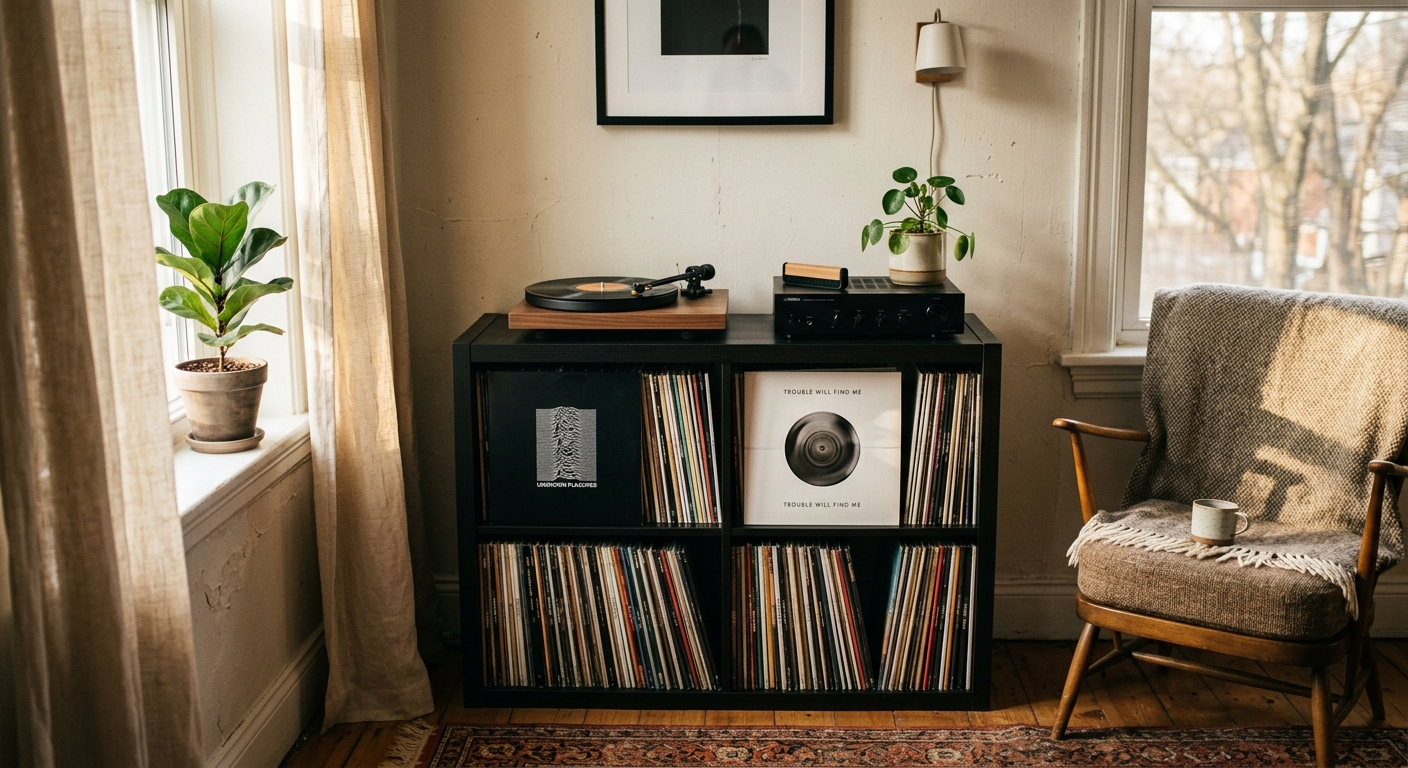
The IKEA Kallax 2x2 and 4x2 cubes are the de facto standard for vinyl in small spaces for good reason. Each cube holds roughly 60 to 75 LPs stored vertically, depending on jacket thickness. The 2x2 unit holds about 120 records in a 30-inch by 30-inch footprint, which is roughly the area of a small armchair. The 4x2 doubles capacity to about 240 records in the same width.
For most small-space collectors, the 2x2 is the right call. It fits under a window, can serve as a side table, and doubles as a room divider when turned perpendicular to a wall. The 4x2 only makes sense once you have committed to a dedicated listening corner.
Wall-mounted shelving for the tightest rooms
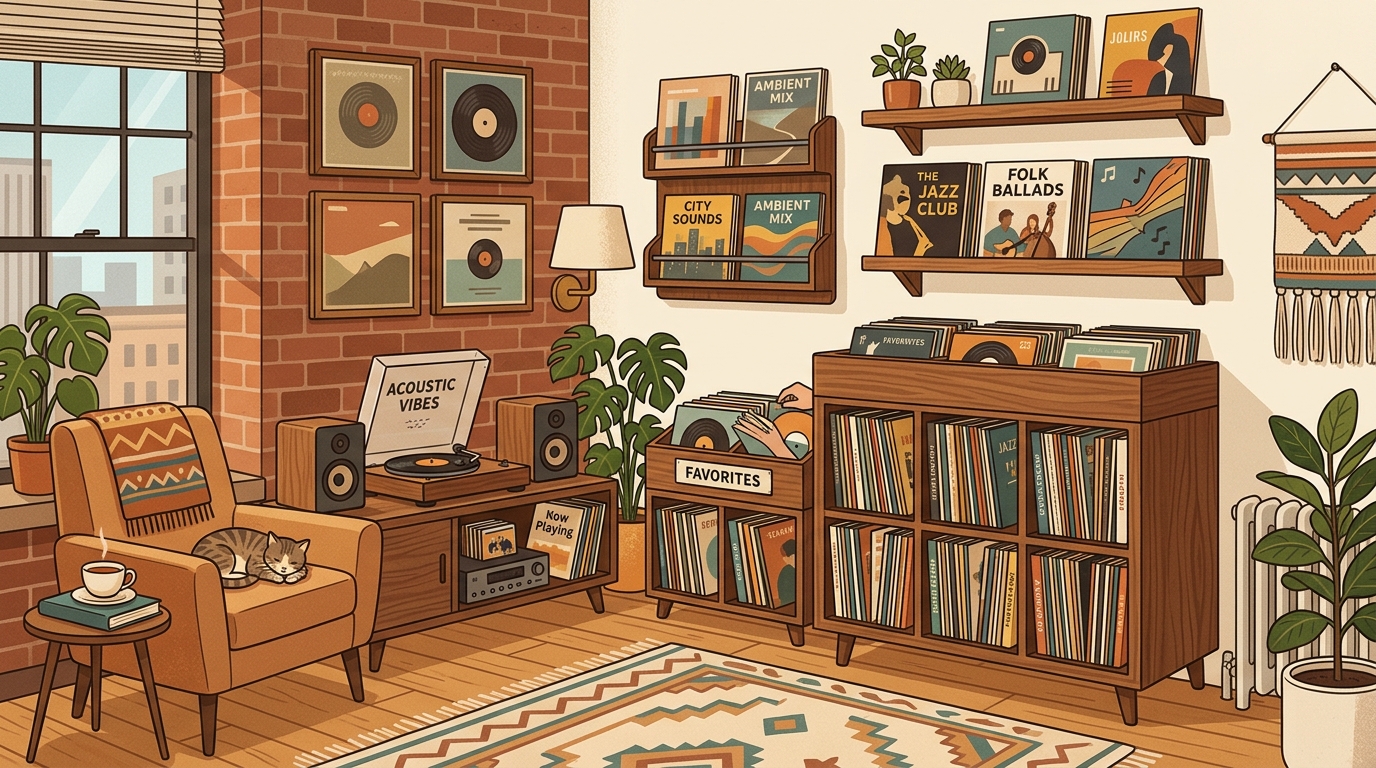
If floor space is the bottleneck, go vertical. A single 36-inch-wide wall-mounted shelf at standard 12-inch depth holds about 75 LPs and uses zero floor area. Look for shelves rated to at least 60 pounds when loaded, since 75 LPs weigh close to 50 pounds on their own.
Two practical patterns work well:
- Two parallel shelves stacked vertically, with about 14 inches of clearance between them. This doubles capacity without taking more wall width.
- A single shelf above a desk or dresser, where the shelf serves double duty as both storage and a turntable platform. The standard 12-inch shelf depth lines up with most turntable bases.
Anchor wall-mounted shelves into studs, not drywall anchors. A loaded shelf pulling out of drywall is a memorable way to lose a collection.
Climate control in a small space
Vinyl tolerates a fairly wide range of conditions, but the enemy is rapid change. Records stored in a closet near an exterior wall, in an attic apartment, or above a heating vent will warp faster than records kept in a stable interior room.
Target 65 to 72 degrees Fahrenheit with 45 to 50 percent relative humidity. Most climate-controlled apartments sit inside that range naturally. The exceptions to watch for:
- Bathrooms and kitchens. Steam from showers and stovetop cooking pushes humidity into the 70 to 90 percent range, which is bad for jacket glue and can promote mold on stored records.
- Direct sun. UV degrades jacket art over time and heats records unevenly, which causes localized warping. Keep records out of south-facing window light.
- Radiators and baseboard heaters. The dry heat dehydrates vinyl and slowly pulls jackets out of square.
If your only available space is near one of these, a small USB-powered dehumidifier or a clear curtain between the records and the heat source buys years of extra life.
Categorization systems that scale
Small spaces force a tradeoff: you can alphabetize, genre-sort, or color-coordinate, but you cannot do all three once you pass 100 records. Pick the system that matches how you actually shop for music to play.
- Genre bins work best for collectors who reach for mood, not artist. Jazz lives together, classical lives together, and you scan spines instead of remembering exact shelf positions.
- Alphabetical by artist is the right call if you collect deeply within a few genres. You know where to find the third Talking Heads record without thinking.
- Acquisition order (oldest on the left, newest on the right) makes sense if you rotate your collection like a working library. New purchases go to the right end and older purchases drift left over time.
Whatever system you pick, add a simple index. A small notebook or a phone note listing the shelf position of your top 20 most-played records saves more time than any storage upgrade.
When to digitize and let go
If your collection has passed 300 records and you have not played at least 20 percent of them in the last three years, the storage problem is actually a curation problem. The standard workflow is to rip the records you want to keep available into a digital library for casual listening, then sell or trade the physical copies that are taking up shelf space without earning their keep.
This is also where a tracking app earns its place. Knowing what you own, when you bought it, and how often you actually pull it off the shelf is the difference between a curated collection and a hoarding problem with a turntable attached.
The minimum viable vinyl corner
For collectors just starting out in a small space, the simplest setup that respects the records is a single 2x2 Kallax against an interior wall, records stored vertically with a small gap so you can flip through them, the turntable on top of the Kallax or on a separate low table to the side, and the speakers on stands or shelves flanking the listening position. That configuration holds about 120 records, costs under 200 dollars in furniture, and fits in any room with a 3-foot by 3-foot open wall.
When the 2x2 fills up, the next step is a second 2x2 stacked or wall-mounted shelves above the existing unit. From there, the only real limit is the room itself.
Try What's Spinning Free
Turn your iPad into a live now-playing display. Track every record you spin.
START FREE TRIALThen $4.99/mo or $39.99/yr · Cancel anytime