How to Spot First Pressings on Vinyl: A Guide
A first pressing is the initial manufacturing run of a release, the one closest to the original master tape, but the term gets used loosely. There is no sticker on the sleeve that says "first pressing." Labels did not print them to be collected; they printed them to be sold. The proof has to come from the record itself.
What follows is the working method collectors use to separate an original from a reissue: read the dead wax, cross-check the label, verify against Discogs, and only then trust the sleeve.
What "first pressing" actually means
When a release is approved, the original master tape is used to cut a lacquer. The lacquer becomes a metal mother, then a stamper, then the vinyl you hold. That first batch of records, pressed before any stamper wore out or got re-cut, is the first pressing.
A few terms that get used interchangeably but mean different things:
- First pressing: the physical first manufacturing run for a given release.
- First edition / first issue: usually refers to packaging or label variants within the same run.
- Original: informal. Often means "first pressing in the buyer's home country."
- Early pressing: a later-run copy that still has desirable mastering (for example, a first stamper pressing after a re-cut).
Two facts worth keeping in mind: a UK first pressing and a US first pressing of the same album are different records, pressed at different plants, often from different masters, and both qualify as "firsts" for their respective markets. And first pressing does not always mean best-sounding. Some later pressings cut by respected engineers outperform the original on audio quality; first-pressing status is about provenance, not automatic superiority.
Step 1: read the dead wax (this is where the answer lives)
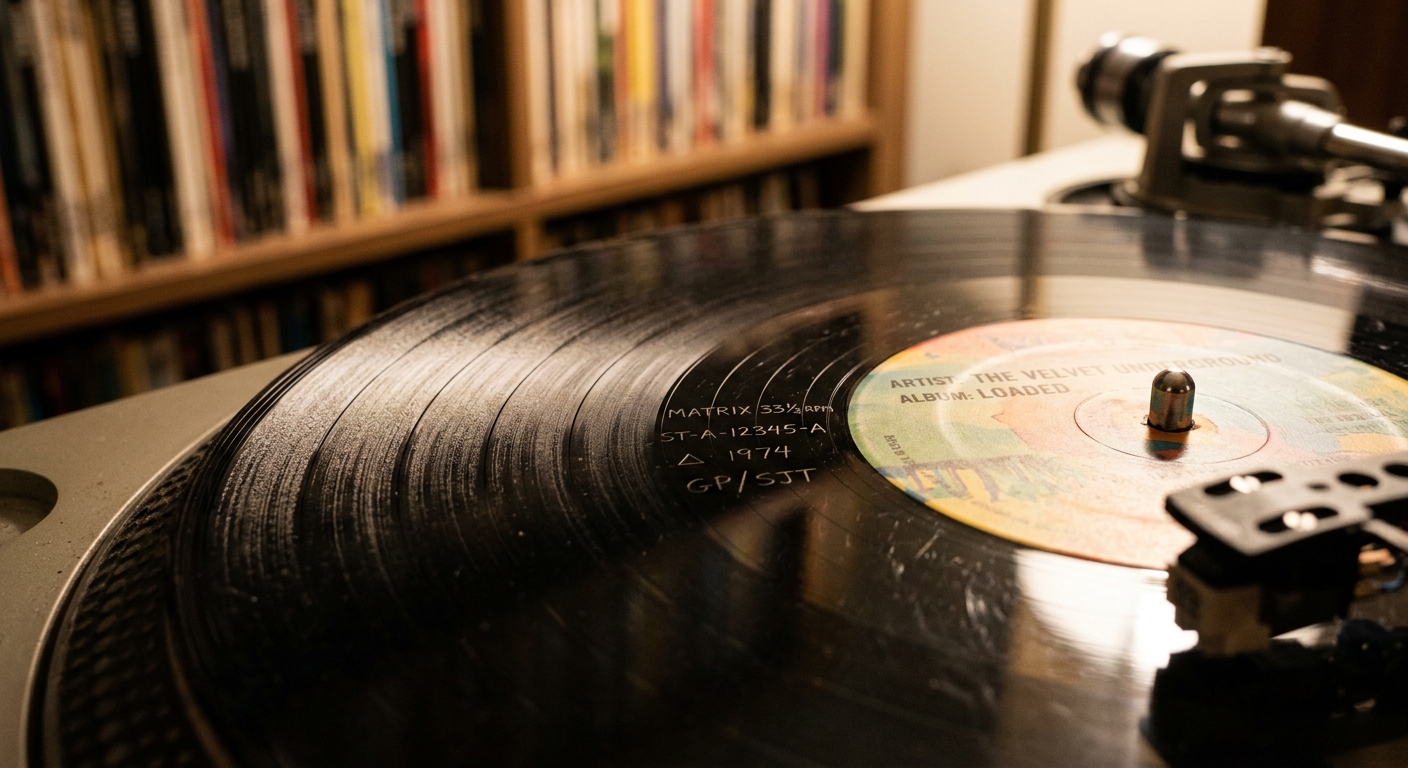
The dead wax is the smooth, ungrooved area between the last track and the centre label on each side. That is where you will find the matrix number, an alphanumeric code, sometimes stamped, sometimes hand-etched, often a combination of both. Wikipedia's matrix-number article describes them as plant-use codes that collectors study because they identify the edition, pressing plant, cutting engineer, or date.
The matrix number is not the same as the catalog number. The catalog number is printed on the label in large type and stays the same on both sides. The matrix number is different on each side, often printed upside-down on the label to keep it from being confused with the catalog.
What to write down when you look at a record:
- Every etched or stamped character, both sides, exactly as it appears.
- The position of slashes, hyphens, and spaces. Spaces are not decorative.
- Any initials or hand-scribbled inscriptions.
Collector rule: dead wax always overrides the sleeve. A pristine-looking jacket means nothing if the runout says otherwise.
What the cut number tells you
The most important suffix on a matrix number is the cut or take number. 12345 on the label but 12345-3 in the runout means this is the third lacquer cut of this side. Lower is earlier, and earlier is usually what collectors want.
Common cut-number formats by label and era:
- UK major labels (1960s-70s):
-1 / -1suffix. Example: Beatles, Abbey Road, UK Parlophone 1969, side A matrixYEX 749-1, side BYEX 750-1.YEXconfirms EMI Hayes pressing;-1is the first lacquer cut.XEXmeans mono. - US Columbia:
1A / 1Bor1 / 1after the catalog number. Example:AL 34111-1A. - US Atlantic (1960s-70s): often
A / Bwith no cut-number suffix; later pressings add-B,-C, etc. Example:ST-A-681461-A. - EMI / Parlophone:
-1 / -1plus tax codes that mark the original UK release.
Important caveat: A1 / B1 does not always mean first pressing. It means first lacquer cut. A record can be cut from a fresh lacquer years after release, so always confirm the year and the stamper generation with one more check.
Engineer and mastering stamps
Hand-etched initials in the dead wax tell you who cut the lacquer. These correlate strongly with sound quality, which is why collector premiums attach to them.
- RL — Robert Ludwig. His early Led Zeppelin II cuts are legendary; later copies look the same but lack the
RLstamp. - PORKY — George "Porky" Peck, UK mastering engineer.
- EML — E. Michael Lunn. Example: Pink Floyd, The Dark Side of the Moon, UK Harvest 1973, side A matrix
SMAS-11163-A-1with hand-etched EML. - GK — Gilbert Kong.
- GF — Greg Fulginiti (Artisan Sound).
- STERLING — Sterling Sound, mastering.
- MASTERDISK — Masterdisk, mastering.
These stamps identify the engineer, not the year. Use them as a context clue, not a date.
Pressing plant codes
Major labels rarely pressed everything themselves; they contracted plants across the country. The dead wax on a US major-label album often shows a plant mark you can read directly. From Discogs forum and label archives:
- CT / CTH — Columbia Records Pressing Plant, Terre Haute, IN. Example: Cream, Disraeli Gears; Yes, Yes.
- CP — Columbia, Pitman, NJ.
- CS / CSM — Columbia, Santa Maria, CA.
- G / G1 — Columbia, Carrollton, GA.
- MO — Monarch Record Mfg. Co., Los Angeles.
- PR / PRC — Presswell / PRC Recording Co.
- PL / PP — Plastic Products.
- SH — Shelley Products.
- ✲ / ☆ (pre-1964) — Capitol Records Pressing Plant, Los Angeles.
- —◁ — Capitol Records Pressing Plant, Winchester.
- 0 / () — Capitol Records Pressing Plant, Jacksonville.
Capitol also used numeric plant codes inside labels: 53 marks a Terre Haute contract pressing (example: Beatles, Beatles VI). US A&M releases use Y or y for Terre Haute.
Plant codes matter because two copies can share a jacket and catalog number but come from different plants or different metal parts. A rare-plant pressing can be worth several multiples of a common-plant copy.
Step 2: inspect the label
The label is the second-most-reliable source. Compare catalog number, label logo, rim text, and the position of any copyright or "Made in" wording against verified Discogs photos for the same release.
Things that change between pressings:
- Label logo design (Atlantic's red-and-black transition, Columbia's "360 Sound" labels).
- Rim text and copyright dates.
- Print quality. Some reissues have noticeably sharper or duller label printing.
- The presence or absence of printed matrix numbers on the label.
Common pitfall: sleeve and vinyl mismatches. A first-print jacket around a later-pressing record is a frequent combo. The dead wax always wins.
Step 3: cross-reference on Discogs
Discogs is the strongest single tool for verifying pressings because its database separates releases by variant, not only by album title. When you compare your copy, match the exact country, label, catalog number, matrix, and visible label design. The marketplace grading guide is built around exact item condition, and the release pages aggregate photos and matrix data from real submissions.
For expensive records, also check:
- Label discographies and reference books.
- Auction archives with photos (Popsike, eBay sold listings).
- Specialist collector sites for the genre or label.
If three sources agree on the matrix, label, and year, you have a solid identification.
Step 4: check the sleeve and inserts last
Sleeve details are the weakest evidence but they can confirm or contradict what you found in the dead wax.
- Jacket printer credit and printer symbol (used on US releases).
- Spine text and barcode placement. Reissues often get a barcode added.
- Inner sleeve. Original US pressings tend to use plain white or company-branded inner sleeves; reissues sometimes switch to lined or printed sleeves.
- Inserts, posters, stickers, and hype stickers. Confirm against the release date.
If the matrix, label, jacket, sleeve, and inserts all agree, you are looking at a first pressing.
Common mistakes collectors make
- Trusting the sleeve over the dead wax. Sleeves get swapped or upgraded; the vinyl is the only source of physical truth.
- Reading only one side. A1 on side A does not mean first pressing if side B is B3 or RE (recut).
- Confusing catalog number with matrix number. The catalog number stays the same across reissues; the matrix number changes.
- Stopping at
A1 / B1. That tells you first cut, not first pressing. Confirm the stamper generation and the year. - Assuming obi means Japanese first pressing. An obi strip on a Japanese pressing affects completeness and value but does not by itself prove first-pressing status.
FAQ
Where exactly is the dead wax on a record?
The smooth, ungrooved area between the last track and the centre label, on each side. Hold the record up to a strong light; etched or stamped codes are usually visible without a magnifier.
Does A1 / B1 always mean first pressing?
No. A1 / B1 means the first lacquer was used. A fresh lacquer can be cut years after release. Confirm the year and the stamper generation with one more check before calling it a first pressing.
Are first pressings always better-sounding?
No. Some later pressings cut by respected engineers outperform the original on audio quality. First-pressing status is about provenance, scarcity, and collector demand, not an automatic guarantee of sound.
What if my record has no matrix number at all?
Some late reissues and budget pressings have minimal runout markings. Cross-reference the label design, catalog number, and country against Discogs. The label and catalog number are still usable.
Can a UK first pressing and a US first pressing of the same album both be "firsts"?
Yes. They are different records, pressed at different plants, often from different masters. Both qualify as first pressings within their own markets.
How do I record what I found?
Log the full matrix from both sides, the plant code, the engineer initials, the catalog number, the label variant, and the pressing country. Save the exact variant in your collection tracker so you always remember whether you are holding the original or a later reissue.
Sources
A spreadsheet tracks what you own. What's Spinning identifies what's playing.
On-device vinyl ID logs your listening history automatically. 7-day free trial.
Looking for Shazam for vinyl?
What's Spinning identifies what's playing on your turntable on-device, logs history, and AirPlays now-playing to your TV.
Comparing vinyl ID apps?
Analog requires Discogs and is iPhone-first (iPad coming). What's Spinning works without Discogs on iPhone and iPad with AirPlay.
Try What's Spinning Free
Turn your iPad into a live now-playing display. Track every record you spin.
START FREE TRIALThen $4.99/mo or $39.99/yr · Cancel anytime