Vinyl Anti-Skating Explained Simply
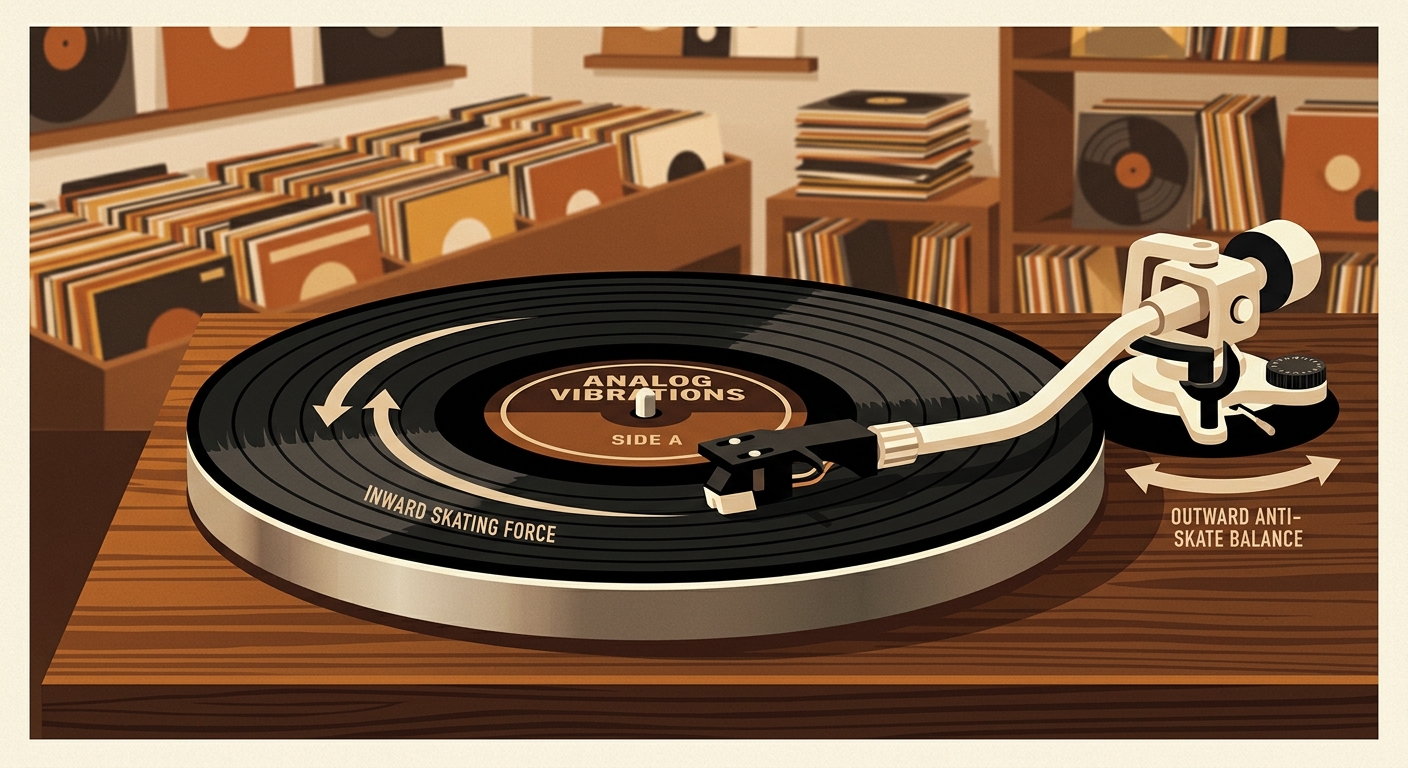
If your turntable has a little dial marked anti-skate, it can feel like one more mysterious vinyl ritual: balance the tonearm, set the tracking force, level the platter, now twist this tiny number and hope the record gods approve. The good news is that anti-skating is not magic. It is a simple counter-force that helps the stylus sit evenly in the groove while the record spins.
Here is the plain-English version: as the record rotates, friction between the moving groove and the stylus tends to pull a pivoted tonearm inward, toward the label. Anti-skate applies a gentle outward force to offset that pull. When it is close, the stylus presses more evenly on both groove walls, which helps stereo balance, reduces mistracking on loud passages, and avoids favoring one side of the stylus or groove.
Why the stylus wants to skate inward
Most common tonearms are pivoted, and the cartridge is mounted at an offset angle so the stylus traces the groove with less tracking error across the side. That geometry is useful, but it also means groove friction creates an inward torque. Wikipedia's technical summary of turntable anti-skating puts it directly: because of the offset between the cartridge axis and the tonearm pivot, friction from the rotating disc tends to draw the tonearm toward the center of the record.
That force is not perfectly constant. The outer groove of a 33 rpm 12-inch LP moves past the stylus faster than the inner groove. The same Wikipedia article gives a useful scale: groove speed changes from about 50 cm/s at the outside to roughly 15 cm/s near the end of a side. The skating force also changes with groove modulation, stylus profile, record condition, tracking force, and where the arm is on the record. That is why anti-skate is best understood as a practical average, not a laser-precise number.
What anti-skate does for sound
A stereo LP stores the left and right channels on opposite groove walls. If the stylus is being pulled harder into one wall than the other, you can hear it as channel imbalance, fuzzy inner-groove distortion, or one channel breaking up before the other during loud vocals, horns, or guitar peaks. Fluance's explainer on anti-skating on a turntable makes the same practical point: too little or too much anti-skate can create distortion, skipping, or uneven pressure, while a well-calibrated setting keeps the stylus seated in the groove with better left-right balance.
This matters most when you are listening critically, making a clean needledrop, or checking a used record before cataloging it. A slightly wrong anti-skate setting will not instantly destroy a treasured Blue Note pressing, but the closer you get, the easier life is for both cartridge and record.
The simple starting point
For most home turntables, the simplest starting point is this: set anti-skate to the same number as your tracking force. If your cartridge tracks at 1.8 grams, start with anti-skate at 1.8. If the dial only has whole numbers, choose the closest mark. Fluance recommends setting tracking force according to the cartridge instructions, then using anti-skate as the counter-balance to that force.
Do not guess tracking force by feel. Balance the arm according to the manual, set the manufacturer's recommended force, and ideally confirm it with a small digital stylus scale.
How to fine-tune it without overthinking
After the basic setting, use music. Pick a clean, familiar record with centered vocals and a few loud inner-side passages. If the right channel splatters or distorts first, you may need a little more anti-skate. If the left channel sounds strained first, you may need a little less. Move in small steps, then replay the same passage.
Some hobbyists use blank records or test records. Those can help, but they can also trick you. A blank surface does not behave like a modulated groove, and a torture-track test can push a cartridge beyond normal music. The goal is stable playback, centered imaging, and clean tracking on real records.
Also remember that anti-skate is only one setup variable. If the turntable is not level, the stylus is dirty, the tracking force is too low, or the cartridge alignment is off, anti-skate will not rescue the system. Ortofon's cartridge FAQ lists proper adjustment of anti-skating, azimuth, and tracking force as part of proper care, and notes that with proper care up to 1,000 hours of stylus life is possible before performance degradation. That is a useful reminder: setup is not audiophile fussiness for its own sake, it is maintenance.
Common signs your anti-skate is off
- Distortion in one channel: especially on loud inner-groove passages.
- The arm pulls inward too eagerly: sometimes visible during cueing or on lead-in grooves.
- Uneven channel balance: vocals or centered instruments feel slightly pulled to one side.
- Skipping or mistracking: especially when tracking force is already set correctly.
Do not chase perfection record by record. Different pressings, groove cuts, and levels will behave differently. Once your setup is close, leave it alone unless you change cartridges, stylus profile, headshell mass, or tracking force.
What collectors should actually do
If you collect records, the practical routine is simple. Set tracking force first. Match anti-skate to that value. Listen to a known clean record. Fine-tune only if you hear repeatable one-channel distortion or mistracking. What's Spinning can help you remember what you played and when, but the setup still happens in the real world, with a stylus in a groove.
Anti-skate is not the most glamorous part of vinyl playback, but it is one of those small adjustments that makes the whole ritual calmer. Set it close, verify with your ears, and stop fiddling before the hobby turns into a spreadsheet with a tonearm attached.
FAQ
Should anti-skate match tracking force?
Usually, yes. Matching the anti-skate number to the tracking force is the best starting point for most pivoted tonearms. From there, fine-tune only if you hear repeatable distortion or imbalance.
Can too much anti-skate damage records?
Too much anti-skate can push the stylus harder against the outer groove wall, which may increase distortion and uneven wear. It is not something to panic about after one side, but it is worth correcting.
Do all turntables need anti-skate?
Most pivoted tonearms benefit from it. Some entry-level turntables have a fixed anti-skate setting, and linear-tracking turntables largely avoid skating because the arm does not swing from a pivot in the same way.
Should I use a blank record to set anti-skate?
A blank record can show whether the arm is being pulled strongly inward or outward, but it is not a perfect simulation of a real groove. Use it as a rough check, not the final authority.
A spreadsheet tracks what you own. What's Spinning identifies what's playing.
On-device vinyl ID logs your listening history automatically. 7-day free trial.
Looking for Shazam for vinyl?
What's Spinning identifies what's playing on your turntable on-device, logs history, and AirPlays now-playing to your TV.
Comparing vinyl ID apps?
Analog requires Discogs and is iPhone-first (iPad coming). What's Spinning works without Discogs on iPhone and iPad with AirPlay.
Try What's Spinning Free
Turn your iPad into a live now-playing display. Track every record you spin.
START FREE TRIALThen $4.99/mo or $39.99/yr · Cancel anytime
Get it on your iPhone
Open on iPhone