Turntable Cleaning Kit Comparison: Top Brands Reviewed
A turntable cleaning kit comparison gets weird fast. The cheapest option on the market, a $15 carbon fiber brush, removes more day-to-day contamination than any machine, because the best cleaning happens before you drop the needle. The most expensive option on the market, a $1,000+ ultrasonic record cleaner, then deep-cleans the grooves that the brush can't reach. Picking the wrong kit usually means spending $400 on a vacuum RCM that sits in a closet because you never set up the fluid, or under-buying a brush-and-cloth setup and then wondering why your thrift-store copy of Pink Moon still pops on every track.
This review-style comparison walks through the seven kits most vinyl collectors actually consider in 2026: three manual options (a basic carbon fiber brush, the GrooveWasher hardwood kit, and the Spin-Clean MKII), two mid-range vacuum machines (Record Doctor VI and Pro-Ject VC-E2), one premium ultrasonic (HumminGuru HG01), and one all-in-one budget bundle (Big Fudge). For each we cover the real-world price in 2026, what it actually cleans, how long it takes per record, what fluid it uses, and who it makes sense for. There is no single "best" turntable cleaning kit. There is a best kit for your collection size, your budget, and how often you buy used records.
Quick comparison: turntable cleaning kits at a glance (September 2026)
| Kit | Type | Price (USD) | Per-record time | Best for |
|---|---|---|---|---|
| AudioQuest Carbon Fiber Brush | Dry brush | $15-25 | 10 seconds | Daily use, every collection |
| Big Fudge 6-in-1 Vinyl Cleaning Kit | Manual bundle | $20-30 | 1-2 minutes | First-time vinyl owners on a budget |
| GrooveWasher Walnut Hardwood Kit | Manual wet kit | $50-65 | 2-3 minutes | Occasional wet cleaning without a machine |
| Spin-Clean Record Washer MKII Deluxe | Manual washer | $80-110 | 30-60 seconds | Up to ~500 records, no electricity |
| Record Doctor VI | Vacuum RCM | $300-400 | 2-4 minutes | Collectors buying used vinyl weekly |
| Pro-Ject VC-E2 | Vacuum RCM | $499 | 1-2 rotations (~30s) | Mid-size collections, quiet operation |
| HumminGuru HG01 | Ultrasonic + vacuum | $699-899 | 5-7 minutes per side | Archival collectors, 200+ records |
1. AudioQuest Carbon Fiber Anti-Static Record Brush — the must-have baseline ($15-25)
If you buy exactly one thing today, buy a carbon fiber record brush. Not a velvet brush, not a "microfiber cleaning pad," a carbon fiber brush. Carbon fibers conduct static away from the record surface as you sweep, so dust lifts off the groove instead of just shifting sideways. The AudioQuest Anti-Static Record Brush has been the default pick in this category for over a decade, and a current model runs about $20.
How to use it correctly: hold the brush so its fibers touch the record lightly while the platter spins, sweep from the label outward across the full surface two or three times, then lift the brush straight up away from the record (do not slide it back across the surface). The AudioQuest has a small reservoir in the handle that holds a felt pad and a few drops of cleaning fluid for stubborn spots, but for daily use the dry brush is enough.
What it cleans: loose surface dust, light static charge, fresh fingerprints (if caught immediately).
What it does not clean: embedded groove dirt, oily fingerprints, smoke residue, anything that's been ground into the vinyl by a contaminated stylus.
Who should buy it: literally everyone who owns a turntable. Even collectors with $800 vacuum RCMs run a carbon fiber brush before every side. The Library of Congress's care guide for grooved audio discs recommends handling records only by the edge and label, and treating routine dust removal as the first line of defense. A $20 brush is the cheapest insurance against stylus wear you'll ever buy.
2. Big Fudge 6-in-1 Vinyl Cleaning Kit — the giftable budget bundle ($20-30)
The Big Fudge kit is the most-searched "vinyl cleaning kit" on Amazon because it bundles six items into one box for roughly the price of a single AudioQuest brush: a carbon fiber record brush, a microfiber cleaning cloth, a stylus gel cleaner, a velvet record brush, replacement inner sleeves, and a small storage pouch. It's a complete starter kit for someone buying their first turntable.
The carbon fiber brush in the bundle is functional, not great — the fibers are thinner and shed faster than the AudioQuest. The microfiber cloth is the same microfiber cloth you'll find in any $5 multi-pack. The stylus gel pad, though, is genuinely useful: you lower the stylus onto the sticky gel a few times and it pulls fuzz off the cantilever, which a $20 stylus brush can't always do without bending cantilever wires.
What it cleans: dust, light fingerprints, stylus contamination, gives you a clean inner sleeve to start with.
What it does not clean: anything that needs wet cleaning. The kit ships with a small spray bottle of fluid, but the bottle is tiny enough that you will run out within a dozen record cleanings and probably not reorder.
Who should buy it: a new vinyl owner who wants everything in one box for under $30. After six months of use you'll likely replace the carbon fiber brush with an AudioQuest and keep the stylus gel as a backup. That's a fine outcome for $25.
3. GrooveWasher Walnut Hardwood Kit — the best manual wet-cleaning option ($50-65)
For collectors who want to wet-clean records without buying a machine, the GrooveWasher walnut hardwood kit is the most-respected manual option. The kit ships with a solid hardwood handle (real walnut, not veneer), a replaceable microfiber cleaning pad, a 4 oz spray bottle of G2 fluid, and a microfiber drying mat. Total price in 2026 is around $55.
G2 fluid is the kit's real selling point. Most "record cleaning fluid" in this price range is distilled water with a drop of dish soap, which leaves residue. GrooveWasher's G2 is engineered to reduce surface tension so the fluid actually flows into the bottom of the groove, suspends the oils and microdust it finds, and lets the microfiber pad lift the dirty solution away rather than smear it around. The fluid is also alcohol-free, which matters because alcohol-based cleaners can dry out and eventually crack older vinyl over years of repeated use.
How to use it: spray two light mists of G2 onto the microfiber pad (not the record), place the record on a flat surface, place the damp pad on the record, and rotate the record under your palm with light pressure 4-6 full revolutions. Flip the record and repeat. Then dry-buff with the included microfiber mat. Total per-record time is about 2-3 minutes, and the wet pad needs a rinse every 5-10 records depending on how dirty the vinyl was.
What it cleans: fingerprints, light grease, smoker-residue film, most everyday contamination on records that aren't visibly scuffed.
What it does not clean: deep groove contamination, mold, anything that needs fluid extraction (a wet pad smears as much as it cleans once the pad is loaded with grime).
Who should buy it: collectors who buy a few used records a month and want a real wet-cleaning method without dedicating counter space to a vacuum machine. If you're cleaning 1-5 records per week, the GrooveWasher kit hits the sweet spot between price, effort, and result.
4. Spin-Clean Record Washer MKII Deluxe — the best value in a real record washer ($80-110)
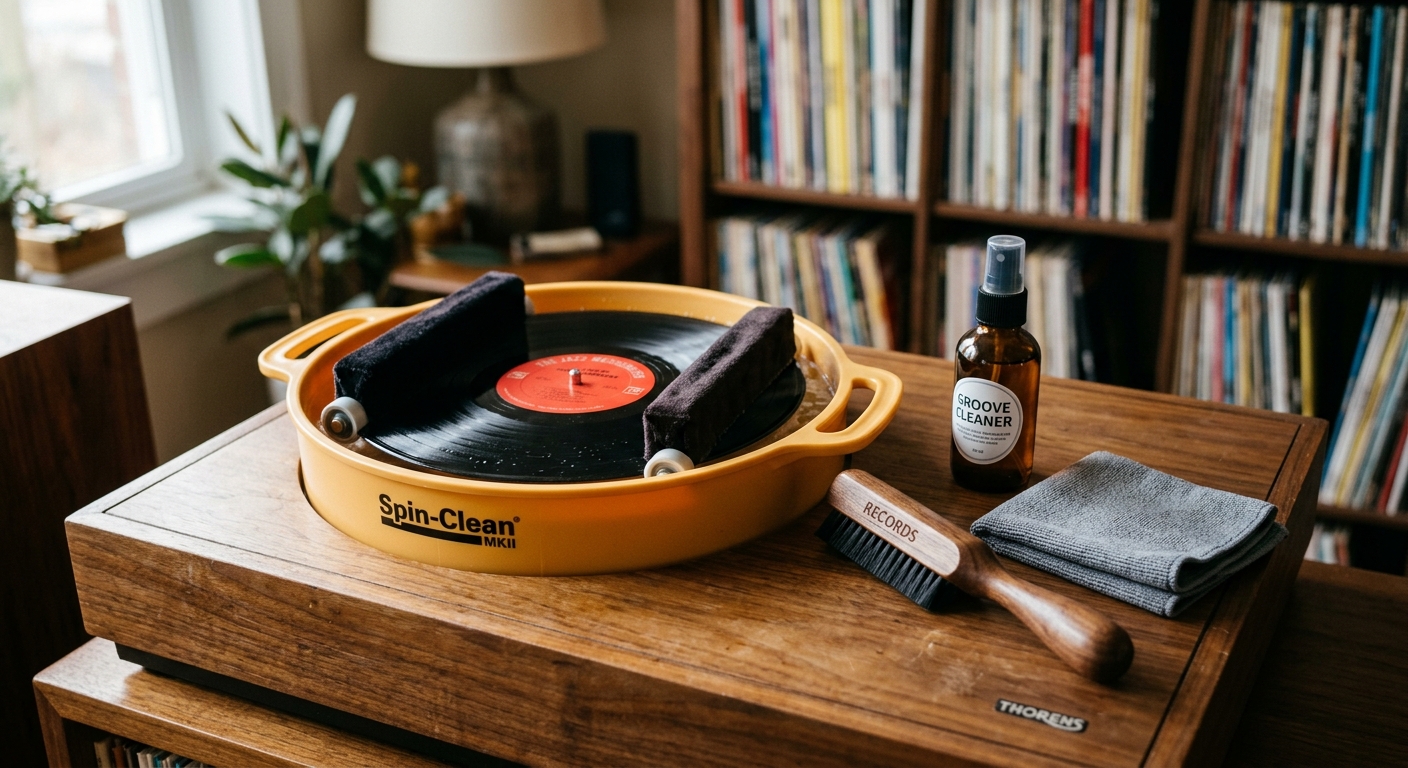
The Spin-Clean MKII has been the budget vinyl-cleaning machine since the 1970s, and it has not been seriously challenged at its price point in fifty years. The current MKII Deluxe Kit runs about $80-110 and includes the washer basin, four fluid oz of Spin-Clean cleaning solution (enough for roughly 100-150 records per bottle), two pairs of brushes for 7-inch and 12-inch records, and a drying mat.
The mechanism is dead simple: you fill the basin with distilled water plus a cap or two of Spin-Clean fluid, drop the record into the slot, and spin the record manually between two velvet-edged brushes for 30-60 seconds. Both sides get cleaned at once because the brushes contact both surfaces simultaneously. Then you lift the record out, blot it with the drying mat, and put it back in its sleeve. No power, no vacuum, no noise.
The Spin-Clean works because the brushes contact the grooves with consistent pressure across the entire record surface, which is more thorough than hand-wiping with a microfiber pad. The fluid is non-alcoholic, non-alkaline, and phosphate-free. Replacement fluid is around $20 for 8 oz, and the brushes last for years of normal use before needing replacement at $25 for a new set.
What it cleans: surface dust, fingerprints, light grease, smoker haze, microdust that a carbon fiber brush can't reach.
What it does not clean: the cleaning fluid stays on the record (the basin can't vacuum it off), so heavily contaminated records may need two passes. For deep groove contamination, a vacuum or ultrasonic machine is necessary.
Who should buy it: anyone with 100-500 records who wants real wet cleaning without spending $300+. The Spin-Clean is the most popular record washer at audio shows and in independent record stores for a reason — it's the only kit under $150 that genuinely cleans both sides of an LP at once.
5. Record Doctor VI — the entry-level vacuum RCM ($300-400)
The Record Doctor VI is the most affordable vacuum record cleaning machine on the market from a recognized brand. It runs about $350-400 in 2026 and includes the cleaning machine, a bottle of Record Doctor cleaning fluid (4 oz), a goat-hair cleaning brush, and a label protector.
How it works: place the record on the platter, drop a magnetic clamp on top to seal the label, apply Record Doctor fluid to the brush, scrub the record while it rotates, then flip a switch to engage the vacuum arm. The vacuum pulls the dirty fluid off the record surface in 2-3 rotations and dries the record ready-to-play. Total cycle time is 2-4 minutes per side.
The big jump from the Spin-Clean to a vacuum RCM is fluid extraction. A Spin-Clean leaves the fluid on the record (the drying mat absorbs surface moisture, but the grooves still hold some fluid until air-drying). A vacuum RCM removes the contaminated fluid completely, which means deeper cleaning and no risk of fluid residue affecting playback. The Record Doctor VI is loud — about as loud as a small shop vac — and it's a 12-pound machine that takes up about a square foot of counter space.
What it cleans: everything the Spin-Clean cleans, plus deeper grease, smoker residue that's been ground into the grooves, light mold (with repeated treatments).
What it does not clean: deep scratches, warps, pressings with manufacturing defects. For truly filthy records (estate-sale finds, flood-damaged vinyl), the next step up is ultrasonic.
Who should buy it: collectors buying used vinyl weekly and wanting a real vacuum RCM without paying $500+ for the Pro-Ject or $700+ for the HumminGuru. The Record Doctor brand has been making these machines for years and the parts (replacement fluid, replacement brushes, replacement vacuum arm strips) are easy to find.
6. Pro-Ject VC-E2 — the audiophile-grade vacuum RCM ($499)
The Pro-Ject VC-E2 is the European answer to the American Record Doctor, and it's the vacuum RCM that most audiophile magazines recommend. Made in Europe and sold through hi-fi dealers at $499 in 2026, it ships with a 100 ml bottle of Pro-Ject's new Wash It 2 cleaning fluid (a non-alcoholic, pre-mixed formula), a goat-hair record brush, self-adhesive arm strips for the vacuum arm, and the magnetic clamp.
Technical specifications from Pro-Ject's manual: the VC-E2 runs at 30 RPM, weighs 6.5 kg net, has a 500 ml (17 fl oz) internal fluid reservoir, and uses 230V/800W (or 120V/360W in North America). It cleans a record in one to two full rotations, which Pro-Ject claims is faster than any comparable vacuum machine at this price. The new magnetic clamp is a real improvement over the older screw-down clamp because it lets you place and remove records faster.
The VC-E2's biggest practical advantage over the Record Doctor VI is the Wash It 2 fluid. The Record Doctor fluid works fine, but Pro-Ject engineered Wash It 2 to evaporate cleanly inside the machine's reservoir, so the tank rarely needs emptying (a Record Doctor tank needs emptying every 5-10 records). The VC-E2 is also noticeably quieter than the Record Doctor at about 60 dB vs 70+ dB.
What it cleans: everything a vacuum RCM can clean. The VC-E2 is particularly effective on shellac records in addition to vinyl, which the Record Doctor VI is not specifically designed for.
What it does not clean: deep groove contamination that needs ultrasonic agitation.
Who should buy it: a collector with 300+ records who wants the most efficient vacuum RCM on the market, and who values build quality and a quieter motor over saving $100. The Pro-Ject is the right machine for someone who's already invested in a serious turntable and wants their cleaning to match.
7. HumminGuru HG01 — the best ultrasonic + vacuum combo ($699-899)
The HumminGuru HG01 is the first widely-available consumer ultrasonic record cleaner with built-in vacuum drying, and in 2026 it's the only machine under $1,000 that combines both technologies. Price runs $699-899 depending on accessories, and it weighs just 9 pounds — far lighter than the Pro-Ject or the larger Nitty Gritty machines it competes with.
How it works: add distilled water plus a few drops of HumminGuru's alcohol-free cleaning formula to the bath reservoir, insert the record vertically into the cleaning slot, and start the cycle. The bath uses 40 kHz ultrasonic waves to agitate the water, which physically dislodges particles from the bottom of the groove that a brush can't reach. After the ultrasonic cycle (typically 5 minutes per side), dual warm-air fans vacuum-dry the record so it's ready to play immediately.
Reviews consistently report 60-70% reductions in surface noise on previously noisy used records — for jazz, classical, and acoustic recordings where groove silence matters, this is a real audible improvement. The HG01 has separate cleaning and drying zones, which means the bath water can be reused for multiple records before draining, and the air filters on the drying fans are replaceable.
What it cleans: deep groove contamination that no other consumer machine can reach. The ultrasonic agitation physically lifts particles that brush scrubbing just smears around. Particularly effective on thrift-store and estate-sale records where you don't know the cleaning history.
What it does not clean: scratches, warps, manufacturing defects. The HG01 cleans what's in the groove; it cannot repair what's wrong with the groove.
Who should buy it: a serious collector with 200+ records who buys used vinyl regularly and wants the best balance of cleaning depth, low noise (the HG01 is markedly quieter than vacuum-only RCMs), and reasonable ongoing cost. If you have a mix of vintage and modern pressings, the ultrasonic bath handles everything from delicate 1960s pressings to scuffed thrift-store finds.
How to choose the right kit for your collection
The right turntable cleaning kit depends on three questions: how many records do you own, how often do you buy used vinyl, and how much counter space do you have?
Under 100 records, mostly new: AudioQuest carbon fiber brush ($20) plus a stylus gel pad ($10). That's the whole kit. You won't wet-clean often enough to justify anything more.
100-300 records, occasional used purchases: Spin-Clean MKII Deluxe ($80-110). The best value in real wet cleaning. Pair it with a carbon fiber brush for daily dust and you're covered for almost any collection.
300-1,000 records, regular used vinyl buying: Record Doctor VI ($350-400) or Pro-Ject VC-E2 ($499). A vacuum RCM is the right tool if you're cleaning 5+ records a week. The Pro-Ject is quieter and faster; the Record Doctor is cheaper and easier to find in stock.
1,000+ records, archival collector: HumminGuru HG01 ($699-899). The ultrasonic cycle is the only consumer-grade technology that cleans as deeply as a professional disc-cleaning service. Worth the investment if you're maintaining a serious collection.
Whichever kit you pick, two habits matter more than the equipment: clean before every play with a carbon fiber brush, and store records vertically in anti-static inner sleeves so they don't get dirty in the first place. The Library of Congress's preservation guide covers both points and is the best free reference for vinyl care.
A turntable cleaning kit is not a one-time purchase — the fluid runs out, the brushes wear, the vacuum arm strips need replacing. Budget for ongoing consumables. Spin-Clean fluid is about $20 for 8 oz. Record Doctor fluid is about $25 for 8 oz. Pro-Ject Wash It 2 is about $30 for 500 ml. HumminGuru cleaning formula is about $25 for 16 oz. None of these are expensive on a per-record basis, but the cost adds up if you're cleaning dozens of records a month.
Frequently asked questions
How often should I clean my records?
Dry-brush with a carbon fiber brush before every play. Wet-clean with a Spin-Clean, vacuum RCM, or ultrasonic machine every 10-25 plays, or whenever you buy a used record before adding it to your collection.
Is a vacuum record cleaning machine worth it?
Yes, if you have 300+ records and buy used vinyl regularly. A vacuum RCM extracts the dirty fluid from the grooves rather than leaving it on the surface, which results in audibly quieter playback on previously noisy records. If you have fewer than 200 records or rarely buy used, a Spin-Clean delivers 80% of the result at 20% of the price.
Are ultrasonic record cleaners safe for vinyl?
Yes. Ultrasonic cleaning uses 40 kHz sound waves in a water bath to agitate particles out of the groove. It does not scratch the vinyl, and it does not damage the playing surface. The HumminGuru HG01 has been the consumer benchmark since 2024 and there are no reported cases of ultrasonic damage to properly-handled vinyl.
What's the best budget turntable cleaning kit under $30?
The Big Fudge 6-in-1 kit at $25 is the most complete budget bundle. But you'll outgrow the carbon fiber brush within six months. A better $30 strategy is the AudioQuest carbon fiber brush ($20) plus a stylus gel pad ($10).
Do I need to clean new vinyl?
New vinyl benefits from a dry brush before first play to remove manufacturing debris, but it does not need wet cleaning until you've played it 10-20 times. The exceptions are records that ship with visible paper dust or fingerprints from the pressing plant, which are rare but do happen.
Can I use the same cleaning fluid for a Spin-Clean and a vacuum RCM?
No. Spin-Clean's fluid is engineered for the basin-and-brush approach and is too concentrated for vacuum RCMs, which use a thinner formula that the vacuum arm can extract. Use each machine's manufacturer-recommended fluid. Distilled water is a poor substitute for any of them — it leaves mineral deposits in the groove.
A spreadsheet tracks what you own. What's Spinning identifies what's playing. A good turntable cleaning kit makes that copy sound its best.
A spreadsheet tracks what you own. What's Spinning identifies what's playing.
On-device vinyl ID logs your listening history automatically. 7-day free trial.
Looking for Shazam for vinyl?
What's Spinning identifies what's playing on your turntable on-device, logs history, and AirPlays now-playing to your TV.
Comparing vinyl ID apps?
Analog requires Discogs and is iPhone-first (iPad coming). What's Spinning works without Discogs on iPhone and iPad with AirPlay.
Try What's Spinning Free
Turn your iPad into a live now-playing display. Track every record you spin.
START FREE TRIALThen $4.99/mo or $39.99/yr · Cancel anytime