The Rise and Fall of Vinyl Pressing Plants in America
There was a time when the sound of a record press was as common in American factory towns as the whistle of a midday train. Across the country, from New Jersey to California, rows of hydraulic presses hummed with the warm crackle of fresh vinyl, stamping out albums by the millions. Today, that industrial chorus has largely gone quiet, replaced by a handful of specialty plants working overtime to keep up with a revival nobody saw coming.
The story of vinyl pressing in America is a tale of boom, bust, and an unlikely return. To understand where the industry stands today, you have to understand just how far it fell.
The Golden Age of American Vinyl
Through the 1960s and 1970s, the United States operated a vast network of vinyl pressing plants. Columbia Records had massive facilities. RCA Victor ran plants capable of turning out tens of thousands of records per day. Independent pressing operations dotted the landscape, serving regional labels and niche markets. At its peak, America was the world's leading manufacturer of vinyl records, supplying not just domestic demand but exporting to markets across the globe.
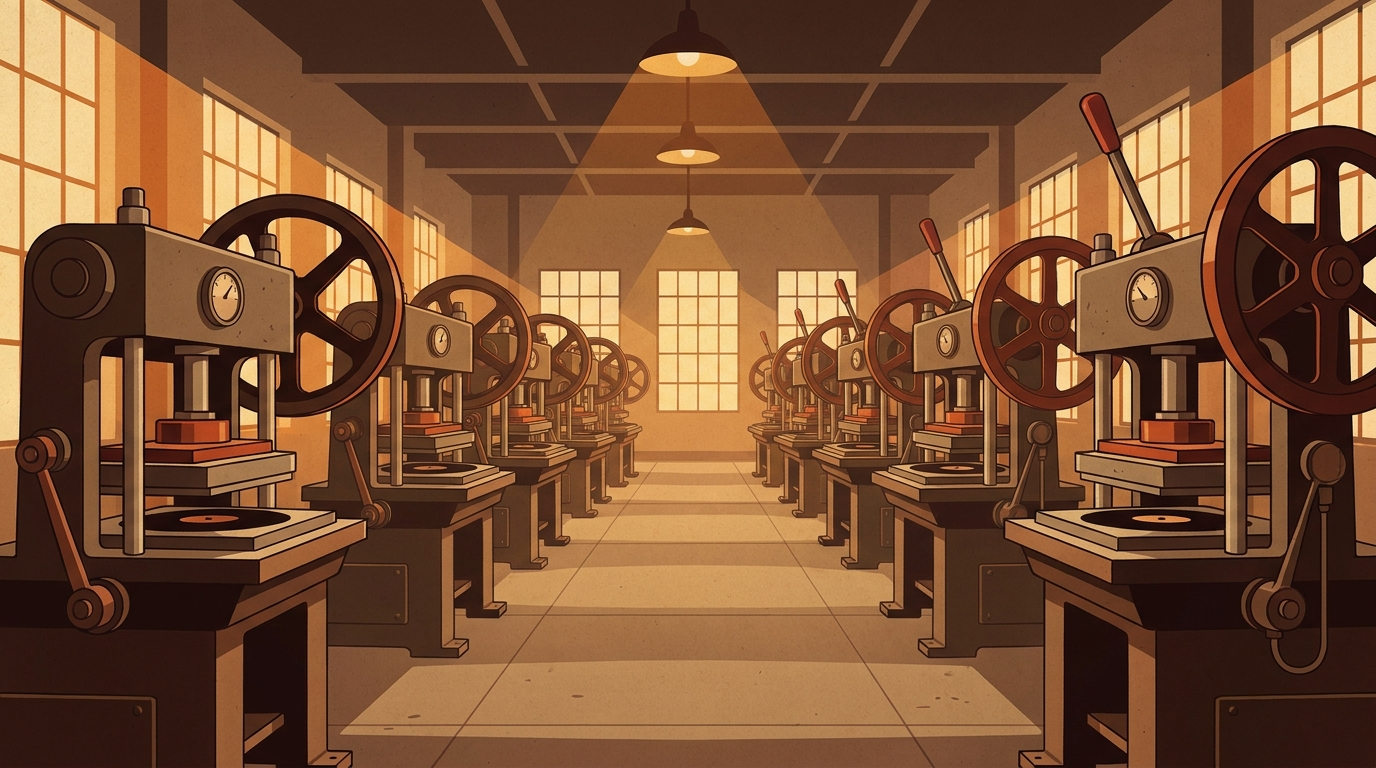
The process itself changed little over the decades. A lacquer disc, cut from a master tape in a mastering studio, was used to create a metal stamp. That stamp was then mounted in a hydraulic press, and molten vinyl was squeezed between two heated plates under enormous pressure. After cooling, out came a gleaming black record, ready to spin on a turntable somewhere in a living room, a car, or a dance hall.
It was grunt work, done by machines that ran hot and loud, but it was steady work. A good plant could press tens of thousands of records in a single shift.
The Compact Disc Uproots Everything
The first real blow to American vinyl pressing came not from any single event but from a slow, relentless tide. When the compact disc debuted commercially in 1982, it carried a promise that seduced the music industry: perfect sound forever, no surface noise, no wear and tear. Record labels saw higher profit margins on CDs than on vinyl. Retailers preferred them because they were smaller, easier to stock, and carried no risk of the scratches and skips that plagued records.
As CDs gained market share through the 1980s, the economics of vinyl pressing deteriorated. Major distributors began charging retailers more for returns on unsold vinyl, then stopped accepting returns entirely. Stores, fearing they would be stuck with inventory they could not sell, dramatically reduced their vinyl orders. Record companies responded by deleting vinyl titles from production and shifting manufacturing capacity to CDs. Pressing plants, suddenly without enough work to stay busy, began closing their doors.
The collapse was swift and complete. By the early 1990s, vinyl record sales had fallen to a tiny fraction of their former levels. Plant after plant shut down. The machinery was sold off, stripped for parts, or simply abandoned. Workers who had spent decades at the presses found their skills no longer in demand. Entire towns that had built modest economies around record manufacturing watched those jobs disappear.
The Revival That Caught the Industry Off Guard
By 2007, something unexpected happened. Vinyl sales, which had been trending downward for two decades, began to climb. A new generation of music fans, many of them born after the CD had won its victory, decided they wanted something the digital file could not offer. They wanted an object. They wanted cover art you could hold. They wanted the ritual of dropping a needle.
Sales rose 85.8% between 2006 and 2007 in the United States. By 2009, annual vinyl sales in America had reached 3.5 million units, the highest since 1998. Record Store Day, launched in 2008, became an annual celebration of the format and the independent shops that carried it. By the mid-2010s, vinyl was generating hundreds of millions of dollars in revenue again.
But here was the problem: the manufacturing infrastructure to support that revival had been almost entirely dismantled. When demand came roaring back, there were simply not enough presses to meet it. Wait times for new vinyl releases stretched to months. Independent labels found themselves competing with major studios for scarce pressing capacity. The industry that had abandoned vinyl so completely was now scrambling to rebuild something it had let decay for two decades.
The Apollo Masters Fire and the Lacquer Crisis
If the capacity shortage was a slow-building crisis, the Apollo Masters fire of February 2020 was a sudden heart attack. On the morning of February 6th, a fire swept through the Apollo Masters Corporation facility in Banning, California. The plant, which employed around 30 people, was the only American manufacturer of lacquer discs, the essential starting point for most vinyl record production. Eighty-two firefighters were needed to bring the blaze under control. The building was destroyed. Miraculously, no one was injured.
Apollo Masters had been responsible for an estimated 70 to 85 percent of all lacquer disc production worldwide. With the plant gone, the world's vinyl pressing industry was suddenly dependent on a small Japanese company called MDC to supply the most critical link in the supply chain. Orders backed up. Lead times stretched. Priority was given to countries with larger volumes, and smaller labels in the United States found themselves waiting in line behind major labels and international customers.
Some pressing plants began experimenting with direct metal mastering, a technique that uses copper instead of lacquer to create a master disc. It produced excellent results but required expensive equipment and expertise that few facilities possessed. The industry began to organize itself in response, forming the Vinyl Record Manufacturers Association of North America to advocate for new domestic lacquer production capacity and to prevent a repeat of the bottleneck.
Where the Industry Stands Today
The American vinyl pressing industry in 2026 is a study in resilience and strain. New pressing plants have opened in recent years, many of them small, independent operations founded by enthusiasts determined to keep the format alive. These include restart efforts at former facilities and greenfield operations in cities where the smell of hot vinyl was once as familiar as asphalt.
But the supply chain remains under pressure. Lacquer discs, the fundamental input for most vinyl production, still flow primarily from a small number of sources, with MDC in Japan carrying a disproportionate share of global production. The lessons of Apollo Masters have not been fully resolved, and industry observers continue to watch the lacquer supply situation closely.
Meanwhile, vinyl sales continue to grow. Americans bought 49.61 million vinyl records in 2023, a 14% increase over the prior year. Vinyl has outsold CDs in revenue terms in multiple recent years. Taylor Swift and other major artists have driven massive spikes in demand, with individual albums selling hundreds of thousands of vinyl copies in their first weeks of release.
The American vinyl pressing industry of today is smaller, more specialized, and more fragile than the one that once hummed across the industrial heartland. But the presses are running again, and for the people who love this format, that sound is worth everything.
A spreadsheet tracks what you own. What's Spinning identifies what's playing.
On-device vinyl ID logs your listening history automatically. 7-day free trial.
Looking for Shazam for vinyl?
What's Spinning identifies what's playing on your turntable on-device, logs history, and AirPlays now-playing to your TV.
Comparing vinyl ID apps?
Analog requires Discogs and is iPhone-first (iPad coming). What's Spinning works without Discogs on iPhone and iPad with AirPlay.
Try What's Spinning Free
Turn your iPad into a live now-playing display. Track every record you spin.
START FREE TRIALThen $4.99/mo or $39.99/yr · Cancel anytime