Advanced Vinyl Storage Beyond Upright Shelving
Most vinyl advice stops at one rule: keep records upright. That rule is sound, but it does not require every collection to live spine-out in a wall of cubes. Advanced vinyl storage beyond upright shelving changes how you access, browse, move, and protect records while the discs remain vertically supported.
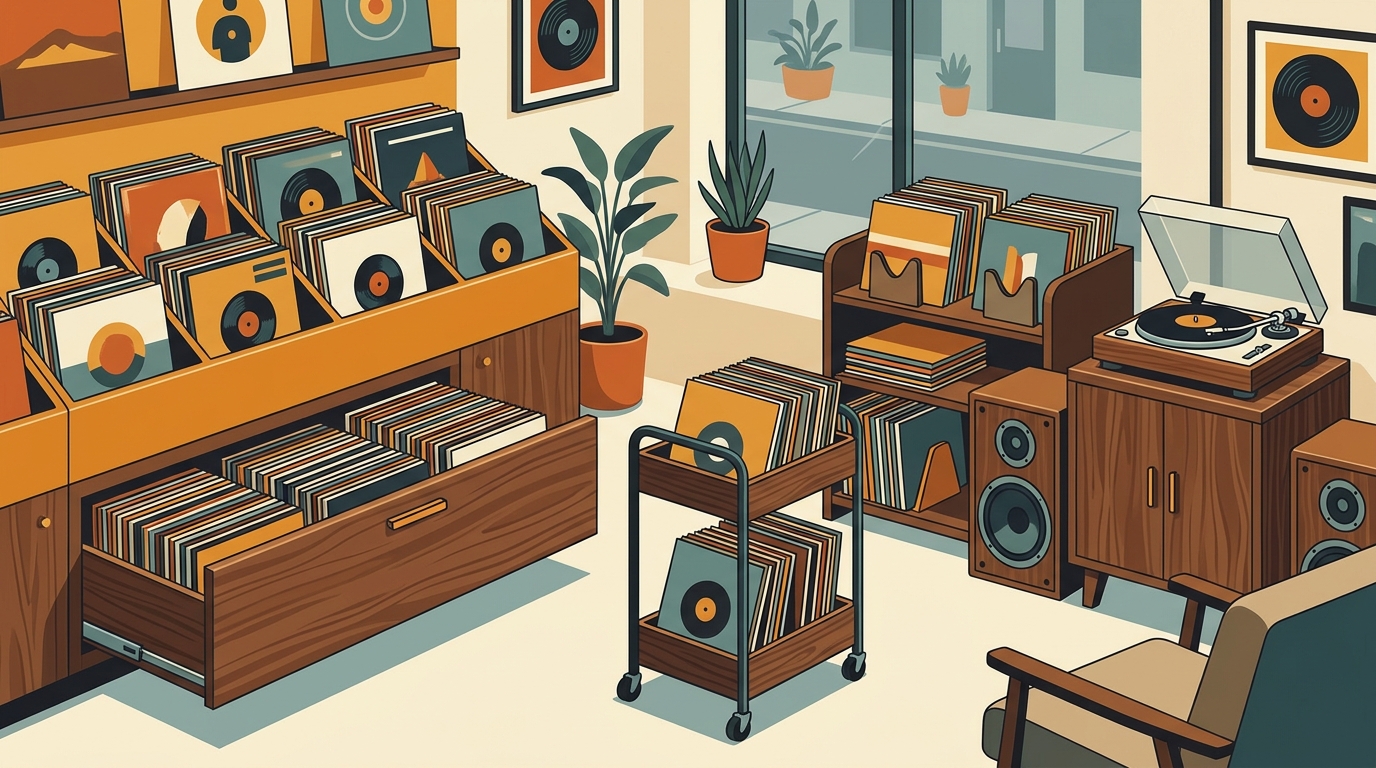
The best systems use face-forward bins, full-extension drawers, rotating trays, mobile carts, and archival boxes. They can be easier to browse and safer for valuable pressings than an overfilled shelf.
Start With the Nonnegotiable Preservation Rules
Before choosing clever hardware, keep the archival basics intact. The Library of Congress recommends storing grooved discs upright, using sturdy dividers every 4 to 6 inches, and supporting the entire face of each sleeved record. It also notes that grooved discs average more than 35 pounds per shelf-foot, which explains why lightweight furniture can bow or fail under a serious collection.[1]
Environment matters just as much as orientation. For home collections, the Library of Congress suggests a cool, stable, clean space at roughly 35 to 40 percent relative humidity, away from attics, basements, vents, leaks, intense light, and vibration.[1] In other words, a beautifully engineered drawer in a damp garage is still bad storage.
1. Use Face-Forward Flip Bins for Active Listening
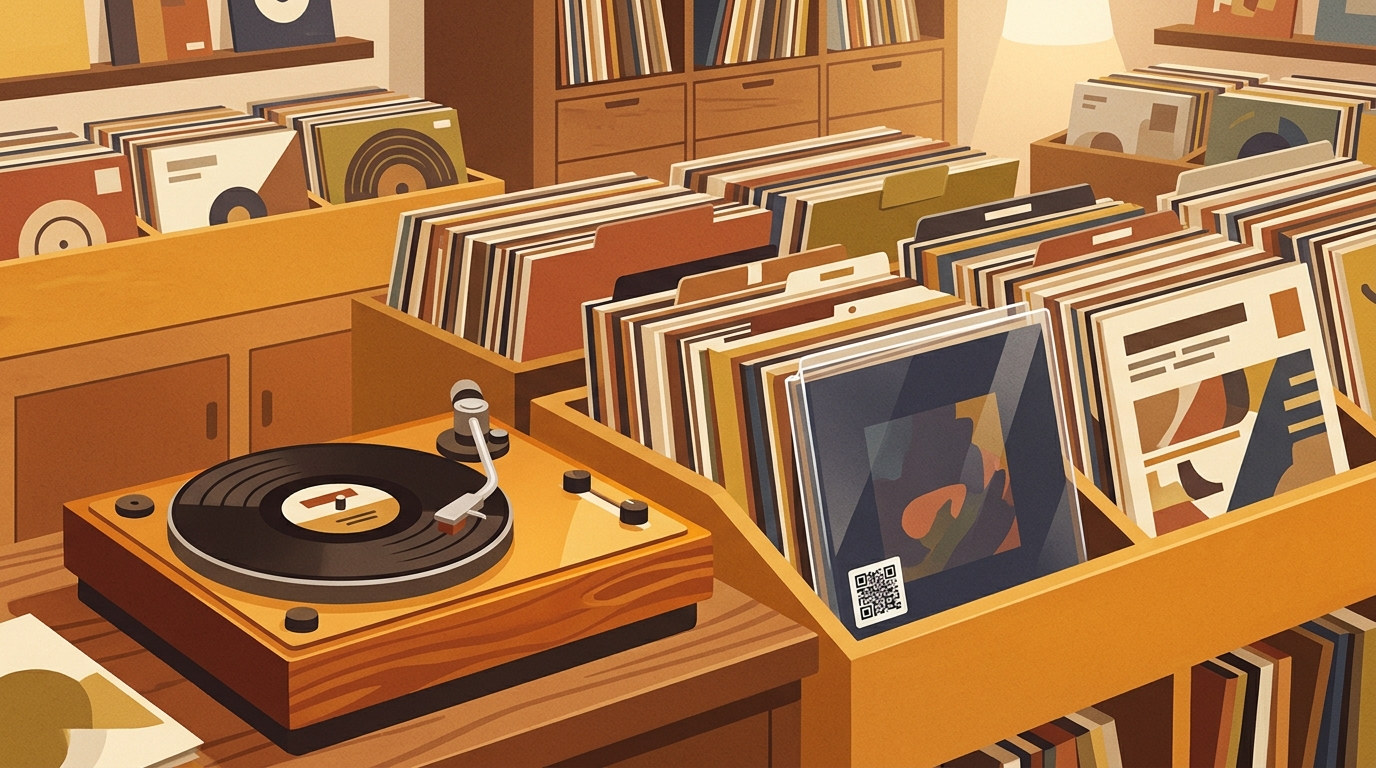
Flip bins solve the biggest weakness of spine-out shelving: narrow spines hide the cover art that helps you remember what you own. A top-access bin lets you browse with the same hand motion used in a record shop. It is especially effective for new arrivals, current favorites, DJ selections, or a rotating “play next” queue.
Do not fill a bin until the jackets are clamped together. Leave enough slack to move a small group forward without bending sleeves. Add full-height dividers so a half-empty section cannot slump. A flip bin can also become the physical counterpart to your What’s Spinning listening queue.
Symbol Audio’s Dovetail line combines top flip bins with full-extension drawers, with some configurations rated at 75 LPs per drawer or bin.[2] The container, supports, and load rating must work together.
2. Choose Full-Extension Drawers for Dense, Protected Storage
Record drawers keep dust and light off the jackets while preserving face-forward browsing. They also make lower storage easier to use because the collection comes toward you instead of forcing you to crouch and read tiny spines.
Atocha Design suggests about 95 LPs per drawer, leaving room to flip, and rates its four-drawer cabinet at roughly 380 LPs.[3] That capacity also illustrates the engineering problem: four loaded drawers concentrate several hundred pounds in a relatively small footprint.
For a custom cabinet, specify full-extension slides rated comfortably above the expected load. Use one drawer at a time, anchor tall cabinets where appropriate, and place the heaviest sections low. Check open clearance before buying, since an extended drawer can easily block a walkway.
3. Consider Rotating Pullout Trays for Shallow Walls
A rotating tray stores records spine-out, pulls forward, then turns 90 degrees for face-forward browsing. This hybrid preserves compact library-style storage without giving up cover browsing.
Toneoptic’s rpm is a useful real-world example. It holds about 60 records when a collection includes reissues and box sets, or up to 80 thinner original pressings. The unit is 17.25 inches deep when closed but reaches 30.5 inches with the drawer extended, and the manufacturer estimates a fully loaded unit can weigh up to about 77 pounds.[4]
For any rotating system, verify the mounting, loaded weight, extension depth, turning clearance, and divider placement. The mechanism must support jackets throughout the rotation.
4. Build a Mobile “Working Collection”
A wheeled cart is ideal when records move between a main library, turntable, desk, or DJ setup. Instead of carrying a heavy crate, you can roll a curated group into position and return it after listening.
Purpose-built steel carts commonly separate the active collection from deep storage. Atelier Article offers an 80 or 100 LP DJ cart and two-level versions for approximately 160 or 200 records. The company also warns that gatefolds, box sets, and outer sleeves reduce real capacity, and its standard wheels rotate freely rather than lock.[5][6]
For home use, choose rubber wheels that clear thresholds, add locking casters on slick floors, and keep the center of gravity low. Tall, narrow carts are less forgiving when pushed sideways.
5. Use Archival Boxes for Rare, Fragile, or Inactive Groups
Archival boxes are not glamorous, but they are excellent for valuable pressings, inherited collections, seasonal records, and sleeves that need protection from light and dust. Choose rigid, acid-free, lignin-free containers that do not retain static, which matches Library of Congress guidance for storage enclosures.[1]
Store each box upright and off the floor. Group records by diameter, since archives advise against mixing disc sizes in the same run.[1] Label each box and keep a catalog location such as “Archive Box B, slot 14.”
A Practical Hybrid Layout
For most collectors, the strongest solution is not one piece of furniture. It is a three-zone system:
- Active zone: 30 to 80 records in a flip bin beside the turntable.
- Library zone: the bulk of the collection in supported drawers, rotating trays, or conventional shelving.
- Archive zone: rare, fragile, oversized, or seldom-played records in labeled protective boxes.
Measure the collection in physical inches, not only album count. Gatefolds, box sets, thick reissues, and outer sleeves change real capacity. Also measure the furniture’s full operating envelope, including open drawers and rotating trays.
The key idea is simple: go beyond the upright shelf, not beyond vertical support. Advanced storage should make records easier to see and play while still controlling lean, weight, light, dust, humidity, and accidental impact.
Frequently Asked Questions
Can vinyl records be stored flat?
Flat stacking is not recommended for routine storage. Weight can become uneven, jackets are harder to retrieve safely, and a growing stack encourages pressure and handling damage. Keep LPs vertical with full-face support, even inside drawers, flip bins, carts, or boxes.
Are drawer cabinets safe for vinyl records?
Yes, if the cabinet and slides are designed for the loaded weight. Use full-extension, heavy-duty hardware, leave browsing room, open one drawer at a time, and anchor the cabinet when its height or design creates a tipping risk.
How much empty space should a flip bin have?
Leave enough room to move a small group of records forward and see several covers without forcing them. There is no universal album count because gatefolds, box sets, and protective sleeves vary in thickness. If browsing bends jackets or requires force, the bin is too full.
What is the best advanced storage option for a small room?
A rotating pullout tray or compact drawer cabinet can provide face-forward access without dedicating permanent floor area to an open bin. Measure the extended depth first. A mobile cart is another good choice when it can be parked in an unused corner between listening sessions.
Sources
- Library of Congress, Care, Handling, and Storage of Audio Visual Materials
- Symbol Audio, Dovetail 3 × 2.5 Storage Cabinet
- Atocha Design, Record Cabinet 4 LP Drawer
- Toneoptic, rpm Rotating Vinyl Storage
- Atelier Article, Vinyl Record Cart on Wheels for DJs
- Atelier Article, Double-Deck Vinyl Record Storage Cart
A spreadsheet tracks what you own. What's Spinning identifies what's playing.
On-device vinyl ID logs your listening history automatically. 7-day free trial.
Looking for Shazam for vinyl?
What's Spinning identifies what's playing on your turntable on-device, logs history, and AirPlays now-playing to your TV.
Comparing vinyl ID apps?
Analog requires Discogs and is iPhone-first (iPad coming). What's Spinning works without Discogs on iPhone and iPad with AirPlay.
Try What's Spinning Free
Turn your iPad into a live now-playing display. Track every record you spin.
START FREE TRIALThen $4.99/mo or $39.99/yr · Cancel anytime
Get it on your iPhone
Open on iPhone