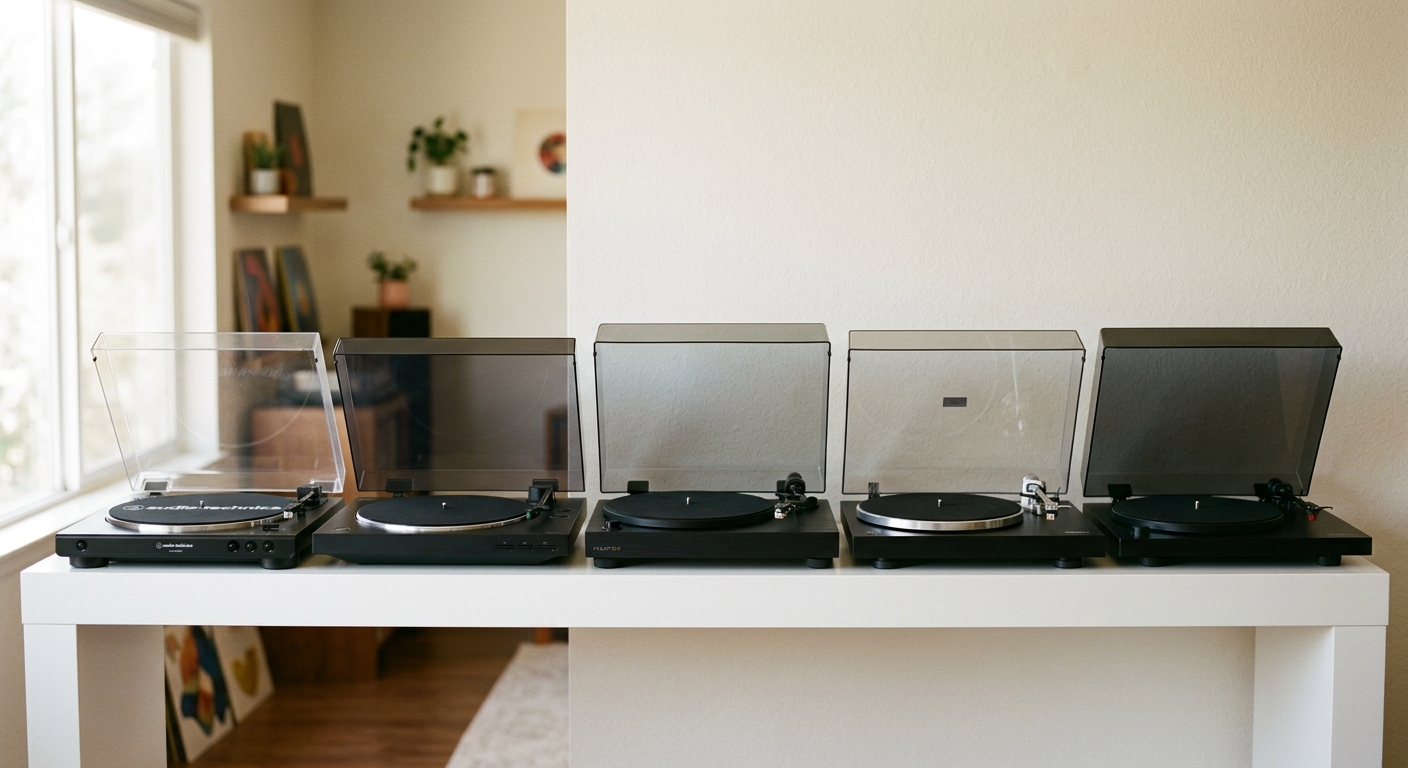
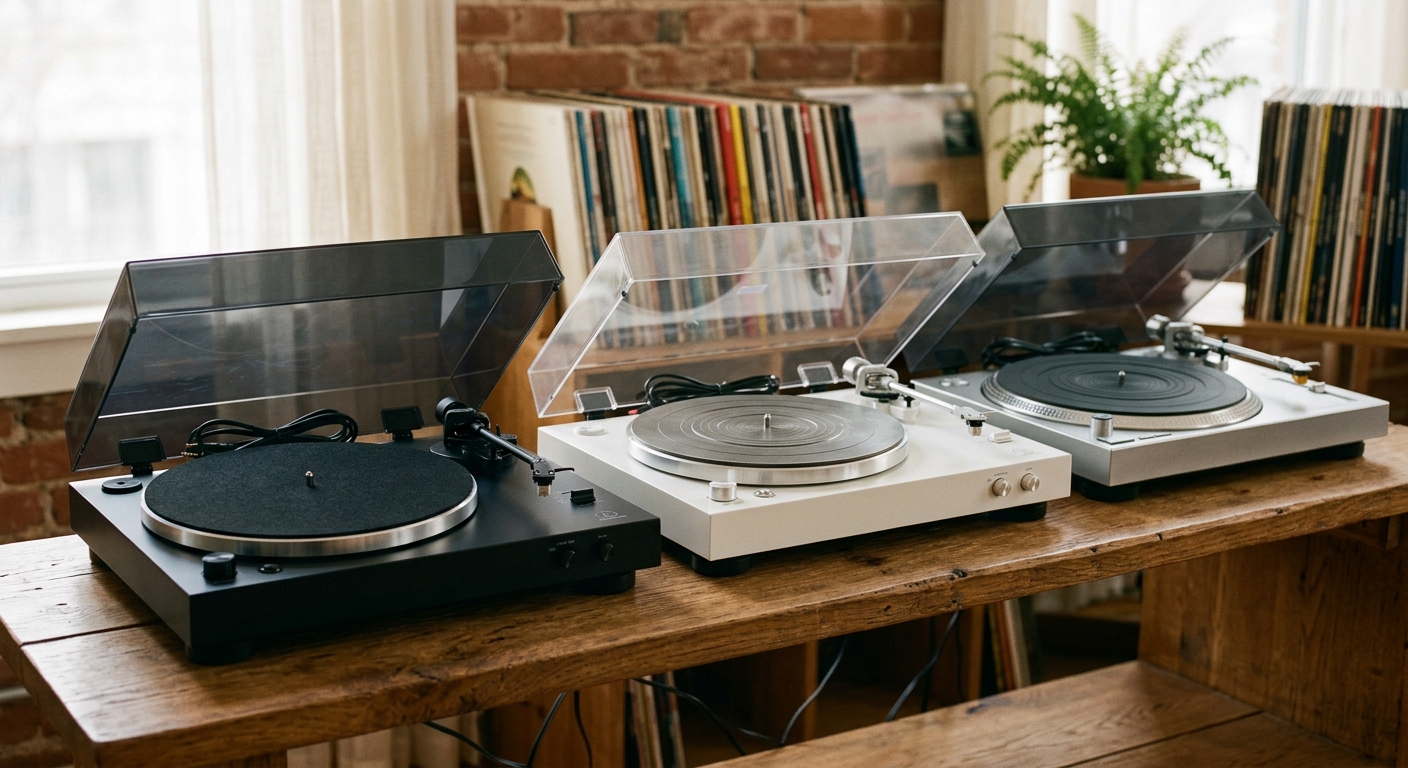
Best Budget Turntables Under $300: Comparison
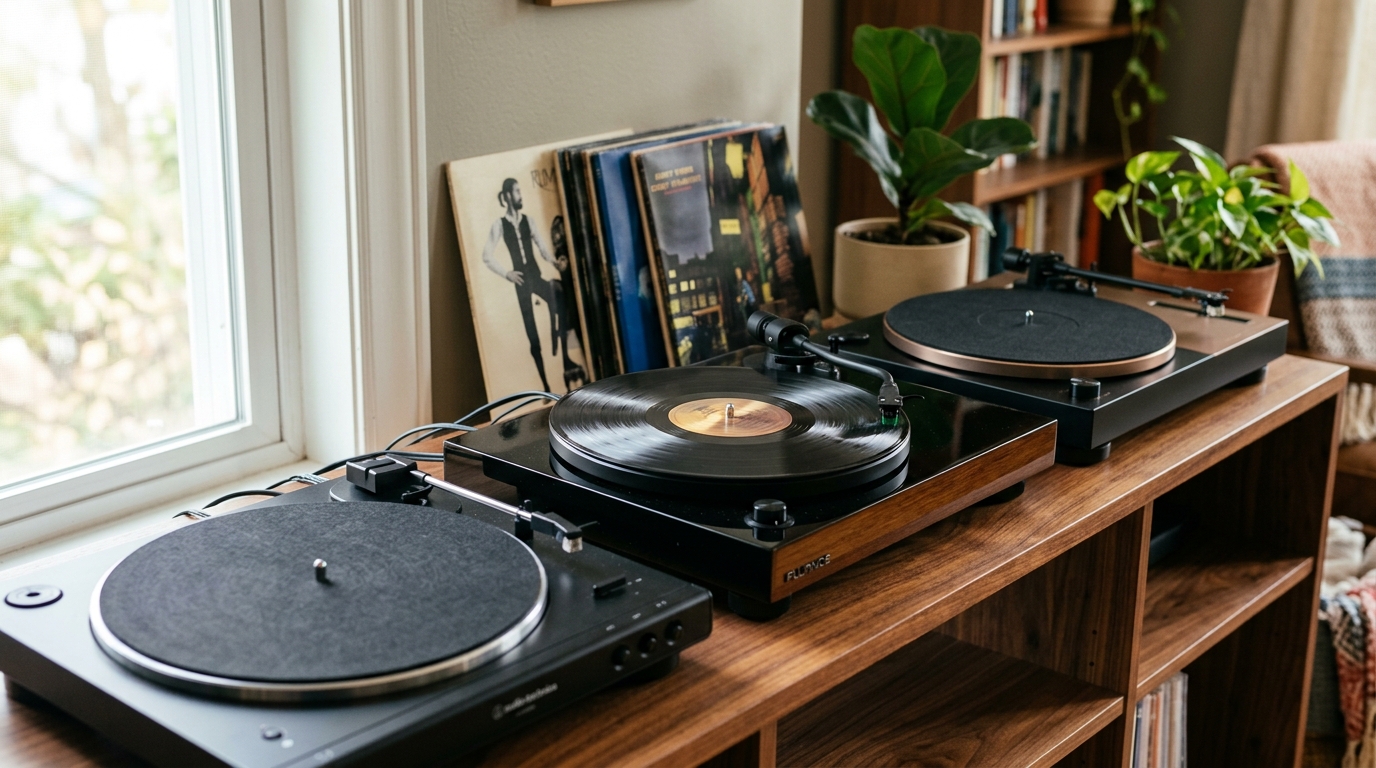
If your vinyl starter budget tops out around $300, you have more good options than any previous generation of record collectors. The under-$300 tier used to mean plastic platters and tracking force you could not adjust. In 2026, it means fully automatic decks from Audio-Technica with 13,000-plus reviews, manual belt-drives from Fluance with proper counterweights, and even upgrade paths that let you grow into audiophile territory without replacing the whole table. The challenge is no longer finding something playable. It is matching the right deck to your speakers, your listening habits, and how long you plan to keep it.
What you actually get for $300 in 2026
The sub-$300 market has settled into three clear categories. Each one makes sense for a different listener.
- Fully automatic belt-drive decks ($99 to $180): Audio-Technica AT-LP60X, AT-LP60XBT, and similar models from 1 BY ONE. You press start, the tonearm lifts, swings, and drops on its own. Best for first-time owners, gifts, dorm rooms, and anyone who does not want to learn cueing technique before they hear their first record.
- Manual belt-drive decks with adjustable counterweight ($169 to $250): Fluance RT80 and RT81, U-Turn Orbit, House of Marley Stir It Up. You cue the needle yourself, but you can dial in tracking force and anti-skate. Better sound, upgradeable cartridges, and a longer product life for serious listeners.
- Automatic decks with an upgrade path ($200 to $300): Audio-Technica AT-LP70X with its VM95 cartridge family, Sony PS-LX310BT with Bluetooth. Combines the convenience of automation with a stylus family you can grow into.
You give up some refinement compared to $600-plus decks: lighter platters, simpler tonearms, and cartridges with bonded rather than nude styluses. But every deck on this list will track a record accurately and play it back without damage if you set it up correctly.
Top picks compared
Audio-Technica AT-LP60X ($99 to $120): best for first-time owners
The AT-LP60X has earned its reputation through sheer volume. With more than 13,000 reviews averaging 4.5 stars on Amazon, it is the most proven sub-$200 turntable ever sold. It is fully automatic, belt-drive, and ships with a switchable built-in phono preamp so you can plug it directly into a pair of powered speakers or any home stereo with no extra gear.
Operation is genuinely foolproof. Press Start, the tonearm lifts, swings over the lead-in groove, and drops. When the side ends, it returns to its rest. You never handle the stylus, which matters because first-time owners frequently drop the tonearm too hard or forget to lift it when the album finishes, which wears both the needle and the record.
Sound is warm and full with surprisingly good bass weight for the price. The die-cast aluminum platter is heavier than the plastic ones on suitcase players, so rotation stays more accurate and motor noise is less likely to bleed into the cartridge. The main compromise is that there is no adjustable counterweight or anti-skate, so you cannot tweak tracking force. That is what you trade for the under-$200 price. For a first deck that protects your records and sounds good through a $300 pair of powered speakers, it is hard to beat.
The Bluetooth-equipped AT-LP60XBT runs about $179 and adds aptX wireless streaming to headphones or Bluetooth speakers. Worth the premium if your speakers are not next to your turntable.
Fluance RT80 ($249.99): best sound under $300
The Fluance RT80 is what the budget turntable world points to when the conversation turns to actual fidelity. It is a manual belt-drive deck with an MDF wood plinth, an aluminum S-type tonearm, and an adjustable counterweight with anti-skate control. Out of the box it ships with the Audio Technica AT91 moving-magnet cartridge, which has a 0.6 mil bonded diamond stylus, a carbon fiber cantilever, and a frequency response of 20 to 20,000 Hz.
The 11-pound MDF plinth is the first thing you notice when you lift it out of the box. That mass damps motor vibration before it reaches the stylus, which shows up as tighter bass and cleaner cymbals on busy passages. The aluminum platter weighs 1.22 pounds and runs on a continuous-loop joint-less rubber belt, with wow and flutter rated at 0.2 percent WRMS.
Because the tonearm accepts any cartridge in the 3.5 to 6.5 gram range, you can swap the AT91 for an AT95E, an Ortofon OM5E, or eventually an AT-VM95E without changing the headshell. That upgrade path is what separates the RT80 from purely disposable decks. Most owners keep the stock AT91 for a year or two, then drop in an AT-VM95E for around $70 to $100 and get a noticeable jump in detail retrieval.
You give up automatic operation. There is no start button that drops the needle for you. You cue by hand, which is a five-minute skill to learn but a permanent barrier for some buyers. There is also no built-in Bluetooth. Fluance offers WiFi and Bluetooth transmitters that connect through the RCA outputs if wireless matters to you.
Audio-Technica AT-LP70X ($249): best upgrade path
The AT-LP70X is what Audio-Technica designed for someone who plans to keep their first turntable for five years or more. It is fully automatic like the LP60X, but it ships with the AT-VM95C cartridge and the VM95 series platform underneath.
The VM95 family matters because the stylus is interchangeable. When the conical stylus on the VM95C wears out after roughly 500 to 1,000 hours, you can swap in a VM95E elliptical stylus for about $50, a VM95EN for $75, or a VM95ML nude microline stylus for $200. None of those swaps require tools beyond what ships in the box. That means you start with a budget-friendly conical and grow into an audiophile-grade nude-elliptical without replacing the cartridge body, the headshell, or the turntable.
The tonearm is the other upgrade. Audio-Technica moved from a straight arm on the LP60X to a J-shaped arm on the LP70X. J-shaped arms have lower effective mass and a geometry that reduces tracking error on the inner grooves, where the most information lives on any record. Combined with a three-piece chassis that Audio-Technica redesigned for better resonance damping, this is a noticeably more refined deck than the LP60X at roughly twice the price.
The chassis is plastic, not wood, so the deck weighs less than the Fluance RT80 and is more prone to transmitting footfall vibration. Place it on a solid shelf, not on a hollow speaker stand. Audio-Technica backs it with a 2-year warranty, double the industry standard for budget turntables.
Sony PS-LX310BT ($249): best Bluetooth option
If wireless is non-negotiable, the Sony PS-LX310BT pairs the convenience of full automation with Bluetooth output. It is belt-drive, fully automatic, ships with a built-in switchable phono preamp, and runs about $249. The Bluetooth implementation is stable and pairs in about 15 seconds. One-touch pairing through the front-panel button is a nice touch.
The tradeoff is sound quality. Compared to the wired AT-LP70X or Fluance RT80 at the same price, the PS-LX310BT sounds slightly less detailed, with a cooler midrange and less bass weight. Bluetooth compression is part of the gap, even with aptX. Owners who compare directly usually describe the Sony as a touch polite, where the Audio-Technica and Fluance are more revealing.
If you have a small apartment, want to stream to wireless headphones or a single Bluetooth speaker, and do not want to run RCA cables across the room, the PS-LX310BT is the cleanest solution under $300. Just know that the wireless convenience has a real sonic cost.
How to choose
Three questions narrow the field fast.
Do you want automatic operation? If yes, your real choice is between the AT-LP60X ($99 to $120), the AT-LP60XBT ($179 with Bluetooth), and the AT-LP70X ($249 with the VM95 upgrade path). The LP60X is the value play. The LP70X is the long-term play.
Do you want the best sound under $300? Manual belt-drive with an adjustable counterweight. The Fluance RT80 ($249) is the answer here. It is the only sub-$300 deck that competes with the $400-plus tier on tonal balance and detail retrieval.
Do you already have powered speakers or a stereo with a phono input? If you have powered speakers, every deck on this list works out of the box using its built-in preamp. If your stereo has a dedicated PHONO input, switch the deck's preamp off and use the external one. Outboard phono stages generally sound cleaner than the built-ins, even on budget turntables.
If you do not have speakers yet, budget for them separately. A $250 turntable through a $100 pair of computer speakers sounds worse than a $100 turntable through a $300 pair of powered bookshelf speakers. Speakers dominate the final sound more than the deck does.
What you give up under $300
No deck in this price range will match the tracking precision, speed stability, or cartridge quality of $600-plus models. Lighter tonearms with less damping mean higher effective mass, which interacts poorly with some compliance cartridges. Platters are thinner and more prone to vibration. Stock cartridges use bonded styluses rather than nude, so contact area with the groove wall is slightly less precise. Speed stability is usually within 0.2 percent WRMS at this tier, where $1,000 decks are within 0.05 percent.
None of that matters for casual listening. It matters if you sit down with a $50 audiophile reissue and want to hear every detail the mastering engineer committed to the lacquer. For everyone else, the budget tier is genuinely good now.
FAQ
Do I need a phono preamp?
Only if your speakers or amplifier do not have a PHONO input. Every deck on this list has a built-in switchable preamp. Flip the switch on the back to LINE when you are using powered speakers or any amplifier without a phono stage. Flip it to PHONO when you are plugging into a dedicated phono input on a receiver.
Can I upgrade the cartridge later?
On the Fluance RT80 and RT81, yes. The tonearm accepts any cartridge in the 3.5 to 6.5 gram weight range, including the AT95E, Ortofon OM5E, and AT-VM95E. On the Audio-Technica AT-LP70X, you upgrade by swapping the stylus assembly within the VM95 family without touching the cartridge body. On the AT-LP60X, the cartridge is integrated and not designed for user replacement, so the upgrade path is replacing the whole turntable.
Is belt-drive or direct-drive better?
Under $300, belt-drive dominates because the motor can sit outside the platter and the rubber belt absorbs motor noise before it reaches the stylus. Direct-drive decks like the Audio-Technica AT-LP120XUSB are built for DJs who need quick start, stop, and pitch control. For home listening at this budget, belt-drive is the right choice.
Should I buy a Bluetooth model?
Only if your speakers are not next to the turntable. RCA cables are cheap and sound better than Bluetooth. If you must have wireless, the AT-LP60XBT or PS-LX310BT both work, but the wired AT-LP60X sounds cleaner through the same pair of powered speakers.
How long will a budget turntable last?
Most owners get 5 to 10 years out of a deck in this tier before something mechanical gives out, usually the auto-return mechanism or the belt. Fluance covers the RT80 with a 2-year warranty and lifetime customer support. Audio-Technica covers the AT-LP70X with 2 years. Replacement belts and styluses are stocked for decades on the popular models, which is why Audio-Technica and Fluance dominate this category.
The short answer
If you want the deck with the lowest possible learning curve and the largest community of happy owners, get the Audio-Technica AT-LP60X for around $120 and spend the rest of your budget on a pair of powered speakers. If you want the best sound under $300 and do not mind cueing by hand, get the Fluance RT80. If you want to grow into audiophile territory without replacing the whole table, get the AT-LP70X for its VM95 cartridge family. There is no wrong answer here, only tradeoffs that match the way you actually listen.
A spreadsheet tracks what you own. What's Spinning identifies what's playing.
On-device vinyl ID logs your listening history automatically. 7-day free trial.
Looking for Shazam for vinyl?
What's Spinning identifies what's playing on your turntable on-device, logs history, and AirPlays now-playing to your TV.
Comparing vinyl ID apps?
Analog requires Discogs and is iPhone-first (iPad coming). What's Spinning works without Discogs on iPhone and iPad with AirPlay.
Try What's Spinning Free
Turn your iPad into a live now-playing display. Track every record you spin.
START FREE TRIALThen $4.99/mo or $39.99/yr · Cancel anytime