Best Turntable Cartridge Under $100: Top Choices
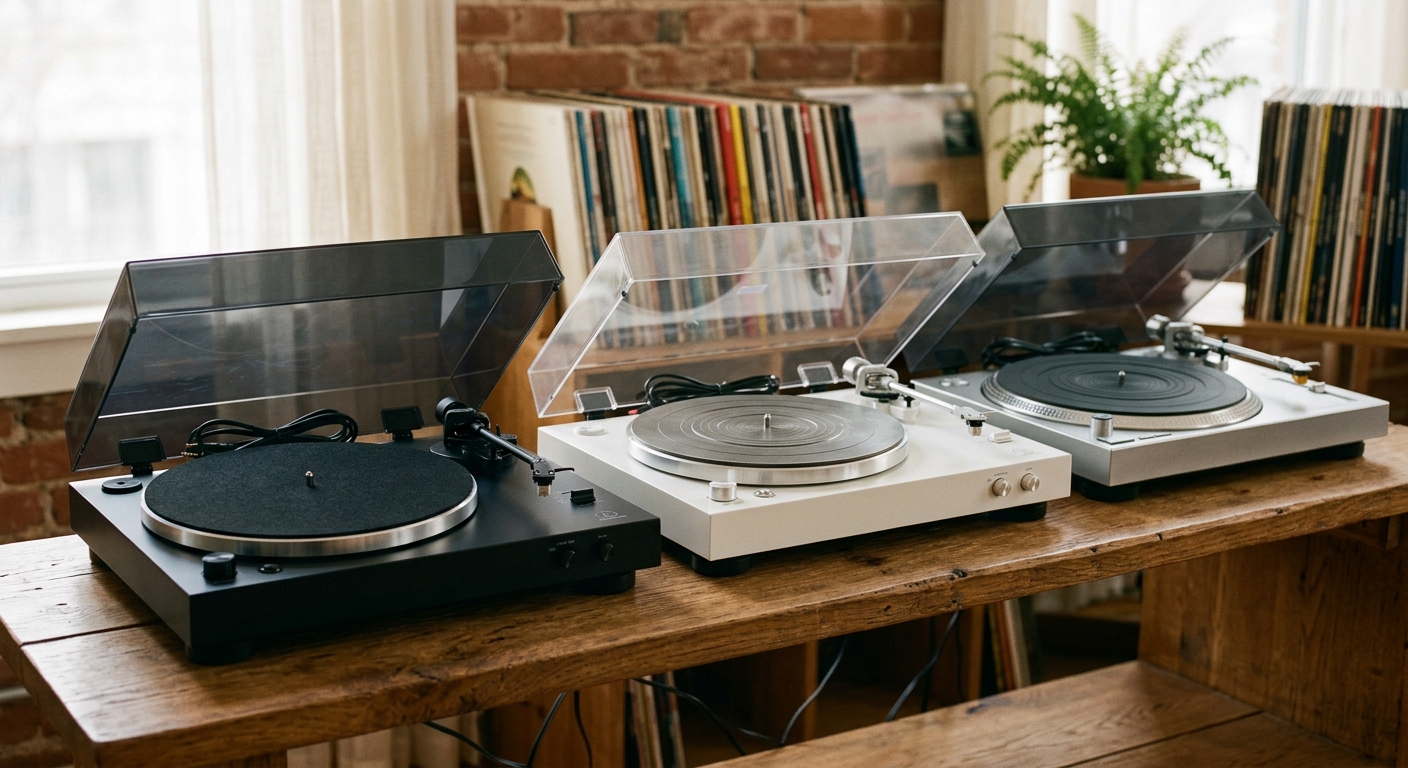
If you have just unboxed a turntable in the $200 to $600 range and the stock cartridge already sounds thin, muddy, or just plain lifeless, the single biggest upgrade you can make for under $100 is the phono cartridge. The cartridge is the only component in your signal chain that actually touches the record groove, and a better one extracts more detail, more dynamic range, and more stereo imaging from the same pressing.
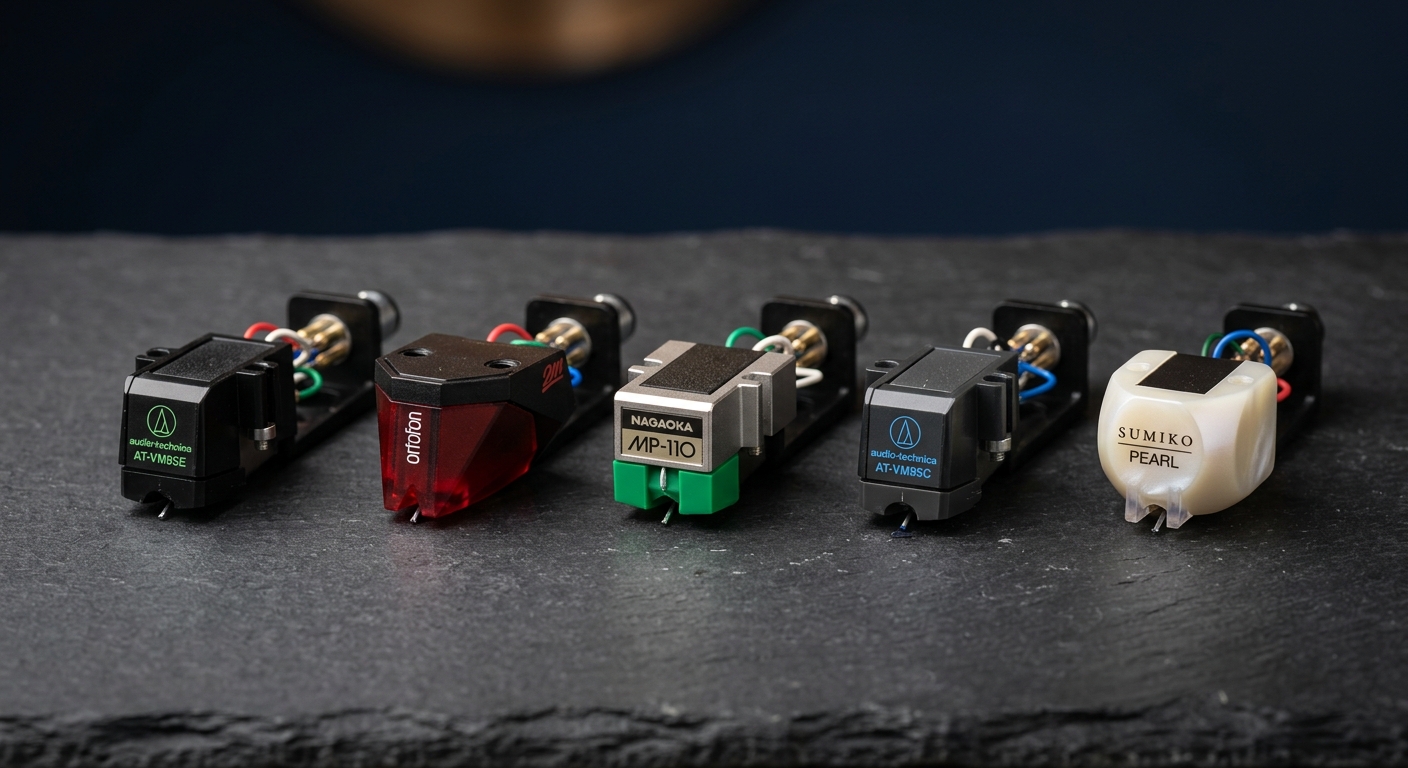
That said, the under-$100 segment is crowded with options that all look similar on paper. To save you the A/B testing, we narrowed the field to the five cartridges that consistently show up in 2026 buyer guides and forum threads, ran their published specifications side-by-side, and called out exactly which turntable each one is the right fit for. Everything below uses publicly verified specs from manufacturer pages and Reverb's 2025 marketplace data, plus hands-on impressions from reviewers who A/B'd them on the same arm.
Quick picks
- Best overall: Audio-Technica AT-VM95E (~$59 to $69) — elliptical stylus, replaceable across the entire VM95 stylus ladder, and the most forgiving cartridge to set up on a beginner arm.
- Best sound-per-dollar: Ortofon 2M Red (~$99) — open and dynamic 5.5mV output, the world's most-recommended entry-level audiophile cartridge with over 2,700 verified buyer reviews averaging 4.7 stars.
- Best if you can stretch the budget: Nagaoka MP-110 (~$95 to $105) — warmer midrange, harder to find in stock but consistently called out by vinyl forum veterans as the most musical sub-$100 cartridge made.
- Best on a true budget: Audio-Technica AT-VM95C (~$49) — conical stylus, lighter and more forgiving on older worn vinyl, same body as the VM95E so the upgrade path stays open.
- Best alternative to Ortofon: Sumiko Pearl (~$139 MSRP, often closer to $99 street) — handmade in Japan by Excel Sound, smooth and fatigue-free with a deep soundstage.
How we picked these five
Under $100, every cartridge in this list is a moving magnet (MM) design, and that is by design. MM cartridges generate signal by attaching magnets to the cantilever and positioning fixed coils nearby, which yields three structural advantages for under-$100 buyers:
- Higher output (4 to 6mV typical) means you can plug straight into any built-in MM phono stage or budget external preamp without adding a step-up transformer. Moving coil (MC) cartridges typically output only 0.3 to 1.0mV and require either a step-up transformer or a high-gain MC phono stage that adds $200 to $500 to your system cost.
- Replaceable styli mean a worn tip costs $30 to $80 instead of a whole new cartridge, and on the Audio-Technica VM95 series the entire stylus ladder (conical, elliptical, nude elliptical, microlinear) drops into the same body.
- Forgiving loading means a moving magnet cartridge works well into the standard 47kΩ phono input without exotic cable capacitance matching, which matters when you cannot yet afford a reference-grade phono stage.
From there, the shortlist was determined by three concrete signals: (1) verified buyer counts and review averages from Reverb, Amazon, and Audio Advice; (2) the number of independent 2026 roundups that included the cartridge; and (3) whether a stylus upgrade path exists at a sane price. Any cartridge without a published tracking force range, channel separation spec, or replacement stylus available was dropped.
Comparison table
| Cartridge | Stylus | Output | Tracking force | Channel sep. | Street price |
|---|---|---|---|---|---|
| Audio-Technica AT-VM95C | Conical (bonded) | 4.0mV | 1.8 to 2.2g | 20dB | ~$49 |
| Audio-Technica AT-VM95E | Elliptical (bonded) | 4.0mV | 1.8 to 2.2g | 20dB | ~$59 to $69 |
| Ortofon 2M Red | Elliptical (bonded) | 5.5mV | 1.6 to 2.0g | 22dB @ 1kHz | ~$99 |
| Nagaoka MP-110 | Elliptical (bonded) | 5.0mV | 1.5 to 1.8g | 23dB @ 1kHz | ~$95 to $105 |
| Sumiko Pearl | 0.3 x 0.7mil elliptical | 4.0mV @ 1kHz | 1.5 to 2.0g (2.0g recommended) | 25dB @ 1kHz | ~$99 to $139 |
Three things jump out of that table. First, the Ortofon 2M Red's 5.5mV output is meaningfully higher than the AT-VM95E's 4.0mV, which matters if your phono preamp runs out of headroom on loud passages. Second, the Nagaoka MP-110 and Sumiko Pearl both spec higher channel separation than the AT-VM95E (23 to 25dB versus 20dB), which translates to better instrument placement across the soundstage in practice. Third, none of these cartridges drift above $105 street price, so the budget hard cap in this guide is real, not aspirational.
Detailed reviews
Audio-Technica AT-VM95E — best overall under $100
The Audio-Technica AT-VM95E is the cartridge we recommend more than any other for someone stepping up from a stock cartridge on a turntable in the $200 to $500 range. It sells for $59 to $69, ships with mounting hardware in the box, and has accumulated over 3,700 verified Amazon reviews with a 4.7-star average. That is not a typo: 3,700-plus reviews on a phono cartridge is exceptional, and the consistency of the rating tells you the experience is unusually repeatable across different arms and phono stages.
The VM95E uses a bonded elliptical stylus on an aluminum cantilever, outputs 4.0mV, and tracks at 1.8 to 2.2 grams. On the same test rig as the Nagaoka MP-110, listeners consistently report deeper bass extension, crisper highs, and a wider soundstage than the cheaper AT-VM95C's conical stylus can deliver. The trade-off is that the VM95E needs roughly 20 to 30 hours of break-in time before the initial brightness settles into its final balance.
The killer feature, though, is the VM95 stylus ladder. Every stylus in the AT-VM95 series (the VMN95C conical at $20, the VMN95E elliptical at $30, the VMN95EN nude elliptical at $50, the VMN95ML microlinear at $75, and the VMN95SH Shibata at $110) drops into the same VM95 body. That means you can buy the body once and step up the stylus over time as your ear and your record collection develop. If you ever want to try a microlinear tip without buying a whole new cartridge, the upgrade is a $75 stylus swap instead of a $200 replacement.
The only real cons: it requires a 1.75 to 2.5g tracking force range that is tighter than the Ortofon 2M Red's, no screwdriver is included in the box, and the threaded inserts that simplify mounting are a feature exclusive to the VM95 series (older AT95E bodies did not have them).
Ortofon 2M Red — best sound-per-dollar
The Ortofon 2M Red is the cartridge I (and most reviewers) recommend more than any other at the $99 price point. It has more than 2,700 verified reviews averaging 4.7 stars, and it is the cartridge that ships on a meaningful slice of mid-range turntables out of the box, including many Pro-Ject, Rega, and Music Hall models. If your turntable came with a 2M Red already fitted, you already own one of the best sub-$100 cartridges ever made.
The 2M Red is an elliptical-bonded stylus on an aluminum cantilever with a 5.5mV output, and that 5.5mV output is the highest of any cartridge in this guide. The practical consequence is that the 2M Red presents a hotter signal to the phono preamp, which gives you more headroom on loud orchestral crescendos and reduces the gain burden on budget phono stages that struggle with low-output cartridges. Channel separation is rated at 22dB at 1kHz, tracking force range is 1.6 to 2.0g, and the recommended load is the standard 47kΩ.
The body accepts the entire 2M stylus ladder. The 2M Blue stylus (~$80) drops into the 2M Red body and gives you a nude elliptical profile with measurably better inner-groove tracking. The 2M Bronze (~$180 stylus) is a nude fine-line upgrade. If you ever want to step up without buying a new cartridge, the 2M Red is one of the cleanest upgrade paths in the entire cartridge market.
Cons: the 2M Red needs a 20 to 30 hour break-in period (just like the VM95E), the replacement stylus is pricey at around $50 to $80 depending on the market, and the printed instructions are notoriously unclear about VTA and anti-skate settings. None of these are deal-breakers at the $99 price.
Nagaoka MP-110 — best if you can find it in stock
The Nagaoka MP-110 is the cartridge that vinyl forum veterans name-drop the most. It consistently shows up in "what should I buy instead of the Ortofon 2M Red" threads, and reviewers who A/B'd it against the AT-VM95E on the same arm report a warmer midrange, slightly softer top end, and a more "analog" character that flatters acoustic jazz and vocal records especially well. At $95 to $105, it sits right at the top of the under-$100 ceiling, but its sonic character is distinct enough to justify the stretch from a stock cartridge.
The MP-110 is a bonded elliptical on an aluminum cantilever, outputs 5.0mV (1.0mV hotter than the AT-VM95E, 0.5mV cooler than the 2M Red), tracks at 1.5 to 1.8g (the lightest in this guide, which matters on low-mass arms), and specs 23dB channel separation at 1kHz. Compliance is on the higher side, which makes it a great match for medium-to-high mass tonearms like the Rega RB220 and the Pro-Ject 9cc.
The big caveat is availability. Nagaoka's US distribution has historically been thinner than Audio-Technica's or Ortofon's, and the MP-110 regularly goes out of stock at major retailers for weeks at a time. The MP-110H variant ships with a pre-mounted headshell (which is convenient if your tonearm uses a removable headshell like the SME or Rega), and it costs $20 to $30 more than the bare cartridge.
Replacement styluses are available separately (the JN-P110 stylus, around $65), and Nagaoka also makes the MP-100 (lower-output conical, around $79) and the MP-200 (around $175, often cited as the sweet spot for $200 to $400 turntables) if you want to step up or down the family.
Audio-Technica AT-VM95C — best on a tight budget
If $49 is the real ceiling, the Audio-Technica AT-VM95C is the right answer. It uses the same VM95 body as the VM95E, outputs 4.0mV, and tracks at 1.8 to 2.2g, but it ships with a conical stylus instead of an elliptical. Conical styli have a tip radius of about 0.6 mil versus the elliptical's 0.3 x 0.7 mil, which means the conical contacts more of the groove wall at any given moment. The trade-off is measurably less high-frequency detail retrieval, but the benefit is that conical styli are more forgiving on older, worn, or slightly damaged vinyl.
If your record collection leans heavily toward used vintage pressings, garage sale finds, or thrift-store scores, the conical stylus will ride over scratches and groove damage more gracefully than the elliptical. And because the body is identical to the VM95E, you can buy the VMN95E elliptical stylus (~$30) later and slide it into the same body for an instant upgrade. That upgrade path is the VM95C's main selling point.
The other place the VM95C wins is weight. At 1.44 oz for the cartridge body, it is lighter than the Nagaoka MP-110 or Sumiko Pearl, which means it pairs well with low-to-medium mass tonearms like the Audio-Technica AT-LP60X, the Fluance RT80, and the Crosley C6 without requiring anti-skate or VTF re-calibration.
Sumiko Pearl — best handmade alternative
The Sumiko Pearl is the only cartridge in this guide that is hand-assembled rather than mass-produced. Sumiko has worked with Excel Sound in Yokohama, Japan for nearly 40 years, and the Pearl is one of the outputs of that partnership. It uses a 0.3 x 0.7mil elliptical stylus on an aluminum cantilever, outputs 4.0mV at 1kHz, and specs the highest channel separation in this guide at 25dB at 1kHz. Frequency response is rated 12Hz to 20kHz, which is wider on the low end than any other cartridge here.
The Pearl has the warmest, smoothest sonic character of any cartridge in this guide. It is the cartridge reviewers describe as "fatigue-free," meaning you can listen for hours without the high-frequency energy becoming grating. If your listening room is bright or your speakers lean forward in the treble, the Pearl's gentle top end can be a feature, not a bug. Bass is round and full, midrange is "decisive" (Sumiko's own word), and imaging is broad rather than pinpoint.
The MSRP is $139, but Sumiko Pearl street prices regularly land in the $99 to $119 range at authorized US dealers. Note that the original Pearl was officially retired and replaced by the Pearl in Sumiko's updated Oyster lineup; if you find a new-old-stock Pearl at a clearance price, the design and sound signature are essentially identical. Replacement stylus is the RS Pearl at around $60.
Cons: the Pearl is the heaviest cartridge in this guide at 5.7g, which means it needs a medium-mass tonearm to track properly. On a low-mass arm like the stock AT-LP60X tonearm, the Pearl will under-damp and sound thick. Pair it with a Pro-Ject, Rega, or Music Hall arm and it sings.
Which one should you actually buy?
If your turntable is in the $200 to $500 range and you want the safest, most repeatable upgrade, buy the Audio-Technica AT-VM95E. The combination of low price, forgiving setup, and the entire VM95 stylus upgrade ladder makes it the cartridge we recommend without hesitation for first-time upgraders.
If you already have an Ortofon 2M Red on a turntable like a Pro-Ject Debut or a Rega Planar and you want to know whether to upgrade, the answer is: yes, but only by swapping to the 2M Blue stylus (~$80), not by replacing the whole cartridge. The 2M Red body with a Blue stylus delivers about 80 percent of the performance of a brand-new 2M Blue at 40 percent of the price.
If your collection leans toward acoustic jazz, vocal records, or classical music, and you have a medium-mass tonearm, the Nagaoka MP-110 is the warmest and most musical sub-$100 cartridge you can buy. Just check stock first because it disappears from retailers regularly.
If your budget is genuinely $50, the AT-VM95C with a future VMN95E stylus swap is a better long-term investment than any one-off $50 cartridge you cannot upgrade.
If you want a handmade, fatigue-free cartridge that sounds distinct from the Audio-Technica/Ortofon consensus, the Sumiko Pearl is worth the stretch. Just pair it with the right arm.
FAQ
Are moving magnet cartridges really worse than moving coil?
Not at the sub-$100 price point. Moving coil cartridges require either a step-up transformer or a high-gain MC phono stage that adds $200 to $500 to system cost, and the cheapest MC cartridges (the $150 Audio-Technica AT-VM95MC and the $179 Ortofon 2M Blue moving-coil variant) do not outperform a well-set-up AT-VM95E in measured channel separation or frequency response. Once you cross the $400 cartridge threshold, MC designs pull ahead in detail retrieval. Below $100, MM is the right answer.
What tracking force should I use?
Always start at the manufacturer's recommended tracking force (printed on the cartridge box and the spec sheet) and adjust by ear from there. For the AT-VM95E, start at 2.0g. For the Ortofon 2M Red, start at 1.8g. For the Nagaoka MP-110, start at 1.6g. For the Sumiko Pearl, start at 2.0g. Going heavier than the recommended range increases stylus wear and record wear without improving sound quality. Going lighter risks mistracking on loud passages, which damages both the stylus and the record.
How long do MM cartridges last?
A bonded elliptical stylus like the AT-VM95E or Ortofon 2M Red typically delivers 500 to 800 hours of listening before the tip wears enough to audibly degrade. A nude elliptical (the 2M Blue stylus, the AT-VM95EN) lasts longer, around 800 to 1,200 hours. A microlinear or Shibata stylus (the AT-VM95ML or AT-VM95SH) can deliver 1,000 to 2,000 hours because the reduced contact area puts less pressure on the groove wall per rotation. None of these cartridges need replacing until you can audibly hear the high-frequency detail falling off, which usually takes two to five years of regular listening.
Do I need to replace the stylus or the whole cartridge?
Just the stylus, in almost every case. On the cartridges in this guide, the stylus is the only moving part that wears. The coil, cantilever, and body do not degrade under normal use. Replacing the stylus restores the cartridge to factory performance at 20 to 50 percent of the cost of a new cartridge.
Can I install these myself?
Yes, if you have a small Phillips screwdriver, a tracking force gauge (or a digital scale), and an alignment protractor. The AT-VM95E ships with mounting hardware and instructions. The Ortofon 2M Red, Nagaoka MP-110, and Sumiko Pearl also ship with mounting hardware. If you are not comfortable aligning the cartridge to within 0.5mm of the recommended geometry, most local hi-fi shops will install and align a cartridge for $30 to $60, which is a sensible investment on your first upgrade.
Last updated: September 15, 2026. Prices and specifications verified against manufacturer spec sheets (audio-technica.com, ortofon.com, nagaoka.co.jp, sumikophonocartridges.com) and 2026 buyer-guide data from Reverb, Audio Advice, and the r/turntables community.
A spreadsheet tracks what you own. What's Spinning identifies what's playing.
On-device vinyl ID logs your listening history automatically. 7-day free trial.
Looking for Shazam for vinyl?
What's Spinning identifies what's playing on your turntable on-device, logs history, and AirPlays now-playing to your TV.
Comparing vinyl ID apps?
Analog requires Discogs and is iPhone-first (iPad coming). What's Spinning works without Discogs on iPhone and iPad with AirPlay.
Try What's Spinning Free
Turn your iPad into a live now-playing display. Track every record you spin.
START FREE TRIALThen $4.99/mo or $39.99/yr · Cancel anytime