The Best Concept Albums on Vinyl
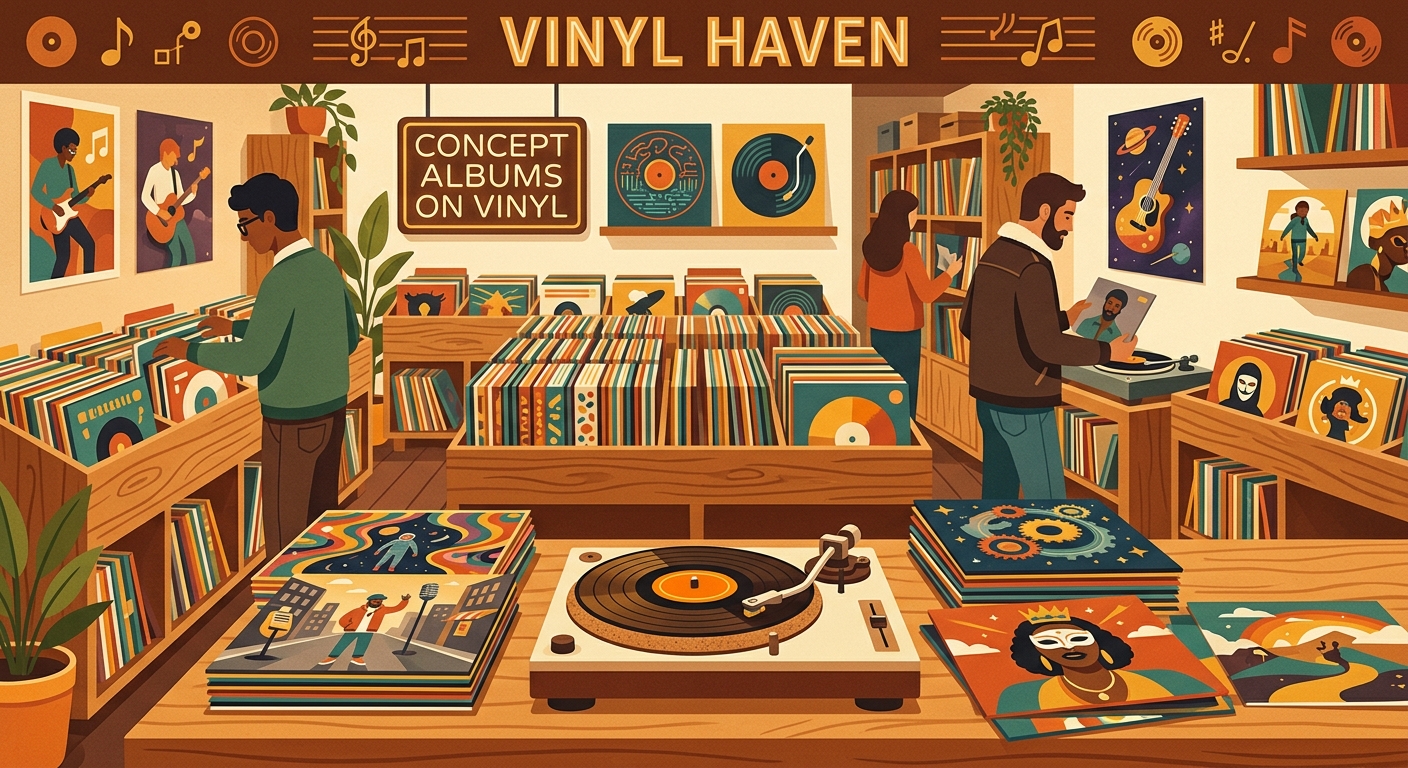
If you are searching for the best concept albums vinyl, you are really looking for albums that make the LP format feel necessary. A concept album gives a record a spine: a story, a character, a political argument, a fictional world, or a recurring emotional problem that makes side one and side two feel connected.
That matters for vinyl collectors because the format rewards commitment. Gatefold art, lyric inserts, side breaks, label design, and mastering choices all become part of the experience. The best concept records are not just famous albums with a theme; they are objects built to be heard, handled, flipped, and revisited. When your collection starts getting serious, a listening log helps too. What's Spinning can track what you actually play from your turntable, which is useful when a shelf full of ambitious double albums starts competing for attention.
This list favors records whose concepts survive real listening. Some are rock operas, some are social song cycles, some are hip-hop narratives, and some are albums where the artwork and sequencing do as much storytelling as the lyrics. For context, the modern idea of a concept album is commonly tied to records unified by a central theme or narrative, and albums like Sgt. Pepper, Tommy, and The Dark Side of the Moon helped turn that idea into album-culture canon.
The best concept albums on vinyl
1. Sgt. Pepper's Lonely Hearts Club Band, The Beatles, 1967. A pretend Edwardian band is a thin narrative frame, but the LP changed what listeners expected a rock album to do. The Beatles worked at EMI Studios with producer George Martin and engineer Geoff Emerick, using four-track machines, tape speed shifts, orchestral overdubs, crowd noise, and careful crossfades to make the record feel like a staged event instead of a stack of singles. The cover matters almost as much as the grooves: Peter Blake and Jann Haworth's collage turned the jacket into a decoding project, which is why worn originals still get handled like cultural artifacts. On vinyl, the side split is tidy: side one sells the imaginary show, while side two wanders through domestic surrealism, Indian classical color, vaudeville, and the monumental final chord of 'A Day in the Life.' Collectors should be picky about condition because inner-groove distortion can be brutal on a tired copy, especially near the closing track. A clean mono or a well-cut modern reissue gives the album back its density without turning the famous sleeve into the only reason to own it. Album source.
2. Tommy, The Who, 1969. Pete Townshend's rock opera works because the band never lets the story get too precious. The plot, a traumatized boy becoming a pinball messiah, can sound absurd in summary; on record, it moves with the force of a touring rock group discovering that a double LP could carry theater, singles, acoustic interludes, and power-chord catharsis at once. Original Track and Decca pressings are collector staples, but the practical buying question is surface noise. Much of Tommy is quiet enough that crackle intrudes, then loud enough that groove wear announces itself. The album's four-side format is part of the experience: each side behaves like an act, with reprises doing real structural work rather than acting as filler. 'Pinball Wizard' is the obvious entry point, but vinyl reveals the connective tissue around it: 'Amazing Journey,' 'Sparks,' and 'We're Not Gonna Take It' make the suite feel physical. If you collect concept albums for narrative ambition, Tommy is unavoidable; if you collect them for band chemistry, it is even better. Album source.
3. What's Going On, Marvin Gaye, 1971. Marvin Gaye's masterpiece is a concept album without fantasy clothing. It follows a Vietnam veteran returning to a country wounded by poverty, police violence, environmental neglect, addiction, and spiritual exhaustion, yet the record never turns into a lecture. The Motown rhythm section, strings, congas, and Eli Fontaine's alto saxophone create a continuous atmosphere, with songs melting into one another like a street conversation overheard from a window. That flow is why vinyl is the right format: the first side moves from the title track into 'What's Happening Brother' and 'Flyin' High' without breaking the spell, then side two deepens the crisis rather than resolving it neatly. Pressing quality varies widely because this is one of those albums that has been loved hard for decades. A clean copy needs quiet passages, centered vocals, and a bass line that stays rounded instead of woolly. The cover's rain-soaked portrait tells you the record's temperature before the needle drops. For collectors who think concept records are only prog suites and sci-fi plots, this album is the corrective. Album source.
4. The Rise and Fall of Ziggy Stardust and the Spiders from Mars, David Bowie, 1972. Ziggy is less a linear story than a brilliantly managed identity crisis pressed at 33⅓ rpm. Bowie invents a doomed alien rock star, then uses that character to make fame, sexuality, apocalypse, and performance feel inseparable. Mick Ronson's arrangements are the secret weapon: string drama, glam crunch, and concise guitar hooks keep the mythology from floating away. The original UK sleeve, with Bowie standing on Heddon Street under the K. West sign, is one of rock's great urban stage sets; even reissues benefit from that visual economy. On vinyl, the album's compact running time helps it hit hard. There is no double-LP sprawl, no overextended lore, just eleven songs that make the concept feel like a rumor spreading through a club. Early RCA pressings have collector cachet, but many listeners are happy with later reissues because clean originals can be noisy and expensive. The key is energy: 'Moonage Daydream' should bloom, 'Starman' should lift, and 'Rock 'n' Roll Suicide' should sound like theater collapsing into confession. Album source.
5. The Dark Side of the Moon, Pink Floyd, 1973. No concept album has been used more often to justify a better turntable, and for once the cliché has a point. Pink Floyd built The Dark Side of the Moon around pressures that grind people down: time, money, travel, conflict, death, and mental strain. Alan Parsons' engineering at Abbey Road gives those ideas a physical architecture, from clocks and cash registers to Clare Torry's wordless vocal on 'The Great Gig in the Sky.' The record spent a staggering run on the Billboard chart, and its prism sleeve became a shorthand for album-era seriousness. Collectors obsess over UK solid-blue triangle pressings, Japanese cuts, MoFi editions, anniversary remasters, and every tiny matrix variation. That can be fun, but the real test is whether the copy tracks cleanly through sibilant vocals, deep bass, and the dense transitions between tracks. Side one is practically a demonstration record; side two turns the same studio polish toward mortality. If someone asks why vinyl people care about mastering, this album is the friendly exhibit A. Album source.
6. Quadrophenia, The Who, 1973. Where Tommy turns mythic, Quadrophenia gets specific: seaside England, Mod identity, pills, scooters, class frustration, and one young man trying to make four conflicting selves add up. The double LP's scale is central to its appeal. Townshend's synthesizer themes and sound effects create weather and geography, while Roger Daltrey sings Jimmy's confusion with more human weight than the premise suggests. The lavish photo booklet is not a bonus trinket; it is part of the storytelling apparatus, turning the package into a film still sequence before the film existed. For vinyl buyers, completeness matters. A copy with the booklet missing loses some of the work's design. Sonically, the album can be dense, and some pressings turn the drums and guitars into a gray wall. Look for copies that keep John Entwistle's bass lines distinct and Keith Moon's cymbals from spitting. Side breaks act like chapter pauses, especially before the emotional final stretch. Quadrophenia is the concept album as subculture portrait, loud enough for rock fans, detailed enough for anyone who cares about packaging. Album source.
7. The Lamb Lies Down on Broadway, Genesis, 1974. Genesis made the strangest possible double album at the exact moment their theatrical frontman was nearing the exit. Peter Gabriel's story follows Rael, a Puerto Rican youth in New York, through a dream logic maze of tunnels, cages, transformations, and bodily anxiety. The plot resists clean explanation, which is part of the record's vinyl fascination. You keep flipping sides not because everything is obvious, but because the band keeps changing the scenery: hard piano rock, ambient passages, odd meters, and unexpectedly tender melodies. The Hipgnosis-designed sleeve, with stark black-and-white photo panels, gives the album a colder visual identity than earlier Genesis fantasy art. Original UK Charisma copies are desirable, but condition and channel balance matter more than mythology because the quieter sections can expose wear. This is also a record where side length and sequencing influence the drama. 'In the Cage' lands early enough to hook skeptics, while the second disc gets weirder and more inward. For prog collectors, The Lamb is not just a big title; it is the point where ambition starts to fray in fascinating ways. Album source.
8. Red Headed Stranger, Willie Nelson, 1975. The most radical thing about Red Headed Stranger is how little it uses. After leaving the Nashville machine, Willie Nelson recorded a spare outlaw-country song cycle about a fugitive preacher, murder, grief, and redemption. Columbia reportedly worried the album sounded like a demo, which tells you how far it sat from the glossy country production norm. On vinyl, that austerity becomes the selling point. Nelson's guitar, small-band arrangements, and dry vocal presence leave space around the story, so every pop and tick on a battered copy feels more intrusive than it would on a louder rock record. Buy the quietest copy you can find. The side structure is compact and novelistic, with traditional songs woven into Nelson's own material until authorship feels secondary to mood. 'Blue Eyes Crying in the Rain' became the commercial breakthrough, but the full LP is about restraint and consequence. For collectors, it is a useful reminder that a concept album does not need orchestras, gatefold diagrams, or sci-fi scale. Sometimes the strongest narrative is a near-empty room. Album source.
9. Animals, Pink Floyd, 1977. Animals is the ugly, concrete cousin of The Dark Side of the Moon. Inspired loosely by George Orwell's Animal Farm, it sorts people into dogs, pigs, and sheep, then stretches that bitterness across long, muscular tracks. The album's industrial cover, with the inflatable pig above Battersea Power Station, is one of the great examples of concept and packaging locking together. On the record itself, the limited number of songs changes how vinyl time feels: 'Dogs' dominates side one after the acoustic bookend, while side two turns from 'Pigs' into 'Sheep' with grim momentum. Original pressings can sound forceful but also unforgiving, and the 2018 remix, released later after delays, gave collectors another serious option by changing the spatial balance and low-end clarity. This is not background Floyd. Guitars bite, keyboards brood, and Roger Waters' lyrics leave very little oxygen in the room. If your shelf already has Dark Side and Wish You Were Here, Animals is where the band becomes harder to love and more interesting to argue about. Album source.
10. The Wall, Pink Floyd, 1979. The Wall is a collector's endurance test in the best sense: four sides, a stark sleeve, Gerald Scarfe imagery, radio hits, theatrical fragments, and a protagonist whose alienation becomes architecture. Roger Waters shaped the story around Pink, a damaged rock star building a psychological wall from grief, school trauma, war memory, romance, drugs, and fascist fantasy. Bob Ezrin's production helps translate that heavy concept into an album with hooks, children's choir, sound effects, orchestration, and enough rock muscle to survive outside the plot. Vinyl buyers should check all four sides carefully. A double album invites mismatched wear, and 'Comfortably Numb' deserves more than a groove-burned chorus. The original packaging's minimal white-brick design is clever because it makes the listener imagine the wall before the record fills it with voices. Some concept albums reward one perfect side; The Wall rewards the ritual of staying with the whole object. It is excessive, uneven in places, and still one of the clearest examples of album-as-world-building in popular music. Album source.
11. The ArchAndroid, Janelle Monáe, 2010. Janelle Monáe's The ArchAndroid arrived decades after the classic concept-LP era, yet it understands the old format better than many retro projects. The album continues the Metropolis suite around android messiah Cindi Mayweather, folding Afrofuturist science fiction into R&B, funk, orchestral pop, glam, and hip-hop. What makes it exciting on vinyl is not nostalgia; it is motion. The record changes rooms constantly, from the overture into 'Dance or Die,' from the Prince-like snap of 'Make the Bus' to the sweeping lift of 'BaBopByeYa.' The cover presents Monáe as an engineered icon, hair transformed into architecture, which suits a package about bodies, control, and liberation. Original vinyl copies became sought after as Monáe's reputation grew, and later reissues helped more listeners hear the album without paying collector-premium prices. Because the production is modern and busy, a good pressing needs clean treble and disciplined bass, not just novelty color. The ArchAndroid proves the concept album did not die with progressive rock; it migrated into artists willing to build a universe. Album source.
12. good kid, m.A.A.d city, Kendrick Lamar, 2012. Kendrick Lamar called this record a short film by Kendrick Lamar, and the phrase is more than marketing. The album tracks a young man's day in Compton through peer pressure, family calls, lust, fear, violence, faith, and survivor's guilt. Skits often age badly on albums; here they act like scene cuts, with voicemail and car noise anchoring the narrative in family and neighborhood detail. On vinyl, the sequencing highlights how deliberately the record changes emotional temperature. 'Bitch, Don't Kill My Vibe' feels suspended, 'Backseat Freestyle' performs reckless bravado, and 'Sing About Me, I'm Dying of Thirst' becomes the moral center across a long, patient stretch. Pressing choices can be confusing because modern hip-hop vinyl often spreads albums over two LPs, sometimes at the cost of convenience but with better side length. The cover image, a family Polaroid with eyes obscured, is exactly the kind of artwork that benefits from twelve inches of space. For collectors who mainly associate concept albums with guitars and capes, good kid, m.A.A.d city is an essential modern correction. Album source.
13. The Black Parade, My Chemical Romance, 2006. The Black Parade is what happens when pop-punk, Queen-sized theatricality, cabaret darkness, and grief counseling all crowd onto one record. The concept follows The Patient, who dies and confronts memory, regret, and spectacle through the image of a parade. Rob Cavallo's production is enormous, which suits the album's emotional scale but makes vinyl mastering important. If a pressing is cut too hot or sourced carelessly, the choruses can harden into glare. A good copy keeps the snare sharp, the guitars layered, and Gerard Way's voice dramatic without becoming shrill. Visually, the skeletal marching-band artwork made the album feel like a complete era, not just a release cycle. That matters for collectors because The Black Parade has always lived through costume, typography, video, and stage design as much as through track order. 'Welcome to the Black Parade' may be the anthem, but the vinyl argument is in the deeper sequencing: 'Cancer,' 'Mama,' and 'Famous Last Words' show how the record turns melodrama into structure. It is maximal, sincere, and built to be owned. Album source.
14. American Idiot, Green Day, 2004. Green Day's punk opera could have been a disaster of overreach. Instead, American Idiot used post-9/11 media saturation, suburban boredom, and political disgust as fuel for a comeback that introduced characters like Jesus of Suburbia and St. Jimmy without abandoning the band's directness. The two nine-minute suites are the reason vinyl collectors should take it seriously. They divide into movements cleanly enough to feel theatrical, yet the guitars stay punchy and plainspoken. Original pressings and later reissues sit in a market where demand is high because the album crossed generations: older fans heard a band reasserting itself, younger fans met a gateway into political rock. The sleeve's hand-grenade heart is simple and instantly legible, the kind of graphic that reads from across a store bin. On a turntable, American Idiot benefits from volume and a setup that controls inner-groove congestion. It is not subtle, and it does not need to be. Its concept works because the anger is broad enough to sing along with, while the structure gives that anger somewhere to go. Album source.
15. The Suburbs, Arcade Fire, 2010. Arcade Fire turned sprawl into subject matter. The Suburbs is not a character-driven opera; it is a memory map of subdivisions, childhood roads, mall-light melancholy, and adulthood looking back at places designed to blur together. That makes the vinyl package unusually apt. Multiple cover variants showing empty suburban scenes reinforce the idea that every copy is both specific and interchangeable. Musically, the album moves between Springsteen-scale rock, synth dread, piano balladry, and motorik pulses, but the emotional through-line is the slow realization that nostalgia can curdle. The record won the Grammy for Album of the Year, a reminder that conceptually ambitious rock could still break into mainstream awards culture in the 2010s. Collectors should pay attention to side transitions because the album's length can make vinyl editions feel episodic. A quiet pressing helps the more reflective tracks, especially 'Wasted Hours' and the title reprises. The Suburbs earns its place here because its concept is architectural. You are not following a fantasy plot; you are driving the same loop until the landscape starts telling on you. Album source.
16. To Pimp a Butterfly, Kendrick Lamar, 2015. To Pimp a Butterfly is dense enough that owning it on vinyl can feel like committing to study, but the record also grooves hard enough to keep the scholarship honest. Kendrick Lamar frames fame, survivor's guilt, Black identity, exploitation, depression, institutional racism, and self-interrogation through a recurring poem that gradually reveals itself across the album. The music pulls from jazz, funk, G-funk, soul, and spoken word, with contributors including Thundercat, Terrace Martin, Kamasi Washington, and George Clinton. That live-instrument texture gives vinyl listeners plenty to notice: bass elasticity, horn placement, crowd chants, and vocal layering that can flatten on weak playback. The cover, shot outside the White House with a group of Black men and children, is deliberately confrontational and communal. Many modern pressings are spread over two LPs, which suits the album's dynamic range better than squeezing it onto fewer sides. The conceptual payoff lands in the staged Tupac conversation on 'Mortal Man,' but the vinyl reward is earlier and more tactile. Each side feels like another room in an argument Kendrick refuses to simplify. Album source.
17. The Downward Spiral, Nine Inch Nails, 1994. Trent Reznor recorded The Downward Spiral in the house where Sharon Tate was murdered, a fact that can overwhelm discussion of the music but does explain some of its claustrophobic mythology. The concept follows a narrator's collapse through control, sex, violence, addiction, self-hatred, and annihilation. Industrial rock albums often date themselves through technology; this one still sounds dangerous because the sound design is so tactile. Guitars are processed until they scrape, drums arrive like machinery failing, and quiet passages feel contaminated rather than restful. Original vinyl was not as common as the CD in the 1990s, so later definitive editions became important for collectors who wanted the artwork and sequencing in LP form. Russell Mills' mixed-media cover art looks especially strong at jacket size, all rust, wound, and texture. Playback quality matters because distortion is part of the composition, but uncontrolled distortion is not. A good pressing lets 'Closer' throb, 'Ruiner' lurch, and 'Hurt' retreat into frightening space. It is a concept album about decay that still rewards careful preservation. Album source.
18. Purple Rain, Prince and the Revolution, 1984. Purple Rain sits between soundtrack, star-making vehicle, and concept album, which is exactly why vinyl collectors keep returning to it. The record is tied to the film's semi-fictional version of Prince as The Kid, but the LP also functions independently as a story about ambition, erotic confidence, band tension, vulnerability, and transcendence. It sold in blockbuster numbers, won major awards, and made the Revolution sound both immaculate and combustible. The original Warner Bros. vinyl is common enough that condition shopping is possible, though many copies were played at parties and show it. You want the Linn drum snap, Wendy and Lisa's harmonic color, and Prince's guitar on the title track to arrive with scale rather than fuzz. The purple motorcycle cover is pure iconography, and the inner sleeve artwork completes the world. Unlike many concept records, Purple Rain does not ask you to follow footnotes. It invites you into a performance persona so vivid that the story, stage, and marketplace merge. On vinyl, that merger feels gloriously physical. Album source.
19. Zen Arcade, Hüsker Dü, 1984. Zen Arcade proves that punk ambition does not have to mean polish. Hüsker Dü recorded a sprawling double album about a young person leaving a broken home and confronting an outside world that may be just as damaged. The SST-era budget and speed are audible, but they are not drawbacks. The guitars roar with sheet-metal thickness, Grant Hart's drums rush forward, and the whole thing sounds like a band trying to outrun its own idea before the tape runs out. That urgency makes original and early pressings attractive despite sonic roughness; this is not an audiophile showpiece in the traditional sense. It is a document of scale achieved through nerve. The side breaks help organize the chaos, moving from hardcore blasts into melodic turns, tape experiments, and the long instrumental 'Reoccurring Dreams.' Clean copies can be tough because punk records were often treated as working objects, not collectibles. If you find one with a strong sleeve and playable vinyl, it carries a different kind of prestige: proof that concept albums can be handmade, noisy, and still emotionally huge. Album source.
20. The Hazards of Love, The Decemberists, 2009. The Decemberists built The Hazards of Love like a folk-rock stage piece, complete with recurring characters, shape-shifting, forbidden romance, a villainous rake, and melodic themes that return with altered weight. That sounds quaint until the guitars get heavy. The album's best trick is moving between pastoral balladry and Sabbath-like crunch without treating either mode as a joke. Guest vocalists Becky Stark and Shara Nova give the story theatrical contrast, while Colin Meloy's writing leans into old ballad language more fully than a casual indie-rock listener might expect. Vinyl suits the project because the artwork, lyrics, and side divisions make it feel closer to an illustrated chapbook than a playlist. Some listeners find the album too ornate, but collectors who enjoy complete worlds will appreciate its commitment. Pressing-wise, look for copies that keep acoustic passages clean and distorted peaks controlled; the album needs both delicacy and weight. The Hazards of Love is not the most famous concept record on this list, yet it is one of the clearest examples of a modern band choosing the LP format because the story needed a vessel. Album source.
What to buy first
If you want the safest first five, buy clean copies of The Dark Side of the Moon, What's Going On, Ziggy Stardust, good kid, m.A.A.d city, and Red Headed Stranger. That group covers audiophile studio craft, soul as social narrative, glam character work, modern hip-hop storytelling, and stripped-down country tragedy. From there, choose by listening habit rather than reputation. Prog fans should move toward Quadrophenia and The Lamb Lies Down on Broadway; heavier collectors should try The Downward Spiral or The Black Parade; anyone who wants a modern universe should hear The ArchAndroid.
For originals versus reissues, be practical. Complete packaging matters on albums like Quadrophenia and The Wall, but a noisy first pressing can ruin quiet passages. Check both discs on double albums, inspect lyric booklets, and favor mastering that lets the side breaks breathe. Concept albums ask for attention, so buy copies you will actually play.
FAQ
What makes an album a concept album?
A concept album is organized around a unifying idea, story, character, setting, or theme rather than simply collecting unrelated songs. Some are full narratives, like Tommy or The Wall; others use a recurring mood or social idea, like What's Going On or The Suburbs.
Are concept albums better on vinyl?
Many are, because side breaks, artwork, lyric inserts, and uninterrupted sequencing are part of the design. Vinyl also encourages listening in longer sections, which helps albums built around narrative or recurring themes.
What concept album should I buy first?
Start with The Dark Side of the Moon if you want audiophile production, Ziggy Stardust if you want glam-rock storytelling, What's Going On if you want a socially grounded song cycle, or good kid, m.A.A.d city if you want a modern narrative classic.
Should collectors choose original pressings or reissues?
Condition matters most. Original pressings can be thrilling when clean and complete, especially with booklets or inserts, but a quiet, well-mastered reissue often beats a noisy first press you will avoid playing.
A spreadsheet tracks what you own. What's Spinning identifies what's playing.
On-device vinyl ID logs your listening history automatically. 7-day free trial.
Looking for Shazam for vinyl?
What's Spinning identifies what's playing on your turntable on-device, logs history, and AirPlays now-playing to your TV.
Comparing vinyl ID apps?
Analog requires Discogs and is iPhone-first (iPad coming). What's Spinning works without Discogs on iPhone and iPad with AirPlay.
Try What's Spinning Free
Turn your iPad into a live now-playing display. Track every record you spin.
START FREE TRIALThen $4.99/mo or $39.99/yr · Cancel anytime